The Gelatinous Drifters: 15 Fascinating Facts About Jellyfish
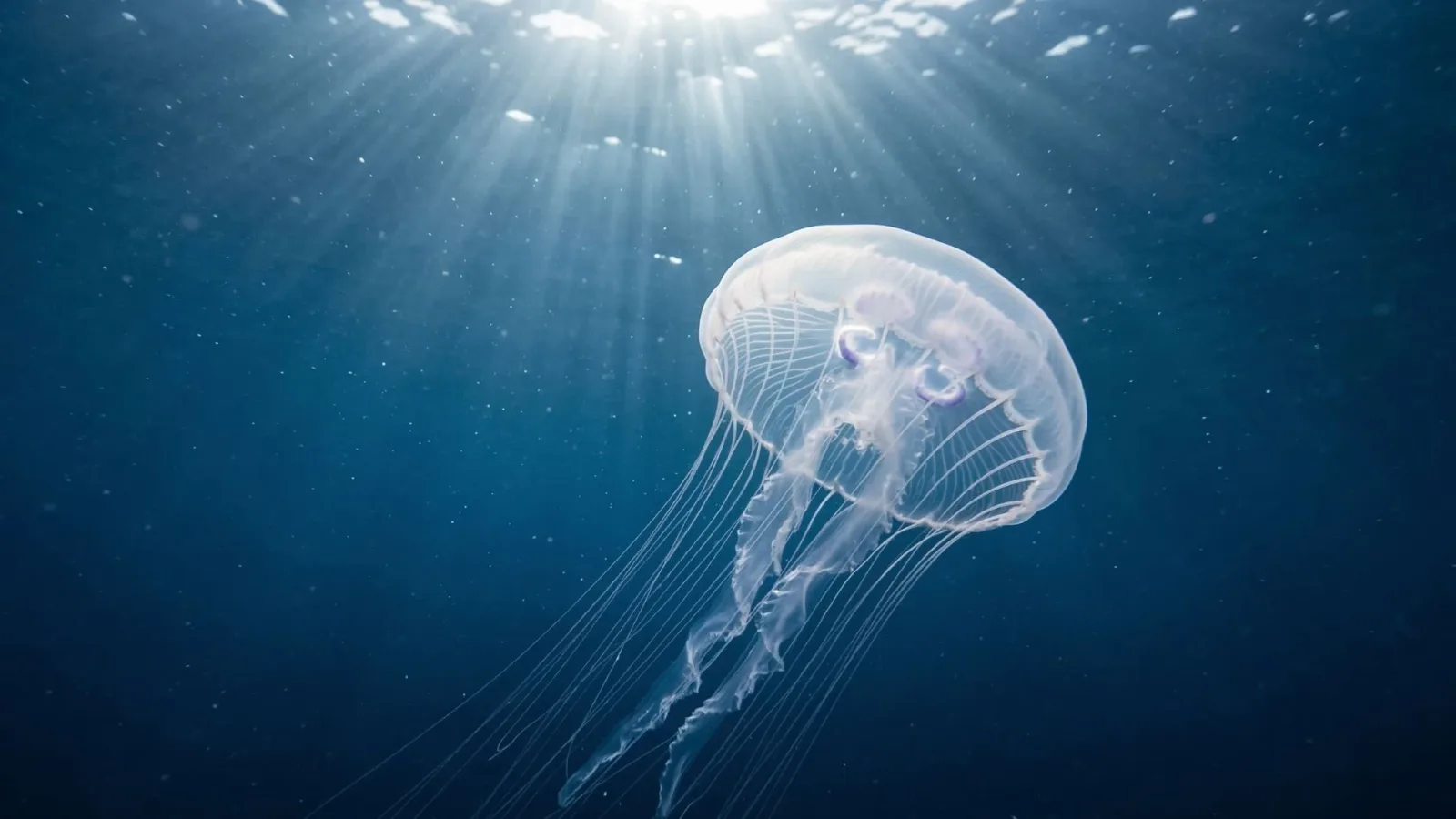
Long before trees took root or dinosaurs roamed the Earth, jellyfish were already navigating prehistoric oceans with remarkable efficiency. Lacking brains, bones, hearts, and blood, these simple yet resilient cnidarians have survived five mass extinction events over more than 500 million years. From deep-sea species that glow in the dark to immortal jellies that can reverse their own aging process, these gelatinous creatures are among the most intriguing organisms in nature. Here are 15 fascinating facts about jellyfish that reveal their incredible biology and secret history.
1. Jellyfish Pre-Date Trees, Dinosaurs, and Flowers
Long before the first trees took root or dinosaurs stomped across terrestrial landscapes, jellyfish were already drifting through prehistoric oceans. Fossil evidence indicates these gelatinous creatures emerged over 500 million years ago during the Cambrian Period, or possibly even earlier in the Ediacaran. Because they lack bones, shells, or hard organs, ancient jellyfish fossils are exceptionally rare and usually preserved as faint impressions in fine silt or mud. Their extraordinary survival through five major mass extinction events demonstrates the remarkable adaptability of their simple body plan. While thousands of ancient species vanished forever, these ancient drifters maintained their ecological niche virtually unchanged for half a billion years.
2. Their Bodies Are Made of 95 Percent Water
A living jellyfish looks like a substantial creature in water, but its structural anatomy is surprisingly minimalist. Roughly 95 percent of a jellyfish's body consists of water, while the remaining five percent is made up of basic structural proteins, collagen, and salt. By comparison, human bodies are around 60 percent water, illustrating just how gelatinous these marine organisms truly are. Because they lack a rigid skeleton or firm cellular walls, jellyfish rely entirely on the buoyancy of surrounding seawater to maintain their shape. If a jellyfish washes ashore, sunlight and dry air quickly cause its liquid contents to evaporate, leaving behind little more than a thin, dried smudge on the beach.
3. They Navigate the Ocean Without a Brain or Heart
Despite lacking a brain, heart, central nervous system, or blood, jellyfish successfully perform complex behaviors like hunting and directional navigation. Instead of a centralized brain, they rely on a loose biological network known as a decentralized nerve net. This circular neural structure is embedded directly into their gelatinous tissue and allows them to detect environmental signals such as light levels, temperature shifts, and water currents. Special sensory organs called rhopalia, located around the rim of their bell, help them orient themselves relative to gravity and ambient light. This elegant sensory architecture proves that complex decisions and survival strategies do not require a central processing brain.
4. One Species Is Biologically Immortal
The species Turritopsis dohrnii, commonly known as the immortal jellyfish, possesses a biological capability unique in the animal kingdom. When faced with physical damage, starvation, or extreme environmental stress, an adult individual can completely reverse its aging process. It absorbs its own tentacles and bell, transforming itself back into a tiny mass of unspecialized cells. Through a rare process called transdifferentiation, these cells reconfigure themselves to form a polyp colony, effectively restarting the organism's life cycle. In theory, an individual jellyfish can repeat this cycle indefinitely, granting it potential biological immortality unless cut short by disease or predators.
5. Deep-Sea Species Produce Their Own Glowing Light
In the pitch-black depths of the ocean, many jellyfish species illuminate the darkness using chemical light. Bioluminescence occurs when a chemical reaction inside the jellyfish's cells converts chemical energy directly into emitted light waves. Creatures use this natural glow to startle incoming predators, lure unsuspecting prey toward their stinging tentacles, or communicate in the deep sea. In fact, research on the green fluorescent protein isolated from the Aequorea victoria jellyfish earned scientists the Nobel Prize in Chemistry in 2008. Today, this jellyfish-derived protein is widely used across medical research to visualize microscopic cellular processes inside human cells.
6. They Are the World's Most Energy-Efficient Swimmers
Swimmers in the animal kingdom spend significant energy propelling themselves through water, but jellyfish have mastered an effortless mechanism. By contracting their muscular bell, they push water out from under their body to propel themselves forward. As the bell expands back to its original shape, it creates a low-pressure vortex in front of the bell that actively pulls the creature forward. This passive recovery stroke allows them to move through currents while consuming up to 48 percent less oxygen than other swimming marine animals. Marine engineers actively study this hyper-efficient propulsion system to design smoother, low-energy underwater vehicles.
7. Jellyfish Polyps Can Clone Themselves
Before growing into the umbrella-shaped medusae most people recognize, many jellyfish go through an elaborate asexual life cycle stage. Free-swimming larvae settle onto the ocean floor and anchor themselves to solid surfaces, transforming into stationary polyp structures. Once established, a single polyp can replicate itself continuous times through a budding process called strobilation. During strobilation, the polyp stacks tiny, disc-like segments that eventually detach one by one into floating juvenile jellyfish known as ephyrae. This efficient reproductive strategy allows a single settled larva to generate hundreds of genetically identical clones into the surrounding ecosystem.
8. They Are a Vital Food Source for Giant Marine Life
Although jellyfish consist mostly of water, they represent a critical food resource for diverse marine species across global oceans. Animals like ocean sunfish and massive leatherback sea turtles feed almost exclusively on large jellies to sustain their massive body weights. Because jellyfish are easy to capture and swallow, predators can consume hundreds of them every single day to obtain necessary nutrients. In addition, juvenile fish often seek shelter beneath the stinging bells of larger jellyfish, gaining protection from larger open-water predators. Far from being ecological dead ends, jellyfish form vital connections that sustain large pelagic fish, seabirds, and marine reptiles.
9. The Lion's Mane Jellyfish Can Grow Longer Than a Blue Whale
While some species are no larger than a grain of sand, others grow into colossal biological leviathans. The lion's mane jellyfish (Cyanea capillata) holds the record as one of the longest known animals on the planet. Its bell can expand over seven feet in diameter, while its thin, hair-like tentacles can stretch out past 120 feet long. That trailing reach exceeds the total body length of a fully grown blue whale, making the giant jelly a formidable open-water hunter. Sweeping through arctic and northern oceans, a single giant lion's mane jellyfish can capture hundreds of small fish and crustaceans in its trailing web.
10. They Breathe Directly Through Their Gelatinous Skin
Jellyfish lack dedicated respiratory organs like gills, lungs, or specialized circulatory blood vessels to transport dissolved gases. Instead, they absorb oxygen directly from the surrounding seawater through a simple physical process called passive diffusion. Their outer cell layers are so remarkably thin that dissolved oxygen molecules can pass straight into their internal tissue layers without barrier. Similarly, metabolic waste products like carbon dioxide diffuse directly out of their body tissue back into the ocean. This anatomical simplicity eliminates the need for complex internal organs, allowing them to thrive in oxygenated ocean waters worldwide.
11. NASA Sent Thousands of Jellyfish Into Space
In 1991, thousands of moon jellyfish embarked on a historic journey aboard the Space Shuttle Columbia during NASA's STS-40 mission. Scientists launched the creatures into orbit to study how microgravity affects their growth, physical movement, and spatial orientation mechanisms. On Earth, jellyfish rely on tiny calcium carbonate crystals within their rhopalia to sense direction and orient themselves relative to gravity. The space-bound jellies successfully reproduced in microgravity, producing thousands of juvenile polyps and free-swimming ephyrae while orbiting the planet. However, when these space-raised jellyfish were returned to Earth, they struggled with swimming coordination because their gravity-sensing organs had adapted to weightlessness.
12. A Group of Jellyfish Can Be Called a Smack or a Fluck
While jellyfish often drift alone through open waters, ocean currents and seasonal population surges frequently gather them into massive groups. Marine biologists officially refer to these dense aquatic concentrations as jellyfish blooms or swarms. However, language enthusiasts and classic texts also refer to a large collection of jellies as a smack or a fluck. Sudden temperature rises and nutrient overloads can trigger explosive population blooms containing millions of individuals spanning miles of coastline. These massive blooms can clog industrial water intake pipes, disrupt local fisheries, and temporarily force entire public beaches to close.
13. Jellyfish Are Not Actually Fish at All
Despite their common English name, jellyfish are not fish in any biological or anatomical sense. True fish are vertebrate animals with backbones, internal skeletons, gills, and true blood circulatory systems. Jellyfish, by contrast, are invertebrate organisms belonging to the ancient phylum Cnidaria. This biological classification places them in close evolutionary relation to sea anemones, hydrozoans, and stony reef-building corals. To avoid confusion, many public aquariums and marine scientists now prefer using the descriptive term ocean jellies instead of jellyfish.
14. Their Stinging Cells Fire Faster Than a Bullet
The tentacles of jellyfish are equipped with specialized stinging cells called cnidocytes, which house microscopic organelles known as nematocysts. When a swimmer or prey animal brushes against tiny sensory triggers on the tentacle, these nematocysts detonate automatically. They fire coiled, barbed shafts into the target tissue at speeds reaching up to 700 nanoseconds per discharge. This explosive mechanical release generates immense acceleration, making it one of the fastest biological movements recorded anywhere in nature. Once injected, the venom instantly paralyzes small prey or deters large marine predators from attacking the jelly.
15. Upside-Down Jellyfish Farm Their Own Food
Members of the genus Cassiopea, known as upside-down jellyfish, have abandoned the traditional drifting lifestyle of their open-water relatives. Instead of swimming freely through the water column, these unusual creatures rest upside down on shallow tropical ocean floors. They position their bells flat against muddy substrate, pointing their frilly, photosynthetic tentacles straight toward the sunlit water surface. Within their body tissues live microscopic symbiotic algae called zooxanthellae, which generate energy via photosynthesis using sunlight. By harvesting carbon compounds produced by their internal algae, these upside-down jellies effectively farm their own food while resting safely on the seabed.
Sources & References
This AI-assisted post was rigorously curated and fact-checked for accuracy by:
 Martin Roháček
How fun was this article? 🤔
Tap a star to rate it
🧠 Quiz: How closely were you paying attention?
10 questions — all answers are in the article above!
Enjoyed these facts? There's more! 💌
Fresh fun facts in your inbox. No spam, ever.