The Total Footballer: 15 Fascinating Facts About Alfredo Di Stéfano
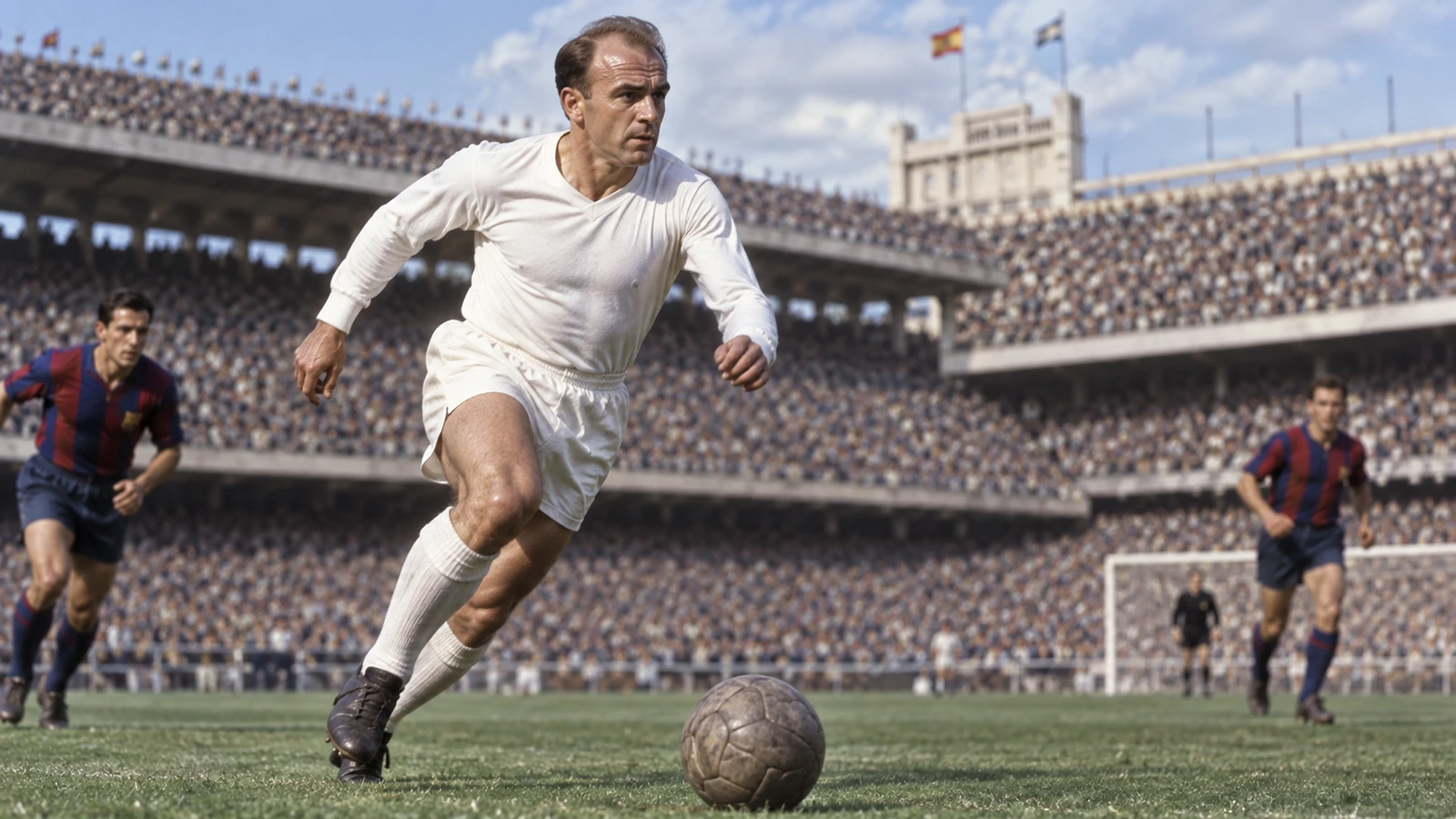
Alfredo Di Stéfano was far more than just a goalscorer; he was the ultimate complete footballer who transformed Real Madrid into an international superpower during the 1950s. From surviving a high-profile kidnapping in Venezuela to winning the only Super Ballon d'Or ever awarded, his career reads like a dramatic movie script. Remarkably, despite representing three national teams and winning five consecutive European Cups, he never played a single minute in a World Cup tournament. Discover 15 astonishing facts about 'La Saeta Rubia' and the extraordinary legacy of one of football's greatest icons.
1. Kidnapped at Gunpoint in Caracas in 1963
In August 1963, armed rebels belonging to the Armed Forces of National Liberation (FALN) abducted Alfredo Di Stéfano at gunpoint from his hotel room in Caracas, Venezuela. The guerrilla group carried out the high-profile kidnapping to attract global media attention to their political movement against President Rómulo Betancourt. Surprisingly, Di Stéfano reported that his captors treated him with remarkable respect during his three days in captivity. He passed the time playing dominoes, chess, and card games with the rebels while listening to radio reports about his own disappearance. After releasing him unharmed near the Spanish embassy, Di Stéfano famously harbored no ill will and even met with one of his former captors decades later.
2. Represented Three Different National Teams
Long before FIFA instituted strict modern regulations on international eligibility, Alfredo Di Stéfano performed the rare feat of playing for three different senior national teams. Born in Buenos Aires, he earned six caps for Argentina in 1947 and scored six goals during their victory in the South American Championship. During a major players' strike in Argentina, he moved to Colombia and made four unofficial appearances for the Colombian national team. After obtaining Spanish citizenship in 1956, Di Stéfano went on to represent Spain 31 times between 1957 and 1961, scoring 23 goals.
3. The Only Player to Win the Super Ballon d'Or
In 1989, French magazine France Football celebrated its 30th anniversary of awarding the Ballon d'Or by creating a unique honor called the Super Ballon d'Or. Alfredo Di Stéfano was selected as the sole recipient of this extraordinary golden trophy, triumphing over legends like Johan Cruyff and Michel Platini in a vote conducted among former winners and readers. The award was designed to recognize the absolute best footballer of the preceding three decades. To this day, Di Stéfano remains the only player in football history to hold this prestigious accolade.
4. The Transfer Battle Between Barcelona and Real Madrid
The transfer that brought Di Stéfano to Spain in 1953 triggered one of the most tumultuous legal disputes in sports history. Both FC Barcelona and Real Madrid claimed rights to the player because Barcelona had reached an agreement with Argentine club River Plate, while Real Madrid had negotiated directly with Colombian club Millonarios. The Spanish Football Federation initially tried to resolve the dispute by decreeing that Di Stéfano would alternate playing seasons between both rival clubs over four years. Outraged by the proposed compromise, Barcelona eventually surrendered their share of the rights, allowing Real Madrid to sign him outright and spark a dominant era in European football.
5. Scored in Five Consecutive European Cup Finals
Di Stéfano established an extraordinary record of high-stakes consistency by scoring in five consecutive European Cup finals between 1956 and 1960. Real Madrid won all five tournaments, cementing their reputation as the dominant club team of the era. His goalscoring streak in finals included a legendary hat-trick during Real Madrid's historic 7-3 victory over Eintracht Frankfurt at Hampden Park in 1960. This remarkable European Cup record remains unmatched by any modern player in Champions League history.
6. The Story Behind "La Saeta Rubia"
Throughout his career, Di Stéfano was universally known by the striking moniker "La Saeta Rubia," which translates to "The Blond Arrow." The nickname was original coined by prominent Argentine sports journalist Roberto Neuberger during Di Stéfano's early breakthrough at River Plate. Neuberger was captivated by the youngster's distinctive pale hair and electrifying speed across the pitch. The moniker perfectly encapsulated his explosive athletic acceleration and sharp attacking style.
7. Starred as Himself in a Feature Film
In 1956, at the height of his fame with Real Madrid, Di Stéfano took his talent from the football pitch to the silver screen. He played the lead role as himself in a fictional Spanish feature film titled Saeta Rubia. The narrative followed the football superstar as he interacted with a group of troubled street urchins in Madrid and inspired them to become honest citizens. The movie proved to be a box-office success in Spain and further cemented his status as a cultural icon beyond sports.
8. The Greatest Icon Never to Play in a World Cup
Despite his legendary status and dominance at the club level, Di Stéfano holds the tragic distinction of never playing a single minute in a FIFA World Cup final tournament. In 1950 and 1954, political boycotts and administrative decisions prevented Argentina from participating or selecting overseas players. By the time he qualified with Spain for the 1962 World Cup in Chile, a severe muscular injury suffered just before the tournament kept him on the bench. His absence from the world's biggest international stage remains one of the great historical ironies of football.
9. Orchestrated Colombia's Famous "Blue Ballet"
Before joining Real Madrid, Di Stéfano played a starring role for Colombian powerhouse Millonarios during the famous "El Dorado" era of breakaway football. The team played such breathtaking and fluid attacking football that journalists nicknamed them "El Ballet Azul," or the Blue Ballet. Spectators and opposing players frequently marveled at their intricate passing moves and effortless dominance on the pitch. Di Stéfano scored 90 goals in 101 matches for Millonarios, attracting intense interest from top European clubs.
10. Masterminded Trophies as an Elite Manager
After retiring as a player, Di Stéfano transitioned smoothly into management and proved that his brilliant tactical mind functioned just as effectively from the sidelines. He guided Valencia to a surprising Spanish La Liga championship in 1971 and later led them to victory in the 1980 European Cup Winners' Cup. In his native Argentina, he achieved the rare feat of winning national league titles as manager of both fiercest rivals, Boca Juniors and River Plate. He also returned to coach Real Madrid in two separate spells, winning the Supercopa de España in 1990.
11. Real Madrid Named Their Reserve Stadium in His Honor
In May 2006, Real Madrid officially opened a state-of-the-art stadium named the Estadio Alfredo Di Stéfano at their Valdebebas training complex. The 6,000-seat stadium serves as the permanent home venue for Real Madrid Castilla, the club's reserve team, and hosted senior first-team matches during stadium renovations in 2020 and 2021. A massive bronze statue of Di Stéfano celebrating a European Cup goal stands proudly outside the main entrance. The club designed the facility to ensure that future generations of young players draw inspiration from his legacy every day.
12. Remarkable Longevity Until the Age of 40
Di Stéfano maintained elite physical condition far longer than most professional athletes of his era, continuing his top-flight career until he was 40 years old. After ending his eleven-year tenure at Real Madrid in 1964, he refused to retire and signed with Catalan side Espanyol. He played two full seasons for Espanyol, making 60 appearances and scoring 14 goals before finally hanging up his boots in 1966. His extraordinary stamina and disciplined physical fitness allowed him to play over 700 competitive matches in total.
13. Coined the Famous Phrase "A Sunday Without Sun"
Di Stéfano was as sharp with his words as he was with his feet, delivering legendary quotes that summarized his romantic football philosophy. He famously stated that "un partido sin goles es como un domingo sin sol"—a football match without goals is like a Sunday without sun. He firmly believed that football was primarily an entertainment business created to bring joy and drama to passionate supporters. This memorable quote is still widely cited by commentators and journalists when discussing attacking football traditions.
14. Served as Real Madrid's Honorary President for Life
In July 2000, under the presidency of Florentino Pérez, Real Madrid appointed Di Stéfano as the club's official Honorary President. He held this distinguished ambassadorial role with great pride for fourteen years until his passing in July 2014 at the age of 88. In this capacity, Di Stéfano personally presented theoretical new signings, including global superstars like Zinedine Zidane, Ronaldo, and Cristiano Ronaldo, with their official club shirts. His presence at official ceremonies maintained a tangible link between Real Madrid's glorious past and its modern era.
15. Pioneered the Concept of "Total Football"
Decades before the Netherlands popularized "Total Football" in the 1970s, Di Stéfano was pioneering the fluid box-to-box role on the pitch. Although listed as a center-forward, he routinely dropped deep into midfield, tackled in defense, and orchestrated attacks from every sector of the field. Teammates and tactical analysts noted that he possessed an all-around skillset and unmatched tactical stamina, effectively functioning as a defender, playmaker, and striker all at once. This revolutionary versatility redefined what spectators expected from a complete football player.
Sources & References
This AI-assisted post was rigorously curated and fact-checked for accuracy by:
 Martin Roháček
How fun was this article? 🤔
Tap a star to rate it
🧠 Quiz: How closely were you paying attention?
10 questions — all answers are in the article above!
Enjoyed these facts? There's more! 💌
Fresh fun facts in your inbox. No spam, ever.