The Imperial Citadel: 15 Fascinating Facts About Angkor Thom
Built at the height of the Khmer Empire's power under King Jayavarman VII, Angkor Thom stands as one of the most ambitious urban and spiritual projects in human history. Enclosed by massive stone ramparts and broad moats, this vast fortified city was designed as a sacred physical model of the universe. From the smiling stone faces of the Bayon to mysterious underground corridors and ancient samurai graffiti, Angkor Thom holds rich stories of imperial power and cosmic symbolism. Here are 15 fascinating facts about the enduring 'Great City' of ancient Cambodia.
1. The Name Means "Great City" and Was Built as a Fortified Sanctuary
Built in the late 12th century by King Jayavarman VII, Angkor Thom translates directly from Khmer as "Great City." Established following a devastating sack of the previous capital by Cham forces, the city was conceived not merely as a royal seat but as an impregnable, divinely protected fortress. Spanning an area of nine square kilometers, it served as the capital of the Khmer Empire during its final golden age. The city integrated both Mahayana Buddhist and Hindu iconographies, reflecting Jayavarman VII's personal faith alongside centuries of Khmer spiritual tradition. Within its massive walls lived an estimated population of several hundred thousand people, making it one of the largest urban centers in the pre-industrial world.
2. The Bayon Temple Represents Mount Meru at the Center of the Universe
At the exact geographic center of Angkor Thom sits the Bayon, the state temple built by Jayavarman VII to function as the axis mundi. In both Hindu and Buddhist cosmology, Mount Meru is the sacred central mountain that supports the heavens and anchors the universe. The architecture of the Bayon deliberately mirrors this cosmic geography, with its rising stone towers mimicking the peaks of the divine mountain. Surrounding structures and outer walls represent the concentric mountain ranges and oceans that encompass the cosmos in ancient mythology. By placing his state temple at the core of the city, the king metaphorically positioned his realm at the central balance point of heaven and Earth.
3. Over 200 Serene Stone Faces Tower Above the Central Complex
The defining aesthetic feature of the Bayon is its collection of giant, smiling stone faces carved into the sides of its towers. Historically, over 50 towers held more than 200 of these massive four-faced sculptures gazing outward toward the cardinal directions. Most scholars believe the features depict Avalokiteshvara, the bodhisattva of compassion, blended with the likeness of King Jayavarman VII himself. This artistic synthesis reinforced the king's status as a god-king, or devaraja, who ruled with divine benevolence. The gentle, enigmatic expression on the faces has intrigued archaeologists and travelers for centuries, earning them a place among Southeast Asia's most iconic artistic masterpieces.
4. Five Monumental Gates Provided Access Across Sacred Boundary Lines
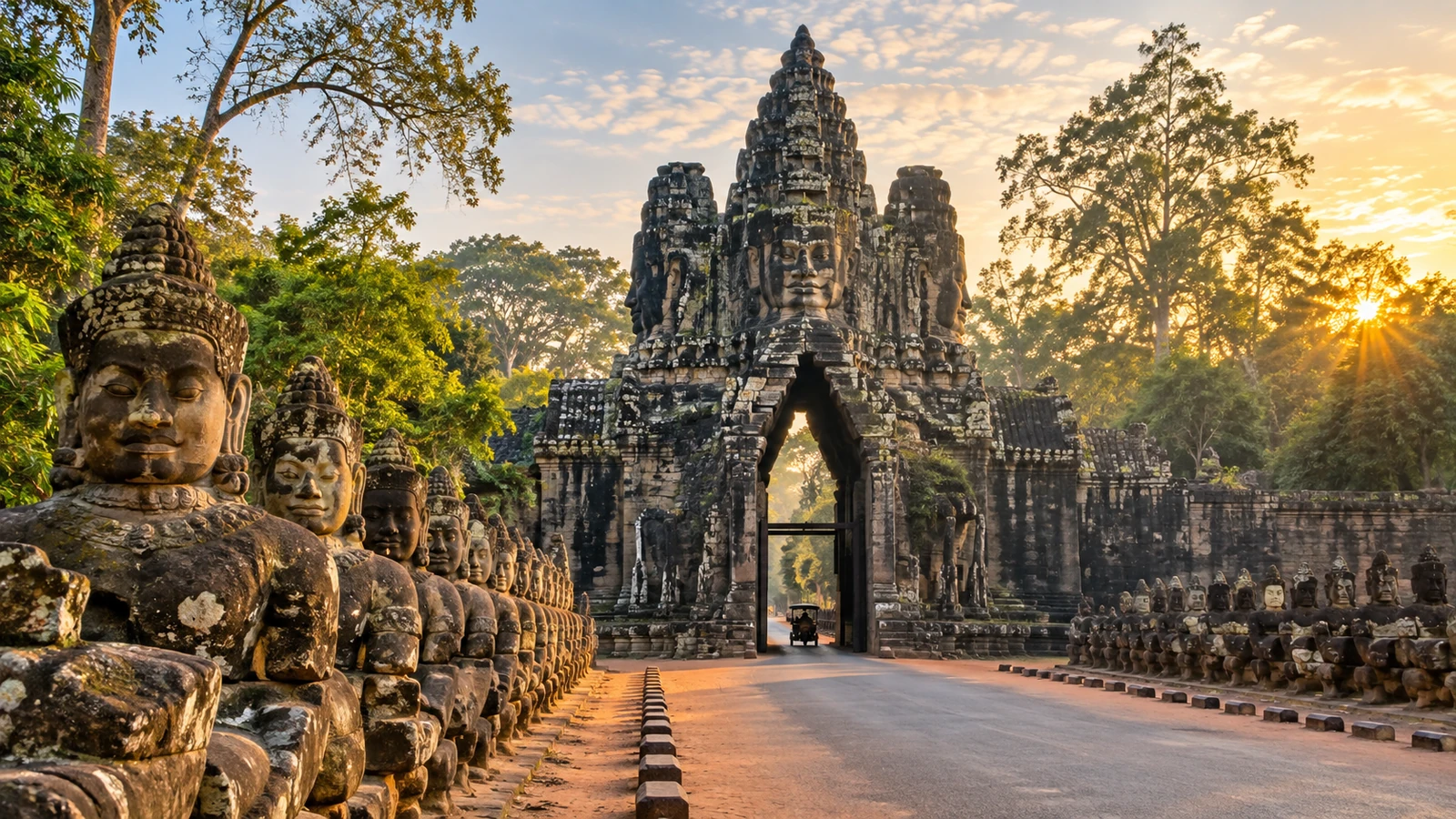
While a typical square ancient city features four entry points aligned with the cardinal directions, Angkor Thom features five monumental gates. Four of these gates lead directly along axial roads to the central Bayon temple, aligned precisely with north, south, east, and west. The fifth, known as the Gate of Victory, branches off eastward to lead directly to the Royal Palace. Each stone gatehouse towers over 20 meters high and is crowned with four giant carved faces looking toward the countryside. Entering through these archways was intended as a transformative experience, marking the transition from the earthly wilderness into a consecrated royal sanctuary.
5. The Entry Causeways Reenact the Churning of the Ocean of Milk
Crossing the moats toward the five city gates requires traversing stone causeways flanked by striking rows of colossal statues. On the left side of each bridge stand 54 benevolent gods (devas), while 54 formidable demons (asuras) line the right side. Together, these 108 statues grasp the body of a giant five-headed naga, or cosmic serpent, in a depiction of the famous creation myth known as the Churning of the Ocean of Milk. According to mythology, gods and demons briefly set aside their enmity to churn the cosmic ocean and produce the elixir of immortality. The total of 108 figures per causeway carries profound cosmic significance, representing sacred numbers deeply rooted in Khmer astronomy and religion.
6. The City Was Enclosed by Massive Walls and Hydrologic Moats
Angkor Thom was designed as an absolute citadel, encased by an eight-meter-high wall of compacted soil and heavy limonite stone. Extending three kilometers along each side, these square ramparts stretch for a total perimeter of 12 kilometers. Outside the walls lies a massive moat, 100 meters wide, which served a dual purpose as a formidable defensive barrier and a crucial water reservoir. This moat was connected to the vast hydraulic network of dams and canals that powered the empire's sophisticated rice agriculture. During the monsoon season, the broad moat reflected the towers and gates, visually reinforcing the concept of the city floating on sacred cosmic waters.
 Ancient and Archaeological Sites
Humanity's impulse to build monumentally has left behind astonishing architectural legacies. From sky-high Incan citadels to sprawling Egyptian necropolises, these sites unite diverse cultures through their shared ambition to conquer geography and secure immortality. Discover the ingenious engineering and hidden histories behind the world's most incredible ancient archaeological wonders.
See All Facts
Ancient and Archaeological Sites
Humanity's impulse to build monumentally has left behind astonishing architectural legacies. From sky-high Incan citadels to sprawling Egyptian necropolises, these sites unite diverse cultures through their shared ambition to conquer geography and secure immortality. Discover the ingenious engineering and hidden histories behind the world's most incredible ancient archaeological wonders.
See All Facts
7. Royalty Resided in Wooden Palaces That Have Long Vanished
Visitors to Angkor Thom today see a city constructed entirely of durable sandstone and laterite, but these stone structures were reserved exclusively for gods and spirits. Human beings, including the king and high court officials, lived in structures built from wood, bamboo, and thatch. Archeological excavations inside the royal enclosure have uncovered postholes, brick foundations, and ceramic tiles revealing the existence of elaborate wooden palaces. Chinese diplomat Zhou Daguan, who visited in 1296, recorded that the royal palace featured magnificent gilded window frames and wooden pavilions of stunning artistry. Because wood decays quickly in Cambodia's tropical climate, only the stone foundations and ceremonial terraces survive today.
8. Detailed Reliefs Document Daily Life in the Khmer Empire
Unlike many ancient monuments that focus solely on divine pantheons and royal lineages, the low-relief carvings of the Bayon offer an intimate view of common folk. Carved into thousands of square meters of outer walls are vivid scenes detailing everyday life in 12th-century Cambodia. Viewers can spot bustling open-air markets, street vendors selling fish, men playing chess, and women giving birth. Other panels capture traditional cockfights, open-air feasts, wrestling matches, and circus performers balancing on poles. These incredible bas-reliefs provide historians with an irreplaceable visual record of the social customs, trades, and domestic activities of ancient Khmer society.
9. The Terrace of the Elephants Acted as a Grand Royal Viewing Platform
Stretching over 300 meters along the heart of Angkor Thom lies the Terrace of the Elephants, a massive stone platform used for public ceremonies. Named for the life-sized carvings of Asian elephants and mahouts that adorn its base, the terrace overlooked the vast central square of the city. King Jayavarman VII and his successors used this grandstand to review returning armies, inspect royal parades, and host foreign dignitaries. Attached directly to the royal palace complex, the elevated platform allowed the monarch to look down upon thousands of assembled subjects. Sculptures of three-headed elephants harvesting lotus flowers with their trunks line the main staircases, symbolizing royalty and rain-bearing clouds.
10. Stone Carvings Depict Fierce Naval Battles on the Tonlé Sap
Among the historical reliefs carved into the walls of the Bayon are dramatic depictions of military conflict, particularly naval battles. These carvings capture crucial battles fought on the Great Lake, the Tonlé Sap, between the Khmer army and their rivals, the Chams. Detailed panels illustrate warships filled with warriors wielding spears and bows, while fallen soldiers are depicted falling into waters teeming with crocodiles. The relief sculptors took care to distinguish Khmer soldiers from Cham invaders by their distinctive hairstyles and headgear. These scenes underscore the naval supremacy required to defend the empire's water-based economy and secure control over trade routes.
11. The Mysterious Terrace of the Leper King Hides Secret Internal Walls
Positioned just north of the Terrace of the Elephants sits the Terrace of the Leper King, an intriguing structure named for a moss-covered, nude statue found at its top. Local legend associated the statue with King Yasovarman I, who reportedly died of leprosy, or with the Hindu god of death, Yama. Excavations in the late 20th century revealed that the terrace was built in multiple stages, creating a hidden inner wall buried behind the outer façade. This concealed corridor is lined with intricate, pristine carvings of underworld deities, multi-headed serpents, and mythological sea creatures. Archaeologists believe the elevated platform served as a royal cremation ground and place of judgment.
12. The Architectural Design Incorporates Astronomical Alignments
The layout of Angkor Thom was far more than an aesthetic or urban engineering project; it was precisely synchronized with celestial movements. Research indicates that the five entry gates and key temple axes were deliberately designed to align with solar events, such as the equinoxes and solstices. During specific days of the solar year, the sun rises directly over key central points when viewed from specific causeways. This deliberate alignment served to harmonize the earthly kingdom with the order of the cosmos, legitimizing the ruler's divine mandate. By locking their capital into solar geometry, Khmer architects believed they could secure prosperity and cosmic protection for the empire.
13. The City Remained Inhabited Long After Other Capital Centers Were Deserted
A widespread historical myth suggests that the Khmer empire's capitals were abruptly abandoned to the encroaching jungle following foreign invasions. In reality, Angkor Thom proved remarkably resilient and remained a living, functioning urban center long after earlier nearby temples fell out of regular maintenance. Historical records show that even after the Thai kingdom of Ayutthaya sacked the city in the 15th century, portions of Angkor Thom remained inhabited. Foreign travelers and Portuguese missionaries in the 16th and 17th centuries documented an active population still living within its ancient stone walls. The city gradually transitioned from a political metropolis into a dedicated spiritual pilgrimage site over several centuries.
14. Ancient Wall Graffiti Records Centuries of International Pilgrims
Long before modern tourists began taking photographs, visitors left their own indelible marks on the walls of Angkor Thom's temples. Inscriptions carved into the sandstone surfaces include messages left by pilgrims, monks, and travelers dating back to the 16th and 17th centuries. Notably, several inscriptions were written in Japanese by samurai who traveled to Cambodia during the early Edo period believing Angkor Wat and Angkor Thom were the sacred Jetavana monastery in India. Other ancient graffiti includes inscriptions in Burmese, Chinese, and Middle Khmer scripts, documenting vows, dates, and names. These historical carvings offer proof that the city was a famous international destination long before European rediscovery.
15. Angkor Thom Continues to Function as a Sacred Center for Modern Buddhists
While Angkor Thom is recognized worldwide as a UNESCO World Heritage Site and tourist destination, it remains a vital spiritual heart for Cambodian Theravada Buddhists. Modern Buddhist shrines, active monasteries, and statues adorned with saffron robes are scattered throughout the forested ruins. Local villagers and pilgrims regularly visit the site to present offerings of incense, flowers, and fruit to ancient stone statues. Monks conduct daily chants and blessings beneath the towering stone faces of the Bayon, preserving a continuous tradition of worship. This living heritage bridges over eight centuries of Cambodian history, maintaining the city's original purpose as a sanctuary of spiritual harmony.
Sources & References
This AI-assisted post was rigorously curated and fact-checked for accuracy by:
 Martin Roháček
How fun was this article? 🤔
Tap a star to rate it
🧠 Quiz: How closely were you paying attention?
10 questions — all answers are in the article above!
Enjoyed these facts? There's more! 💌
Fresh fun facts in your inbox. No spam, ever.