The Sacred Metropolis: 15 Fascinating Facts About Angkor Wat
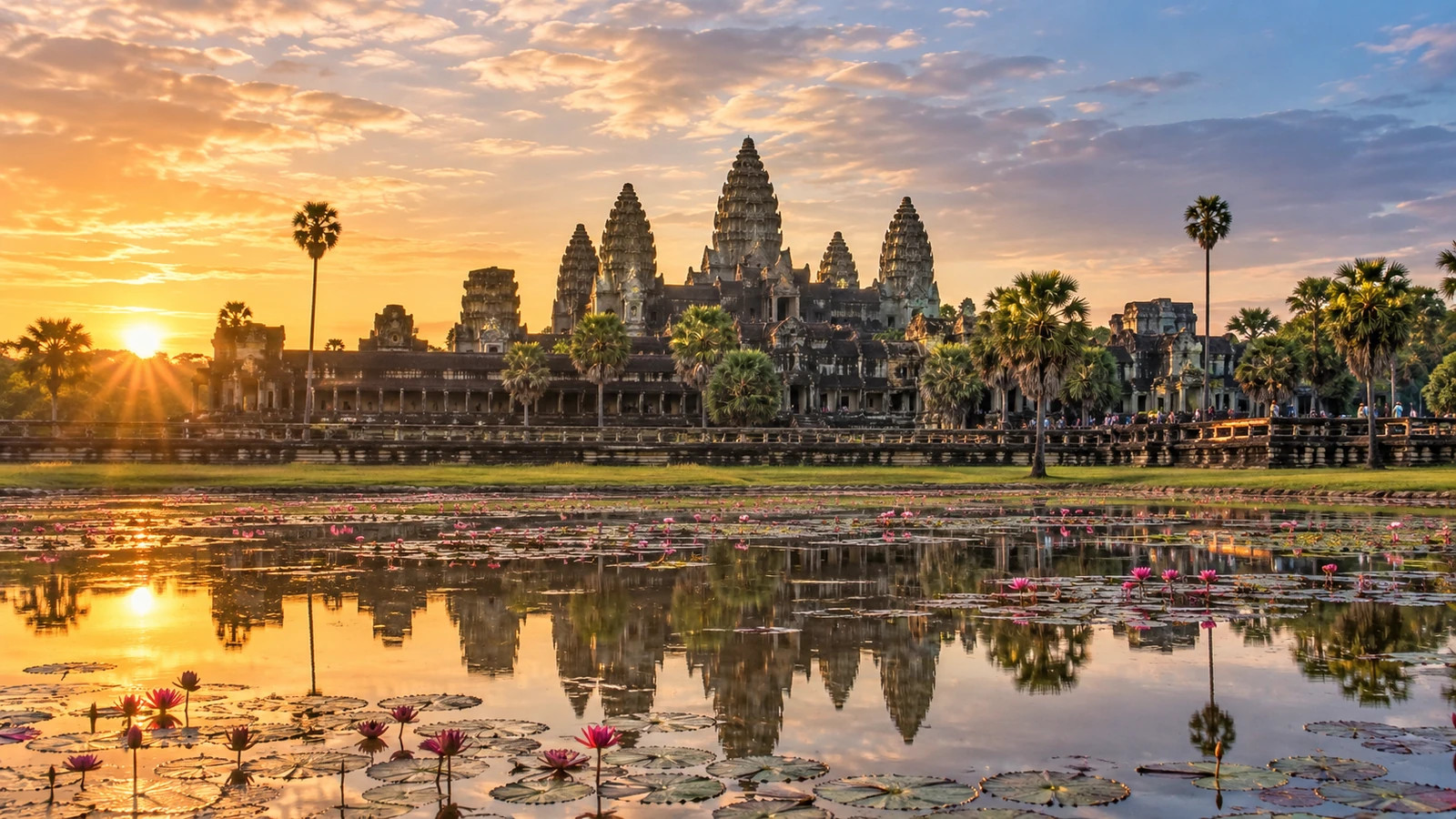
Angkor Wat stands as the ultimate achievement of ancient Khmer engineering and remains the world's largest religious monument by area. Built in the 12th century as a magnificent Hindu temple dedicated to Lord Vishnu, this stone complex later evolved into a vibrant Theravada Buddhist sanctuary. From subterranean digital art discoveries to sophisticated hydraulic engineering that prevents the structure from sinking, its stone corridors hold remarkable secrets. Discover 15 fascinating facts about the astronomical precision, royal funeral rituals, and hidden urban sprawl of Cambodia's ancient wonder.
1. It Contains More Stone Than the Great Pyramid of Giza
The sheer volume of material used in constructing Angkor Wat outmatches even the most famous ancient architectural achievements. Khmer masons utilized an estimated five to ten million sandstone blocks, each weighing up to 1.5 tons, to erect the colossal sanctuary. In terms of mass displacement and total masonry volume, the complex far exceeds the physical stone bulk of the Great Pyramid of Giza. Rather than sourcing local limestone, builders quarried massive amounts of high-density sandstone miles away. This unprecedented expenditure of natural rock makes Angkor Wat the largest single religious structure in human history.
2. The Temple Defies Tradition by Facing West
Unlike almost all contemporary Khmer temples, which face east to greet the rising sun, Angkor Wat opens directly toward the west. In classical Hindu cosmology, the east represents life, light, and creation, while the west is associated with Yama, the god of death. This unique orientation led many archaeologists to conclude that King Suryavarman II intended the complex primarily as his personal royal tomb and funerary shrine. However, because the temple was originally dedicated to the deity Vishnu, who governs the western quadrant of the universe, the layout served a combined celestial and mortuary function. This deliberate directional shift sets it apart from traditional Asian religious architecture.
3. Advanced Digital Scans Revealed Hidden Wall Paintings
To the naked eye, many inner chamber walls of Angkor Wat look like worn, plain grey stone weathered by centuries of atmospheric moisture. However, in 2014, researchers employing decorrelation stretch digital imaging uncovered over 200 invisible wall paintings hidden under centuries of grime. These detailed murals depict traditional Khmer musical ensembles, royal horse cavalcades, riverboats, and geometric deities. Experts believe these artworks were added during the 16th century when the complex transitioned from a Hindu sanctuary into a Buddhist pilgrimage site. The discovery proved that the inner corridors were once vibrant and brightly decorated canvas environments.
4. Its Layout Mirrors the Constellation Draco
Astronomical alignments are deeply embedded within the architectural blueprint of the ancient Khmer kingdom. Researchers and astro-archeologists have demonstrated that the relative spatial positioning of key temples across the regional plain mirrors the constellation Draco. Specifically, the site plan matches the star formation as it would have appeared on the spring equinox thousands of years prior to its construction. While mainstream historians debate whether this celestial mapping was intentional or symbolic, the precision of the central towers relative to solstices remains undisputed. This alignment highlights the ancient Khmer worldview, which sought to reflect cosmic harmony down on Earth.
5. Thousands of Sandstone Blocks Floated Down Artificial Canals
The colossal sandstone blocks forming the temple walls were not quarried at the construction site, but extracted near Mount Kulen, located over 25 miles away. Transporting millions of tons of stone across tropical jungles presented an incredible logistical hurdle for ancient builders. High-resolution satellite scans revealed that engineers dug a vast grid of artificial transport canals connecting the mountain quarries straight to the temple grounds. Thousands of heavy stones were rafted down these river highways using seasonal currents and animal transport. This hydro-logistical innovation slashed construction timelines that would have otherwise spanned centuries.
6. The Central Tower Aligns Perfectly with the Equinox
Angkor Wat acts as a giant solar calendar, engineered to track astronomical seasons with remarkable accuracy. On the morning of both the vernal and autumnal equinoxes, an observer standing at the western causeway can watch the sun rise directly behind the central tower peak. This solar alignment casts a dramatic silhouette, illuminating the central sanctuary with direct morning rays. Khmer architects carefully adjusted the height, width, and spacing of the outer gates to achieve this optical result twice a year. The event symbolized the perfect equilibrium between cosmic divine power and earthly royal rule.
7. Its Original Name Was "Vrah Vishnuloka"
The modern name "Angkor Wat" translates from Khmer to "City of Temples," a title conferred long after its heyday. During the reign of its founder, King Suryavarman II, the official name of the complex was Vrah Vishnuloka, meaning "The Sacred Dwelling of Lord Vishnu." This title reflected its primary status as a earthly home for the Hindu preserver deity. When the region embraced Theravada Buddhism in the 14th century, the original Sanskrit name gradually faded from everyday language. Despite the name transformation, the sprawling complex retained its place as the spiritual heart of Cambodia.
8. The Massive Structure Was Built Without Mortar
Remarkably, the entire stone sprawling complex was erected without using a single drop of mortar or chemical cement. Instead, skilled workers ground adjacent sandstone blocks against one another using wet sand until the touching surfaces became glass-smooth. They then fitted the massive stones together using tight mortise-and-tenon joints and dry masonry techniques. In many remaining walls, the seams are so exceptionally tight that a human hair or thin sheet of paper cannot fit between the blocks. The sheer weight of the stones combined with precise stone-cutting techniques kept the complex structural framework standing for nearly 900 years.
9. The Surrounding Moat Keeps the Earth from Collapsing
The massive square moat surrounding Angkor Wat is far more than an ornamental lagoon or defensive trench. Spanning over 600 feet wide and holding millions of gallons of water, it functions as a vital hydraulic engineering mechanism. The underlying soil beneath the heavy stone towers consists of fine sand and clay that shrinks and shifts dramatically between wet and dry seasons. The constant water pressure provided by the filled moat keeps the subterranean water table completely stable throughout the year. Without this continuous hydraulic support, the immense weight of the sandstone buildings would have caused the ground to cave in long ago.
10. Construction Was Completed in Record Time
Despite its unbelievable scale and elaborate decorative stone carvings, Angkor Wat was constructed within a surprisingly brief period. Work began around 1113 CE under King Suryavarman II and was substantially complete by his death in 1150 CE, taking roughly 35 years. In comparison, medieval European cathedrals constructed during the same era frequently required anywhere from 100 to 300 years to build. This astonishing speed was powered by a highly organized workforce comprising hundreds of thousands of artisans, sculptors, hydraulic engineers, and laborers. The quick execution ensured that the monarch could enjoy his legacy within his natural lifespan.
11. The Bas-Reliefs Are Designed to Be Read Counter-Clockwise
The lower outer galleries feature over 13,000 square feet of detailed bas-relief carvings depicting scenes from the Ramayana and Mahabharata. Intriguingly, these sprawling narrative panels are sculpted to be viewed in a counter-clockwise direction, a pattern called prasavya. In classical Hindu custom, moving around a temple counter-clockwise is strictly associated with funerary rites and ancestor worship, while cheerful devotion moves clockwise. This deliberate artistic ordering provides heavy evidence that the site was constructed to serve as King Suryavarman II's ultimate resting place. The carvings represent one of the crowning artistic feats of pre-modern Asia.
12. It Is Featured on Cambodia's National Flag
Angkor Wat holds such extraordinary cultural significance to the Cambodian people that its three-towered silhouette is depicted directly on the national flag. Cambodia is one of only a small handful of sovereign nations worldwide to display a specific architectural monument on its national emblem. Since gaining independence from France, the iconic red and blue flag has retained the temple layout through diverse political eras, including the turbulent Khmer Rouge period. While flag designs were modified under different governing regimes, the symbol of Angkor Wat remained constant. It stands as an eternal emblem of pride, national identity, and cultural resilience.
13. A Famous First Lady Visited During the Vietnam War
In November 1967, former U.S. First Lady Jacqueline Kennedy fulfilled a personal dream by visiting Angkor Wat during an official trip to Asia. Accompanied by Cambodian leader Prince Norodom Sihanouk, her high-profile tour took place amidst intense regional instability during the Vietnam War. Kennedy's presence attracted massive international press coverage, directing global media focus toward the artistic beauty of the ruins. Photographs of Jacqueline touring the ancient stone causeways were published worldwide, helping jumpstart early international preservation efforts. Her brave journey cemented the temple's status as a top-tier destination for international cultural heritage travel.
14. It Was the Center of the World's Largest Pre-Industrial City
Far from being an isolated jungle temple, Angkor Wat served as the ceremonial heart of a sprawling mega-metropolis known as Greater Angkor. At its population peak during the 12th century, this interconnected urban environment covered over 380 square miles and supported nearly one million people. By contrast, major contemporary European cities like London or Paris were modest settlements housing around 30,000 to 50,000 residents. Modern airborne airborne LIDAR mapping has revealed hundreds of buried residential grid networks, roads, and canals surrounding the main complex. This vast urban network represents the largest low-density urban center established prior to the industrial revolution.
15. The Temple Was Never Truly Abandoned
Popular Western myths often paint Angkor Wat as a lost ruin forgotten in the jungle until French natural scientist Henri Mouhot arrived in 1860. In reality, while the surrounding political capital shifted southward in the 15th century, the central temple was never abandoned by the local population. Theravada Buddhist monks inhabited the grounds continuously, converting Hindu shrines into active Buddhist alters and maintaining the surrounding stone structures. Local Khmer communities consistently used the space for continuous worship and seasonal festivals across the centuries. Mouhot merely introduced the wonder to Western audiences, but local caretakers had preserved its sacred flame without interruption.
Sources & References
This AI-assisted post was rigorously curated and fact-checked for accuracy by:
 Martin Roháček
How fun was this article? 🤔
Tap a star to rate it
🧠 Quiz: How closely were you paying attention?
10 questions — all answers are in the article above!
Enjoyed these facts? There's more! 💌
Fresh fun facts in your inbox. No spam, ever.