The Architectural Wonder: 15 Fascinating Facts About Barcelona
Barcelona stands as one of the world's most vibrant coastal metropolises, renowned for its architectural marvels, rich Catalan culture, and Mediterranean coastline. Behind its famous boulevards and sun-drenched plazas lies a treasure trove of unexpected history and astonishing urban secrets. From beaches built with imported Egyptian sand to a supercomputer operating inside a historic church, the city is full of surprises. Here are 15 fascinating facts about Barcelona that reveal the true history behind its iconic landmarks.
1. The Sagrada Família Has Taken Longer to Build Than the Great Pyramids
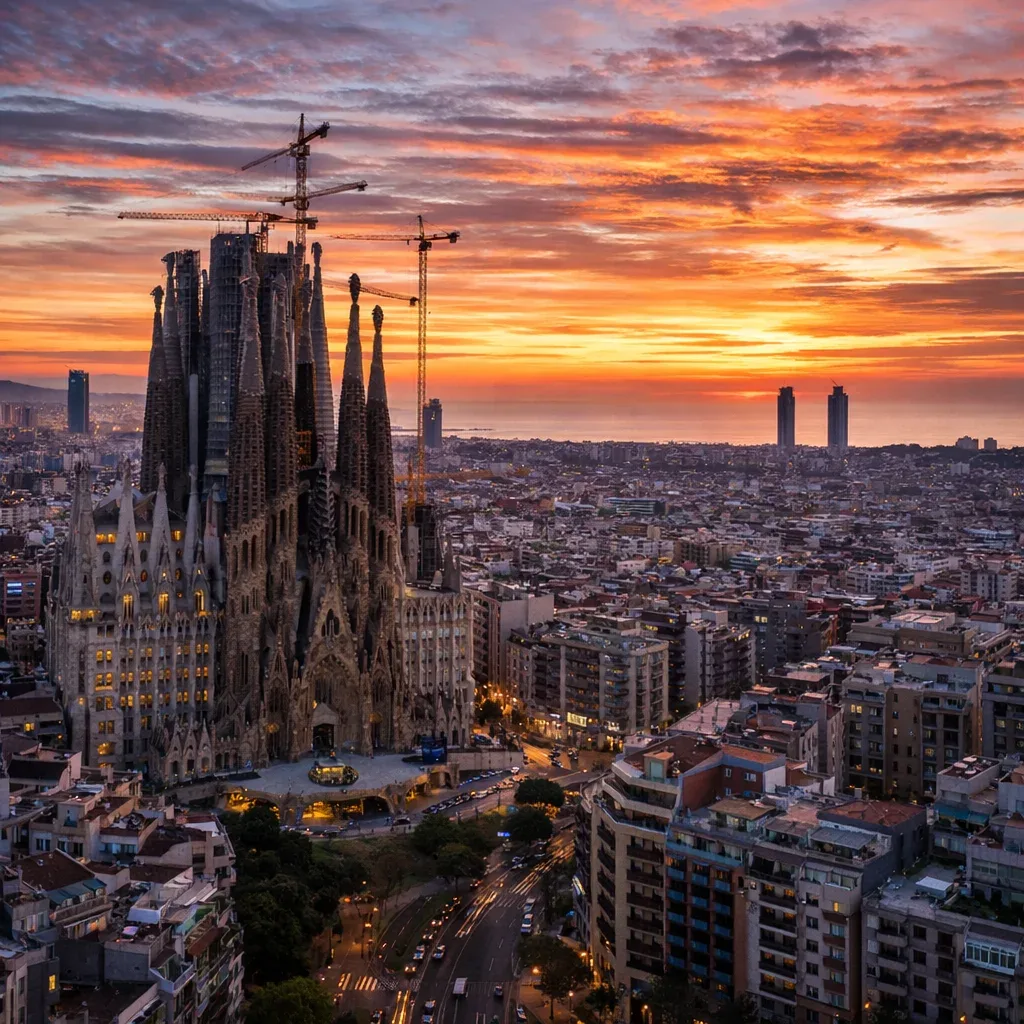
Antoni Gaudí’s masterwork, the Basílica de la Sagrada Família, has been under continuous construction since 1882. By contrast, historical estimates suggest the ancient Egyptians completed the Great Pyramid of Giza in just twenty to thirty years. Construction was delayed for decades by political unrest, financial deficits, and the loss of Gaudí’s original architectural models during the Spanish Civil War. Modern construction methods relying on computer-aided design and off-site stone carving have finally accelerated progress toward its final completion. When the central tower of Jesus Christ is crowned, the basilica will stand as the tallest church building in the world.
2. Barcelona’s Famous Beaches Are Entirely Artificial
Visitors sunbathing on Barcelona’s sandy Mediterranean coastline might be surprised to learn that the city had no leisure beaches for most of its modern history. Before the 1992 Summer Olympics, the seafront was dominated by derelict industrial warehouses, railway tracks, and run-down shantytowns. As part of a massive urban renewal project ahead of the Games, the city demolished the industrial bluffs and cleared two miles of coastline. Engineers imported tons of heavy golden sand directly from Egypt to construct the world-famous urban beaches enjoyed today. The transformation completely re-oriented Barcelona toward the sea, creating one of Europe's premier seaside urban destinations.
3. The Columbus Monument Points in the Wrong Direction
Standing 200 feet tall at the lower end of La Rambla, the Monument to Christopher Columbus features a prominent bronze statue pointing toward the horizon. While logic dictates that a statue honoring the explorer's voyage to the Americas should point west toward the New World, Columbus points east-southeast. Historical accounts indicate that pointing west would have required the statue to point inland over the city center, which designers felt lacked dramatic flair. Instead, sculptors pointed his right hand out toward the sea, roughly aiming toward Mallorca and broader Mediterranean trade routes. A popular alternative theory claims he points toward his supposed birthplace of Genoa, Italy, though his hand actually points slightly south of it.
4. A Magic Square on the Sagrada Família Sums to 33
Etched into the Passion Façade of the Sagrada Família is a mysterious four-by-four grid of numbers known as a cryptogram or magic square. Sculptor Josep Maria Subirachs added the numerical grid in 1987, creating a mathematical puzzle where every row, column, and diagonal sums to thirty-three. This specific total was intentionally chosen to represent the traditional age of Jesus Christ at the time of his crucifixion. To achieve this constant sum without using standard consecutive numbers, Subirachs duplicated two numbers in the matrix, breaking classic magic square rules for symbolic resonance. Visitors frequently stop to solve the mathematical puzzle embedded directly into the stone artwork.
5. Gustave Eiffel Originally Proposed His Tower to Barcelona
Before presenting his radical iron lattice tower design to Paris for the 1889 World's Fair, French engineer Gustave Eiffel originally pitched the concept to Barcelona. Local authorities in Catalonia reviewed the bold blueprints for the 1888 Barcelona Universal Exposition but ultimately rejected the proposal. City officials and municipal architects viewed the towering iron structure as visually intrusive, overly expensive, and entirely unsuited to the city's aesthetic. Rebuffed by Barcelona, Eiffel took his controversial plans back to Paris, where the structure was built to overwhelming global fame. Today, history enthusiasts often ponder how different the Catalan skyline would look had city leaders accepted Eiffel's design.
6. It Is the Only City Ever Awarded a Royal Gold Medal for Architecture
In 1999, the Royal Institute of British Architects took the unprecedented step of bestowing the prestigious Royal Gold Medal to the entire city of Barcelona. Established in 1848 by Queen Victoria, this award traditionally honors an individual architect or collaborative firm for lifetime achievement in spatial design. Barcelona remains the only municipality in history to receive the honor, recognized for its dramatic urban revitalization led by mayor Pasqual Maragall. The judging committee praised the city's innovative urban planning, public plazas, and seamless integration of contemporary design into its historic fabric. This unique honor cemented Barcelona's global reputation as a Mecca for pioneering architecture.
7. The Unique Octagonal City Grid Was Designed for Steam Trams and Light
The iconic octagonal urban grid of the Eixample district was designed in the mid-19th century by pioneering Catalan urban planner Ildefons Cerdà. Cerdà introduced chamfered, forty-five-degree cut-off corners on every street block to improve airflow, daylight exposure, and traffic maneuverability. The wide, angled intersections were specifically calculated to enable long steam trams to make turns smoothly without blocking traffic. Cerdà envisioned these spacious street corners serving as neighborhood gathering spaces and loading bays for commercial delivery wagons. Today, this unique urban layout provides driver visibility and creates the unmistakable aerial checkerboard pattern characteristic of Barcelona.
8. Books and Roses Replace Chocolates on Barcelona's Valentine's Day
On April 23rd, Barcelona celebrates the Feast of Saint George, known locally as Diada de Sant Jordi, which serves as the region's official day of romance. Instead of traditional Valentine's Day gifts, custom dictates that men give women red roses and women give men books in return. The holiday honors the region's patron saint and coincides with the death anniversaries of literary giants William Shakespeare and Miguel de Cervantes. Streets across the city fill with thousands of pop-up bookstalls and vibrant floral displays. In recent decades, the tradition has evolved so that everyone exchanges both books and roses regardless of gender, making it one of Catalonia's most cherished cultural events.
9. Camp Nou Is the Largest Football Stadium in Europe
Home to FC Barcelona, the legendary Camp Nou stadium is the largest sports arena in all of Europe. Opening in 1957, the stadium reached a peak capacity of over 120,000 spectators during the 1982 FIFA World Cup before modern safety regulations instituted all-seater seating. Even after seating reductions, the stadium comfortably accommodated nearly 100,000 football fans, easily dwarfing major venues like London's Wembley Stadium. An ambitious redevelopment project known as Espai Barça is currently modernizing the venue, adding a retractable roof and expanding total seating to 105,000. For sports enthusiasts, attending a match inside this monumental stadium remains an unparalleled bucket-list experience.
10. Antoni Gaudí Was Killed by a Tram After Being Mistaken for a Beggar
On June 7, 1926, master architect Antoni Gaudí was struck by a moving tram while walking along Gran Via de les Corts Catalanes. Because he dressed in shabby, worn clothes and carried no identification documents, nearby cab drivers mistook the elderly genius for an impoverished vagrant. Several taxi drivers initially refused to transport him to a hospital, fearing he would be unable to pay the fare. By the time he was finally brought to the Santa Creu Hospital for indigents, his severe injuries had gone untreated for crucial hours. When friends finally located him the following day, Gaudí refused transfer to a private clinic, passing away three days after the accident.
11. One of the World's Most Powerful Supercomputers Lives Inside a Chapel
Inside the deconsecrated 19th-century Chapel of Torre Girona on the UPC university campus sits MareNostrum, one of Europe's most powerful supercomputers. Housed entirely inside a giant, climate-controlled glass cube situated within the nave of the former place of worship, the system offers a striking visual contrast between sacred stone arches and futuristic computing hardware. The supercomputer performs complex scientific computations, climate modeling, and genomic research for scientists across the globe. Engineers selected the former chapel because its tall ceilings provided ideal airflow and structural support for heavy processing racks. This juxtaposition of historic ecclesiastical architecture and cutting-edge technology makes it one of the world's most unusual data centers.
12. La Rambla Is Actually Five Distinct Boulevard Sections Joined Together
While world travelers refer to the iconic pedestrian tree-lined promenade simply as La Rambla, locals know it is actually a series of five distinct street segments connected end-to-end. Because of this multi-part layout, the famous thoroughfare is frequently referred to in the plural form as Las Ramblas. Starting inland at Plaça de Catalunya, pedestrians pass through Rambla de Canaletes, Rambla dels Estudis, Rambla de Sant Josep, Rambla dels Caputxins, and Rambla de Santa Mònica. Each section possesses its own distinct history and character, ranging from bird markets and flower stalls to historical theaters. A modern wooden footbridge extension, known as Rambla de Mar, continues the walk directly into the harbor complex.
13. A Hidden Network of Twelve Ghost Stations Lies Beneath the Metro
Hidden beneath the bustling streets of Barcelona lies a mysterious network of twelve abandoned underground metro stations. Known locally as estacions fantasma, these decommissioned stops were closed or relocated as the city expanded its rapid transit system over the 20th century. Stations like Gaudí, built near the famous basilica, were fully constructed but never opened to the public due to alterations in line routing. Other platforms, such as Banco and Correos, were shut down as train lengths increased and station spacing was modernized. Today, commuters riding through tunnel sections can occasionally glimpse the dark, tile-covered platforms through train windows, and the transit authority periodically hosts guided historic night tours.
14. Citizens Built Over 1,000 Underground Bomb Shelters During the Civil War
During the Spanish Civil War from 1936 to 1939, Barcelona suffered relentless aerial bombardment from fascist air forces. In response to the crisis, local neighborhood committees and civilians organized to hand-dig over 1,400 underground air-raid shelters throughout the municipality. These engineered bunkers featured brick lining, ventilation shafts, infirmaries, and defense chicane entrances to mitigate blast waves. One of the largest preserved public shelters, Refugi 307 at the base of Montjuïc, contains over 400 meters of subterranean tunnels carved directly into mountain stone. Today, preserved shelters serve as poignant historic memorials reminding visitors of civil resilience during wartime crisis.
15. Ancient Myth Claims Hercules Founded the City After Losing a Ship
According to local mythology, the founding of Barcelona pre-dates Rome and is tied to the legendary Greek demigod Hercules. As the myth goes, Hercules joined Jason and the Argonauts on a quest across the Mediterranean with a fleet of nine ships. A violent storm scattered the fleet off the Catalan coast, and Hercules led search parties until finding the missing ninth ship stranded near Montjuïc hill. Enchanted by the fertile beauty of the surrounding landscape, the crew decided to establish a city, calling it "Barca Nona" after their ninth vessel. While real history credits Carthaginian ruler Hamilcar Barca or Roman colonizers with founding the city, the legend of Hercules remains deeply woven into Catalan folklore.
Sources & References
This AI-assisted post was rigorously curated and fact-checked for accuracy by:
 Martin Roháček
How fun was this article? 🤔
Tap a star to rate it
🧠 Quiz: How closely were you paying attention?
10 questions — all answers are in the article above!
Enjoyed these facts? There's more! 💌
Fresh fun facts in your inbox. No spam, ever.