
The Sovereign Leviathan: 15 Fascinating Facts About Blue Whales
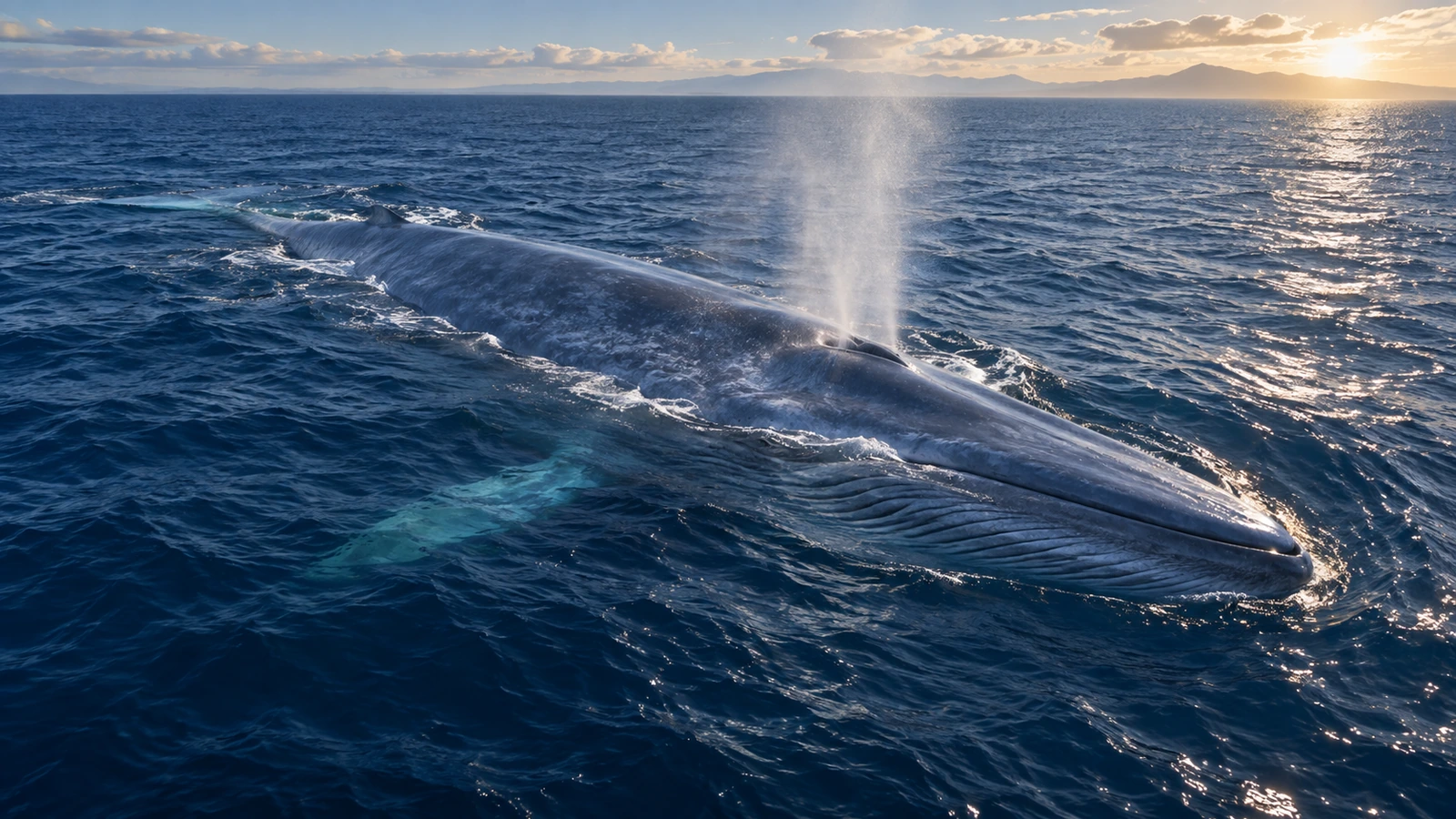
Blue whales are the undisputed titans of the planet, growing larger than even the grandest prehistoric dinosaurs that ever walked the Earth. Reaching lengths over 100 feet and weighing up to 200 tons, these marine mammals possess biological traits that sound like works of science fiction. From hearts the size of golf carts to underwater calls capable of traversing whole oceans, their scale is almost unimaginable. Discover the astonishing reality behind Earth's largest living creature.
1. They Are the Largest Animals Ever to Exist
Blue whales (Balaenoptera musculus) are officially the largest known animals to have ever inhabited planet Earth, surpassing even the most colossal prehistoric dinosaurs like Argentinosaurus. An adult blue whale can stretch over 100 feet in length and weigh up to 200 tons, which is equivalent to roughly 33 commercial school buses. Their gargantuan size is made possible by the buoyancy of seawater, which supports their immense body mass without collapsing their internal organs under gravity. Remarkably, female blue whales are generally larger than males, a trait common among baleen whale species.
2. Their Heart Beats as Slowly as Two Times Per Minute
A blue whale's heart is a marvel of biology, weighing approximately 400 pounds and standing about the size of a small golf cart or bumper car. During deep foraging dives, its pulse drops dramatically to preserve oxygen, beating as few as two to four times per minute. When the whale surfaces to breathe, its heart rate accelerates up to 37 beats per minute to rapidly replenish oxygen levels in its bloodstream. Scientists captured the first recorded cardiac signal of a wild blue whale using non-invasive suction-cup sensors attached near its pectoral fin.
3. A Single Tongue Weighs as Much as an Elephant
The tongue of a mature blue whale is an extraordinarily massive muscle that can weigh up to 6,000 pounds, comparable to the weight of a full-grown female Asian elephant. This immense organ plays a pivotal role during lunge-feeding, pushing water out through the whale's baleen plates while retaining trapped prey. Despite the sheer volume of its mouth, a blue whale cannot swallow anything larger than a beach ball because its esophagus measures only about 4 to 8 inches in diameter.
4. They Produce the Loudest Sounds of Any Animal
Blue whales are the undisputed acoustic champions of the animal kingdom, capable of emitting low-frequency vocalizations that reach up to 188 decibels. For comparison, a jet engine taking off generates roughly 140 decibels, and sound levels over 130 decibels cause immediate pain to human ears. These underwater calls—consisting of deep rumbles, moans, and pulses below the threshold of human hearing—can travel across ocean basins for hundreds of miles. Marine biologists believe these powerful vocalizations allow blue whales to locate mates and coordinate feeding over immense spatial distances.
5. Newborn Calves Gain 200 Pounds Every Single Day
Blue whale calves are born as instant giants, measuring around 23 feet long and weighing up to 3 tons at birth. To support such rapid growth, a nursing calf consumes between 50 and 150 gallons of mother's milk daily, which contains roughly 35 to 50 percent milk fat. Thanks to this high-calorie diet, a calf gains about 200 pounds every 24 hours during its first seven months of life. This represents one of the fastest growth rates of any animal on Earth.
6. Their Massive Bodies Depend Entirely on Tiny Krill
Despite being the largest creatures on Earth, blue whales feed almost exclusively on tiny marine crustaceans known as krill, which average less than two inches in length. During peak summer feeding seasons in nutrient-rich polar waters, a single adult blue whale can devour up to 4 to 6 tons of krill per day, consuming roughly 40 million individual organisms. They filter these tiny creatures from seawater using rows of dark, fringed baleen plates made of keratin—the same structural protein found in human fingernails and hair.
 Marine and Freshwater Animals
See All Facts
Marine and Freshwater Animals
See All Facts
7. Scientists Determine Their Age Using Earwax Plugs
Determining the precise age of a living blue whale was once nearly impossible until researchers studied the ear canals of deceased individuals. Blue whales accumulate cerumen, or earwax, which forms a dense plug that grows continuously throughout their lives. This earplug exhibits alternating light and dark bands corresponding to seasonal periods of feeding and migration, much like the growth rings in a tree trunk. By counting these layers, scientists can determine the animal's exact age and analyze trapped stress hormones and environmental pollutants across its lifespan.
8. Their Famous Coloration Is Actually an Optical Illusion
Despite their common name, blue whales are not actually solid blue when viewed out of the water. Their skin features a mottled pattern of slate gray, blue-gray, and silvery flecks that are unique to every individual whale, acting much like a human fingerprint. When viewed from above the surface, seawater filters out longer light wavelengths, causing the whale's mottled skin to reflect a brilliant turquoise blue hue. Additionally, skin micro-algae known as diatoms can give their bellies a yellowish tint, earning them the historical nickname "sulfur bottom."
9. Twin Blowholes Shoot Water Spouts 30 Feet High
Unlike toothed whales such as dolphins and sperm whales that possess only one blowhole, blue whales are baleen whales with paired twin blowholes. Located on top of their broad heads, these blowholes are controlled by powerful muscular valves that seal tight while diving to prevent water entry. When a blue whale surfaces to exhale, it forcefully expels warm, compressed air at speeds exceeding 300 miles per hour, producing a vertical vapor column that can shoot nearly 30 feet into the air.
10. They Sleep with Only Half Their Brain at a Time
As marine mammals, blue whales are conscious breathers, meaning they must actively choose to surface and draw air into their lungs. Because falling into a deep, unconscious sleep would cause them to drown, blue whales practice a phenomenon called unihemispheric slow-wave sleep. They shut down only one hemisphere of their brain at a time while keeping the other half alert to manage respiration, watch for danger, and navigate. During these resting periods, blue whales float near the ocean surface or swim very slowly in a state known as "logging."
11. Their Mouths Can Hold Their Entire Body Weight in Water
When a blue whale lunges into a dense swarm of krill, it opens its lower jaw to an astonishing angle of nearly 90 degrees. Special pleated grooves running from its lower jaw down to its navel expand like an accordion, allowing its mouth cavity to engulf up to 90 tons of water and food in a single gulp—a mass equal to the weight of the whale itself. Once the mouth closes, the whale uses its enormous tongue to push the trapped water out through its baleen plates, leaving thousands of krill behind to be swallowed.
12. Their Scientific Name Contains a Clever Latin Pun
In 1758, Swedish taxonomist Carl Linnaeus formally assigned the blue whale its scientific name, Balaenoptera musculus. The genus name Balaenoptera translates from Latin to "fin whale" or "winged whale," referencing the small dorsal fin located on its back. However, the species name musculus carries a famous double meaning: while it can be translated as "muscular," it is also the Latin word for "little mouse." Scholars widely believe Linnaeus intentionally named the largest animal on Earth "little mouse whale" as an ironic academic joke.
13. They Undertake Thousands of Miles of Fasting Migrations
Blue whales participate in incredible annual migrations that span thousands of miles between temperate or polar feeding grounds and tropical breeding waters. During the cold summer months, they gorge themselves on abundant polar krill to build up thick reserves of blubber. When winter arrives, they journey to warmer equatorial regions to mate and give birth, during which time they fast completely for months on end, sustaining themselves entirely by burning their accumulated fat reserves.
14. They Are Among the Longest-Lived Mammals on Earth
Blue whales enjoy impressive natural lifespans that rival those of human beings. By counting earwax layers and analyzing long-term photo-identification catalogues, marine biologists estimate that blue whales typically live between 80 and 90 years in the wild under natural conditions. The oldest recorded blue whale individual identified through earplug analysis reached an astonishing age of approximately 110 years old, placing them among the longest-lived mammals in the ocean.
15. Urban Legends Exaggerate Their Blood Vessel Dimensions
A popular internet myth asserts that a human adult could easily swim through the main aorta of a blue whale's heart. While a blue whale's blood vessels are undoubtedly massive—with the main aorta measuring roughly 9 to 10 inches in diameter—it is nowhere near wide enough for a human adult to swim through. However, the aorta is large enough to pump over 60 gallons of oxygenated blood per heartbeat through a network of vessels spanning hundreds of miles.
Sources & References
This AI-assisted post was rigorously curated and fact-checked for accuracy by:
 Martin Roháček
How fun was this article? 🤔
Tap a star to rate it
🧠 Quiz: How closely were you paying attention?
10 questions — all answers are in the article above!
Enjoyed these facts? There's more! 💌
Fresh fun facts in your inbox. No spam, ever.