The Literary Iconoclast: 15 Fascinating Facts About Elvis Costello
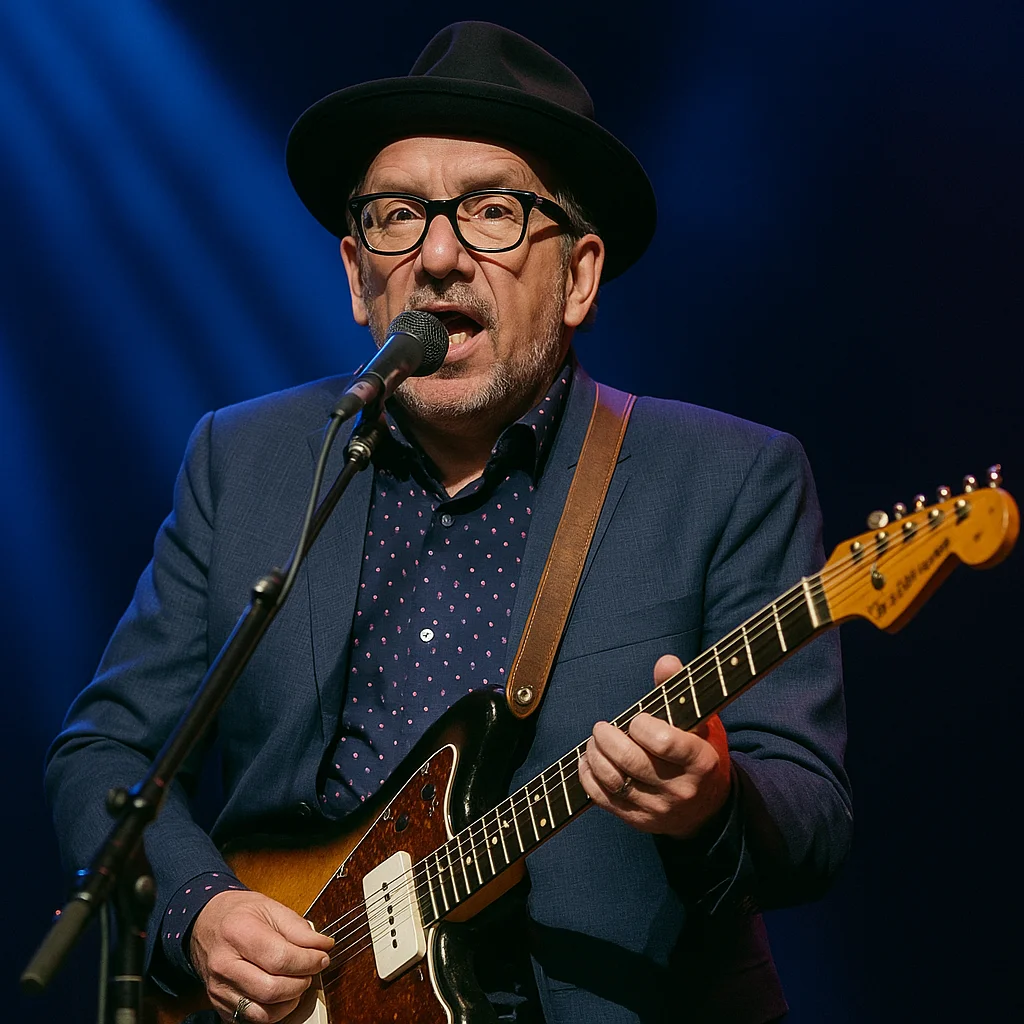
Emerging from the UK's late-1970s punk and new wave explosion, Elvis Costello established himself as one of the most prolific and literate songwriters in modern music history. From his famously abrupt rebellion on live television to his genre-spanning collaborations with pop legends, classical quartets, and jazz icons, his career is a study in relentless creative reinvention. Beyond the thick-rimmed glasses and sharp wordplay lies a complex artist whose impact stretches far beyond rock 'n' roll. Here are 15 fascinating facts about the life, music, and legacy of Elvis Costello.
1. His Real Name Is Declan Patrick MacManus
Before adopting his iconic stage name, the singer-songwriter was born Declan Patrick MacManus in London on August 25, 1954. Musical talent ran deep in his family; his father, Ross MacManus, was a prominent trumpet player and vocalist with the famous Joe Loss Orchestra. His mother worked in a record shop, giving young Declan access to a vast and diverse world of vinyl records throughout his childhood. This rich musical upbringing instilled a deep respect for eclectic genres long before he stepped into the public spotlight.
2. His Stage Name Combines Royalty and Family Tradition
The pseudonym "Elvis Costello" was conceived in 1977 by Jake Riviera, the co-founder of Stiff Records. Riviera suggested pairing the bold, flash first name of Elvis Presley with "Costello," which was the maiden name of Declan's maternal grandmother. Initially, the artist performed under the moniker D.P. Costello before embracing the full provocative alias to command attention in the crowded UK punk scene. The sharp contrast between his nerdy, horn-rimmed image and the legendary moniker created immediate media intrigue.
3. He Was Banned from Saturday Night Live for 12 Years
As a last-minute substitute for The Sex Pistols on Saturday Night Live in December 1977, Costello pulled off one of live television's most famous stunts. A few seconds into performing his record label's preferred track, "Less Than Zero," he stopped his band, turned to the audience, and declared there was no reason to play that song. He immediately launched into the scathing anti-broadcasting anthem "Radio, Radio," infuriating executive producer Lorne Michaels. The unscripted rebellion resulted in Costello being banned from the show until his triumphant return in 1989.
4. He Recorded His Debut Album While Working a Data Entry Job
Before pursuing music full-time, Costello earned his living working as a computer data entry operator at an Elizabeth Arden cosmetics factory in London. He called in sick or used vacation days to record his groundbreaking 1977 debut album, My Aim Is True, during late-night studio sessions. His backing musicians for the album were the American roots-rock group Clover, who were uncredited at the time due to contractual reasons. Costello famously wrote many of the album's sharp, cynical lyrics while taking late-night commuter trains home from work.
5. A Street Busking Stunt Got Him Arrested and Signed
To capture the attention of American record executives, Costello staged an impromptu guerrilla performance outside the London Hilton in 1977. CBS Records was holding an international corporate convention inside the hotel when Costello set up his guitar and battery-powered amplifier on the sidewalk. He performed passionately until local police arrived and arrested him for obstruction of the public highway. The headline-grabbing stunt paid off massively, leading directly to Columbia Records signing him for U.S. distribution.
6. He Produced Landmark Albums for The Specials and The Pogues
Beyond his achievements as a recording artist, Costello played a pivotal role as a record producer in shaping British subcultures. In 1979, he produced the self-titled debut album by ska revivalists The Specials, a masterwork that defined the 2 Tone movement and political street culture. Years later, in 1985, he produced Rum Sodomy & the Lash for the folk-punk band The Pogues, successfully capturing their chaotic energy and traditional Celtic instrumentation. His work behind the mixing console helped bring diverse underground sounds into the mainstream charts.
7. He Formed a Prolific Songwriting Partnership with Paul McCartney
In the late 1980s, Paul McCartney invited Costello to collaborate on material, resulting in one of the most celebrated songwriting teams of that era. Together, the pair co-wrote over a dozen tracks, evoking memories of the legendary Lennon-McCartney dynamic due to Costello's biting lyrical wit and McCartney's melodic genius. Their efforts produced major hits including McCartney's 1989 single "My Brave Face" and Costello's chart success "Veronica." Costello wrote "Veronica" as a moving tribute to his grandmother, who was battling severe Alzheimer's disease.
8. "Oliver's Army" Was Inspired by the Northern Ireland Conflict
Costello's biggest commercial single in the United Kingdom was "Oliver's Army," which reached number two on the UK Singles Chart in 1979 and sold over 500,000 copies. Despite its sparkling, bright piano riff inspired by ABBA, the song delivers a fierce critique of British imperialism and military recruitment. Costello was motivated to write the song after observing armed British soldiers patrolling the streets of Belfast during the Troubles. The lyrics highlight how economically depressed working-class youths were routinely targeted for military service.
9. He Earned a Grammy Award with Burt Bacharach
Costello surprised music critics in the mid-1990s by teaming up with legendary pop composer Burt Bacharach for a sophisticated collaborative project. What began as a single track for the film Grace of My Heart evolved into the critically lauded 1998 full-length album Painted from Memory. Combining Bacharach's lush orchestral arrangements with Costello's emotionally complex vocal delivery, the album earned widespread acclaim. The track "I Still Have That Other Girl" went on to win the Grammy Award for Best Pop Collaboration with Vocals.
10. He Learned Musical Notation to Compose a Classical Album
Refusing to be boxed in by rock 'n' roll, Costello expanded his artistic horizons in 1993 by composing The Juliet Letters alongside the classical string group The Brodsky Quartet. The concept album consisted of a sequence of song-letters addressed to Shakespeare's Juliet Capulet, blending classical string arrangements with pop balladry. To participate fully in the project, Costello spent months teaching himself how to read and write formal classical musical notation. This bold artistic leap opened the door for his future orchestral compositions and ballet scores.
11. He Recorded the First Post-Katrina Album in New Orleans
In the tragic aftermath of Hurricane Katrina in 2005, Costello partnered with New Orleans rhythm and blues icon Allen Toussaint to record The River in Reverse. Recorded partially in New Orleans, it became the first major studio album produced in the city after the catastrophic flooding. The project combined classic Toussaint compositions with new joint material that directly addressed the government's sluggish disaster response. The album stood as a triumphant celebration of New Orleans' resilient musical culture during a period of immense recovery.
12. His Backing Band The Attractions Entered the Hall of Fame
Central to Costello's explosive early career was his powerhouse backing band, The Attractions, featuring Steve Nieve on keyboards, Bruce Thomas on bass, and Pete Thomas on drums. Together, they forged an unmistakable musical identity defined by hyper-energetic rhythms and organ-driven melodies across albums like This Year's Model and Armed Forces. Despite well-documented personal tensions and stormy interpersonal relationships, their undeniable chemistry earned them collective entry into the Rock and Roll Hall of Fame in 2003. Their recorded legacy remains a benchmark for the post-punk era.
13. He Shocked Fans by Recording a Country Album in Nashville
At the peak of his reputation as an intense new wave pioneer, Costello caught critics off guard in 1981 by heading to Tennessee to record a country covers record titled Almost Blue. Produced by legendary country musician Billy Sherrill, the album featured Costello covering songs by Hank Williams, Merle Haggard, and Gram Parsons. While initially polarizing to rock purists, the project showcased his extraordinary vocal flexibility and genuine reverence for American roots music. Today, the record is viewed as an early forerunner to the modern alternative country movement.
14. He Is Married to Jazz Superstar Diana Krall
In December 2003, Costello married internationally acclaimed Canadian jazz pianist and vocalist Diana Krall at a private ceremony hosted at Elton John's estate in Surrey, England. The two prominent musicians had originally met backstage at the 2002 Grammy Awards before embarking on a relationship. Their shared passion for musical history has led to frequent artistic collaborations, including Costello writing lyrics for several of Krall's original compositions. The couple welcomed twin sons, Dexter Henry Lorcan and Frank Harlan James, in 2006.
15. He Published an Acclaimed 600-Page Literary Memoir
Costello proved that his mastery of language extends to prose when he published his comprehensive memoir, Unfaithful Music & Disappearing Ink, in 2015. Spanning more than 600 pages, the book rejected a standard chronological timeline in favor of a thematic exploration of his family roots and artistic evolution. The memoir received glowing reviews from literary critics for its candid self-reflection, sharp humor, and vivid portrait of the modern music industry. It quickly became a New York Times bestseller, solidifying his reputation as a true literary talent.
Sources & References
This AI-assisted post was rigorously curated and fact-checked for accuracy by:
 Martin Roháček
How fun was this article? 🤔
Tap a star to rate it
🧠 Quiz: How closely were you paying attention?
10 questions — all answers are in the article above!
Enjoyed these facts? There's more! 💌
Fresh fun facts in your inbox. No spam, ever.