The Uncompromising Icon: 15 Fascinating Facts About Frida Kahlo
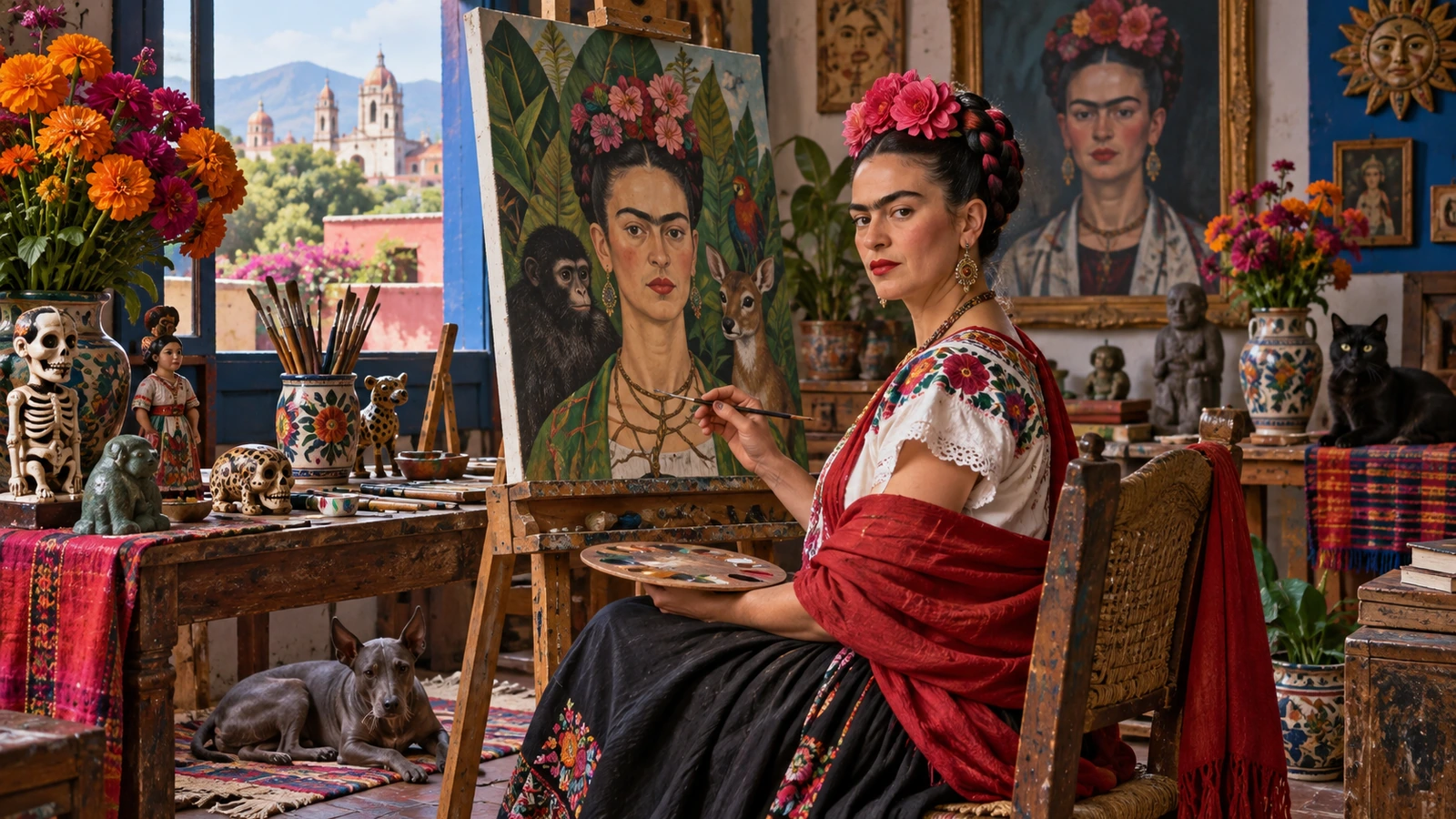
Frida Kahlo remains one of the most recognizable and influential figures in modern art history, famous for her intensely personal self-portraits and vibrant style. Born in Coyoacán, Mexico, she transformed unimaginable physical suffering into breathtaking canvases that continue to captivate audiences worldwide. From her secret political affairs to her revolutionary fashion, her life was every bit as dramatic and complex as her art. Here are 15 fascinating facts about the extraordinary life and legacy of Frida Kahlo.
1. She Rewrote Her Birth Year to Match the Mexican Revolution
Long before she became a global cultural icon, Frida Kahlo took deliberate control over her own narrative by changing her date of birth. Though she was actually born on July 6, 1907, she publicly claimed her birth year was 1910 so that it coincided with the outbreak of the Mexican Revolution. By tying her personal timeline to the birth of modern Mexico, she reinforced her deep commitment to national identity and social reform. This ideological re-framing allowed her to present herself as a direct child of the revolution throughout her adult life. Her friends and admirers accepted this symbolic gesture, which cemented her image as an embodiment of Mexico's cultural rebirth.
2. She Was Training to Be a Doctor Before Her Bus Accident
Art was not Frida Kahlo’s original career path, as she initially aimed to enter the medical profession. In 1922, she was admitted to the prestigious National Preparatory School in Mexico City, where she studied natural sciences with the goal of becoming a doctor. She was one of only 35 female students enrolled in an institution with over 2,000 pupils, showcasing her intellectual drive from a young age. While at the school, she immersed herself in philosophy, literature, and politics alongside a group of radical intellectual peers. However, her medical ambitions were abruptly halted three years later when a devastating accident redirected her genius toward visual art.
3. Polio in Childhood Shaped Her Wardrobe and Resilience
At the age of six, Kahlo contracted polio, a disease that left her right leg noticeably shorter and thinner than her left. The resulting physical impairment made her the target of harsh bullying from neighborhood children, who cruelly dubbed her "Frida pata de palo" or "peg-leg Frida." To conceal her asymmetrical limbs and overcome her self-consciousness, she began wearing heavy socks, built-up shoes, and long, layered skirts. Rather than shrinking away from public view, she learned to use fashion as a defensive armor to control how others perceived her body. This early ordeal instilled in her a lifelong resilience and laid the foundation for her celebrated, distinctive style.
4. A Catastrophic Streetcar Collision Ignited Her Artistic Career
On September 17, 1925, eighteen-year-old Kahlo suffered catastrophic injuries when the wooden bus she was riding collided with a streetcar. A steel handrail impaled her hip and pelvis, fracturing her spine, collarbone, ribs, and leg in multiple places. During months of agonizing bed rest in a body cast, her mother gifted her a specialized easel and attached a mirror to her bed canopy. Unable to move, Kahlo began painting self-portraits to process her intense physical torment and pass the grueling hours. What began as a therapeutic outlet during recovery ultimately forged her path into world-renowned fine art.
5. Her Parents Called Her Marriage 'The Elephant and the Dove'
In 1929, Kahlo married the famous Mexican muralist Diego Rivera, a man 20 years her senior and significantly larger in stature. Her parents strongly disapproved of the union, famously referring to the newlyweds as "the elephant and the dove" due to their stark physical contrast. Their marriage was notoriously turbulent, marked by mutual artistic inspiration, multiple extramarital affairs, divorce, and eventual remarriage in 1940. Despite the personal volatility and heartbreak, Rivera remained one of the most fervent champions of Kahlo’s artistic talent. Their complex dynamics directly influenced some of her most powerful self-portraits and surrealistic compositions.
6. She Had an Affair with Exiled Revolutionary Leon Trotsky
During the late 1930s, Kahlo and Rivera opened their home to the exiled Russian Marxist revolutionary Leon Trotsky and his wife. Trotsky was fleeing persecution from Soviet leader Joseph Stalin and sought political asylum in Mexico under Rivera’s sponsorship. While residing at La Casa Azul, Kahlo and Trotsky engaged in a brief, secret romantic affair that lasted several months. Following the end of their romance, she painted a famous self-portrait depicting herself in elegant attire holding a letter addressed to him. Today, Self-Portrait Dedicated to Leon Trotsky stands as a captivating testament to this dramatic intersection of art and geopolitical history.
 Painters and Visual Artists
Explore the fascinating lives and enduring legacies of history's greatest visual artists. From Renaissance polymaths to modern revolutionaries, uncover the eccentricities, rivalries, and brilliance behind the world's most famous canvases.
See All Facts
Painters and Visual Artists
Explore the fascinating lives and enduring legacies of history's greatest visual artists. From Renaissance polymaths to modern revolutionaries, uncover the eccentricities, rivalries, and brilliance behind the world's most famous canvases.
See All Facts
7. She Was the First 20th-Century Mexican Artist in the Louvre
In 1939, the renowned Louvre Museum in Paris acquired Kahlo’s painting titled The Frame (El marco). This historic purchase made her the very first 20th-century Mexican artist to have a work included in the Louvre’s prestigious permanent collection. Remarkably, she achieved this milestone before she had ever held a solo art exhibition in her native Mexico. The acquisition brought international prestige to Mexican modernism and established Kahlo as an undeniable force in the global art scene. Surrealist icons like André Breton lauded her work, cementing her reputation across the European continent.
8. She Vehemently Rejected the 'Surrealist' Label
Although European intellectuals and Surrealist leader André Breton eagerly claimed Kahlo as one of their own, she firmly rejected the label. Breton described her art as a "ribbon around a bomb," but Kahlo insisted that her work did not belong to the Surrealist movement. She famously declared that she never painted dreams or nightmares, but rather her own immediate and unfiltered reality. While Surrealists used dream imagery to access the subconscious mind, Kahlo’s surreal elements were visual metaphors for real physical agony and identity. Her insistence on artistic independence preserved her unique position in art history outside rigid movement boundaries.
9. She Attended Her First Mexican Solo Exhibition in an Ambulance
Kahlo did not receive her first solo exhibition in Mexico until April 1953, near the very end of her life. At the time, her health had severely deteriorated, and her doctor strictly ordered her to remain on bed rest and skip the opening gallery night. Refusing to miss her triumphant moment, Kahlo arranged to be transported to the gallery in an ambulance. She was carried inside on a four-poster bed and spent the evening entertaining amazed guests from under her blankets. This dramatic appearance highlighted her legendary defiance and unyielding devotion to her artistic legacy.
10. Her Personal Menagerie Served as Symbols in Her Art
The courtyard of La Casa Azul was home to a vibrant menagerie of exotic pets that doubled as living companions and symbolic muses. Kahlo kept spider monkeys, hairless Xoloitzcuintli dogs, Amazonian parrots, birds, and even a fawn named Granizo. In traditional Mexican mythology, hairless dogs were believed to guide souls through the underworld, reflecting her deep fascination with mortality. Spider monkeys, which she frequently depicted resting on her shoulders in self-portraits, symbolized protection, tenderness, and alter-egos. These animals provided her with comfort during periods of extreme isolation and added rich symbolic layers to her canvases.
11. Her Iconic Tehuana Style Was Both Political and Practical
Kahlo’s signature wardrobe was heavily inspired by the traditional dress of the matriarchal Tehuana culture in southern Mexico. She favored floor-length, embroidered skirts, elaborate blouses, and intricate floral headdresses. Beyond making a bold political statement celebrating indigenous heritage and anti-colonialism, these garments served a highly practical function. The flowing layers successfully concealed her asymmetrical right leg and the rigid medical body braces she was forced to wear. This brilliant synthesis of style and utility turned her physical impairments into an iconic, empowering aesthetic.
12. She Turned Her Plaster Corsets into Works of Art
Due to chronic spinal pain stemming from her bus accident, Kahlo spent long stretches of her life encased in plaster and steel corsets. Rather than viewing these orthopedic devices as passive instruments of suffering, she converted them into intimate artistic canvases. Using mirror reflections while lying flat, she painted vivid butterflies, communist symbols like the hammer and sickle, and depictions of her broken spine directly onto the plaster. Transforming medical equipment into art allowed her to reassert bodily autonomy and control over her physical pain. Several of these painted plaster corsets are preserved today, offering a moving glimpse into her artistic endurance.
13. She Redefined Beauty Standards and Inspired High Fashion
Kahlo radically challenged prevailing beauty standards of the 20th century by refusing to alter her natural facial features. She prominently featured her natural unibrow and dark upper lip hair in both her self-portraits and public life as a middle finger to conventional feminine expectations. Her daring aesthetic caught the eye of the fashion elite, earning her a feature in Vogue magazine as early as 1937. Decades after her death, major international fashion houses continue to draw heavy inspiration from her bold patterns, braided hair, and floral accessories. Today, she remains a timeless global symbol of self-acceptance, body positivity, and artistic individuality.
14. She Lived and Died in the Same House
Frida Kahlo’s entire life was anchored to a single vibrant building in Coyoacán, Mexico City, known as La Casa Azul (The Blue House). She was born in the house in 1907, grew up within its cobalt-blue walls, and ultimately passed away in an upstairs bedroom in 1954. In 1958, Diego Rivera donated the property to the Mexican public to be preserved as the Museo Frida Kahlo. Visitors today can explore preserved rooms filled with her personal belongings, including her customized wheelchair, paint palettes, and unfinished canvases. The museum remains one of Mexico City’s most popular cultural destinations, offering an intimate window into her inner world.
15. Her Ashes Rest Inside a Pre-Columbian Frog Urn
Following her death in 1954 at age 47, Kahlo was cremated according to her wishes rather than buried underground. Her ashes were placed inside an exquisite pre-Columbian ceramic urn shaped like a frog or toad. This shape was deeply symbolic, as Diego Rivera often affectionately referred to himself as "the frog-toad" (el sapo-rana). The urn rests quietly on her bedside table inside her former bedroom at La Casa Azul, surrounded by her personal trinkets. This poetic resting place ensures that her physical remains remain permanently tied to the home and art that defined her life.
Sources & References
This AI-assisted post was rigorously curated and fact-checked for accuracy by:
 Martin Roháček
How fun was this article? 🤔
Tap a star to rate it
🧠 Quiz: How closely were you paying attention?
10 questions — all answers are in the article above!
Enjoyed these facts? There's more! 💌
Fresh fun facts in your inbox. No spam, ever.