The Dashing Plunge-Diver: 15 Fascinating Facts About Gannets
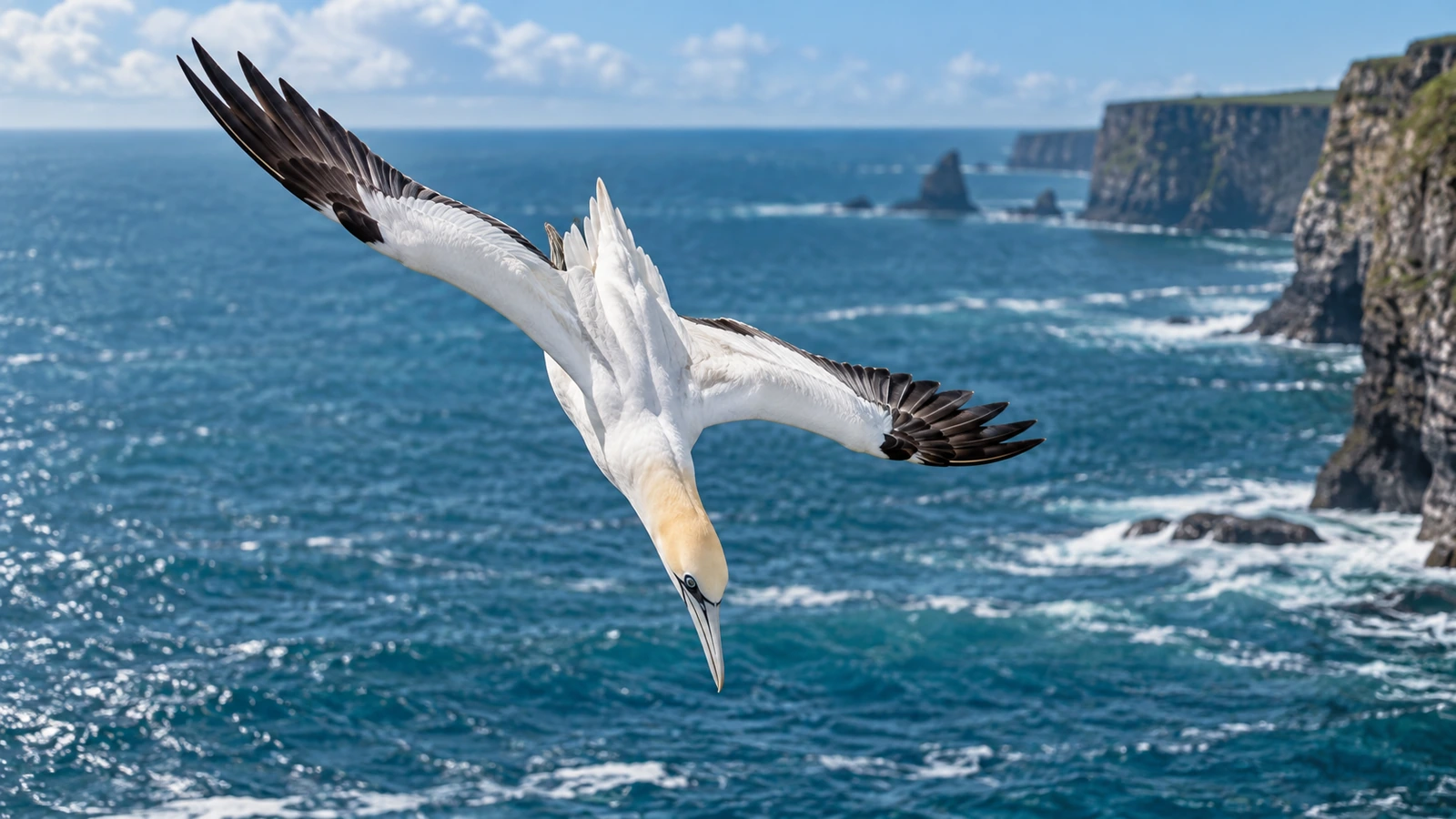
Renowned for their jaw-dropping aerial acrobatic displays and missile-like plunges, gannets are among the most remarkable seabirds in the world. Capable of diving into the ocean at speeds reaching 100 km/h, these magnificent ocean hunters possess biological airbags, internal nostrils, and shock-absorbing skulls engineered for high-velocity fishing. Behind their elegant white plumage and striking golden heads lies a complex creature that incubates eggs with webbed feet and navigates thousands of miles on its maiden flight. Discover the surprising evolutionary marvels that make the gannet an absolute masterpiece of wild nature.
1. Extreme 100 km/h Plunge-Diving Speed
Northern gannets are nature's ultimate high-velocity divers, capable of plummeting toward the ocean from heights of up to 30 meters (100 feet). During these vertical dives, they fold their wings back like arrowheads and can reach breathtaking speeds of up to 100 km/h (62 mph). This extreme velocity allows them to penetrate up to 11 meters underwater under their own momentum, catching fish far deeper than other surface-feeding seabirds. To pursue prey even deeper, they swim using both their wings and webbed feet, reaching depths of up to 20 meters.
2. Built-In Biological Airbags
Hitting the water at highway speeds would inflict fatal trauma on most creatures, but gannets possess specialized anatomical armor. Beneath the skin of their face and chest lies a network of expandable, subcutaneous air sacs. When a gannet strikes the water, these air sacs automatically inflate to absorb the kinetic shock, acting as biological bubble wrap for their internal organs. This unique evolutionary feature cushions the violent transition from air to liquid and keeps the bird uninjured dive after dive.
3. Internal Nostrils Inside the Mouth
To survive high-impact entry into ocean waters, gannets evolved an unusual respiratory system that completely lacks external nostril openings. If they had standard open nostrils on their beaks, water would be forced violently into their respiratory tract at impact. Instead, their nostrils are positioned inside the roof of their mouth, sealed tight by soft tissue flaps during dives. They breathe through their mouth when on land or flying, completely eliminating the risk of water filling their lungs upon entering the ocean.
4. Egg Incubation Using Webbed Feet
Unlike most birds that possess a featherless patch of bare skin on their belly called a brood patch, gannets use their feet to incubate their eggs. Their large webbed feet are exceptionally rich in blood vessels, providing an ideal thermal pad. When a female lays her single egg, both parents take turns standing directly on top of it, wrapping their warm, fleshy webs around the shell. This unusual method keeps the egg continuously heated at precise temperatures throughout the 44-day incubation period.
5. Binocular Vision for Precision Target Tracking
Unlike many prey-focused birds with eyes set on the sides of their heads, gannets have forward-facing eyes that grant them exceptional binocular vision. This structural placement gives them precise depth perception, allowing them to calculate distance and speed while plunging from the sky. Their eyes also feature powerful muscles that adjust the lens shape instantaneously to compensate for light refraction as they pass from air into water. This visual acuity allows them to track and target slippery, fast-moving fish with remarkable precision.
6. Elaborate Courtship and Fencing Rituals
Gannets maintain lifelong monogamous partnerships, reinforcing their bonds each breeding season through highly dramatic display behaviors. Upon returning to their nest sites, mates engage in bill-fencing, standing breast-to-breast, reaching their necks upward, and rapidly clashing their beaks together like swords. They compliment this with sky-pointing, stretching their necks straight toward the heavens while calling loudly and holding their wings partially open. These intense displays not only greet mates but also signal territorial ownership to neighboring pairs in dense colonies.
7. Dark Juvenile Plumage and Multi-Year Transformation
A newly fledged gannet looks astonishingly different from its snowy-white parents, featuring entirely dark brown or slate-black plumage speckled with tiny white spots. Over the course of four to five years, the young bird undergoes a gradual transformation through several distinct molting phases. Each annual molt adds more white feathers to its body and a brilliant yellow wash to its head, while dark wing tips slowly refine into the classic adult pattern. This gradual change allows older colony members to immediately recognize sexually immature birds and reduce aggressive territorial conflicts.
8. Coordinated Mass Plunge-Feeding
While gannets often hunt individually, the discovery of a dense school of fish can trigger a spectacular, coordinated feeding frenzy involving hundreds of birds. Flocks encircle the target area and plunge simultaneously into the ocean, creating a vertical bombardment that resembles falling rain. This rapid, multi-angle attack disorients schools of herring, mackerel, or sand eels, trapping them near the surface and preventing escape. The sheer chaos created by dozens of hitting bodies disorganizes the fish, ensuring high hunting success for the entire flock.
9. Terrestrial Clumsiness and Crash Landings
Although gannets are masterpieces of aerial and aquatic aerodynamics, their long, heavy bodies and narrow wings make them spectacularly awkward on solid ground. Landings at crowded breeding colonies frequently devolve into uncontrolled tumbles, skid-marks, and violent collisions with neighboring birds. Their feet are positioned far back on their body for efficient swimming, forcing them to waddle awkwardly when walking on land. If blown off course or grounded on flat inland terrain without wind, they often struggle to regain flight without an elevated ledge or cliff edge.
10. Perilous Autonomous Migrations
When juvenile gannets leave the nest for the first time, they must embark on a treacherous oceanic migration without any parental guidance. Leaving their North Atlantic breeding cliffs, fledglings fly south over distances exceeding 2,700 kilometers (1,700 miles) toward the coast of West Africa or the Mediterranean. Because young birds lack fully developed flight muscles, they often spend their initial days swimming southward on the ocean surface before taking to the air. Sadly, high mortality rates during this maiden voyage filter out weaker individuals, leaving only the fittest to return years later.
11. Impermeable Preen Gland Waterproofing
To stay warm and buoyant in freezing North Atlantic ocean currents, gannets rely on a specialized oil produced by their uropygial, or preen, gland located at the base of the tail. They spend hours meticulously spreading this lipid-rich oil across their dense plumage using their beaks and heads. The waterproof coating prevents icy sea water from penetrating down to their insulating layer of down feathers. Additionally, the oil provides structural rigidity to their primary wing feathers, allowing them to withstand extreme hydro-dynamic pressures during high-speed underwater pursuits.
12. Urohidrosis and Webbed-Foot Thermoregulation
Crowded nesting colonies on sun-exposed sea cliffs can reach uncomfortably high temperatures during the summer months, putting gannets at risk of overheating. To cool down, they utilize their large, heavily vascularized webbed feet as natural heat exchangers, spreading them wide to radiate heat into the ocean breeze. When temperatures climb dangerously high, they practice urohidrosis, intentionally excreting onto their own feet and legs. As the moisture evaporates from the skin, it rapidly draws heat away from the underlying blood vessels, lowering their core body temperature.
13. High-Impact Skeletal and Muscular Adaptations
Beyond their air sacs, gannets possess several remarkable skeletal modifications engineered to survive repeated, violent impacts with the sea. Their skulls are unusually thick and fused, providing rigid structural protection around the braincase to prevent concussion upon water entry. Their long, dagger-like beaks lack serrations or flexible joints, forming a solid, hydrodynamic wedge that parts the water effortlessly. Furthermore, their neck muscles are exceptionally strong, locking the cervical vertebrae in a rigid straight line at the moment of impact to prevent neck fractures.
14. Modern Nest Construction and Marine Plastic Hazards
Traditionally, gannets build sturdy, pedestal-shaped nests on rocky cliffs using seaweed, mud, feathers, and guano, which hardens over years into a cement-like structure. Modern gannet colonies, however, increasingly feature nests constructed with synthetic marine debris, particularly discarded plastic fishing nets and synthetic ropes. While these durable materials help bind the nest structure, they pose a lethal threat to both adults and chicks, which often become tangled in the plastic threads. Researchers estimate that in some colonies, over 80 percent of nests contain man-made plastic refuse.
15. Megacity Breeding Colonies and Guano Landscapes
Gannets are intensely social birds that breed in massive, tightly packed colonies known as gannetries, located on isolated islands and steep coastal cliffs. The world's largest Northern gannet colony at Bass Rock in Scotland hosts over 150,000 birds during peak breeding season, turning the dark volcanic island solid white. The sheer noise of tens of thousands of screeching birds can be heard kilometers away, while their accumulated nitrogen-rich guano shapes the local ecosystem and creates a pungent microclimate. These megacities offer safety from land predators like foxes, allowing birds to raise their single chick securely.
Sources & References
This AI-assisted post was rigorously curated and fact-checked for accuracy by:
 Martin Roháček
How fun was this article? 🤔
Tap a star to rate it
🧠 Quiz: How closely were you paying attention?
10 questions — all answers are in the article above!
Enjoyed these facts? There's more! 💌
Fresh fun facts in your inbox. No spam, ever.