
The Eternal Wonders: 15 Fascinating Facts About the Giza Necropolis
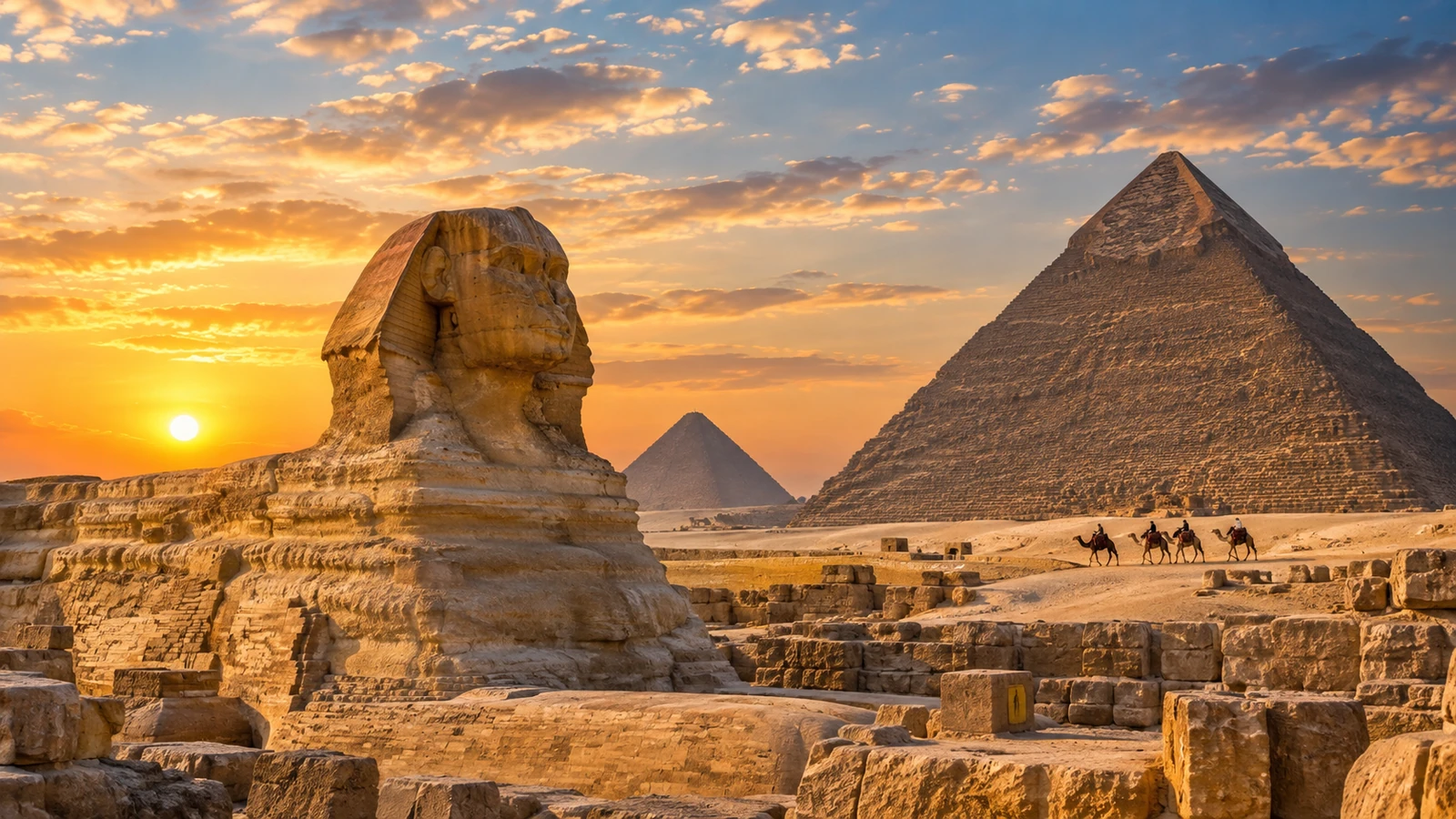
Situated on the edge of the Libyan Desert near Cairo, the Giza Necropolis stands as one of humanity's greatest architectural and cultural achievements. Built over 4,500 years ago during Egypt's Old Kingdom, this sprawling complex includes the legendary Great Pyramid of Khufu, the enigmatic Great Sphinx, and thousands of royal tombs. Beyond their breathtaking scale, these ancient monuments embody remarkable mathematical precision, hidden chambers, and fascinating engineering secrets that continue to intrigue scientists today. Discover the most extraordinary, lesser-known facts surrounding the world's most famous archaeological site.
1. The Great Pyramid Held the Height Record for Over Three Millennia
Constructed during the reign of Pharaoh Khufu around 2560 BCE, the Great Pyramid originally reached an astonishing height of 146.6 meters (481 feet). This massive architectural achievement allowed it to reign supreme as the tallest man-made structure on Earth for more than 3,800 years. It was finally surpassed in 1311 CE when England's Lincoln Cathedral completed its massive central spire. Over centuries of erosion and stone harvesting, the Great Pyramid lost its outer casing and top capstone, shrinking to its current height of 138.5 meters (454 feet). Despite losing several meters from its summit, the ancient monument still dominates the skyline of the Giza Plateau today.
2. The Pyramids Were Built by Paid Laborers, Not Slaves
Contrary to the long-standing myth popularized by ancient Greek historian Herodotus and modern cinema, the Giza pyramids were not erected by hundreds of thousands of enslaved workers. Extensive archaeological excavations on the plateau have uncovered the remains of a vast, planned city built specifically to house the workforce. Analysis of animal bones and garbage dumps revealed that these workers were fed high-grade beef, bread, and beer, diets far superior to typical ancient peasants. Furthermore, skeletal remains show evidence of skilled medical treatments, such as set bone fractures and brain surgery, proving workers received exceptional care. These builders were respected, paid laborers who worked in seasonal shifts and were proud to serve their divine pharaoh.
3. The Great Pyramid Is Aligned to True North with Astounding Precision
The engineering accuracy of the Great Pyramid of Giza continues to baffle modern architects and astronomers. The base of the pyramid is aligned almost perfectly with true cardinal north, deviating by only four-sixtieths of one degree. This precise orientation was achieved thousands of years before the invention of the magnetic compass or modern surveying tools. Researchers believe the ancient Egyptian builders achieved this alignment by carefully observing the rotation of circumpolar stars in the night sky. Such extraordinary precision demonstrates that Old Kingdom Egyptians possessed remarkably sophisticated mathematical and astronomical knowledge.
4. The Monuments Once Shone Like Giant Mirrors Under the Sun
When the pyramids were originally completed, they looked radically different from the rough, golden-brown stone structures seen today. Their exterior faces were completely covered in a smooth layer of highly polished, bright white Tura limestone casing stones. These gleaming outer stones were fitted together so tightly that a thin knife blade could not be inserted between them. Under the intense Egyptian sun, the reflective surface would have made the pyramids shine like radiant beacons visible from miles away. Most of these pristine casing stones were stripped away during the Middle Ages to build mosques and fortifications in nearby Cairo following a major earthquake.
5. The Great Sphinx Was Carved Out of Bedrock Rather Than Assembled
Standing east of the pyramids, the Great Sphinx is one of the largest and oldest single-stone statues in the world. Rather than being assembled from individual stone blocks, the body of the lion and head of the pharaoh were carved directly out of the plateau's natural limestone bedrock. Quarry workers extracted massive blocks around the bedrock ridge to construct the neighboring Sphinx Temple, leaving the central core to be sculpted into the iconic beast. Because different layers of the limestone bed vary in density, the monument has weathered unevenly over thousands of years. Many Egyptologists believe the face of the Sphinx represents Pharaoh Khafre, who ruled during the Fourth Dynasty.
6. The Pyramid of Khafre Creates a Clever Optical Illusion
Visitors walking across the Giza Plateau often mistake the Pyramid of Khafre for the largest structure on the site. In reality, Khafre’s pyramid is roughly ten feet shorter and significantly smaller in volume than his father Khufu’s Great Pyramid. The illusion occurs because Khafre chose a location on higher bedrock, elevating his pyramid’s base above the surrounding terrain. Additionally, Khafre constructed his pyramid with a steeper slope angle of 53 degrees compared to the Great Pyramid's 51 degrees. Khafre’s monument is also easily recognizable because it is the only pyramid that still retains its smooth limestone casing stones at its apex.
 Ancient and Archaeological Sites
Humanity's impulse to build monumentally has left behind astonishing architectural legacies. From sky-high Incan citadels to sprawling Egyptian necropolises, these sites unite diverse cultures through their shared ambition to conquer geography and secure immortality. Discover the ingenious engineering and hidden histories behind the world's most incredible ancient archaeological wonders.
See All Facts
Ancient and Archaeological Sites
Humanity's impulse to build monumentally has left behind astonishing architectural legacies. From sky-high Incan citadels to sprawling Egyptian necropolises, these sites unite diverse cultures through their shared ambition to conquer geography and secure immortality. Discover the ingenious engineering and hidden histories behind the world's most incredible ancient archaeological wonders.
See All Facts
7. Giza Is the Only Surviving Ancient Wonder of the World
In antiquity, classical travel writers compiled a list of the seven most impressive architectural feats of the known world. Among ancient marvels like the Hanging Gardens of Babylon and the Colossus of Rhodes, the Great Pyramid was the oldest entry on the list. Today, it enjoys the unique distinction of being the only ancient wonder that has survived intact into the modern era. While earthquakes, fires, and warfare destroyed all six other ancient wonders over the centuries, the sheer scale of Giza's stone masonry preserved it. Having endured for over 4,500 years, the Giza complex stands as an extraordinary monument to human endurance and engineering.
8. The Necropolis Was a Sprawling Sacred City of the Dead
While the three major pyramids dominate photos, the Giza Necropolis covers a vast network of interconnected sacred spaces spanning several square kilometers. The complex includes valley temples near the Nile, long covered causeways, and satellite pyramids built for royal queens. Surrounding the royal pyramids are extensive fields of flat-topped stone tombs known as mastabas. These mastabas served as the final resting places for high-ranking officials, priests, royal family members, and court administrators. This layout created a symbolic eternal city where the deceased pharaoh continued to rule over his court in the afterlife.
9. A Fully Preserved 140-Foot Wooden Solar Boat Was Buried On Site
In 1954, Egyptian archaeologist Kamal el-Mallakh made a breathtaking discovery in a sealed pit alongside the southern face of the Great Pyramid. Deep underground lay 1,224 individual pieces of cedar wood, meticulously dismantled and preserved for over four thousand years. It took experts over a decade to assemble the fragments into a magnificent, 43.6-meter-long (143 feet) solar ship without using a single nail. Known as the Khufu Ship, this vessel was likely designed as a ritual boat to transport the resurrected king across the heavens with the sun god Ra. The ancient vessel was housed in a dedicated museum at Giza before being relocated to the Grand Egyptian Museum in 2021.
10. The Great Pyramid Maintains a Constant Interior Temperature
Despite being situated in the harsh, scorching climate of the Sahara desert, the core of the Great Pyramid acts as a natural climate control system. The immense thickness of the solid stone walls isolates the inner chambers from outside weather fluctuations. As a result, the internal temperature deep inside the pyramid remains virtually constant at 20 degrees Celsius (68 degrees Fahrenheit). This matches the average earth temperature of the region and creates a surprisingly cool environment during hot summers and warmth during cold desert nights. This natural thermal stability helped preserve delicate internal features and ancient wooden artifacts over thousands of years.
11. The Chemical Composition of the Mortar Remains Unsolved
The construction of the Giza pyramids required an astounding quantity of mortar to set and level millions of heavy limestone blocks. Estimates suggest that over 500,000 tons of mortar were used during the construction of the Great Pyramid alone. Chemical analysis reveals that the mortar is composed mostly of processed gypsum and plaster, but its exact binding compound remains unknown to scientists. The resulting material is inexplicably stronger than the limestone blocks it joins together and holds tight thousands of years later. Despite access to modern chemistry, scientists have been unable to fully replicate the precise recipe used by ancient Egyptian stonemasons.
12. The Great Pyramid Is Actually an Eight-Sided Structure
To the casual observer, the Great Pyramid appears to be a standard four-sided pyramid with flat triangular faces. However, high-altitude aerial photography reveals a fascinating structural detail: each of the four main faces is slightly concave. A subtle vertical indentation runs down the exact center of each face, effectively dividing the structure into an eight-sided pyramid. This extraordinary feature is virtually invisible from the ground and can only be clearly seen from above under specific lighting conditions during the spring and autumn equinoxes. Whether this eight-sided geometry served a structural purpose to distribute weight or had astronomical significance remains heavily debated among experts.
13. A Medieval Sultan Attempted to Demolish the Pyramids
In 1196 CE, Al-Aziz Uthman, the Ayyubid Sultan of Egypt and son of Saladin, ordered the complete destruction of the Giza pyramid complex. He recruited a massive army of workmen and stonemasons, starting with Menkaure’s Pyramid, the smallest of the three main structures. The task proved far more difficult and expensive than anticipated, as workers could only manage to remove one or two heavy stones per day. After eight exhausting months of labor, the Sultan realized the impossibility of the endeavor and abandoned the demolition attempt. Today, a huge vertical gash remains visible on the northern face of Menkaure’s Pyramid as a testament to that failed effort.
14. The Great Sphinx Was Buried Up to Its Neck for Centuries
Over the millennia, shifting desert sands repeatedly engulfed the Great Sphinx, obscuring its massive body beneath the dunes. By the 14th century BCE, Prince Thutmose IV cleared the sand around the statue after dreaming that the Sphinx promised him the crown of Egypt in exchange. After antiquity, the sand reclaimed the statue, leaving only its giant head visible to medieval visitors and early European travelers. It was not until the late 1920s that a full-scale archaeological excavation led by Émile Baraize completely freed the body from the desert. Today, continuous maintenance and sand barriers are necessary to prevent the desert from reclaiming the iconic monument once again.
plots15. Cosmic-Ray Technology Discovered a Hidden Void Inside the Pyramid
Even after centuries of exploration, the Great Pyramid continues to reveal hidden internal architectural secrets. In 2017, the international ScanPyramids project utilized non-invasive cosmic-ray muon radiography to scan the internal structure of the monument. The high-tech scans revealed a massive, previously unknown hidden void located directly above the Grand Gallery. Spanning at least 30 meters (100 feet) in length, this void represents the first major internal structure discovered inside the pyramid since the 19th century. Archaeologists are currently utilizing miniature robotics and endoscopes to explore the void without causing any damage to the ancient monument.
Sources & References
This AI-assisted post was rigorously curated and fact-checked for accuracy by:
 Martin Roháček
How fun was this article? 🤔
Tap a star to rate it
🧠 Quiz: How closely were you paying attention?
10 questions — all answers are in the article above!
Enjoyed these facts? There's more! 💌
Fresh fun facts in your inbox. No spam, ever.