
The Lion of the North: 15 Fascinating Facts About Gustavus Adolphus
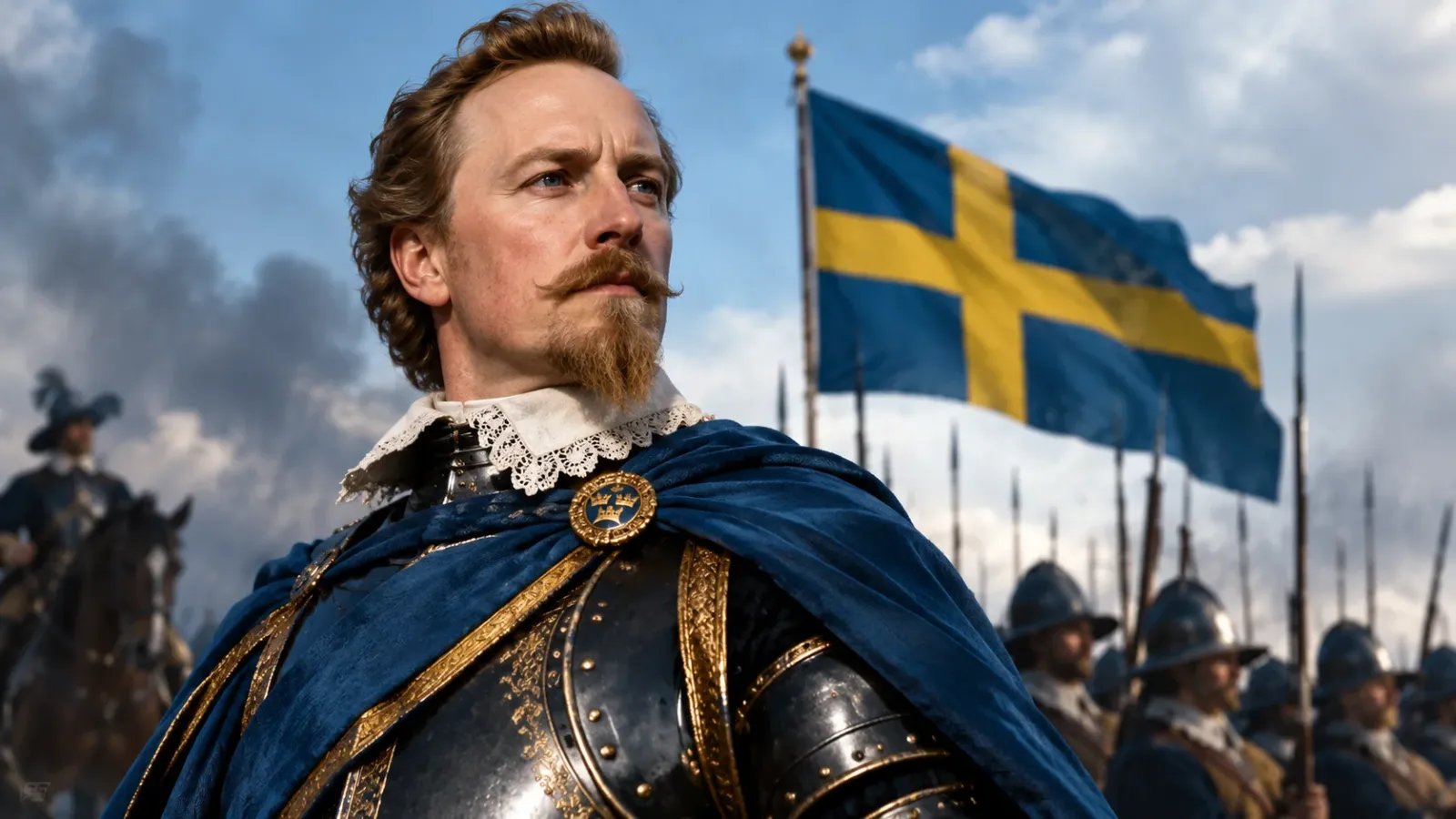
Gustavus Adolphus took the throne of a poor, sparsely populated kingdom at just sixteen and turned Sweden into one of Europe's great powers. Hailed as the father of modern warfare, he reinvented how armies fought, marched deep into Germany during the Thirty Years' War, and died leading a cavalry charge in the fog at Lützen. Discover the soldier-king behind the legend of the Lion of the North.
1. He became king at sixteen and inherited three wars.
When his father, Charles IX, died in 1611, the sixteen-year-old Gustavus Adolphus inherited the throne, together with wars against Denmark-Norway, Russia, and his cousin Sigismund III of Poland. The Riksdag declared that he could not be formally crowned until he reached the age of 24, so the experienced statesman Axel Oxenstierna helped him govern at first. Of the wars, the conflict with Denmark was the most serious. Over the following decades, Sweden rose from a regional Baltic power to one of the great powers of Europe.
2. He is often called the father of modern warfare.
Gustavus Adolphus is credited with an early form of combined-arms warfare, which integrated infantry, cavalry, and artillery, along with careful logistics. His infantry were drilled to fire quickly in shallow lines, and pikemen could also use firearms. Carl von Clausewitz and Napoleon Bonaparte considered him one of the greatest generals of all time. Some modern historians, however, think his reputation as a unique innovator is exaggerated, since several of his ideas were developed earlier in the Dutch army.
3. His army used mobile artillery.
Seventeenth-century artillery was usually heavy and difficult to move. Gustavus Adolphus' army made greater use of lighter guns that could be moved by a few men and horses and attached to infantry regiments. At the Battle of Breitenfeld, the more numerous and more mobile Swedish artillery helped to defeat the imperial army. His use of artillery earned him a reputation as an innovator.
4. He studied several languages.
As a boy, Gustavus Adolphus was tutored by the intellectual Johan Skytte, and his studies included history, politics, law, military training, and languages. He spoke Swedish and German and had some knowledge of Latin, French, Dutch, and Italian. These skills helped him communicate with the many foreign officers, diplomats, and allies he met during his campaigns.
5. German Protestants called him the "Lion of the North."
His intervention in the Thirty Years' War in 1630 gave rise to the nickname "the Lion from the North." Protestants in Germany, who had suffered heavy defeats, saw in him a savior, and some linked him to older prophecies of a "lion from midnight" who would help them. He was widely commemorated afterward as the main defender of the Protestant cause, and a charitable organization, the Gustav-Adolf-Werk, still carries his name.
6. His army relied on a national levy supported by foreign mercenaries.
Gustavus Adolphus reformed the Swedish administration, including a parish registration of the population that allowed the central government to tax and conscript people more efficiently. His troops included a core of Swedish and Finnish conscripts, but as he moved into Germany, a large share of the army consisted of foreign mercenaries. Historians have questioned the claim that his was a uniquely disciplined national army, but he undoubtedly created a stronger and more organized military machine than Sweden had before.
7. The warship Vasa sank on its maiden voyage in 1628.
The great warship Vasa, built on the king's orders as a symbol of Swedish power, set sail from Stockholm on 10 August 1628. It was top-heavy, and after only about a nautical mile a gust of wind heeled it over, and it sank in front of crowds. Gustavus Adolphus himself was away, campaigning in Prussia. The ship was raised in 1961 in remarkably good condition and is now the centerpiece of the Vasa Museum in Stockholm, one of Scandinavia's most visited museums.
8. His victory at Breitenfeld changed the Thirty Years' War.
On 17 September 1631, Gustavus Adolphus met the Catholic army under Count Tilly near Leipzig. Using a combined attack of cavalry, disciplined infantry, and mobile artillery, the Swedes and their allies won a decisive victory. It was the first major Protestant victory of the war, and it opened the way for the Swedish army to march deep into southern Germany. It is generally regarded as his most notable military victory.
9. A bullet in his neck could never be removed.
Gustavus Adolphus often led from the front. In 1627, near Dirschau in Prussia, a Polish soldier shot him in the right side of the neck, and the bullet lodged in the muscles above his right shoulder blade. He was convinced the wound was fatal, but he survived. The doctors could not remove the bullet, and afterward he could not wear heavy armor comfortably.
10. He was killed in the fog at Lützen in 1632.
On 6 November 1632 (16 November in the Gregorian calendar), Gustavus Adolphus met the imperial army under Albrecht von Wallenstein at Lützen. At a crucial point in the battle, he became separated from his troops while leading a cavalry charge on his wing, in thick fog and powder smoke, and was killed. The Swedes won the battle, but the loss of their king turned the victory into a national tragedy.
11. The horse and coat from his last battle survive in Stockholm.
The king's horse, Streiff, was also wounded at Lützen, and its preserved hide is displayed in the Royal Armoury (Livrustkammaren) in Stockholm. The museum also keeps the king's leather coat from his last battle, with its bullet holes. These relics have made his death one of the most tangible moments in Swedish history.
12. His six-year-old daughter inherited the throne.
Gustavus Adolphus' only surviving legitimate child, Christina, was six years old when he died. Axel Oxenstierna acted as regent until she came of age. Christina became one of the most unconventional monarchs in Europe. In 1654 she abdicated, converted to Catholicism, and settled in Rome.
13. He is the only Swedish king officially called "the Great."
In 1634, the Riksdag of the Estates posthumously gave him the name Gustavus Adolphus the Great (Latin: Gustavus Adolphus Magnus). Gustavus Adolphus Day is celebrated in Sweden each year on 6 November, the anniversary of his death, and one of its traditions is eating a Gustavus Adolphus pastry, decorated with a chocolate or marzipan portrait of the king. In Finland the day is celebrated as Swedishness Day.
14. He founded Gothenburg and supported Uppsala University.
Gustavus Adolphus was also a builder and reformer. In 1621 he founded the city of Gothenburg on the west coast, giving Sweden a gateway to the North Sea; it is now the country's second-largest city. He gave lands to Uppsala University to secure its finances and, with Oxenstierna, modernized the administration of the Swedish state. He also became known as a "bookraider," seizing Jesuit library collections during his campaigns.
15. His reign marked the rise of Sweden as a great power.
Gustavus Adolphus is credited with the rise of Sweden as a great European power, known in Swedish as the Stormaktstiden, the "Great Power Era." During his reign Sweden won control of important Baltic territories, including Livonia, and became a decisive force in the Thirty Years' War. Under his successors, the Swedish Empire reached its greatest extent in the seventeenth century.
Sources & References
This AI-assisted post was rigorously curated and fact-checked for accuracy by:
 Martin Roháček
How fun was this article? 🤔
Tap a star to rate it
🧠 Quiz: How closely were you paying attention?
10 questions — all answers are in the article above!
Enjoyed these facts? There's more! 💌
Fresh fun facts in your inbox. No spam, ever.