The Diminutive Architect: 15 Fascinating Facts About James Madison
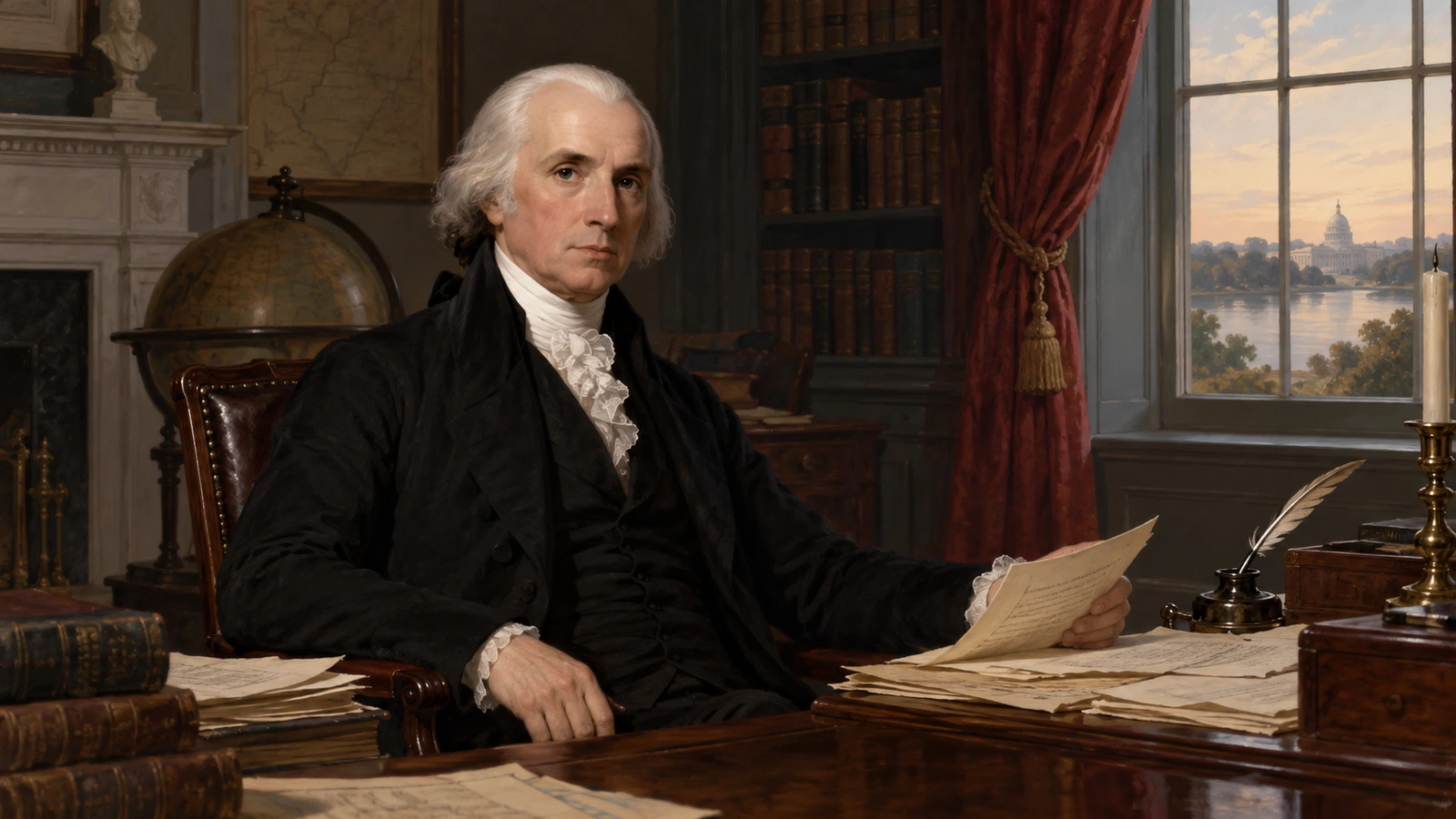
James Madison may have been the smallest president in American history, but his political and intellectual footprint remains unmatched. As the primary author of the U.S. Constitution and the Bill of Rights, Madison shaped the core foundation of modern democracy. From fleeing a burning White House during the War of 1812 to surviving enemy fire on the battlefront and keeping daily climate logs, his life was full of surprising achievements. Uncover 15 fascinating facts about the visionary Father of the Constitution.
1. He Remains the Smallest President in American History
Standing at just five feet four inches tall and weighing barely one hundred pounds, James Madison holds the record as the physically smallest chief executive in United States history. Political rivals frequently made light of his diminutive stature, with one contemporary describing him as little more than a withered little apple-john. Despite his frail physical appearance, Madison possessed an intellectual presence that intimidated even his fiercest political opponents. He relied on sharp logic, exhaustive preparation, and masterful debate tactics rather than booming theatricality to dominate legislative battles. His towering contributions to the nation's founding proved that presidential greatness has nothing to do with physical height.
2. He Drafted the Bill of Rights Despite Initial Hesitation
Although history remembers James Madison as the primary architect of the Bill of Rights, he initially believed a separate list of rights was entirely unnecessary. Madison originally argued that the Constitution's built-in separation of powers provided sufficient protection against federal overreach. However, when anti-Federalist opposition threatened to derail the ratification of the Constitution, Madison shrewdly adapted his stance to secure the nation's future. He carefully sifted through hundreds of proposed constitutional amendments and drafted the first ten himself to safeguard individual freedoms like speech and religion. His pragmatism transformed what he once considered a political redundancy into the foundational cornerstone of American civil liberties.
3. He Suffered from Neurological Attacks and Chronic Ill Health
Throughout his long life, Madison struggled with severe health problems characterized by sudden attacks that closely resembled modern epileptic seizures. He described these frightening episodes as sudden attacks that left him feeling physically incapacitated and suffering from chronic exhaustion. Modern medical historians speculate that these ailments may have been stress-induced non-epileptic seizures or a manifestation of severe hypochondria. The intense physical strain of his political work frequently forced him to take prolonged leaves of absence to recover his strength. Despite living under the shadow of poor health for over eight decades, Madison maintained an astonishing work ethic that outlasted almost all his peers.
4. He Popularized Trousers over Aristocratic European Fashions
James Madison was the first U.S. president to regularly wear long trousers instead of traditional knee breeches and silk stockings. This subtle wardrobe choice represented a conscious symbolic departure from old European aristocratic styles toward a modern republican identity. Madison preferred modest black suits that mirrored his austere, intellectual personality rather than the flashy garments favored by wealthy elites. His practical fashion sense set a precedent for future American leaders seeking to project an image of democratic simplicity. Historians view his wardrobe shift as an early example of modern political branding in the young republic.
5. British Soldiers Ate His Dinner Before Burning the Executive Mansion
During the War of 1812, British forces invaded Washington, D.C., forcing President Madison to flee into the surrounding countryside. When enemy troops swept into the President's House in August 1814, they discovered a forty-person dinner feast sitting freshly prepared on the dining table. British officers gleefully devoured Madison's food and toasted his downfall before setting the entire mansion ablaze. The invasion marked the only time since the American Revolution that a foreign power occupied the nation's capital. Madison spent several tense days in exile organizing the government's retreat and planning the city's eventual defense.
6. First Lady Dolley Madison Saved a Famous Portrait of Washington
As British troops approached Washington, First Lady Dolley Madison refused to abandon the President's House without rescuing precious national treasures. She famously ordered servants to unscrew and cut Gilbert Stuart's iconic full-length portrait of George Washington from its heavy gilded frame. Dolley packed the canvas safely away in a wagon along with crucial executive cabinet documents just minutes before enemy forces arrived. Her quick thinking and heroic courage under pressure preserved an irreplaceable piece of American heritage from destruction. The daring rescue cemented Dolley's status as one of the most beloved and heroic First Ladies in American history.
 US Presidents
Discover the eccentricities, secret talents, and surprising hidden lives of America's most influential presidents, from frontier wrestlers to covert strategists.
See All Facts
US Presidents
Discover the eccentricities, secret talents, and surprising hidden lives of America's most influential presidents, from frontier wrestlers to covert strategists.
See All Facts
7. He Co-Authored the Federalist Papers Under a Pseudonym
To convince reluctant states to ratify the new Constitution, Madison teamed up with Alexander Hamilton and John Jay to write a set of persuasive essays. The trio published eighty-five articles under the collective pen name Publius, honoring a statesman of the early Roman Republic. Madison wrote twenty-nine of the essays, including the famous Federalist No. 10 and Federalist No. 51 on checks and balances. These papers remain the supreme authoritative commentary on the intended meaning and structure of the U.S. Constitution. Scholars still study Madison's political philosophy within the Federalist Papers to resolve complex constitutional disputes today.
8. He Was the Only Sitting President to Come Under Direct Enemy Fire
At the tragic Battle of Bladensburg in 1814, Madison became the only sitting commander-in-chief to ride onto an active battlefield. Driven by desperation to inspect American defensive lines, he inadvertently rode dangerously close to advancing British lines. As enemy artillery shells exploded nearby, Madison narrowly escaped death or capture when the militia broke in complete disarray. His presence on the battlefield demonstrated extraordinary personal bravery, even as the military operation ended in disaster. No sitting president before or since has ever been positioned so directly in the line of combat fire.
9. He Maintained a Legendary Fifty-Year Friendship with Thomas Jefferson
James Madison and Thomas Jefferson shared one of the most productive political partnerships and deep personal friendships in world history. Over a span of five decades, the two Virginian statesmen exchanged thousands of letters discussing political theory, botany, and literature. They frequently visited each other's nearby estates at Monticello and Montpelier to experiment with modern agricultural techniques. Together, they founded the Democratic-Republican Party and created the University of Virginia to foster enlightened higher education. When Jefferson died in 1826, Madison mourned the loss of the man he considered his closest intellectual soulmate.
10. He Outlived Every Other Signer of the U.S. Constitution
Living to the ripe age of eighty-five, Madison became the final surviving member of the Constitutional Convention of 1787. As the last living Founding Father, he was widely regarded as a sacred national treasure by mid-nineteenth-century Americans. In his quiet final years at Montpelier, he meticulously edited his detailed private notes from the Constitutional Convention for posterity. His decision to withhold his notes until after his death ensured that the historical record remained unclouded by political feuds. When he passed away in 1836, the era of the American Constitutional founders officially came to its final end.
11. His Face Once Gracefully Adorned the $5,000 Bill
Although few people ever saw one in circulation, James Madison was chosen to feature on the U.S. five thousand dollar bill. The federal government issued these high-denomination bills primarily for large-scale financial transactions between banking institutions. Madison was selected for the note in recognition of his financial acuity and role in structuring the nation's economic framework. Printing of the $5,000 bill officially ceased in 1945, and the Treasury discontinued high-denomination bills entirely by 1969. Today, surviving specimens of Madison's $5,000 note are prized collector items that command astronomical prices at currency auctions.
12. He Graduated College in Just Two Years and Broke His Health
In 1769, young Madison enrolled at the College of New Jersey, which later became Princeton University, to study classical philosophy and law. Driven by intense academic ambition, he completed the rigorous four-year degree curriculum in a staggering two years. He routinely slept only three or four hours a night while mastering Latin, Greek, Hebrew, and political philosophy. This punishing schedule severely undermined his delicate physical constitution and triggered a nervous breakdown upon graduation. He spent the following year recovering at home, uncertain whether his health would ever allow him to enter public life.
13. He Kept Detailed Scientific Journals Tracking Daily Weather
Beyond his passion for statecraft, Madison harbored a deep lifelong obsession with natural science and meteorology. For decades, he recorded detailed observations regarding local temperature, rainfall, wind direction, and seasonal plant growth every single day. He believed that meticulous environmental data collection was vital for improving American agriculture and ensuring national food security. His systematic records provided valuable historical climate data that modern environmental scientists still consult today. This scientific mindset reflected the Enlightenment conviction that reason and empirical data could solve practical human problems.
14. He Was an Extremely Quiet and Soft-Spoken Orator
Unlike many grandiloquent politicians of his era, Madison spoke in a remarkably quiet, thin, and raspy voice. During the heated debates of the Constitutional Convention, delegates frequently had to lean forward or change seats just to hear him speak. He suffered from severe stage fright early in his career and explicitly disliked large public gatherings and noisy political rallies. Despite his soft delivery, his arguments were so logically airtight that listeners remained completely captivated by his intellect. He demonstrated that compelling ideas and brilliant scholarship could overpower dramatic public grandstanding.
15. He Died Peacefully at Montpelier with a Famous Witty Remark
On the morning of June 28, 1836, Madison was sitting down to breakfast at his beloved Virginia plantation, Montpelier. When his niece noticed he was having trouble swallowing and expressed concern, Madison calmly delivered his final witty remark. He famously replied, "Nothing more than a change in my mind, my dear," before passing away peacefully in his chair. Another famous tradition recorded his dry humor near his deathbed, where he remarked, "I always talk better lying down." He died as he lived—surrounded by his beloved books, family, and a quiet commitment to reason and peace.
Sources & References
This AI-assisted post was rigorously curated and fact-checked for accuracy by:
 Martin Roháček
How fun was this article? 🤔
Tap a star to rate it
🧠 Quiz: How closely were you paying attention?
10 questions — all answers are in the article above!
Enjoyed these facts? There's more! 💌
Fresh fun facts in your inbox. No spam, ever.