The Master Harmonist: 15 Fascinating Facts About Johann Sebastian Bach
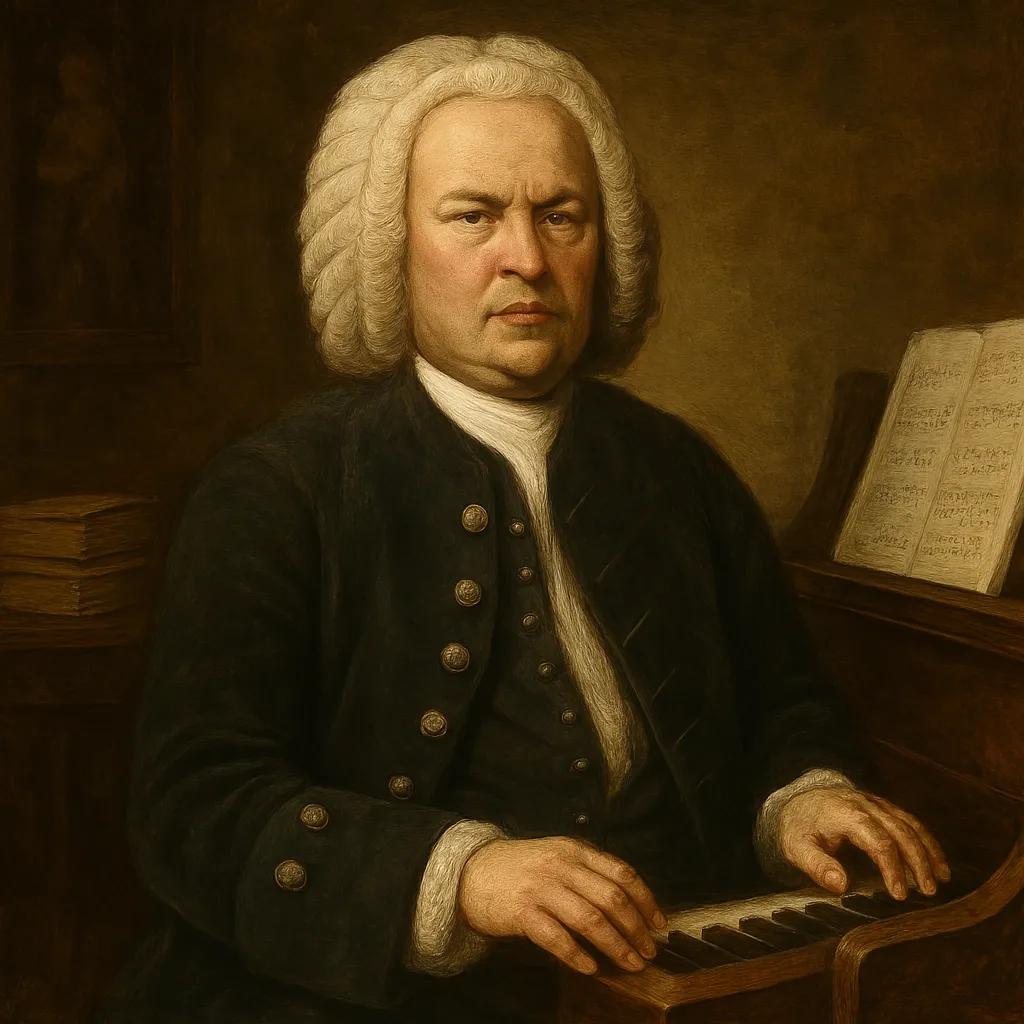
Johann Sebastian Bach is widely considered the ultimate master of Western classical music, whose death in 1750 formally closed the Baroque era. Yet during his lifetime, he was known primarily as a stubborn organist and court musician rather than a titan of composition. From walking hundreds of miles on foot to hear his musical idol to spending weeks in prison for attempting to quit his job, Bach lived a life as dramatic and intense as his fugues. Discover fifteen incredible facts about the composer who turned mathematical symmetry into sublime spiritual art.
1. The 250-Mile Walk to Hear an Organ Legend
Johann Sebastian Bach possessed an obsessive devotion to his craft that was evident even in his youth. In 1705, while working as a 20-year-old organist in Arnstadt, he requested a four-week leave of absence to travel to Lübeck to hear the legendary organist Dieterich Buxtehude. Bach ended up walking over 250 miles on foot across northern Germany just to witness Buxtehude perform at the Marienkirche. Intoxicated by Buxtehude’s improvisational virtuosity, Bach stayed in Lübeck for four months instead of four weeks, severely overstaying his approved leave. This audacious journey deeply transformed Bach's musical style, introducing dramatic counterpoint and rich ornamentation into his own work. When he finally returned to Arnstadt, his employer was furious about his prolonged absence, but music history was forever altered.
2. A Massive Family of Musically Gifted Children
Bach fathered an astounding twenty children across two marriages, first to his second cousin Maria Barbara Bach and later to Anna Magdalena Wilcke. Although only ten of his children survived to adulthood due to the high infant mortality rates of the 18th century, several became renowned figures in music history themselves. Sons like Carl Philipp Emanuel Bach and Johann Christian Bach actually achieved greater fame during their own lifetimes than their father did. Johann Christian Bach even moved to London and profoundly influenced a young Wolfgang Amadeus Mozart. Music was truly the family business, with household life revolving around copywork, rehearsal, and instrument maintenance.
3. Imprisoned for Trying to Quit His Job
In 1717, Bach learned the hard way that feudal employers did not react kindly to unapproved resignations. Serving as concertmaster for Duke Wilhelm Ernst of Saxe-Weimar, Bach grew frustrated after being passed over for the position of court Kapellmeister. When the Prince of Anhalt-Köthen offered him a superior role, Bach demanded his immediate release from the Duke’s service. Offended by Bach's stubborn insistence, the Duke ordered the composer arrested and held in a Weimar county jail for nearly four weeks. Undeterred by imprisonment, Bach spent his time in jail productively, writing parts of his famous keyboard collection, The Well-Tempered Clavier.
4. Famous as an Organist, Overlooked as a Composer
During his lifetime, Bach was not recognized as the monumental genius of Western composition that we consider him today. Instead, contemporaries revered him primarily as an extraordinary organ virtuoso, tester of instruments, and master of improvisation. His intricate compositions were often criticized by contemporaries like Johann Adolph Scheibe as being overly complex, artificial, and old-fashioned compared to the emerging galant style. When the Leipzig Town Council hired Bach as Thomaskantor in 1723, he was actually their third choice after Georg Philipp Telemann and Christoph Graupner turned down the offer. It took nearly a century after his death for the music world to appreciate the true depth of his compositional achievements.
5. Mathematical Genius and Musical Cryptography
Bach possessed a deep fascination with numerical patterns, symmetry, and musical cryptography, often embedding hidden codes into his scores. He frequently used the note sequence B-A-C-H (which translates in German musical nomenclature to B-flat, A, C, and B-natural) as a musical signature across various compositions. In masterpieces like The Musical Offering and The Art of Fugue, he constructed complex crab canons that could be played backward, upside down, or simultaneously flipped. Some scholars argue that Bach used gematria—assigning numerical values to letters—to encode his own name and sacred symbolism into bar counts and theme structures. This mathematical perfection has led modern scientists and mathematicians to revere Bach as much as musicians do.
6. Revolutionizing Keyboard Tuning for the Western World
Before the publication of Bach's The Well-Tempered Clavier, keyboard instruments were tuned in ways that made playing in certain key signatures sound hopelessly out of tune. Bach championed a modern system known as well temperament, which adjusted the ratios between notes so that all twenty-four major and minor keys were pleasantly playable. To prove the practical genius of this system, Bach composed two complete sets of 24 preludes and fugues—one in every major and minor key. This monumental work effectively unlocked the full tonal range of keyboard instruments, paving the way for future classical composers. Today, The Well-Tempered Clavier remains an essential pillar of Western classical music education.
7. A Relentless Weekly Output of Sacred Cantatas
When Bach assumed the role of Thomaskantor in Leipzig in 1723, his official duty required him to write a new cantata for every Sunday and feast day of the Lutheran church calendar. Bach maintained this staggering pace for several consecutive years, composing, copying parts, and rehearsing a complete 20-minute sacred work each week. In total, he composed around 300 church cantatas across five annual cycles, of which roughly 200 have survived to the present day. Modern composers find this sheer volume and speed of high-quality production almost unimaginable. Each cantata featured complex choral movements, intricate recitatives, and expressive arias written for modest forces of boy singers and local musicians.
8. The Infamous Street Brawl with a Student
Bach was known to have a fiery temperament, especially when dealing with poor musicianship or disrespectful students. In 1705, while working in Arnstadt, he clashed with a bassoon player named Johann Heinrich Geyersbach, whom Bach had publicly insulted by calling him a "zippel-fagottist" (a nanny-goat bassoonist). Outraged by the insult, Geyersbach attacked Bach with a walking stick in the town square while Bach was returning home at night. Bach immediately drew his dagger to defend himself, leading to a violent brawl until bystanders separated the two men. When brought before the church council, Bach refused to apologize, arguing that he had every right to criticize incompetent performance.
9. Dedications Signed "To God Alone the Glory"
Despite his enormous intellect and secular job disputes, Bach viewed his musical talent as a divine duty dedicated entirely to his Lutheran faith. At the end of almost all his sacred compositions—and even many secular pieces—he penned the initials S.D.G., standing for Soli Deo Gloria ("To God Alone the Glory"). At the beginning of many manuscripts, he would write J.J. for Jesu Juva ("Jesus, help"). For Bach, the boundary between sacred and secular music was fluid, believing that all music was meant to refresh the spirit and praise God. He famously stated that where devotional music is performed, God is always present with His grace.
10. Beethoven Called Him the "Original Father of Harmony"
Ludwig van Beethoven was a passionate admirer of Bach, studying The Well-Tempered Clavier intensively from a young age. Beethoven famously played on Bach's name using a German pun, declaring: "Nicht Bach, sondern Meer sollte er heißen"—meaning "Not a brook [Bach], but an ocean should he be called." Beethoven also referred to the Baroque master as the original father of harmony, acknowledging how much 19th-century romanticism owed to Bach's foundational structures. Later composers like Johannes Brahms and Frédéric Chopin similarly kept Bach’s scores on their pianos as the ultimate masterclasses in counterpoint and form.
11. The Unperformed Masterpiece: Mass in B Minor
Bach spent his final years assembling the Mass in B Minor, universally regarded today as one of the supreme monuments of human artistic creation. Paradoxically, this grandiose Latin Mass was never performed in its entirety during Bach's lifetime, largely because its monumental scale exceeded the practical requirements of both Lutheran and Catholic church services of the era. Bach created it by compiling, revising, and expanding movements he had composed over several decades, treating the work as a definitive legacy of his life's output. The complete work was not performed publicly until 1859, more than a century after Bach died. Today, it is revered as a monumental synthesis of sacred music styles spanning centuries.
12. Late-Life Blindness and a Botched Eye Surgery
In his final years, Bach's eyesight severely deteriorated due to cataracts, rendering him virtually blind while trying to complete his last works. Desperate for a remedy, Bach submitted to two eye surgeries in 1750 performed by John Taylor, a flamboyant English itinerant eye surgeon who was essentially a charlatan. The crude procedures failed completely, leaving Bach totally blind and causing severe post-operative infections that shattered his overall health. Despite his blindness and failing body, Bach dictated his final choral prelude, Vor deinen Thron tret ich hiermit ("Before Your Throne I Now Appear"), from his deathbed. Taylor later operated on George Frideric Handel with similarly disastrous results.
13. Master of Recycling and Musical Repurposing
Bach was an extraordinarily practical composer who frequently recycled, rearranged, and adapted his own compositions through a process known as parody. Rather than writing every piece entirely from scratch, he often transformed secular cantatas into sacred works by altering the text and tweaking the instrumentation. For instance, several movements of his beloved Christmas Oratorio were adapted directly from secular pieces written to celebrate royal birthdays and anniversaries. Far from being lazy, this practice reflected the Baroque mentality that good musical material was a resource to be perfected and reused in different contexts.
14. Mendelssohn and the Great 19th-Century Rediscovery
After Bach died in 1750, his music fell into relative obscurity, studied mostly by connoisseurs and keyboard teachers rather than performed for the general public. That changed dramatically in 1829 when a 20-year-old Felix Mendelssohn organized and conducted a historic performance of Bach’s St. Matthew Passion in Berlin. Mendelssohn’s revival sparked an overwhelming wave of public enthusiasm that rescued Bach's vast catalog from archival dust. This performance ignited the 19th-century Bach Revival, leading to the formation of the Bach-Gesellschaft, which set out to publish the composer's complete works for the first time.
15. His Death Marked the End of the Baroque Era
Johann Sebastian Bach passed away on July 28, 1750, in Leipzig, following a stroke complicated by his failed eye operations. Music historians routinely use the exact year of Bach's death, 1750, as the formal end date of the Baroque era in music history. With his passing, the intricate polyphonic and contrapuntal style he had perfected gave way completely to the lighter, homophonic Classical style championed by composers like Joseph Haydn and W.A. Mozart. Today, Bach is universally acknowledged as one of the greatest creative minds in human history, whose works continue to define the boundaries of musical artistry.
Sources & References
This AI-assisted post was rigorously curated and fact-checked for accuracy by:
 Martin Roháček
How fun was this article? 🤔
Tap a star to rate it
🧠 Quiz: How closely were you paying attention?
10 questions — all answers are in the article above!
Enjoyed these facts? There's more! 💌
Fresh fun facts in your inbox. No spam, ever.