
The Reluctant Master: 15 Fascinating Facts About Johannes Brahms
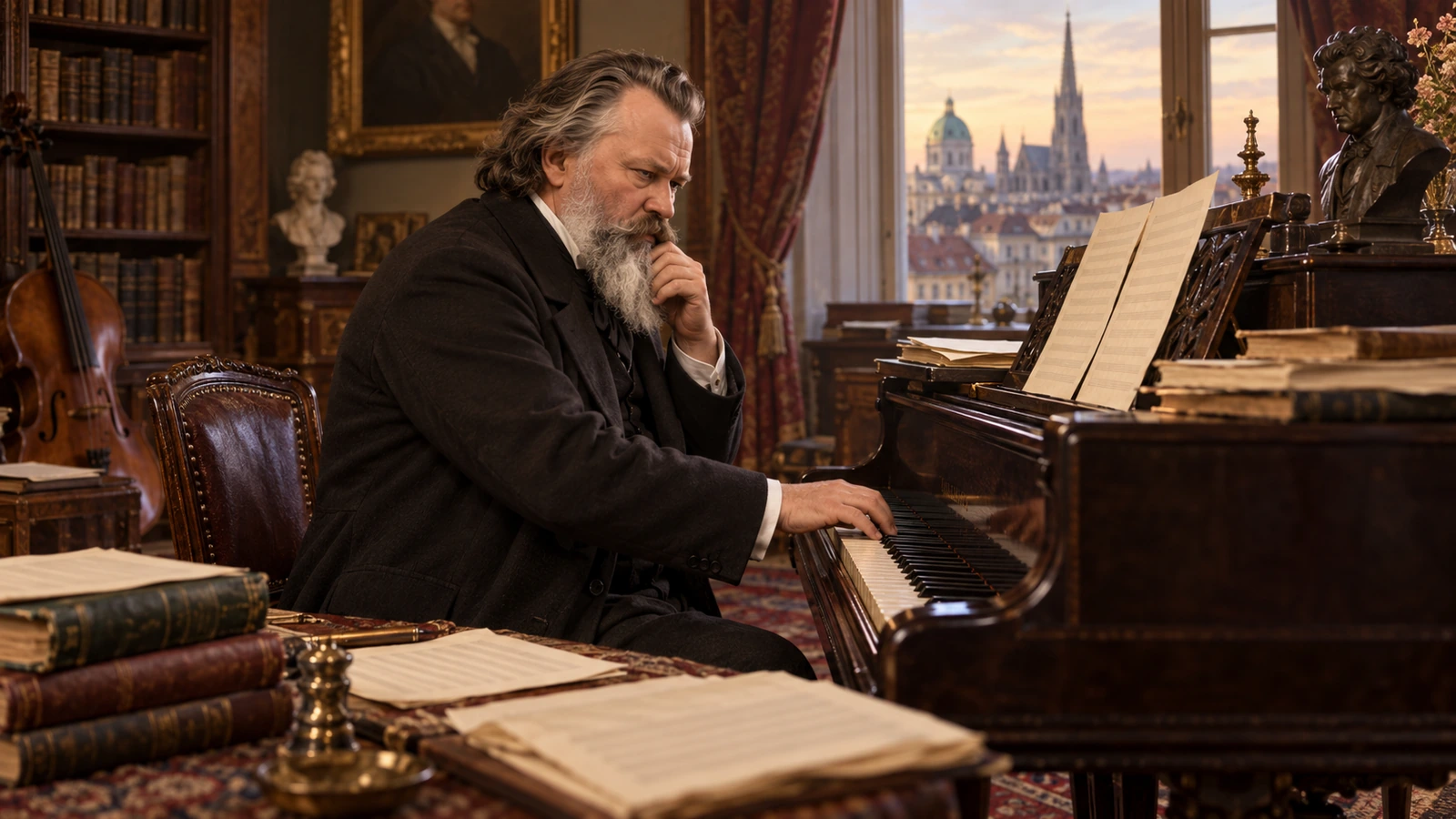
Johannes Brahms stands as one of the titanic figures of Romantic music, revered alongside Bach and Beethoven as one of history's ultimate musical masters. Yet behind his formidable reputation as a stern, bearded craftsman lies a deeply complex man of profound insecurities, fierce loyalty, and secret generosity. From his early years playing piano in Hamburg taverns to his agonizing twenty-year struggle to complete his first symphony, Brahms's life was defined by obsessive perfectionism and artistic integrity. Discover the fascinating truths behind the legendary composer's world-famous lullaby, his sharp wit, and his enduring passions.
1. The Myth and Reality of His Teenage Tavern Gigs
As a teenager in Hamburg, Johannes Brahms earned money for his struggling family by playing piano in local dance halls and harbor taverns known as Lokale. Early biographers dramatically claimed he played in notorious brothels late into the night, but modern scholars believe these accounts were somewhat exaggerated to create a tragic romantic narrative. Nevertheless, the young musician was exposed to a raw, rowdy environment that introduced him to popular melodies, dance rhythms, and folk music. Playing for hours in loud, smoke-filled rooms sharpened his sight-reading abilities and improvisational skills under demanding conditions. This grueling early work instilled a lifelong work ethic and a deep appreciation for accessible, popular musical forms.
2. The 20-Year Shadow of Beethoven's First Symphony
Brahms spent more than twenty years revising and agonizing over his First Symphony before finally allowing it to be premiered in 1876. He felt immense pressure living in the shadow of Ludwig van Beethoven, famously declaring that hearing the giant marching behind him made composing symphonies daunting. When conductor Hans von Bülow famously dubbed the work "Beethoven's Tenth Symphony," Brahms was less than thrilled, disliking any direct comparison. The symphony features a main theme in the final movement that deliberately echoes Beethoven's Ninth, serving as both an homage and a declaration of mastery. The triumph of this piece finally cemented Brahms's reputation as a worthy successor to the great classical masters.
3. The Complex Bond with Clara Schumann
In 1853, a 20-year-old Brahms visited the home of composer Robert Schumann and his pianist wife, Clara, initiating one of music history's most compelling relationships. Robert immediately hailed the young prodigy as a genius in a famous journal article, and the Schumann household became Brahms's artistic home. Following Robert's mental breakdown and eventual death in an asylum, Brahms moved close to Clara to help manage her family and household. While their correspondence reveals intense emotional devotion and affection, Brahms never married Clara, and the exact physical nature of their relationship remains debated. Their deep friendship endured for over four decades until Clara's death in 1896, which left Brahms emotionally shattered just a year before his own passing.
4. The Ruthless Destruction of His Own Compositions
Brahms was an unrelenting perfectionist who routinely destroyed any music he felt did not meet his exacting standards. He reportedly tore up or burned twenty completed string quartets before publishing his official First String Quartet in C minor. Early sonatas, choral pieces, and sketches went up in flames or were thrown into rivers throughout his career. He believed that publication was a permanent record that must withstand the test of time alongside history's greatest masters. As a result of this extreme self-criticism, only works of exceptionally high craftsmanship survived his rigorous self-editing process.
5. A Secretly Generous Hermit
Outwardly, Brahms cultivated a gruff, abrasive persona, dressed in worn-out clothing, and lived in a surprisingly simple Viennese apartment. Behind this crusty exterior, however, he was extraordinarily generous with his wealth once his compositions made him financially secure. He routinely sent substantial sums of money anonymously to struggling young musicians, relatives, and friends without asking for acknowledgment. When his publisher Antonín Dvořák was an impoverished young composer, Brahms championed his work and provided crucial financial backing. He quietly paid for medical treatments, music lessons, and living expenses for dozens of people while keeping his own lifestyle frugal.
6. The True Origin of His World-Famous Lullaby
Brahms's "Wiegenlied" (Opus 49, No. 4), globally recognized today as "Brahms' Lullaby," was composed in 1868 for a very personal occasion. He wrote the soothing song to celebrate the birth of the second son of his close friend, Bertha Faber. Brahms hid a subtle romantic memory inside the music by embedding a counter-melody based on a Viennese folk song Bertha used to sing to him years earlier. Though it became one of the most profitable and ubiquitous tunes in human history, Brahms earned relatively little directly from its widespread commercial printings. Today, its gentle melody remains the universal soundtrack for lulling infants to sleep across the globe.
7. The Late-Life Transformation of His Iconic Beard
The image most people associate with Brahms—a stocky man with a long, bushy beard and broad shoulders—was actually a late transformation. For the first four decades of his life, Brahms was clean-shaven, slender, and possessed a surprisingly high-pitched voice. He decided to grow his famous beard in 1878 at age 45, partially to avoid being mistaken for a younger, inexperienced musician. When he arrived in Vienna with his new facial hair, even close friends like Clara Schumann failed to recognize him at first. The full beard gave him the venerable, majestic appearance of an Old Testament patriarch, matching his elder statesman status in German music.
8. Composing on Long Walks in Nature
Brahms rarely composed while sitting at a piano; instead, his creative process relied heavily on long, solitary walks through forests and mountains. He carried small notebooks and pencils everywhere he went, scribbling down themes and counterpoint ideas while trekking through the Austrian countryside. Summer retreats to scenic towns like Bad Ischl, Lichtenthal, and Pörtschach provided the tranquil backdrops for many of his greatest masterpieces. Local residents frequently spotted the composer walking rapidly with his hands clasped behind his back, humming loudly and swinging his walking stick. Nature provided both the physical rhythm for his phrasing and the emotional solace he needed to compose.
9. The Hungarian Connection and Legal Feuds
Throughout his career, Brahms held a deep passion for Hungarian and Romani folk traditions, which inspired his wildly successful Hungarian Dances. Originally published as piano duets, these twenty-one energetic pieces brought Brahms immense international fame and financial prosperity. However, their immense success also triggered intense controversies and accusations of plagiarism from Hungarian musicians who claimed he stole traditional melodies. Brahms successfully defended himself by pointing out that he had published the works as arrangements rather than original compositions. These fiery pieces helped bridge the gap between high art concert hall music and popular urban entertainment.
10. A Notorious and Sarcastic Wit
Beneath his serious artistic reputation, Brahms possessed a biting, irreverent sense of humor that often made his social circle cringe. He was famous for delivering blunt, sarcastic retorts at high-society gatherings where he felt uncomfortable or bored. On one legendary occasion, upon leaving a Vienna salon, he famously turned to the room and remarked, "If there is anyone here whom I have not insulted, I beg his pardon." He loved practical jokes, often teasing his colleagues with absurd musical riddles or fake manuscripts. This thorny humor served as a protective armor, keeping overly adoring fans and intrusive journalists at a safe distance.
11. The Lifelong Friendship and Feud with Joseph Joachim
Virtuoso violinist Joseph Joachim was one of Brahms's closest artistic collaborators, premiering his Violin Concerto and offering vital technical advice. Their intense creative partnership spanned decades, shaping some of the most famous violin literature in the classical canon. However, their relationship suffered a devastating fracture when Joachim filed for divorce from his wife, accusing her of infidelity. Brahms believed the wife was innocent and wrote her a long letter of support, which she subsequently presented in court as evidence. Enraged by Brahms's intervention, Joachim refused to speak to him for years until Brahms composed the Double Concerto as a peace offering.
12. A Requiem for Humanity, Not the Church
Brahms's masterwork A German Requiem (Ein deutsches Requiem) broke radically from traditional Catholic funeral masses of the 19th century. Instead of using the standard Latin liturgical text focused on judgment and damnation, Brahms selected his own passages from the German Luther Bible. Composed following the tragic death of his mother and the earlier suicide attempt of Robert Schumann, the work focuses entirely on comforting the living. Brahms explicitly stated that he would have happily named it "A Human Requiem" because its message was meant for all people regardless of religious dogma. The work's premiere in 1868 established him as one of Europe's premier choral composers.
13. The Irreverent Academic Festival Overture
In 1879, the University of Wrocław awarded Brahms an honorary doctorate, assuming the serious composer would acknowledge the honor with a dignified piece of sacred music. Brahms initially sent a simple postcard of thanks, but when informed that custom required a musical homage, he decided to have some fun. He composed the Academic Festival Overture, a boisterous orchestral work cleverly woven from popular college drinking songs. The piece featured rowdy student anthems like "Gaudeamus Igitur," delighting the student body while shocking some of the formal faculty members. It remains one of his most frequently performed and joyful orchestral works.
14. Coffee Obsession and 5 AM Rituals
Brahms was an uncompromising coffee snob who refused to let anyone else prepare his morning brew. Every morning, winter or summer, he rose precisely at 5:00 AM to make his own coffee using a specialized machine he imported from Vienna. He insisted on using extremely strong, freshly ground coffee beans and drank it pitch black while contemplating his early morning thoughts. Friends who stayed with him reported that the aroma of his dark roast filled the apartment long before sunrise. This caffeine-fueled morning routine provided the quiet prelude to his daily composing and editing sessions.
15. A Giant's Resting Place in Vienna
Johannes Brahms passed away on April 3, 1897, at the age of 63, likely from pancreatic or liver cancer, the same disease that killed his father. His death sparked widespread mourning across Europe, with flags flown at half-mast on ships in his hometown harbor of Hamburg. He was buried in Vienna's famous Zentralfriedhof (Central Cemetery), just a short walk from the graves of Ludwig van Beethoven and Franz Schubert. Today, his monument stands alongside those of the classical titans he spent his early career fearing he could never match. His legacy endures as one of the "Three Bs" of classical music—alongside Bach and Beethoven.
Sources & References
This AI-assisted post was rigorously curated and fact-checked for accuracy by:
 Martin Roháček
How fun was this article? 🤔
Tap a star to rate it
🧠 Quiz: How closely were you paying attention?
10 questions — all answers are in the article above!
Enjoyed these facts? There's more! 💌
Fresh fun facts in your inbox. No spam, ever.