
The Celestial Mathematician: 15 Fascinating Facts About Johannes Kepler
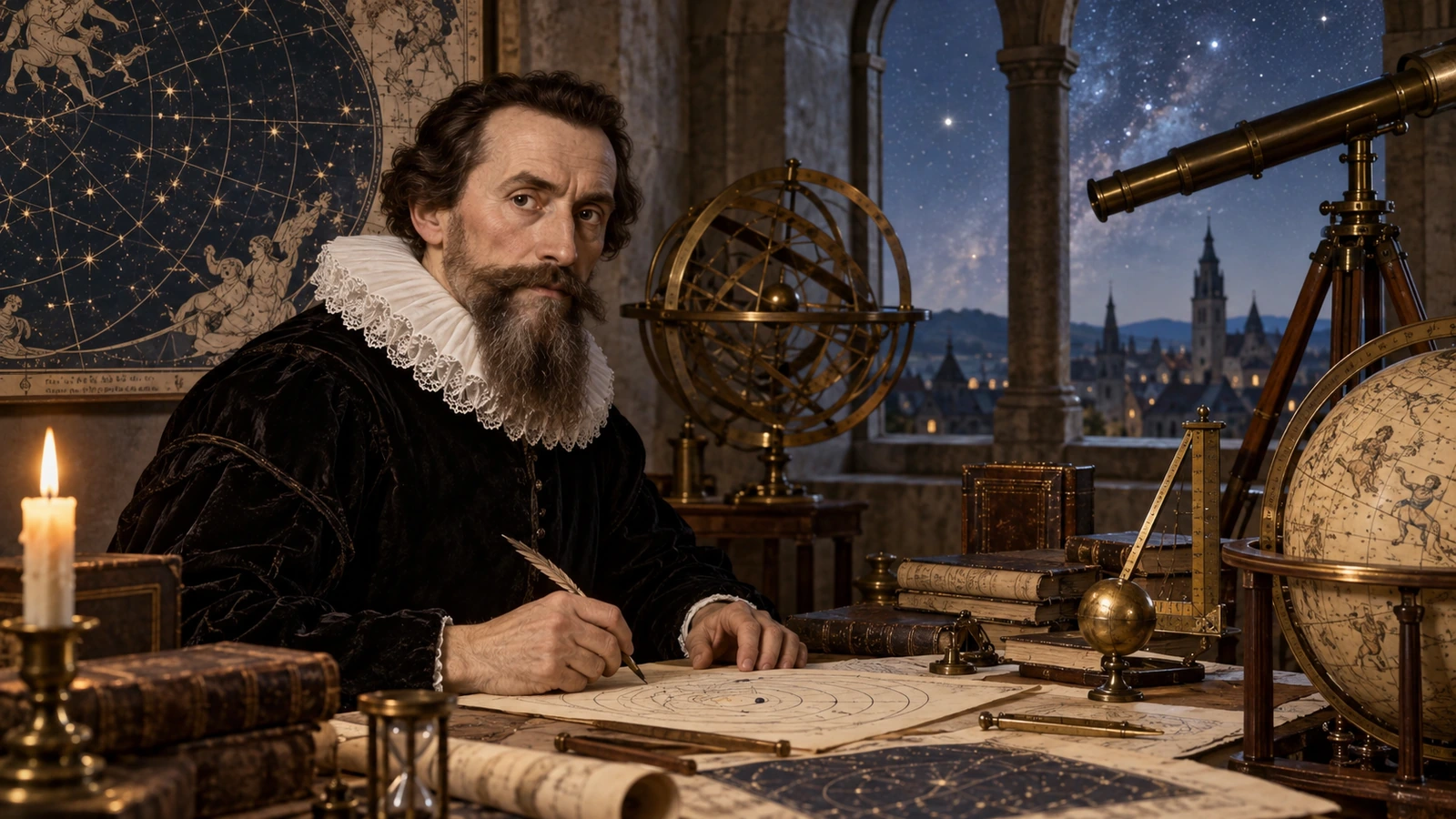
Long before modern computers or optical satellites, Johannes Kepler unlocked the true mathematical order of the cosmos. By shattering two thousand years of dogmatic belief in circular planetary orbits, Kepler paved the way for Sir Isaac Newton and modern astrophysics. From writing the first true science fiction novel and defending his mother in a notorious witchcraft trial to explaining how the human eye focuses light, his life was as dramatic as it was visionary. Here are 15 fascinating facts about the extraordinary mathematician who decoded the laws of planetary motion.
1. He Originally Trained to Be a Lutheran Minister
Long before revolutionizing astronomy, Johannes Kepler was on track to enter the clergy. He studied theology, Greek, and Hebrew at the University of Tübingen, showing an early genius for mathematics alongside his theological studies. However, when the Protestant University of Graz needed a mathematics teacher in 1594, his professors recommended Kepler for the position. Taking this academic role redirected his life away from the pulpit and directly into professional science. Despite leaving formal ministry behind, Kepler retained a deeply spiritual worldview, seeing his mathematical work as a way to glorify the divine.
2. He Discovered Planetary Laws Without Ever Using a Telescope
It is a common misconception that Kepler’s groundbreaking discoveries were made by peering through powerful telescopes. In reality, Kepler published his first two laws of planetary motion in 1609, before he had regular access to an astronomical telescope. He relied entirely on tedious, manual calculations using ink, paper, and observational data collected by the naked eye. It took him nearly a decade of painstaking arithmetic to untangle the orbit of Mars. His sheer mathematical endurance accomplished what centuries of visual stargazing had failed to achieve.
3. He Believed the Universe Was Built Around Geometric Solids
Kepler was convinced that the universe was constructed according to precise geometric principles. In his early 1596 treatise, Mysterium Cosmographicum, he proposed that the distances of the six known planets from the Sun were defined by nesting the five regular Platonic solids inside celestial spheres. Though this model ultimately proved physical nonsense, it represented a revolutionary attempt to find unifying mathematical physical laws behind planetary orbits. Kepler never completely abandoned his fascination with geometric harmony, which later inspired his third law of planetary motion.
4. He Wrote What Is Considered the First Science Fiction Novel
Among his scientific papers, Kepler penned a narrative titled Somnium ("The Dream"), written around 1608 and published posthumously in 1634. The story describes an Icelandic boy and his mother who travel to the Moon named Levania with the help of supernatural spirits. It details how the Earth would look from the lunar surface and speculates on how lunar inhabitants would adapt to extreme biweekly day-and-night cycles. Luminaries like Carl Sagan and Isaac Asimov cited Somnium as the very first work of hard science fiction, as it used real physics and astronomical theory to frame space travel.
5. He Earned His Living as an Imperial Astrologer
While Kepler is remembered today as a founding father of modern astronomy, he made much of his income practicing astrology. As the Imperial Mathematician to Holy Roman Emperors Rudolph II, Matthias, and Ferdinand II, he was routinely required to cast horoscopes for high nobility. Kepler held a complex view of astrology, rejecting superstitious fortune-telling while believing celestial alignments subtly influenced earthly weather and human temperaments. He famously quipped that astrology was the foolish daughter of astronomy who helped keep her wise mother from starving.
6. Poor Health and Vision Loss Hampered His Personal Observations
Irony shadowed Kepler's life, as the man who decoded the mechanics of visual perception and planetary motion suffered from severe visual impairments. A childhood bout of smallpox left him with crippled hands and permanently damaged eyesight, resulting in myopia and multiple vision. He could not perform precise astronomical observations with his own eyes due to blurriness and ghost images. Instead, he relied on his phenomenal mathematical intellect to process data collected by other astronomers with far better eyesight.
 Scientists and Inventors Who Changed the World
Twenty-three scientists and inventors, from Archimedes to Stephen Hawking, with the surprising habits, failures and discoveries behind their fame.
See All Facts
Scientists and Inventors Who Changed the World
Twenty-three scientists and inventors, from Archimedes to Stephen Hawking, with the surprising habits, failures and discoveries behind their fame.
See All Facts
7. He Saved His Mother from Being Burned as a Witch
In 1615, Kepler’s elderly mother, Katharina, was accused of witchcraft by neighbors in their hometown of Leonberg amid a wave of witch-hunt hysteria. She was accused of brewing dark potions, causing mysterious illnesses, and riding enchanted goats. Kepler suspended his scientific research for years to write a rigorous, 128-page legal defense grounded in logic and medical science. Katharina spent fourteen months chained in a stone prison, but Kepler’s brilliant legal defense ultimately secured her full acquittal in 1621.
8. He Shattered Two Thousand Years of Perfect Circles
Since the time of Aristotle and Ptolemy, astronomers insisted that celestial bodies moved in perfect, uniform circles. Kepler spent years trying to fit Tycho Brahe’s observations of Mars into circular models, but noticed a tiny discrepancy of eight arcminutes that could not be ignored. Refusing to dismiss this small error, Kepler abandoned circular orbits and realized that planets move in ellipses with the Sun at one focus. This radical discovery, known as Kepler’s First Law, overturned two millennia of dogma and laid the foundation for modern orbital mechanics.
9. He Inherited Data After a Bitter Feud with Tycho Brahe
Kepler’s breakthroughs were made possible by data collected by Tycho Brahe, a wealthy Danish nobleman famous for his eccentric life and silver-copper prosthetic nose lost in a duel. Brahe possessed the world’s most accurate observational records, but was deeply secretive and distrustful of Kepler. When Brahe died abruptly in 1601—traditionally attributed to a ruptured bladder at a royal banquet—Kepler aggressively secured Brahe’s massive treasure trove of observational logbooks from his heirs. Without access to Brahe's uncommonly accurate data on Mars, Kepler might never have derived his laws.
10. His Third Law Still Guides NASA Spacecraft Today
Published in 1619 in Harmonices Mundi, Kepler’s Third Law established a direct mathematical relationship between a planet’s orbital period and its average distance from the Sun. Specifically, the square of a planet's orbital period is proportional to the cube of its semi-major axis. This elegant relationship allows scientists to calculate the exact speed, orbital height, and trajectory of any orbiting body. Today, NASA and space agencies around the world still rely on Kepler’s Third Law to calculate trajectories for satellites and interplanetary space probes.
11. He Solved the Physics of the Human Eye
Beyond planetary physics, Kepler made foundational contributions to optics. In his 1604 treatise Ad Vitellionem Paralipomena, he correctly described for the first time how light is refracted by the eye’s cornea and lens to project an inverted image onto the retina. He explained how the human brain interprets this reversed image and formulated the inverse-square law for light intensity. His research also provided the first true scientific explanation of how convex and concave eyeglasses correct hyperopia and myopia.
12. He Re-Dated the Birth of Jesus Christ
Kepler applied his astronomical precision to fixing human history and the calendar. He wrote extensive treatises proposing calendar updates to properly realign the Christian year with solar cycles, supporting the adoption of the Gregorian calendar across Protestant Europe. Furthermore, by calculating historical lunar eclipses and rare planetary conjunctions, Kepler asserted that Jesus Christ was actually born around 4 BCE rather than 1 CE. His work in astronomical chronology helped reshape how modern historians date ancient events.
13. He Invented the Keplerian Refracting Telescope
After learning of Galileo Galilei’s astronomical discoveries made with a simple spyglass, Kepler analyzed the instrument's physics and significantly improved it. In 1611, he published Dioptrice, proposing a design that used two convex lenses instead of Galileo's combination of a convex and a concave lens. This new arrangement, known as the Keplerian telescope, offered a much wider field of view and higher magnification, though it inverted the image. Kepler's design quickly became the standard configuration for astronomical refracting telescopes and remains influential today.
14. He Saw Scientific Discovery as a Religious Calling
Unlike many modern thinkers who separate science and faith, Kepler was driven by a deep religious conviction that studying nature was a religious duty. He famously wrote that his scientific discoveries were simply "thinking God's thoughts after Him." Kepler believed that God had created the universe according to geometric order, and that humans were granted intellect specifically to uncover this divine design. His scientific passion was fueled not by secular skepticism, but by an ardent desire to worship the divine order through mathematics.
15. He Died in Poverty, but Laid the Key for Isaac Newton
Despite his monumental contributions, Kepler lived a life marked by personal tragedy, religious persecution, and financial hardship caused by unpaid imperial salaries during the Thirty Years' War. He died in Regensburg in 1630 while traveling to collect back pay, and his grave was destroyed shortly after when war swept through the region. However, his work survived and provided the crucial empirical stepping stones for Sir Isaac Newton. Decades later, Newton used Kepler’s laws to formulate his law of universal gravitation, cementing Kepler's legacy as a cornerstone of modern science.
Sources & References
This AI-assisted post was rigorously curated and fact-checked for accuracy by:
 Martin Roháček
How fun was this article? 🤔
Tap a star to rate it
🧠 Quiz: How closely were you paying attention?
10 questions — all answers are in the article above!
Enjoyed these facts? There's more! 💌
Fresh fun facts in your inbox. No spam, ever.