The Sovereign Solitary Peak: 15 Fascinating Facts About Mount Kilimanjaro
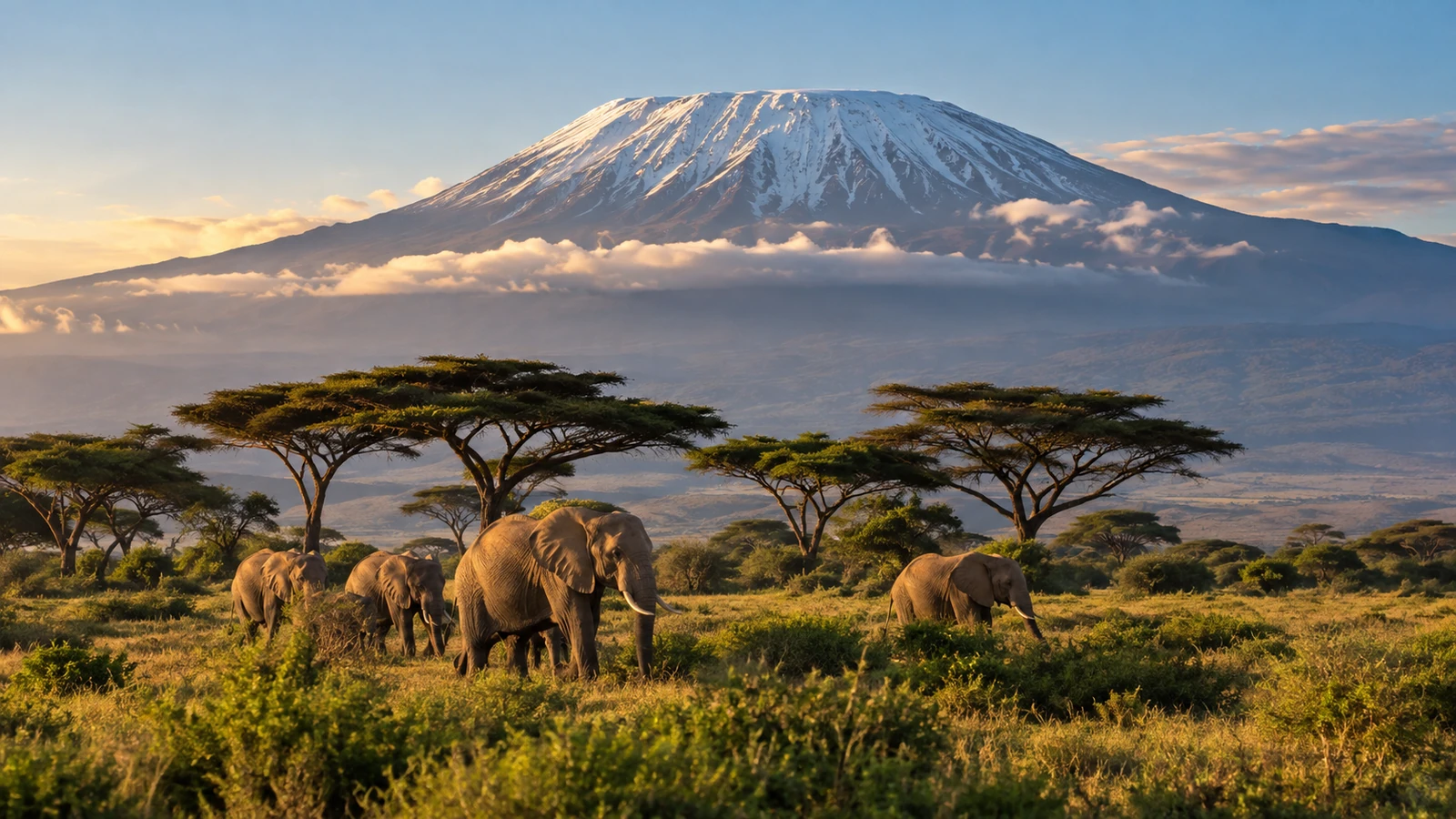
Mount Kilimanjaro towers over the East African plains as a breathtaking monument to natural power and endurance. As Earth's highest free-standing mountain, this dormant stratovolcano invites tens of thousands of adventurers every year to trek through tropical rainforests up to frozen, ancient glaciers. Beneath its picturesque snows lie fascinating geological features, unique prehistoric flora, and world-record history. Discover the surprising truths and mysterious legends surrounding Africa's legendary roof.
1. Earth's Tallest Free-Standing Mountain
Mount Kilimanjaro holds the world record as the tallest free-standing mountain on Earth, towering 5,895 meters (19,341 feet) above sea level. Unlike ranges like the Himalayas or the Andes, which are formed by colliding tectonic plates, Kilimanjaro stands completely isolated on the open plains of northern Tanzania. It rises roughly 4,900 meters directly from its surrounding savanna base, giving it the greatest vertical drop from base to peak of any land-based mountain. This solitary stature makes its snow-capped peak visible from hundreds of miles away, including across the nearby border in Kenya. Climbers looking for the ultimate summit experience are drawn to this massive solitary giant for its unparalleled panoramic views.
2. A Trio of Volcanic Cones
Rather than being a single mountain peak, Kilimanjaro is actually a massive stratovolcano featuring three distinct volcanic cones. Shira is the oldest and lowest cone at 3,962 meters, which collapsed into a broad plateau millions of years ago. Mawenzi is a rugged, craggy peak reaching 5,149 meters that requires technical rock climbing skills and is classified as extinct. Kibo is the central, highest cone that features the famous snow-capped summit crater and remains classified as dormant rather than extinct. While Kibo has not erupted for roughly 360,000 years, active fumaroles inside its crater still emit sulfur gas, reminding visitors that the giant beneath them is merely sleeping.
3. Journey Through Five Climate Zones
Ascending Mount Kilimanjaro is often described as walking from the Equator to the North Pole in just a few days. The mountain contains five separate ecological climate zones, each defined by distinct vegetation, temperature ranges, and weather patterns. Trekkers begin in lush, tropical rainforest filled with mosses and primates before passing into shrubby heath and moorland. Higher up, the landscape transitions into a stark alpine desert characterized by volatile temperature swings and thin air. Finally, the trail reaches the arctic summit zone, where freezing temperatures, bare rock, and ancient glaciers dominate the barren terrain.
4. Uhuru Peak Means Freedom
The highest point on Mount Kilimanjaro sits at 5,895 meters above sea level on the crater rim of Kibo cone. Originally named Kaiser-Wilhelm-Spitze during the era of German colonial rule in 1900, the peak was renamed Uhuru Peak in 1961 when Tanganyika gained independence. The word "Uhuru" means "Freedom" in Swahili, symbolizing the young nation's self-determination and national pride. Reaching Uhuru Peak is the ultimate goal for tens of thousands of global adventurers every year. Standing beside the famous wooden summit sign at dawn provides a breathtaking view over the cloud layer stretching across East Africa.
5. Rapidly Disappearing Ice Fields
Kilimanjaro's iconic equatorial snow cap is rapidly melting and may disappear entirely within our lifetimes. Satellite data shows that the ice fields on the summit have lost over 85 percent of their total surface area since 1912. Scientists attribute this drastic retreat to a combination of global climate change and localized deforestation, which reduces atmospheric moisture. Unlike continental glaciers that slide downhill, Kilimanjaro's ice sheets sublimate directly into atmospheric gas under intense sunlight. Researchers estimate that if current climate trends continue, the iconic ice caps could vanish completely between 2030 and 2050.
6. Endemic Prehistoric Flora
To survive the extreme environmental conditions of Kilimanjaro, local plants have evolved remarkable adaptations. The giant groundsel (Dendrosenecio kilimanjari) is an endemic species found only on this mountain, growing up to five meters tall in the moorland zone. These alien-looking plants look like giant candelabras with thick trunks capped by dense rosettes of fleshy leaves. At night, when temperatures plunge below freezing, the plant folds its old, dead leaves around its living central bud to act as natural insulation. This evolutionary marvel allows the giant groundsel to thrive in an environment defined by daily freeze-thaw cycles.
7. High Failure Rate Due to Elevation
Despite requiring no ropes, ice axes, or technical mountaineering skills, Mount Kilimanjaro turns back a surprisingly high percentage of climbers. Roughly 30,000 to 50,000 people attempt to reach Uhuru Peak every year, yet nearly half fail to reach the summit. The primary reason for failure is Acute Mountain Sickness (AMS), caused by ascending too rapidly into oxygen-depleted high altitudes. Trekkers who choose shorter routes without adequate acclimation days suffer higher failure rates than those on longer itineraries. Proper hydration, slow pacing, and choosing a six-to-eight-day route are the most effective strategies for overcoming the mountain's harsh elevation.
8. Age-Defying Record Holders
Mount Kilimanjaro has seen some extraordinary age-related mountaineering feats throughout history. In July 2019, an American woman named Anne Lorimor summitted Uhuru Peak at the astounding age of 89 years and 37 days. She climbed unassisted over nine days to reclaim her title as the oldest person to ever scale the mountain. On the opposite end of the spectrum, seven-year-old Keats Boyd successfully reached the summit in 2002 despite the standard minimum age limit being ten. These remarkable record-holders prove that with enough determination and proper acclimatization, age is not an insurmountable barrier to reaching the top.
9. Speed Runs Under Seven Hours
While most trekkers spend anywhere from five to nine days reaching the summit of Kilimanjaro, elite mountain runners complete the journey in hours. In August 2014, Swiss-Ecuadorian athlete Karl Egloff set the astonishing world record for the fastest unassisted ascent and descent. He ran from the base gate to Uhuru Peak and back down in a staggering 6 hours, 42 minutes, and 24 seconds. The ascent alone took him just 4 hours and 56 minutes, shattering the previous record held by Spanish runner Kilian Jornet. These incredible mountain runners sprint past multiple climate zones in a single morning while battling extreme altitude and plunging oxygen levels.
10. A Double Summit in a Wheelchair
In 2003, a South African man named Bernard Goosen accomplished a feat many considered impossible by summiting Mount Kilimanjaro in a wheelchair. Born with cerebral palsy, Goosen modified an off-road wheelchair fitted with thick rubber tires to navigate the steep, rocky mountain trails. He completed his initial ascent in nine days with minimal physical assistance from a support team. Four years later, in 2007, he returned to the mountain and broke his own record, completing the trek in just six days. His triumph serves as a global symbol of human resilience and physical determination against extraordinary physical challenges.
11. The Highest Land-Based Pizza Delivery
In May 2016, Mount Kilimanjaro became the backdrop for the highest land-based pizza delivery in history. To mark the opening of its first restaurant in Tanzania, Pizza Hut organized an expedition to carry a fresh pepperoni pizza to Uhuru Peak. A team of guides and employees carried the pie up the mountain in a specially designed thermal backpack equipped with battery-powered heaters. After a multi-day trek reaching 5,897 meters altitude, team members ate the still-warm pizza at the summit sign. Guinness World Records officially verified the event as the highest land-based pizza delivery ever recorded.
12. The Summit's Secret Logbook
Every hiker who successfully climbs Mount Kilimanjaro and reaches Uhuru Peak gets the chance to sign an official summit record. Inside a weather-resistant wooden box near the iconic summit sign, park officials maintain a notebook where adventurers record their names, dates, and personal thoughts. Thousands of climbers from around the globe have filled these notebooks with emotional notes, messages of victory, and tributes to loved ones. The summit logbook acts as a historical archive of human achievement high above the East African clouds. Once filled, these logbooks are collected by Tanzania National Parks authorities for preservation.
13. An Etymological Puzzle
The origin of the name "Kilimanjaro" is shrouded in linguistic mystery and debate among historians and local tribes. The most popular theory suggests it comes from the Swahili word Kilima (meaning "little mountain") and the Chagga word Njaro (meaning "whiteness" or "shining"). Another theory posits that Njaro was a Chagga word for a demon that caused mountain sickness, or referred to something that "defeats the caravan." Indigenous Chagga people historically had distinct names for the individual peaks, Mawenzi and Kibo, but no single word for the mountain as a whole. European explorers eventually synthesized these regional words into the world-famous name used today.
14. Formed by the Great East African Rift
Mount Kilimanjaro's creation began approximately three to four million years ago during the formation of the East African Rift System. As tectonic plates pulled apart across East Africa, deep fractures opened in the Earth's crust, allowing massive amounts of molten basaltic magma to escape. Over millions of years, repeated volcanic eruptions poured out layers of lava, ash, and pumice that built up the mountain's colossal structure. The earliest cone, Shira, grew and subsequently collapsed before Mawenzi and Kibo erupted to form the current high-altitude landscape. Today, the East African Rift remains tectonically active, shaping the geology of the entire surrounding continent.
15. The Most Accessible Seven Summit Peak
Kilimanjaro is often categorized as the easiest of the Seven Summits—the highest peaks on each of the seven continents. Because it requires no ropes, crampons, or technical climbing skills, it is far more accessible to amateur hikers than Everest or Denali. However, its accessibility often lures unprepared hikers into underestimating its hazards. Extreme temperatures, severe hypothermia, high-altitude pulmonary edema (HAPE), and high-altitude cerebral edema (HACE) make it genuinely dangerous. Park statistics indicate that several climbers die on the mountain each year, reinforcing that Kilimanjaro must be treated with serious respect.
Sources & References
This AI-assisted post was rigorously curated and fact-checked for accuracy by:
 Martin Roháček
How fun was this article? 🤔
Tap a star to rate it
🧠 Quiz: How closely were you paying attention?
10 questions — all answers are in the article above!
Enjoyed these facts? There's more! 💌
Fresh fun facts in your inbox. No spam, ever.