The Knockout Artist: 15 Fascinating Facts About Mantis Shrimp
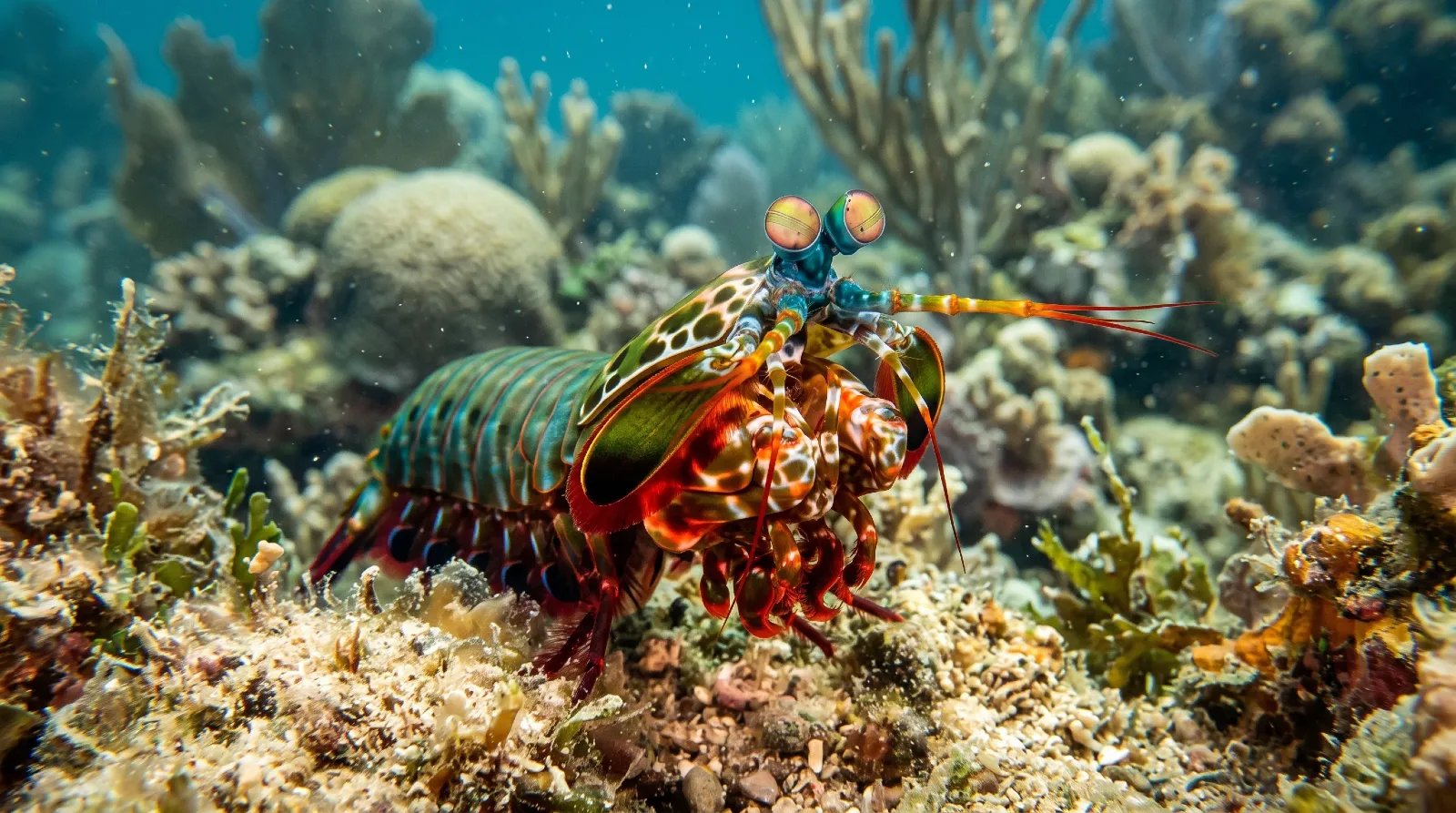
The mantis shrimp is neither a mantis nor a shrimp, but it may be the most extraordinary creature on the reef. It punches with the acceleration of a bullet, creates bubbles that briefly reach the temperature of the Sun's surface and has some of the most complex eyes in the animal kingdom. Here are the surprising facts about this tiny heavyweight.
1. It is neither a mantis nor a shrimp.
Mantis shrimp got their name because they look a little like shrimp and have front limbs that fold like those of a praying mantis. In fact, they belong to their own group of crustaceans called stomatopods. Their lineage split from other crustaceans around 400 million years ago, long before the first dinosaurs.
2. Its punch is as fast as a bullet leaving a gun.
The peacock mantis shrimp attacks with a pair of club-like limbs that it fires using a spring-and-latch mechanism. The club accelerates at more than 10,000 times the force of gravity and reaches speeds of about 23 metres per second, or 83 kilometres per hour, from a standing start. In terms of acceleration, the strike is comparable to a bullet fired from a pistol.
3. Every punch hits twice.
The strike is so fast that the water around the club briefly vaporises, forming tiny bubbles. When these cavitation bubbles collapse a fraction of a second later, they release a second shock wave that hits the prey again. So even if the mantis shrimp misses with its club, the collapsing bubbles can still stun or kill its target.
4. The bubbles briefly flash with light and heat.
The collapse of the cavitation bubbles is so violent that it produces a tiny flash of light, a phenomenon called sonoluminescence. For an instant, the temperature inside the collapsing bubbles can reach thousands of degrees Celsius. The effect lasts only a tiny fraction of a second, but it shows just how much energy the punch contains.
5. There are "smashers" and "spearers".
Mantis shrimp come in two main types. Smashers have heavy, hammer-like clubs that crack open the shells of snails, crabs and clams. Spearers have sharp, barbed limbs that they use to impale fast-moving prey such as fish, often ambushing them from a burrow in the sand.
6. Their clubs have inspired stronger materials.
A smasher's club can strike thousands of times without breaking. Scientists have found that it is made of layers of mineralised fibres arranged in a spiral, a structure that stops cracks from spreading. Engineers have used this design as inspiration for tough new materials for products such as helmets, body armour and aircraft parts.
7. They have some of the most complex eyes on Earth.
Humans have three types of colour-sensitive cells in their eyes. Mantis shrimp have twelve types of photoreceptor cells dedicated to colour, four of which detect ultraviolet light, plus others for detecting polarised light. Their eyes sit on mobile stalks and can move independently in different directions.
8. Surprisingly, they are not great at telling colours apart.
With so many colour receptors, you might expect mantis shrimp to see an incredible range of colours. However, a 2014 study found they are actually worse than humans at telling similar colours apart. Scientists think their eyes recognise colours very quickly, without the complex processing our brains do, which helps them react fast on a busy reef.
9. They can see a kind of light no other animal is known to see.
Several species of mantis shrimp can detect circularly polarised light, a type of light in which the waves spiral as they travel. No other animal has been shown to do this. Some mantis shrimp even reflect circularly polarised light from parts of their bodies, possibly as a secret signal that predators cannot detect.
10. Each eye has depth perception on its own.
Each mantis shrimp eye is divided into three regions, so a single eye can view an object from three slightly different angles. This gives each eye its own depth perception, something humans need two eyes for. It helps them judge distances precisely before launching a strike.
11. Divers call them "thumb splitters".
Mantis shrimp can inflict painful wounds on anyone who handles them carelessly. Fishermen and divers have long nicknamed them "thumb splitters" because of the injuries they can cause. Large spearers have been known to slice fingers, and large smashers can deliver a painful blow.
12. They can break aquarium glass, but rarely do.
Mantis shrimp sometimes arrive in home aquariums hidden inside pieces of live rock. Once inside, they may hunt the other inhabitants and are notoriously difficult to catch. There are accounts of large smashers cracking aquarium glass, although such cases are rare.
13. Some couples stay together for 20 years.
Not all mantis shrimp are solitary fighters. In some species, males and females form long-term monogamous pairs that share the same burrow and may stay together for up to 20 years. Both partners often help to care for the eggs.
14. There are more than 500 species.
Scientists have described more than 520 species of mantis shrimp. Most live in shallow, warm tropical and subtropical seas, where they are among the most important predators. They range from just a couple of centimetres long to around 40 centimetres.
15. The peacock mantis shrimp is a living rainbow.
The most famous species, the peacock mantis shrimp of the Indo-Pacific, is covered in brilliant shades of green, blue, red and orange. Its striking colours and powerful punch have made it a popular subject for nature documentaries and online videos, and it has become something of an internet celebrity.
Sources & References
This AI-assisted post was rigorously curated and fact-checked for accuracy by:
 Martin Roháček
How fun was this article? 🤔
Tap a star to rate it
🧠 Quiz: How closely were you paying attention?
10 questions — all answers are in the article above!
Enjoyed these facts? There's more! 💌
Fresh fun facts in your inbox. No spam, ever.