The Gentle Giant: 15 Fascinating Facts About Manatees
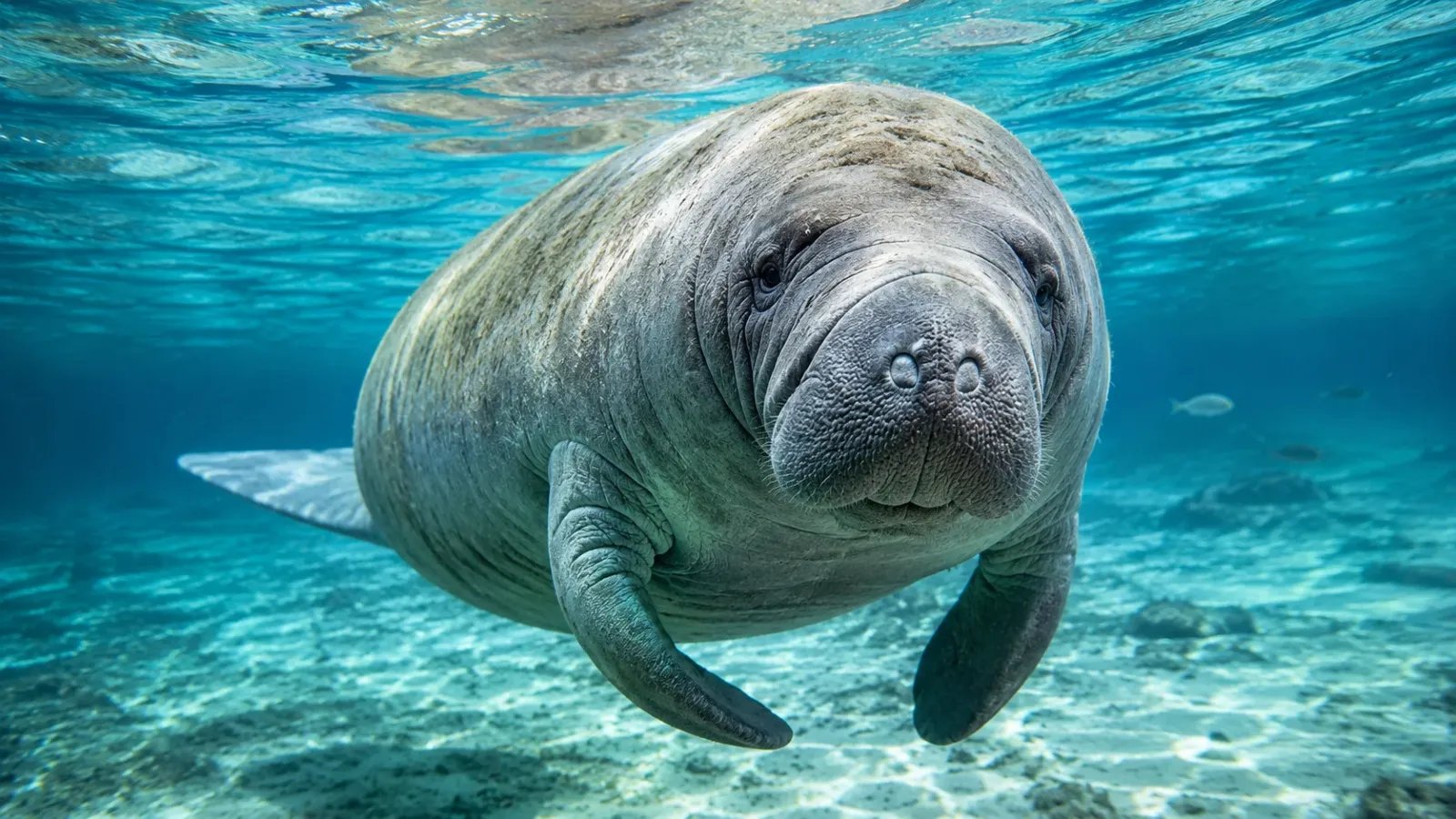
Despite their sea cow nickname, manatees are not related to bovines, but are actually aquatic cousins of the elephant. Far from being simple blubbery beasts, these mammals possess specialized biology, surprising intelligence, and a unique evolutionary history. Discover fifteen truths that reveal the hidden complexities of this vastly misunderstood creature.
1. Manatees do not possess a layer of blubber to keep them warm in cold water.
Contrary to popular belief about marine mammals, manatees have very little body fat. Their large size is mostly due to their massive digestive tract, which takes up a significant portion of their body cavity to process a diet of tough, fibrous seagrass. Because they lack insulating blubber, manatees are highly susceptible to cold stress and must migrate to warmer waters or natural springs when temperatures drop below sixty-eight degrees Fahrenheit.
2. Manatees replace their teeth continuously throughout their entire lives in a process called marching molars.
A manatee's diet is incredibly abrasive, filled with sand and silica from underwater vegetation. To combat the constant wearing down of their teeth, they evolved polyphyodonty. New molars continuously form at the back of their jaw and slowly move forward on a conveyor belt system, eventually pushing the worn, older teeth out at the front.
3. The manatee brain is entirely smooth and lacks the deep folds seen in humans and other intelligent mammals.
While cortical folds generally indicate higher intelligence and complex processing in mammals, the manatee's smooth brain does not mean they are unintelligent. Scientists have discovered that manatees are remarkably adept at associative learning and have excellent long-term memory, which they use to navigate complex migration routes and remember the exact locations of warm-water refuges year after year.
4. A manatee's body is covered in specialized tactile hairs that act like a full-body lateral line sensory system.
While they appear relatively hairless, manatees are actually covered in about three thousand sparsely distributed vibrissae, with another two thousand heavily concentrated on their facial disk. These hairs are connected to dense networks of nerves, allowing the manatee to detect minute changes in water currents, shifts in pressure, and the approach of potential threats or specific tidal movements, much like the sensory systems of fish.
5. Manatees regulate their buoyancy not just by breathing, but by releasing flatulence.
Because manatees lack a swim bladder and have incredibly dense, heavy bones to help them sink and graze on the sea floor, they manage their position in the water column using their digestive gas. When a manatee wants to dive, it compresses the gas in its intestinal tract, and when it needs to sink rapidly, it can expel this gas. A build-up of unreleased gas can actually cause a manatee to float uncontrollably.
6. Manatees have only six cervical vertebrae, unlike nearly all other mammals which have seven.
From mice to giraffes, almost every mammal on Earth shares the anatomical trait of having exactly seven neck bones. The manatee, alongside the two-toed sloth, is a rare exception to this evolutionary rule. Because they only have six cervical vertebrae, manatees cannot physically turn their heads; they must pivot their entire bodies to look around them.
 Marine and Freshwater Animals
Twenty-five animals of the sea and rivers, from the largest creature ever to exist to a seahorse dad, each linked to its full 15-fact article.
See All Facts
Marine and Freshwater Animals
Twenty-five animals of the sea and rivers, from the largest creature ever to exist to a seahorse dad, each linked to its full 15-fact article.
See All Facts
7. The lungs of a manatee span almost the entire length of its body and compress flat when the animal dives.
Unlike most mammals whose lungs are positioned relatively high in the chest cavity, a manatee's lungs are flattened, elongated organs located along the spine. This unique anatomical placement helps the manatee maintain a horizontal orientation in the water. Furthermore, they can renew up to ninety percent of the air in their lungs with a single breath, compared to humans who only replace about ten percent.
8. Christopher Columbus famously mistook manatees for mermaids during his first voyage to the Americas in 1493.
The myth of the mermaid was heavily fueled by early naval encounters with sirenians, the scientific order to which manatees belong. Columbus recorded in his log that he spotted three mermaids rising high out of the sea, though he was deeply disappointed to note they were not half as beautiful as they were painted, observing that they had distinctly masculine traits in their faces.
9. Manatees possess a uniquely split upper lip that works like a pair of muscular fingers.
A manatee's prehensile upper lip is divided into two distinct, independent halves. These sides can move separately from one another to grasp, tear, and maneuver sea grasses directly into the manatee's mouth. This specialized adaptation is crucial for an animal that spends up to eight hours a day eating and must consume up to ten percent of its massive body weight in vegetation daily.
10. Manatees have no natural predators in the wild, which explains their notoriously slow and peaceful demeanor.
Because they evolved in shallow, slow-moving rivers and coastal areas devoid of massive aquatic hunters, manatees never needed to develop speed, aggressive defense mechanisms, or a pack mentality. Even alligators and sharks, which share their habitats, generally ignore them due to the manatee's massive size and thick hide. Tragically, this evolutionary lack of fear is what makes them so vulnerable to boat strikes.
11. A manatee's bones are entirely solid and lack marrow cavities.
This condition, known as pachyostosis, means their bones are exceptionally thick and dense. The heavy skeleton acts as a natural biological weight belt, counteracting the buoyancy of their large lungs and the thick gases produced by their vegetarian diet. The red blood cells typically produced in the marrow of other mammals are instead manufactured in the manatee's sternum and vertebral bodies.
12. Female manatees have their mammary glands located directly under their flippers.
This anatomical quirk is a shared trait with their closest terrestrial relative, the elephant. When a manatee calf needs to nurse, it must swim just behind its mother's front flipper to access the teats. The mother will often use her flipper to gently cradle the calf and help guide it to the milk source while they slowly cruise through the water.
13. Manatees can survive in both strictly freshwater and highly saline oceanic environments.
While many aquatic animals will quickly perish if moved between fresh and salt water due to cellular shock, the manatee is euryhaline. Their kidneys are highly specialized to maintain proper water and salt balance regardless of the salinity of their environment. However, they must periodically return to fresh water to drink, which they accomplish by seeking out rivers, springs, or even drinking from hoses off docks.
14. The West Indian manatee possesses a highly unusual visual system that allows them to see in color.
Many marine mammals are monochromatic, meaning they see only in shades of gray, which is sufficient for murky or deep-water navigation. However, manatees have dichromatic vision, possessing both blue and green light-sensitive cones in their retinas. This evolutionary adaptation likely helps them distinguish between different types of seagrasses in the shallow, sunlit waters where they graze.
15. The closest living relatives to the manatee are the elephant and the tiny rock hyrax.
Through a group of mammals known as subungulates, manatees share a common terrestrial ancestor that lived more than fifty million years ago. Despite the vast differences in their modern habitats and appearances, manatees share several distinct anatomical traits with elephants and hyraxes, including their lack of collarbones, the presence of tusklike incisors in some species, and unique reproductive biology.
Sources & References
This AI-assisted post was rigorously curated and fact-checked for accuracy by:
 Martin Roháček
How fun was this article? 🤔
Tap a star to rate it
🧠 Quiz: How closely were you paying attention?
10 questions — all answers are in the article above!
Enjoyed these facts? There's more! 💌
Fresh fun facts in your inbox. No spam, ever.