15 Surprising Facts About Idaho
Parachuting beavers, a boardinghouse with its own ball court, and four light bulbs that marked a nuclear milestone: Idaho's stories reach far beyond potatoes.
1. Idaho parachuted beavers into the backcountry
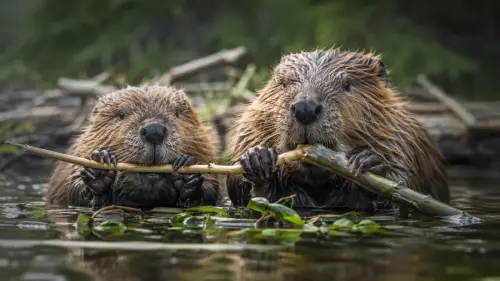
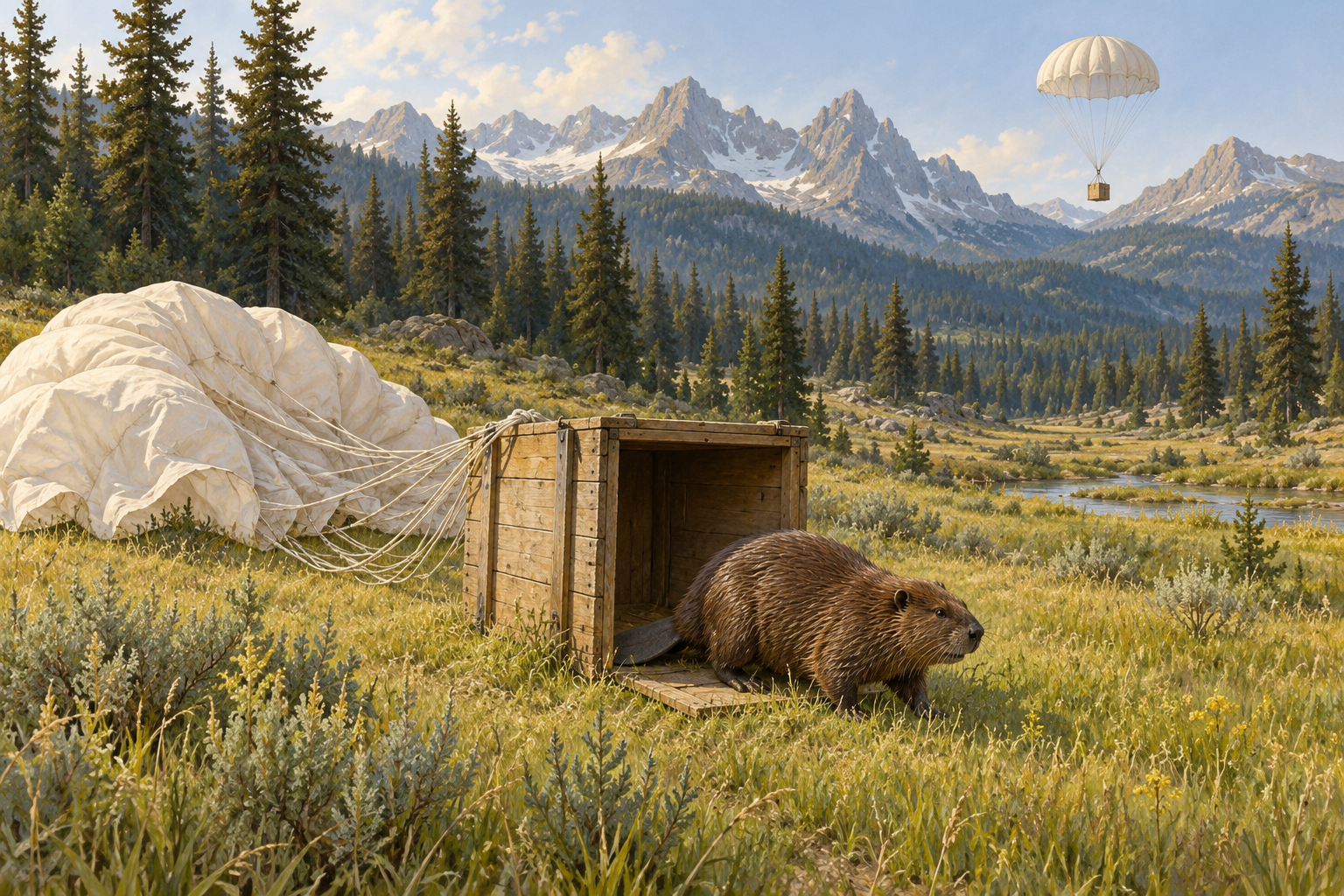
In 1948, Idaho wildlife managers sent 76 beavers into the remote Chamberlain Basin by parachute. The animals traveled inside specially designed wooden boxes that opened after landing; they were not individually strapped into harnesses. Seventy-five survived the drops. An older male named Geronimo had been used to test the equipment before joining the relocation. The remarkable delivery method helped move animals away from conflicts with people to country that was difficult to reach by road.
2. Four light bulbs announced a nuclear milestone
On December 20, 1951, Experimental Breeder Reactor I in eastern Idaho generated enough electricity to illuminate four 200-watt light bulbs. The next day it supplied its own building. The Department of Energy identifies EBR-I as the first power plant to produce usable electricity through nuclear fission. Its other important achievement was fuel breeding: the reactor demonstrated that it could produce more nuclear fuel than it consumed. A modest-looking row of bulbs represented a much larger engineering experiment.
3. A banana-handling idea helped put skiers in the air
Sun Valley's pioneering ski chairlifts grew out of Union Pacific engineer Jim Curran's experience with equipment for loading bananas onto ships. He adapted the idea of moving suspended loads into a system that carried people up a mountain. Chairlifts were installed on Dollar and Proctor mountains in 1936, the resort's opening year. The borrowed industrial idea helped establish the modern ski chairlift, giving skiers a seated alternative to climbing back uphill.
4. Some trees left their bark behind in lava
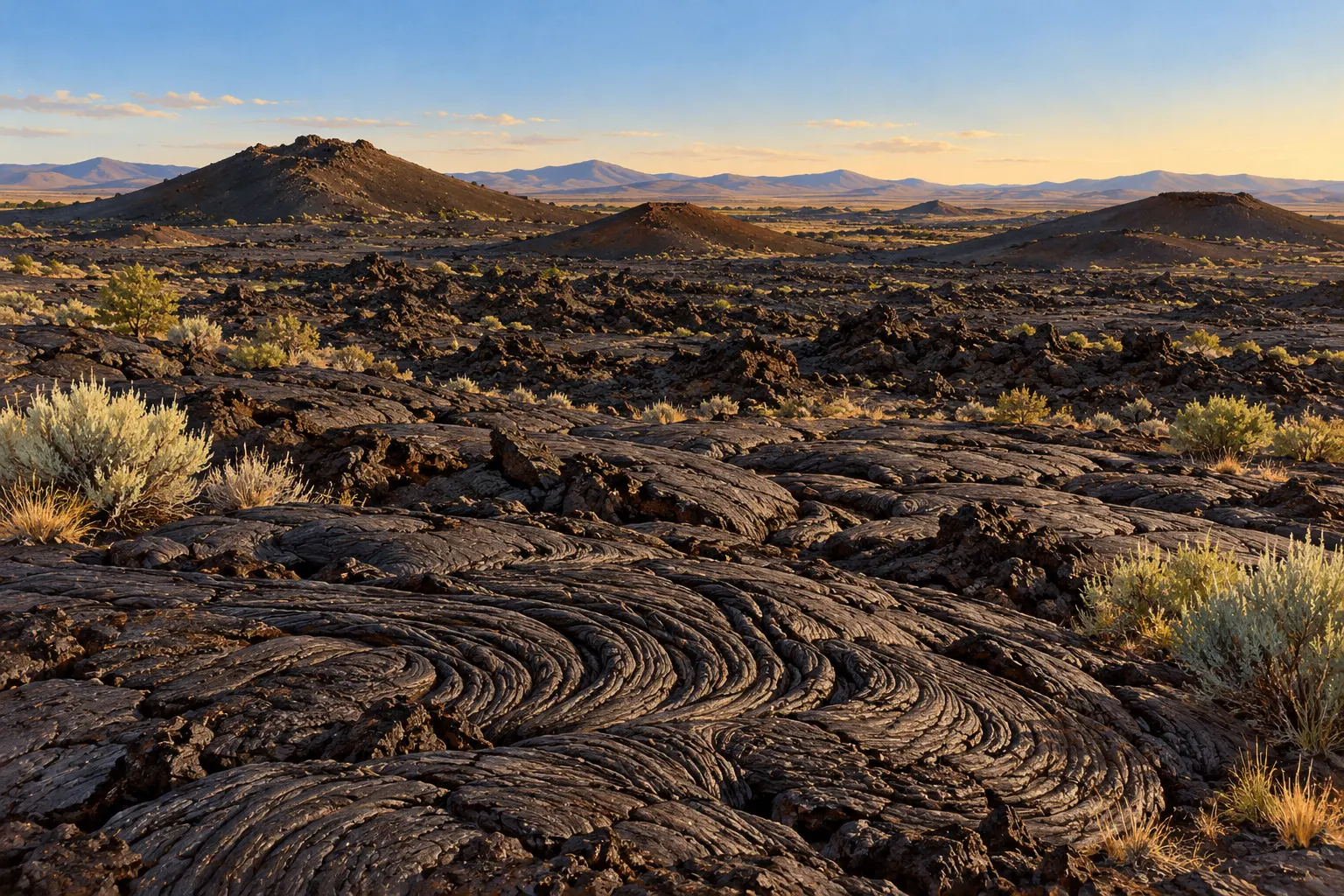
At Craters of the Moon, lava preserved impressions of trees that the heat eventually destroyed. When a flow encountered wood, the lava touching it cooled quickly enough to record its outer shape. The wood then burned away, leaving a hollow mold. Along the Tree Molds Trail, some examples preserve fine bark details; others lie horizontally where fallen trunks met the flow. These fossils record an absent tree rather than a trunk whose woody tissue turned to stone.
5. A swimming-pool project accidentally created a geyser
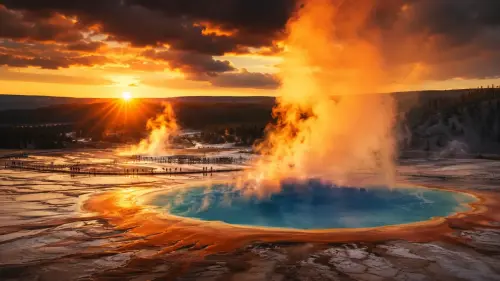
In 1937, drillers at Soda Springs were looking for hot water for a swimming pool. At a depth of 315 feet, they instead released water driven upward by carbon dioxide pressure. The resulting geyser was eventually capped and controlled with a valve. Its eruption mechanism is an especially useful detail: escaping gas drives the display, rather than the steam-pressure cycle associated with many famous geothermal geysers. The surprise came from a borehole, not a newly discovered natural vent.
6. One fossil quarry supplied horse skeletons to the world
During the 1930s, Smithsonian paleontologists excavated 120 horse skulls and 20 complete skeletons from Idaho's Hagerman Horse Quarry. Exchanges sent some of the skeletons to other museums, spreading the discovery far beyond Idaho. The animal, Equus simplicidens, lived about 3.5 million years ago and had a skull resembling a zebra's. Whether it wore stripes remains speculation: the striking reconstructions sometimes shown in illustrations go beyond what the recovered bones can directly reveal.
 You might also like
The Sparrow From Minsk: 15 Fascinating Facts About Olga Korbut
7. An earthquake drew a new line across the landscape
The Borah Peak earthquake of October 28, 1983, ruptured the ground along the Lost River fault for roughly 35 kilometers. USGS field studies measured maximum vertical fault displacement of about 2.7 meters. The fresh scarps made movement usually hidden underground visible across the mountain front. The event also had a human cost: collapsing walls killed two children in Challis. Field reports documented changes in springs and groundwater, showing that the shaking altered the behavior of water as well as the visible ground.
8. An Idaho ice dam helped unleash floods across Washington
During the last ice age, a lobe of the Cordilleran Ice Sheet occupied the area of present-day Lake Pend Oreille. It blocked the Clark Fork River, impounding Glacial Lake Missoula upstream in Montana. Repeated failures of that ice dam released enormous floods westward across eastern Washington. Idaho's connection to the story is therefore a crucial piece of frozen plumbing: the barrier that held the lake back stood here, even though the lake's name points to Montana.
9. Wallace put the center of the universe on a manhole cover
In 2004, Wallace's mayor proclaimed the town the center of the universe. A manhole cover at Bank and Sixth streets marks the designated spot, complete with initials representing local mining companies. The town has celebrated the declaration with rededication events. This is a deliberately playful civic claim, not a scientific finding about the cosmos. Its physical marker makes the joke unusually easy to visit: an extravagant title attached to an ordinary piece of street infrastructure.
10. A Boise boardinghouse had a Basque ball court inside
When the Anduiza family built a hotel-style boardinghouse on Boise's Grove Street in 1914, they included a full fronton, a court for Basque ball games. Nearby boardinghouses also served as social centers where immigrants could speak Euskera, share meals, and find community far from the Basque Country. The Jacobs/Uberuaga House operated as a boardinghouse from 1910 to 1969. Together, these buildings preserve a history of migration that involved much more than rooms for passing workers.
11. The Nez Perce Tribe helped bring coho salmon back
Coho salmon had disappeared from Idaho waters before the Nez Perce Tribe began a restoration effort in the 1990s. The Tribe secured eggs in 1994 and released about 630,000 young fish in 1995. In 1997, 92 returning adults were observed at Lower Granite Dam, an early milestone in the reintroduction. The continuing Clearwater coho program combines fish production with the return of a species important to the Tribe's culture and relationship with the rivers.
12. A Rigby teacher's memory helped in a television patent battle
In 1922, teenage Philo Farnsworth explained an electronic television idea to his chemistry teacher, Justin Tolman, in Rigby. Years later, Tolman's recollection and reconstruction of the classroom drawing helped establish how early Farnsworth had conceived his system during a patent dispute. Farnsworth demonstrated an electronic television system in San Francisco in 1927. The Idaho connection lies in that earlier classroom conversation, where an idea that would become commercially significant first reached a teacher willing to listen.
13. Evel Knievel's canyon vehicle was a steam-powered rocket
For his September 8, 1974, attempt to cross the Snake River Canyon near Twin Falls, Evel Knievel climbed inside the Skycycle X-2. Despite its name and his motorcycle reputation, the vehicle was a steam-powered rocket designed by Robert Truax. Its parachute deployed prematurely, and wind carried it back toward the launch side instead of delivering Knievel across the canyon. He survived with minor injuries. The famous attempt was therefore a failed rocket crossing, not a successful motorcycle leap.
14. Some Idaho waterfalls emerge halfway down a cliff
Along the Thousand Springs reach of the Snake River Canyon, groundwater emerges from openings in the canyon wall. Water travels through the eastern Snake River Plain's basalt aquifer and escapes where the river has cut into it. USGS descriptions of individual springs record outlets roughly 140 to 150 feet above the river. The result can look like a waterfall whose upstream river has vanished: its immediate source is water moving through rock behind the cliff.
15. The Idaho Spud contains no potato
The Idaho Spud candy bar takes its name and shape from the state's best-known crop, but its maker explicitly says it contains no actual potato. Introduced in 1918, it combines a cocoa-flavored marshmallow center with a dark chocolate coating and coconut sprinkles. The Idaho Candy Company still associates it with its Boise factory, built in 1909. For a state so strongly linked with potatoes, one of its enduring edible souvenirs turns out to be a confectionery impersonation.
How did these facts land?
Know someone who'd love these facts? Share them 👇