15 Surprising Facts About Arizona
Arizona's stories reach far beyond its desert scenery: a young astronomer found Pluto on photographic plates, engineers blasted a practice Moon into volcanic ground, and a London bridge acquired a new concrete skeleton. There are also mule-carried letters, a secret cave and a forest that seems to have been cut with a chainsaw.
1. A saguaro may need a century to grow its first arm
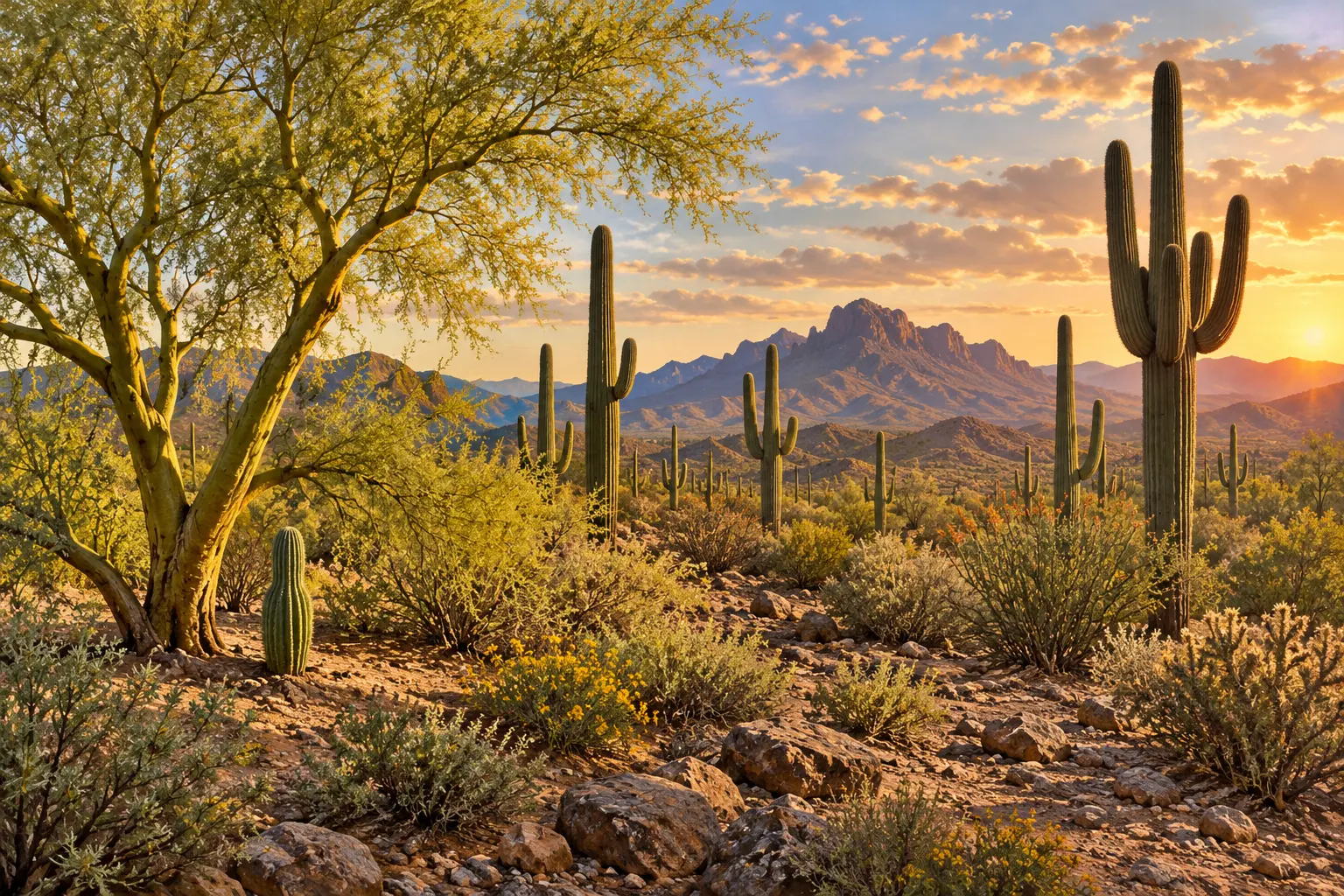
The familiar cactus silhouette takes extraordinary patience. At Saguaro National Park, seedlings can remain only a few inches tall after ten years, sheltered beneath nurse trees that soften summer sun and winter frost. Arms generally develop after many decades; in drier places, the wait can approach 100 years. That small cactus beneath a palo verde may be much older than its size suggests, while an enormous branching neighbor has outlived generations of people.
2. The Petrified Forest's logs were not sliced with a chainsaw
Some stone trunks at Petrified Forest National Park look suspiciously like neatly cut firewood. Their clean breaks are natural. Buried trees became mineralized after silica-bearing water entered their tissues more than 200 million years ago. Much later, geological stress fractured the hard, brittle quartz into segments. Iron, manganese and other impurities supplied the colors, so these apparent woodpiles combine the structure of ancient trees with the sparkle and breaking behavior of crystal.
3. One line in the Grand Canyon skips about 1.2 billion years
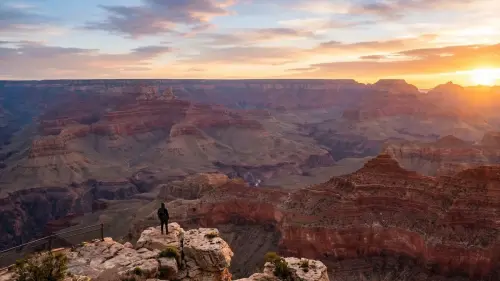
The Grand Canyon is a spectacular history book with missing pages. Where younger layered rocks rest directly on the ancient Vishnu Basement Rocks, the contact called the Great Unconformity can represent roughly 1.2 billion years absent from the local rock record. Erosion and intervals without deposition created the gap. A geological boundary that looks like a thin line therefore bridges an almost unimaginable stretch of time; it does not mark the age of the canyon itself.
4. Pluto appeared when a Kansas telescope maker compared two photographs
Clyde Tombaugh arrived at Flagstaff's Lowell Observatory in 1929 after building telescopes at home in Kansas. His early duties included maintenance and clearing snow, alongside the search for a distant planet. On February 18, 1930, he used a blink comparator to examine photographic plates taken on January 23 and 29. A tiny point changed position against the stars: Pluto. The discovery depended on patient comparison of photographs, rather than a dramatic first glimpse through an eyepiece.
5. Scientists blasted a practice Moon into a volcanic cinder field
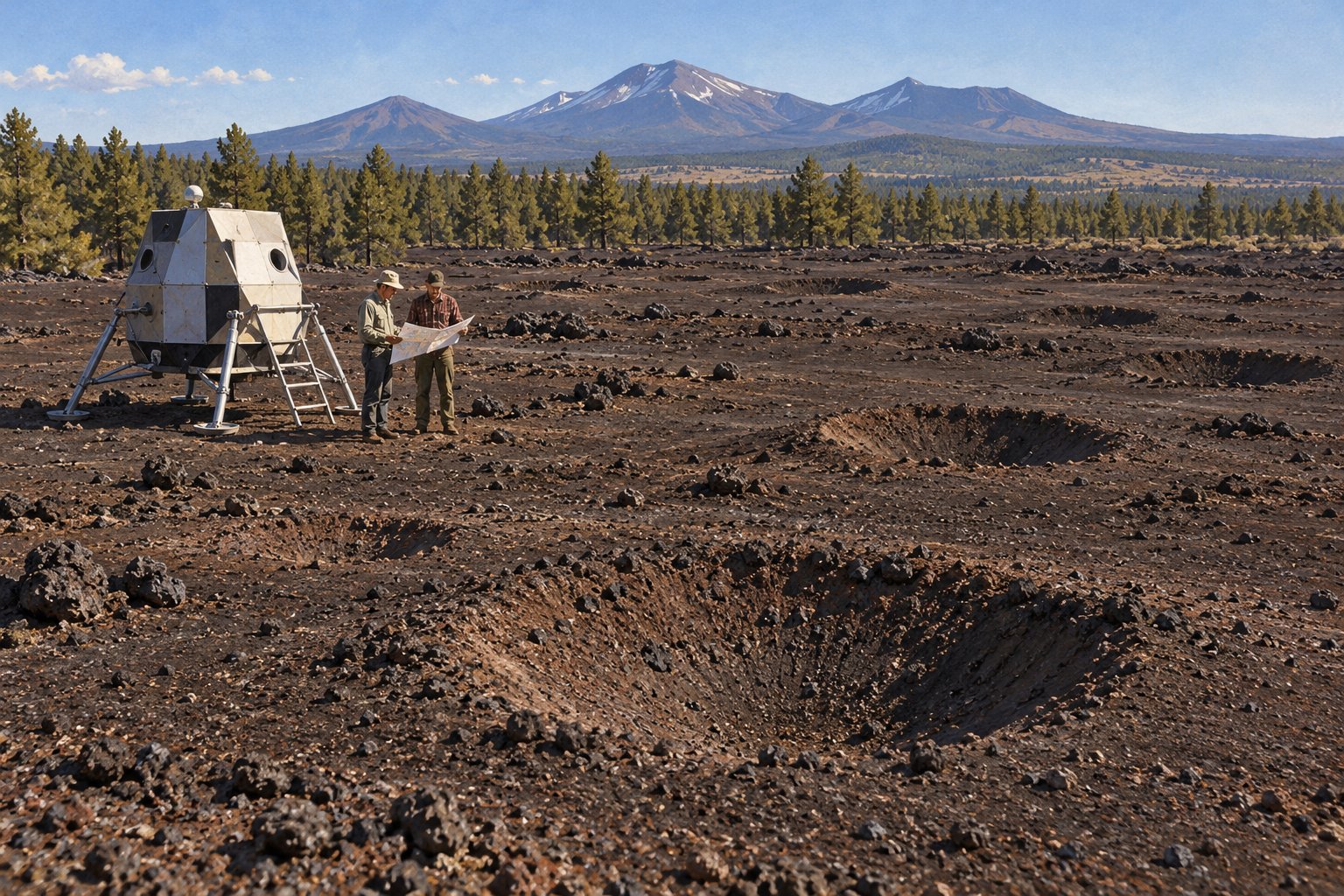
Near Flagstaff, the USGS used explosives to turn part of Cinder Lake into a landscape modeled on lunar terrain. The work supported Apollo preparations: a 1967 study tested whether people looking through the windows of a lunar-module mockup could identify their position using orbital photographs. Arizona also gave astronauts experience in geological observation and sampling. The dark, cratered ground was a working navigation and geology classroom, not simply a space-age film set.
6. London Bridge was rebuilt on dry ground with a new concrete skeleton
The bridge at Lake Havasu City contains stone from the London Bridge opened over the Thames in 1831, but its modern engineering is a different story. Contractor Sundt built a reinforced-concrete structure and fitted the numbered granite blocks around it as exterior cladding. The work took place on dry land, using earth to support the arches during construction. A channel was then excavated beneath the bridge, which was completed in 1971. Arizona imported the historic exterior, not the entire original structural mass.
 You might also like
15 Fascinating Facts About Coatis
7. Crossing into the Navajo Nation can change your clock without leaving Arizona
Most of Arizona stays on Mountain Standard Time throughout the year, declining the seasonal clock change used by much of the country. The Navajo Nation observes daylight saving time, including within Arizona. During the daylight-saving part of the year, a journey between these areas can therefore involve a one-hour change without crossing a state boundary. The exception makes the familiar advice that Arizona never changes its clocks incomplete.
8. A fight over recalling judges delayed Arizona's statehood
President William Howard Taft vetoed Arizona's admission legislation in 1911 because its proposed constitution allowed voters to recall judges. Arizonans removed the offending provision, clearing the way for admission on February 14, 1912. They then restored judicial recall at the first state election. The sequence gave Arizona an unusually defiant constitutional beginning: voters temporarily accepted a change demanded in Washington, gained statehood, and reversed that change once the state existed.
9. Twenty-five German prisoners tunneled out of a camp near Phoenix
On the night of December 23–24, 1944, 25 German prisoners of war escaped from the Papago Park camp through a tunnel. The surrounding desert proved a formidable obstacle to their plans, and all were eventually recaptured. It is an unexpected chapter in the history of metropolitan Phoenix: during World War II, the area held an overseas prison camp whose escape story unfolded among canals, desert terrain and nearby civilian communities.
10. Biosphere 2's sealed-world experiment needed oxygen from outside
Eight people entered Biosphere 2 in 1991 for a two-year experiment in living within an enclosed ecological system. Growing food was only part of the challenge: the atmosphere itself changed. Oxygen fell sufficiently that additional oxygen had to be supplied in January 1993. Participant Mark Nelson's account describes the physical effects and the decision to intervene. The glass complex near Tucson produced a striking lesson in how difficult it is to balance an atmosphere, even when the entire miniature world is on Earth.
11. Letters to Supai make the last part of their journey by mule
The U.S. Postal Service still uses pack animals to carry mail into Supai, the Havasupai community within the Grand Canyon. USPS identifies it as the country's last mule mail route. The animals descend canyon trails with letters and supplies that ordinary delivery trucks cannot bring to the village. Outgoing mail can receive a special “Mailed by Mule” marking: an unusual postal souvenir that reflects a practical service for a living community.
12. Chiricahua's stone towers began as a massive cloud of volcanic ash
The pinnacles of Chiricahua in southeastern Arizona are remnants of the Turkey Creek caldera eruption about 27 million years ago. Hot volcanic ash accumulated and welded into rock called rhyolite tuff. Cooling created fractures; later water, freezing and weathering widened the cracks and isolated columns, balancing rocks and narrow towers. The improbable-looking formations are therefore volcanic architecture reshaped over time, rather than a sandstone landscape carved into towers by wind alone.
13. Kartchner Caverns remained a closely guarded secret for more than thirteen years
After Randy Tufts and Gary Tenen discovered Kartchner Caverns in 1974, they kept it from the wider public and caving community while seeking a way to protect it. Even the landowners were not approached until 1978. The eventual plan involved the Kartchner family, conservationists and Arizona State Parks; state-park protection arrived in 1988. Their first-person account explains the paradox: supervised public access offered a better long-term defense against vandalism than hoping an accessible cave would stay secret forever.
14. Meteor Crater inspired a mining venture that could not find its imagined fortune
Daniel Moreau Barringer correctly argued that an impact made Meteor Crater, but he also hoped to recover a valuable buried mass of iron and nickel. His venture drilled and built substantial mining infrastructure without recovering an economically workable deposit. The impact had fragmented, melted and vaporized the incoming body rather than leaving a convenient intact metal mountain underground. Barringer's investment failed even as the geological explanation he championed helped establish a landmark in impact science.
15. Tucson's international food distinction rests on thousands of years of desert agriculture
In 2015, Tucson became the first U.S. city designated a UNESCO Creative City of Gastronomy. The recognition reaches beyond restaurant menus to an agricultural history extending back more than 4,000 years. Indigenous food traditions, including those of the Tohono O'odham, and later cultural influences shaped a cuisine adapted to the Sonoran Desert. Beans, squash, mesquite and other regional foods tell a story of cultivation and ingenuity in a landscape outsiders may assume cannot feed people.
How did these facts land?
Know someone who'd love these facts? Share them 👇