15 Interesting Facts About the Attack on Pearl Harbor: The Sudden Onslaught
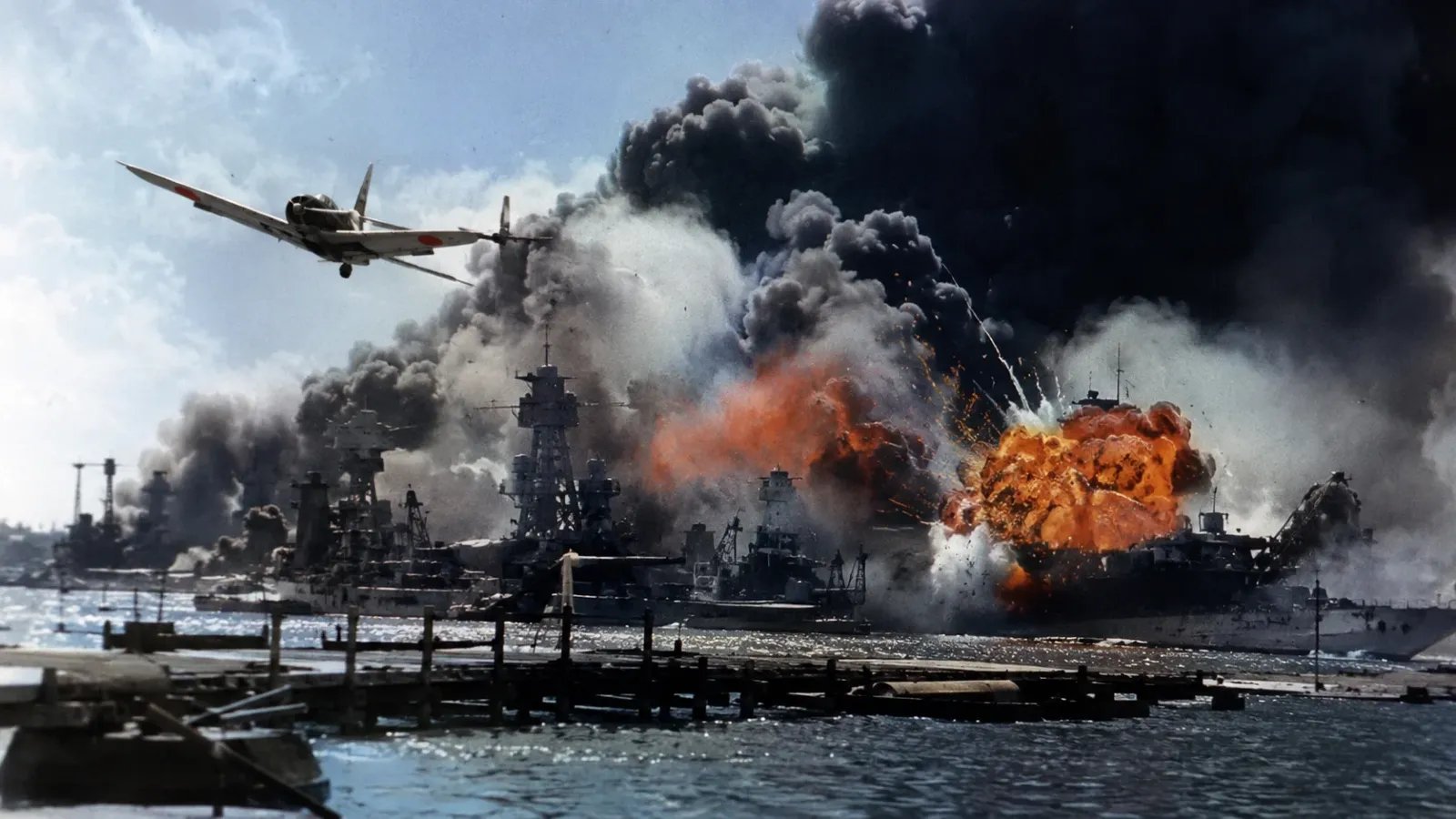
Often viewed as a completely unprovoked surprise, Pearl Harbor was actually the climax of a decades-long strategic chess match. American officials fully expected war with Japan, they just assumed it would begin in the Philippines. Discover the obscure realities, ignored radar warnings, and tactical myths behind the fateful day that thrust the United States into the Second World War.
1. The first shots of the attack were actually fired by the Americans, not the Japanese.
Early in the morning of December 7, roughly an hour before the aerial bombardment began, the American destroyer USS Ward spotted a Japanese midget submarine attempting to sneak into the harbor entrance. The Ward fired on and sank the submarine, officially firing the first American shots of World War II in the Pacific. Unfortunately, the report of this engagement was delayed in traversing the chain of command, squandering a brief window where the base could have been fully alerted.
2. A radar station detected the incoming Japanese strike force but the warning was dismissed as a flight of American bombers.
Two privates operating an experimental radar station at Opana Point tracked a massive swarm of incoming aircraft at 7:02 a.m. When they called in the sighting to the information center, a newly assigned officer assumed the blips were a scheduled flight of six American B-17 bombers arriving from California. Because of this fatal miscommunication, the radar operators were told not to worry about it, leaving the naval base defenseless when the enemy planes arrived.
3. The Japanese strike force sailed over three thousand miles in complete radio silence to avoid detection.
To maintain the element of surprise, Vice Admiral Chuichi Nagumo's fleet of six aircraft carriers and supporting warships traveled across the northern Pacific without transmitting a single radio signal. They took an isolated, storm-tossed route far from regular shipping lanes, relying solely on visual flag signaling and light flashes at night. This extreme discipline prevented American radio intelligence from triangulating their location, contributing heavily to the belief that the Japanese fleet was still docked in its home waters.
4. The shallow waters of Pearl Harbor were supposed to make aerial torpedo attacks physically impossible.
American naval commanders felt secure believing that traditional aerial torpedoes would plunge deep into the mud of the forty-foot-deep harbor before arming and leveling out. To counter this, Japanese engineers fitted their Type 91 torpedoes with special wooden tail fins that broke off upon hitting the water, preventing the weapon from diving too deeply. This brilliant, low-tech modification allowed torpedo bombers to wreak havoc on Battleship Row, completely subverting American defensive assumptions.
5. Japan intended to officially sever diplomatic ties thirty minutes before the attack, but decoding delays prevented it.
The attack is historically remembered as a treacherous sneak assault, but the Japanese government actually meant to deliver a formal severance of diplomatic ties just prior to the bombing. The fourteen-part message took too long for the Japanese embassy in Washington to decrypt, type up, and deliver to the American Secretary of State. By the time the Japanese diplomats finally handed over the document, the bombs had already been falling on Hawaii for over an hour.
6. The United States military had already cracked Japan's highest diplomatic code prior to the attack.
Long before the attack, American cryptanalysts had successfully deciphered the Japanese diplomatic cipher machine known as Magic, allowing Washington officials to read top-secret messages between Tokyo and its embassies. While this intelligence indicated that war was imminent, it never specified Pearl Harbor as a target. Because military codes remained largely unbroken and Japanese diplomats themselves were kept in the dark about military operations, the precise location of the strike remained a mystery until it was too late.
 Wars and Conflicts of the 20th Century
Explore the hidden realities of 20th-century warfare and geopolitical conflicts. From world-altering military campaigns and covert intelligence operations to the eccentricities of ruthless dictators, uncover the surprising truths behind the events that shaped the modern world.
See All Facts
Wars and Conflicts of the 20th Century
Explore the hidden realities of 20th-century warfare and geopolitical conflicts. From world-altering military campaigns and covert intelligence operations to the eccentricities of ruthless dictators, uncover the surprising truths behind the events that shaped the modern world.
See All Facts
7. American aircraft were intentionally parked wingtip-to-wingtip on the runways to prevent local sabotage.
In the weeks leading up to the attack, the primary security concern for American commanders in Hawaii was not an aerial bombardment, but local sabotage from Japanese sympathizers. To make the planes easier to guard, military leaders ordered them clustered closely together in the center of the airfields. This anti-sabotage measure proved disastrous during the actual attack, as it allowed Japanese fighter planes and dive bombers to easily destroy hundreds of American aircraft on the ground in a single strafing run.
8. The primary targets of the Japanese fleet, the American aircraft carriers, were entirely absent from the harbor.
The ultimate goal of the Japanese strike was to cripple the Pacific Fleet's offensive capabilities by sinking its aircraft carriers. By a stroke of immense luck for the United States, all three Pacific Fleet carriers were away from Pearl Harbor on December 7. The USS Enterprise and USS Lexington were delivering aircraft to Midway and Wake Island, while the USS Saratoga was undergoing maintenance in San Diego, preserving the very assets that would eventually win the Pacific War.
9. A Japanese pilot crash-landed on a nearby Hawaiian island and terrorized its civilian residents for a week.
Shigenori Nishikaichi, a Japanese Zero pilot whose plane was damaged during the attack, crash-landed on the small island of Niihau. Initially treated with hospitality by the isolated residents who were unaware of the bombing, the situation violently escalated once the truth emerged. The resulting Niihau Incident, which involved the pilot conspiring with local residents of Japanese descent to take hostages, ended with Nishikaichi's death and fueled widespread American paranoia regarding the loyalty of Japanese Americans.
10. The sunken USS Arizona continues to leak hundreds of gallons of oil into the harbor every year.
When a Japanese armor-piercing bomb detonated the forward magazine of the USS Arizona, the battleship sank with roughly one and a half million gallons of fuel oil still in its hold. Today, more than eighty years later, the wreckage slowly weeps up to nine quarts of oil into the water each day. Observers and veterans poignantly refer to these iridescent slicks constantly rising to the surface of the memorial as the tears of the Arizona.
11. Nearly half of all American casualties during the attack occurred on a single ship.
The sheer scale of human destruction at Pearl Harbor is largely defined by the catastrophic explosion of the USS Arizona. The massive magazine detonation tore the ship apart and sank it within minutes, resulting in the deaths of 1,177 officers and crewmen. Out of the 2,403 Americans who lost their lives on December 7, nearly fifty percent of them perished aboard this single Pennsylvania-class battleship.
12. A fleet of civilian aircraft inadvertently flew right into the middle of the active battle.
In a bizarre historical coincidence, a group of civilian flight instructors and their students were enjoying a peaceful Sunday morning flight when the Japanese armada descended. Several of these unarmed, brightly colored civilian planes were targeted and shot down by Japanese fighters. Cornelia Fort, one of the civilian instructors who narrowly escaped after a Japanese Zero buzzed her aircraft, survived and later became one of the first members of the Women Airforce Service Pilots.
13. Japanese commanders called off a planned third wave of bombings, fearing an American counterattack.
The Japanese strike consisted of two distinct waves of aircraft, but a third wave was originally considered to target the harbor's vital dry docks, submarine bases, and massive fuel storage tanks. Admiral Nagumo decided against launching it, reasoning that the American defenses had fully mobilized and that the missing American aircraft carriers might be lurking nearby to ambush his fleet. Had the third wave destroyed the fuel depots and repair yards, the Pacific Fleet would have been forced to retreat to the West Coast, prolonging the war by years.
14. A military band aboard the USS Nevada continued playing the national anthem while under active machine-gun fire.
At 7:55 a.m., the ship's band was assembled on the aft deck to play the "Star-Spangled Banner" for the morning colors ceremony. As the first notes rang out, Japanese planes swept down and began strafing the harbor. Unfazed by the sudden assault, bandmaster Oden McMillan refused to break protocol, directing his musicians to finish the entire anthem before scrambling for cover, which they did even as shrapnel tore through their sheet music.
15. Congress voted to declare war on Japan with only a single dissenting vote.
On December 8, President Franklin D. Roosevelt delivered his famous Day of Infamy speech, asking Congress for a formal declaration of war against the Japanese Empire. The resolution passed the Senate unanimously and the House of Representatives with a near-unanimous vote of 388 to 1. The sole dissenting vote belonged to Jeannette Rankin, a committed pacifist who had also voted against American entry into World War I, cementing a remarkable moment of almost absolute political unity.
Sources & References
This AI-assisted post was rigorously curated and fact-checked for accuracy by:
 Martin Roháček
How fun was this article? 🤔
Tap a star to rate it
🧠 Quiz: How closely were you paying attention?
10 questions — all answers are in the article above!
Enjoyed these facts? There's more! 💌
Fresh fun facts in your inbox. No spam, ever.