The Shadow War: 15 Fascinating Facts About the Cold War
For nearly half a century, the global standoff between the United States and the Soviet Union pushed humanity to the brink of nuclear destruction. Behind the high-stakes diplomacy lay a surreal realm of bizarre intelligence operations, strange space race secrets, and absurd military miscalculations. From surgical cat spies and covert spacecraft hijackings to a wandering black bear that nearly triggered World War III, here are 15 fascinating facts about the Cold War.
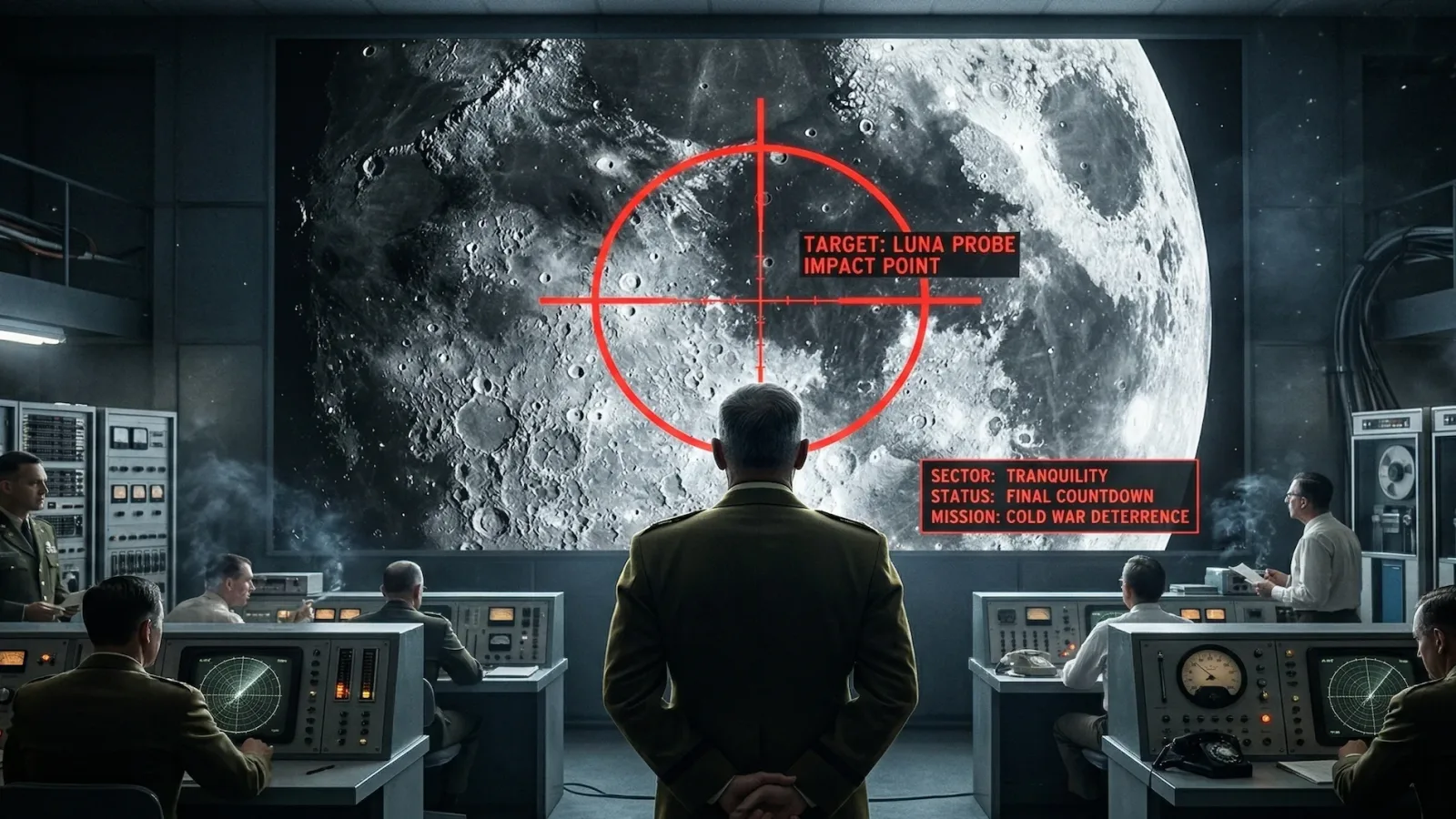
1. The U.S. Planned to Nuke the Moon to Show Off
Driven by intense anxiety over early Soviet successes in the Space Race, American military planners developed a covert initiative known as Project A119. The secret plan called for detonating a nuclear warhead on the lunar terminator line, creating a massive explosion and dust cloud visible to the naked eye from Earth. Scientists calculated that a small nuclear device could produce a dramatic spectacle that would boost Western morale and intimidate the Soviet leadership. Ultimately, the Air Force abandoned the project after deciding the risks of contaminating the Moon and potentially endangering future human spaceflight far outweighed the brief propaganda victory.
2. Soviet Cosmonauts Carried Triple-Barreled Survival Pistols
Soviet space capsules were engineered to land on solid ground, but early guidance systems were notoriously imprecise, often dropping cosmonauts deep into the freezing wilderness of the Siberian taiga. To protect landed crews from aggressive brown bears and wolves while waiting days for rescue teams, Soviet space agency officials equipped them with the custom-made TP-82 survival pistol. This unique firearm featured three barrels capable of firing rifle rounds, shotgun shells, and signal flares, and its detachable shoulder stock doubled as a heavy-duty machete. Cosmonauts regularly trained with the weapon and carried it aboard space missions from 1986 until 2006.
3. The CIA Spent Millions Turning Live Cats into Bugging Devices
In the 1960s, the CIA’s Directorate of Science and Technology embarked on Operation Acoustic Kitty, an extraordinary effort to transform house cats into covert listening devices. Veterinary surgeons implanted a tiny microphone inside a cat's ear canal, a radio transmitter at the base of its skull, and a fine wire antenna woven into its fur. Intelligence officials hoped the feline agents could casually wander near Soviet diplomats sitting on public park benches without drawing suspicion. However, during its very first field test in Washington, D.C., the cat wandered off into traffic and was struck by a taxi, leading the CIA to scrap the expensive project as completely impractical.
4. Psychological Warfare Planners Proposed Dropping Oversized Condoms
During the height of Cold War tensions, American military strategists explored unconventional psychological warfare methods designed to demoralize the Soviet population and armed forces. One genuine intelligence proposal suggested air-dropping thousands of extraordinarily large condoms over Soviet territory, each prominently labeled as "Medium." Planners reasoned that such a bizarre delivery would subvert the morale of Soviet soldiers by subtly imparting a sense of psychological and physical inferiority to their American counterparts. Though the absurd operation was never officially executed, it remains one of the most eccentric examples of Cold War psychological strategy.
5. A Wandering Black Bear Nearly Caused a Nuclear Exchange
At the peak of the Cuban Missile Crisis in October 1962, nuclear tensions were so high that a simple mistake could have triggered global annihilation. Late one night at a military base in Duluth, Minnesota, a sentry spotted a dark figure scaling the perimeter fence and fired, triggering a sabotage alarm. Due to an erroneous wiring setup, the alarm accidentally rang at nearby Volk Field in Wisconsin, signaling pilots that World War III had begun and ordering armed F-106 interceptors onto the runway. Fortunately, base commanders quickly communicated the mistake before takeoff, discovering the intruder scaling the fence was actually just a local black bear.
6. The Famous White House "Red Phone" Was Never Actually a Phone
Pop culture and Hollywood films popularized the iconic image of a glowing red telephone sitting on the U.S. President’s desk, ready to instantly call Moscow. In reality, the Washington-Moscow Direct Communications Link established in 1963 after the Cuban Missile Crisis was a bulky, highly encrypted teletype machine system. Leaders specifically avoided direct voice communication because they feared emotional outbursts, language misinterpretations, or tone of voice could escalate an already volatile diplomatic crisis. Written text was transmitted via undersea transatlantic cables, translated by official interpreters, and carefully vetted before being delivered to world leaders.
 Wars and Conflicts of the 20th Century
Explore the hidden realities of 20th-century warfare and geopolitical conflicts. From world-altering military campaigns and covert intelligence operations to the eccentricities of ruthless dictators, uncover the surprising truths behind the events that shaped the modern world.
See All Facts
Wars and Conflicts of the 20th Century
Explore the hidden realities of 20th-century warfare and geopolitical conflicts. From world-altering military campaigns and covert intelligence operations to the eccentricities of ruthless dictators, uncover the surprising truths behind the events that shaped the modern world.
See All Facts
7. America Detonated a Thermonuclear Bomb in Outer Space
In July 1962, the United States military conducted Operation Starfish Prime, launching a 1.4-megaton nuclear warhead 250 miles into the atmosphere above the Pacific Ocean. The high-altitude explosion generated an artificial aurora visible thousands of miles away, illuminating the night sky with stunning ribbons of light. However, the blast also created a massive electromagnetic pulse that knocked out streetlights, telephone networks, and burglar alarms in Hawaii, over 800 miles away. The radiation from the explosion lingered in orbit, unexpectedly damaging or completely destroying at least one-third of all low-Earth orbit satellites in operation at the time.
8. Disgraced Cosmonauts Were Systematically Erased from History
The Soviet Union maintained strict control over its public image, portraying its space program as an unflinching model of communist perfection. When early cosmonauts fell out of favor due to misconduct, government censors worked tirelessly to erase them from official history. Cosmonaut Grigori Nelyubov, a standout member of the elite Vanguard Six chosen alongside Yuri Gagarin, was expelled from the space program following a drunken altercation with military guards. State censors subsequently airbrushed Nelyubov out of official group photographs and revoked his achievements, keeping his role in space history hidden until the Soviet collapse.
9. CIA Operatives Stole a Soviet Spacecraft for One Night
In 1959, the Soviet Union toured an international exhibition showcasing its technological prowess, featuring a full-scale mockup of the Lunik space probe. Unbeknownst to the Soviets, CIA intelligence operatives tracked the exhibit's transport truck in Mexico and secretly hijacked the vehicle when the driver took an overnight break. Over the course of several hours in a nearby garage, a team of engineers meticulously dismantled the spacecraft, photographed its internal instruments, and recorded its engine specifications. They reassembled the probe perfectly and returned the truck before morning, leaving the Soviet guards completely unaware that their prized technology had been thoroughly cataloged.
10. Former Nazi Scientists Built the Foundation of the U.S. Space Program
Immediately following the defeat of Nazi Germany, the United States government initiated Operation Paperclip, a secret effort to recruit top German scientists and technicians. Over 1,600 engineers—including Wernher von Braun, who had created the devastating V-2 rocket for the Third Reich—were brought to America to work for the military and NASA. Despite their controversial pasts, these scientists were crucial in developing ballistic missile technology and the Saturn V rocket that eventually carried Apollo astronauts to the Moon. The operation remained highly classified for decades to prevent public backlash regarding the employment of former Nazi party members.
11. Moonwalkers Had to Fill Out Customs Forms Upon Returning to Earth
After completing the monumental Apollo 11 mission and becoming the first humans to step foot on the lunar surface, Neil Armstrong, Buzz Aldrin, and Michael Collins faced an unexpected earthly chore. Upon being retrieved from their ocean landing site and arriving in Honolulu, Hawaii, the astronauts were required to fill out standard U.S. Customs and Immigration declaration forms. On the form, dated August 13, 1969, they officially declared their departure point as "Moon" and listed their cargo as "moon rock and moon dust samples." Thankfully, customs officials processed the form without incident, clearing the heroes and their extraterrestrial cargo for entry into the country.
12. President Kennedy Proposed a Joint U.S.-Soviet Moon Mission
Although the Space Race is remembered as a fierce head-to-head battle between rival superpowers, President John F. Kennedy attempted to turn it into a peaceful global venture. In September 1963, during an address to the United Nations General Assembly, Kennedy publicly proposed that the United States and the Soviet Union join forces to send astronauts and cosmonauts to the Moon together. Kennedy argued that pooling scientific resources and financial capital would save billions of dollars while reducing international tensions. Soviet Premier Nikita Khrushchev was initially receptive to negotiating the proposal, but the initiative collapsed following Kennedy's assassination two months later.
13. The U.S. Air Force Secretly Built a Military Space Station
Long before NASA operated the civilian Skylab, the United States Air Force ran a covert space station project known as the Manned Orbiting Laboratory (MOL). Active from 1963 to 1969, the program planned to launch two-person crews into orbit inside a modified Gemini spacecraft attached to an orbital laboratory module. The primary mission was overhead reconnaissance, equipping military astronauts with high-powered telescopes and cameras to photograph Soviet military installations from space. The heavily funded program was ultimately canceled before launching a crew because unmanned spy satellites proved far cheaper and equally effective.
14. Both Superpowers Spent Decades Researching Psychic Warfare
Driven by rumors that the Soviet Union was making breakthroughs in parapsychology, the U.S. government launched its own secret psychic research program, eventually named Project Stargate. Operating for over two decades under the CIA and Defense Intelligence Agency, the project investigated whether "remote viewing" could be used to peek into Soviet military bases, locate hostages, or gather classified intelligence. Participants were tasked with using their minds to describe distant, unseen targets across the globe. While some remote viewers claimed surprising successes, independent scientific reviews concluded the results were inconsistent and useless for military operations, leading to the project's termination in 1995.
15. The Apollo Guidance Computer Was Less Powerful Than a Modern Calculator
Navigating Apollo 11 across 240,000 miles of deep space required groundbreaking technology, yet the spacecraft's Apollo Guidance Computer (AGC) was astonishingly primitive by modern standards. The computer operated with a mere 64 kilobytes of memory and ran at a processing speed of 0.043 megahertz—far less computing power than a basic modern pocket calculator or key fob. To store the software program, engineers used "core rope memory," where women in textile factories literally wove copper wires through magnetic rings by hand. Led by software pioneer Margaret Hamilton, the development team built robust code that prioritized vital tasks, enabling the lunar module to land safely despite system overloads.
Sources & References
This AI-assisted post was rigorously curated and fact-checked for accuracy by:
 Martin Roháček
How fun was this article? 🤔
Tap a star to rate it
🧠 Quiz: How closely were you paying attention?
10 questions — all answers are in the article above!
Enjoyed these facts? There's more! 💌
Fresh fun facts in your inbox. No spam, ever.