The Forgotten Conflict: 15 Fascinating Facts About the Korean War
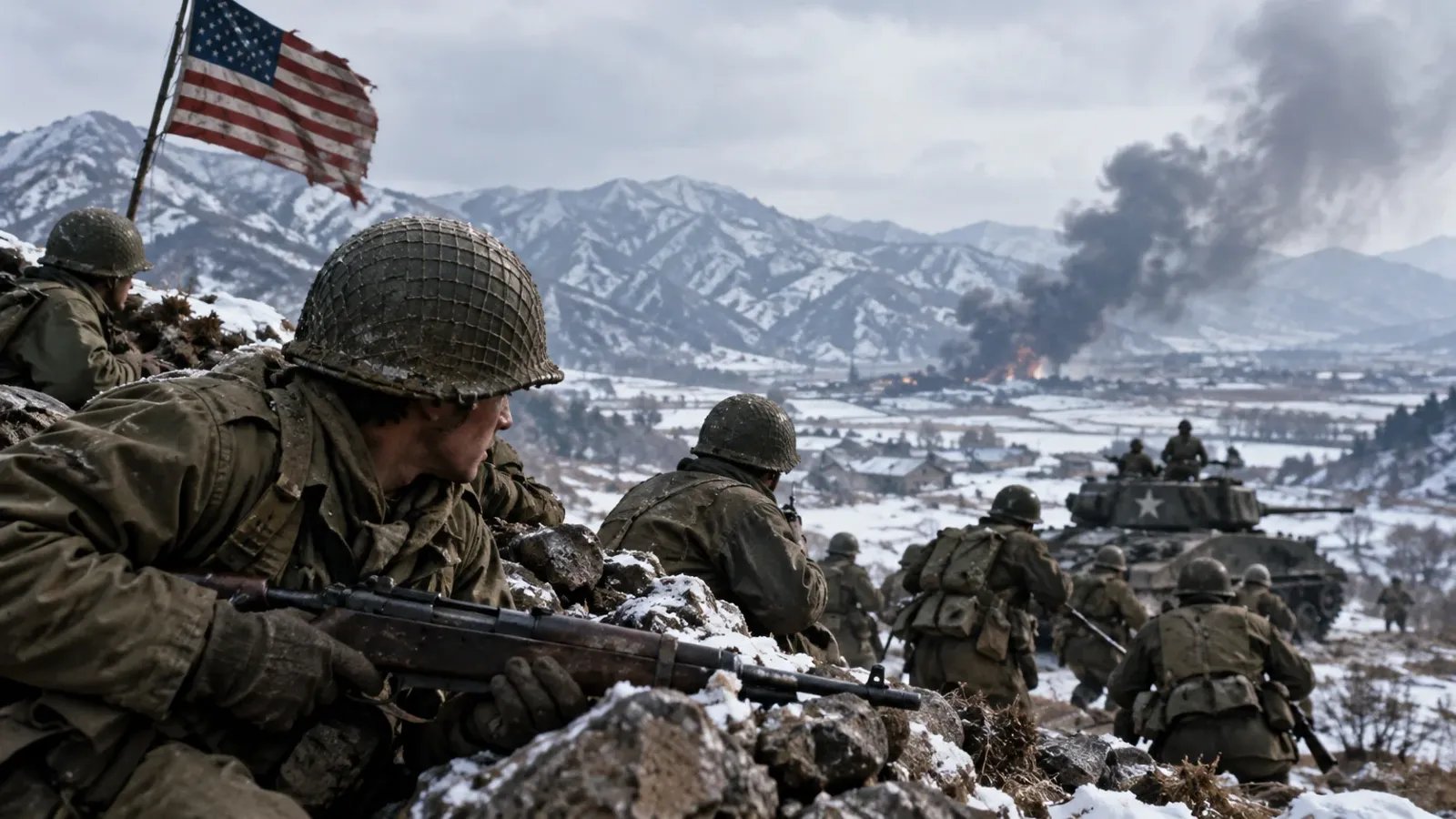
Often dismissed as a minor proxy skirmish sandwiched between WWII and Vietnam, the Korean War was actually a groundbreaking, devastating conflict. It introduced jet-to-jet combat, saw massive civilian casualties, and established the modern Cold War paradigm. This unresolved war still shapes global geopolitics today.
1. The Korean War never officially ended.
When active fighting ceased on July 27, 1953, military commanders from the United States, North Korea, and China signed an armistice agreement rather than a peace treaty. This document merely established a ceasefire and created the Demilitarized Zone to separate the opposing forces. Because no formal diplomatic resolution was ever ratified by the warring governments, North and South Korea technically remain in a state of war to this day, making it one of the longest ongoing conflicts in modern history.
2. The United States never formally declared war on North Korea.
Despite committing hundreds of thousands of combat troops, the United States Congress never issued a formal declaration of war. Instead, President Harry S. Truman classified the military intervention as a "police action" under the auspices of the newly formed United Nations. This set a monumental legal and historical precedent, allowing future American presidents to bypass congressional war declarations to deploy military forces around the globe.
3. The conflict witnessed the first jet-to-jet aerial combat in human history.
Prior to the Korean War, dogfights were strictly propeller-driven affairs. The skies over northwestern North Korea, famously dubbed MiG Alley, became the world's first arena for jet fighter combat. American pilots flying F-86 Sabres clashed with communist pilots flying Soviet-built MiG-15s at near-supersonic speeds, fundamentally changing military aviation and the engineering of fighter aircraft forever.
4. More bombs were dropped on the Korean peninsula than on the entire Pacific theater during World War II.
During the three-year conflict, American aircraft dropped approximately 635,000 tons of explosives and tens of thousands of tons of napalm on North Korea. This massive, sustained aerial bombardment campaign decimated the region's infrastructure. By the end of the war, an estimated 85 percent of all North Korean buildings had been destroyed, forcing citizens and military factories to relocate into a massive network of underground tunnels and caves.
5. The war popularized the concept of Mobile Army Surgical Hospital units and helicopter evacuations.
The harsh, mountainous terrain of Korea made traditional ambulance transport nearly impossible, leading the military to heavily utilize helicopters for medical evacuations. By airlifting critically wounded soldiers directly from the front lines to Mobile Army Surgical Hospital units, the military achieved a staggering 97 percent survival rate for troops who reached these facilities alive, revolutionizing trauma medicine both in the military and in civilian life.
6. Colombia was the only Latin American nation to send combat troops to fight in the Korean War.
In response to the United Nations' call for international assistance, Colombia deployed an infantry battalion and naval frigates to the Korean peninsula. The Colombian Battalion fought fiercely alongside the US 24th Infantry Division, distinguishing themselves in brutal engagements like the Battle of Old Baldy. Their participation remains a unique and highly respected chapter in South American military history.
 Wars and Conflicts of the 20th Century
Explore the hidden realities of 20th-century warfare and geopolitical conflicts. From world-altering military campaigns and covert intelligence operations to the eccentricities of ruthless dictators, uncover the surprising truths behind the events that shaped the modern world.
See All Facts
Wars and Conflicts of the 20th Century
Explore the hidden realities of 20th-century warfare and geopolitical conflicts. From world-altering military campaigns and covert intelligence operations to the eccentricities of ruthless dictators, uncover the surprising truths behind the events that shaped the modern world.
See All Facts
7. The demarcation line dividing the two Koreas accidentally became a deeply fortified nature preserve.
The Demilitarized Zone, a 160-mile long and 2.5-mile wide strip of land separating North and South Korea, is the most heavily militarized border in the world. However, because humans have been strictly barred from entering the area for over seventy years, it has transformed into an untouched ecological sanctuary. It currently serves as a thriving haven for rare and endangered wildlife, including Asiatic black bears, Amur leopards, and thousands of migratory birds.
8. Soviet pilots secretly flew combat missions in North Korean aircraft against United Nations forces.
To avoid directly sparking World War III with the United States, the Soviet Union secretly deployed its elite World War II veteran pilots to fly MiG-15s for the communist forces. To maintain plausible deniability, the Soviet pilots wore Chinese uniforms, carried fake identification, and were strictly ordered to speak only Korean on their radios. However, in the heat of combat, the deception frequently fell apart as panicked pilots resorted to shouting in Russian.
9. The total integration of the United States military was solidified on the battlefields of Korea.
Although President Truman issued Executive Order 9981 in 1948 to desegregate the armed forces, the military had dragged its feet on implementation. The massive manpower demands and heavy casualties of the early Korean War finally forced commanders to dissolve all-Black units, like the historic 24th Infantry Regiment, and distribute their soldiers into depleted white units. Korea became the first conflict where fully integrated American troops fought side by side.
10. Freezing winters caused more devastating non-battle casualties than enemy fire in several early campaigns.
The Korean peninsula experiences incredibly harsh winter weather, largely driven by freezing winds sweeping down from Siberia. During the infamous Battle of Chosin Reservoir in late 1950, temperatures plummeted to 30 degrees below zero Fahrenheit. The extreme cold froze blood plasma, caused artillery shells to misfire, and inflicted severe frostbite on thousands of soldiers, rendering the weather as deadly as the surrounding enemy forces.
11. South Korea was not a signatory to the 1953 armistice agreement.
While representatives from the United Nations Command, the North Korean military, and the Chinese military signed the armistice to halt the fighting, South Korean President Syngman Rhee vehemently refused to sign. Rhee believed that agreeing to the armistice meant accepting the permanent division of his country, and he demanded that the war continue until the entire peninsula was unified under a democratic government.
12. The concept of brainwashing became a widespread psychological phenomenon due to American prisoners of war.
When the war ended, twenty-one American prisoners of war famously refused repatriation and chose to remain in communist China. Additionally, several captured US airmen made public broadcasts confessing to using biological weapons. The CIA and American media popularized the term brainwashing to explain how the Chinese and North Korean captors allegedly used psychological torture and indoctrination to overwrite the minds of these soldiers.
13. The initial North Korean invasion force overwhelmed the south largely due to superior Soviet-supplied tanks.
When North Korea crossed the 38th Parallel in June 1950, they spearheaded their assault with Soviet T-34 tanks, the same legendary armor that had crushed the German military in World War II. South Korean and early arriving American forces had absolutely no tanks or adequate anti-tank weaponry to stop them. American bazooka rounds literally bounced off the T-34s, allowing the North Koreans to conquer the vast majority of the peninsula before UN reinforcements arrived.
14. The war saw the largest mass evacuation of civilians by a single ship in military history.
In December 1950, as United Nations forces retreated from the port of Hungnam, the crew of the SS Meredith Victory, an American merchant marine freighter designed to carry just 12 passengers, made a miraculous decision. The captain ordered all weapons and cargo jettisoned to make room for desperate North Korean refugees fleeing the communist advance. The ship safely transported 14,000 civilians through mine-infested waters without a single casualty, earning it the nickname the Ship of Miracles.
15. A massive number of captured Chinese and North Korean soldiers refused to return to their home countries.
During the peace negotiations, the repatriation of prisoners became a massive diplomatic stumbling block. While communist governments demanded the return of all their captured soldiers, the United Nations insisted on voluntary repatriation. In the end, over 22,000 Chinese and North Korean prisoners of war explicitly refused to return to their communist homelands, opting instead to resettle in Taiwan, South Korea, or other neutral nations.
Sources & References
This AI-assisted post was rigorously curated and fact-checked for accuracy by:
 Martin Roháček
How fun was this article? 🤔
Tap a star to rate it
🧠 Quiz: How closely were you paying attention?
10 questions — all answers are in the article above!
Enjoyed these facts? There's more! 💌
Fresh fun facts in your inbox. No spam, ever.