The Hermit Kingdom: 15 Fascinating Facts About North Korea
From customized basketball rules and closed intranet networks to mythic archaeological declarations and abandoned mega-projects, North Korea remains one of the world's most secretive and misunderstood nations. While foreign headlines often focus on geopolitical tensions, daily life inside the totalitarian state is governed by extraordinary ideological rules and surprising regime mandates. These 15 fascinating facts reveal the surreal, dark, and astonishing realities of life inside the Hermit Kingdom.
1. The Government Enforces Three Generations of Punishment
Under a collective punishment policy known as Yeon-jwa-je, the North Korean state punishes entire families for the political crimes or defections of a single individual. If a citizen is accused of treason or attempts to flee the country, their parents, children, and grandparents can all be sent to penal labor camps alongside them. This brutal law was formally instituted to purge perceived counter-revolutionary elements and ensure absolute obedience through fear. Relatives often spend their entire lives in harsh prison colonies for offenses they never committed or even knew about. Consequently, the threat of destroying one's family remains one of the regime's most effective tools for preventing dissent.
2. The Country Rewrote the Official Rules of Basketball
North Korea developed its own customized scoring system for basketball to make the sport more fast-paced and aggressive. In the North Korean league, a slam dunk is awarded three points instead of two, and a three-pointer that hits nothing but net earns four points. Conversely, teams are penalized with a deduction of one point for every missed free throw attempt. Additionally, any field goal scored in the final three seconds of a game is worth eight points, creating dramatic last-second comebacks. Dictator Kim Jong Un, a passionate fan of the sport, has continued to endorse this unique set of rules.
3. Citizens Face Mandatory Quotas for Human Waste
Due to severe economic sanctions and a lack of chemical fertilizers, North Korea relies heavily on human excrement for agricultural production. The state imposes strict quotas on households, schools, and factories, demanding hundreds of kilograms of nightsoil from each source annually. During collection seasons, families actively guard their toilets and battle neighbors over waste to meet their government-mandated targets. Some citizens even resort to stealing human waste from public facilities or buying it from markets to avoid harsh punishment. This bizarre system highlights the extreme agricultural strain and resource scarcity facing the nation.
4. Blue Jeans Are Outlawed as a Symbol of Imperialism
The regime strictly regulates fashion, placing an explicit ban on blue denim jeans across the country. State authorities view blue jeans as an overt symbol of Western culture, American capitalism, and anti-socialist corruption. Special government fashion police patrol city streets to inspect citizens' clothing, hairstyles, and footwear for Western influences. While black or dark-colored trousers are permitted, wearing blue denim can result in public humiliation, fines, or forced hard labor. Visitors and foreign tourists are also required to dress conservatively when visiting sacred national monuments.
5. A Completely Uninhabited "Peace Village" Sits on the Border
Directly across from the Demilitarized Zone lies Kijong-dong, a colorful settlement built in the 1950s that the regime calls "Peace Village." From a distance, the town features bright multi-story buildings, fully functional electric lights, and a massive 525-foot flagpole displaying the national flag. However, telescopic observation from South Korea revealed that the structures are empty concrete shells without real windows or interior rooms. Electric lights turn on and off automatically via timers, while caretakers sweep empty sidewalks to maintain the illusion of a prosperous community. Western observers widely refer to the site as a ghost town designed purely for border propaganda.
6. State Media Claimed Kim Jong Il Shot 38 Under Par in Golf
Official state media once reported an incredible sports achievement regarding former leader Kim Jong Il's very first attempt at golf in 1994. According to state propaganda broadcasts, Kim played an 18-hole round at the Pyongyang Golf Complex and finished at 38 under par. The extraordinary scorecard allegedly included five holes-in-one, witnessed by seventeen personal bodyguards on site. Following this supernatural performance, state outlets claimed that the leader immediately retired from golf forever, having mastered the sport instantly. This legendary tale remains one of the most surreal examples of personality cult propaganda in modern history.
7. Dictator Kim Jong Il Kidnapped a Director to Make a Monster Movie
In 1978, North Korean secret agents abducted renowned South Korean film director Shin Sang-ok and his ex-wife, actress Choi Eun-hee. Dictator Kim Jong Il, a film enthusiast, imprisoned the couple for years before forcing them to modernize North Korea's film industry. Their most famous propaganda project was Pulgasari, a giant monster film heavily inspired by Japan's Godzilla franchise. During a foreign press tour in Vienna in 1986, Shin and Choi managed a daring escape by fleeing into the United States Embassy. The movie remains a cult classic among film historians for its bizarre, politically charged production history.
8. The Nation Uses Its Own Calendar Based on Kim Il Sung's Birth
Instead of relying on the Gregorian calendar used across most of the globe, North Korea utilizes its own ideological calendar system known as the Juche calendar. The calendar counts years starting from April 15, 1912, the birth date of the nation's founder, Kim Il Sung. Under this system, year 1 begins in 1912, meaning that the year 2024 corresponds to Juche 113. While calendar months and days align with international standards, all official state documents and media print the Juche year alongside Gregorian dates. This calendar reflects the nation's total ideological devotion to the ruling Kim dynasty.
9. Elections Feature Only One Pre-Approved Name on the Ballot
North Korea holds parliamentary elections every five years, but the process is completely devoid of democratic choice. Voters receive a single ballot containing only one state-approved candidate selected by the ruling party for each district. While citizens technically have the option to cross out the candidate's name in a private voting booth, doing so is viewed as an act of treason. Secret police officers monitor polling stations, ensuring that nearly 100 percent of voters cast an unmarked affirmative vote. The ritual serves primarily as a mandatory political census and an exercise in public compliance.
10. State Archaeologists Claimed to Discover a Unicorn Lair
In 2012, the Korean Central News Agency announced that state archaeologists had discovered a "unicorn lair" near a temple in Pyongyang. Researchers reported finding a rectangular rock carved with the words "Unicorn Lair," which they claimed dated back to the ancient Goguryeo Kingdom. According to government historians, this site belonged to King Tongmyong, a legendary monarch who supposedly rode a mythical creature called a kirin. While Western media reported the story as a literal belief in unicorns, the regime used the discovery symbolically to reinforce Pyongyang's status as the historic capital of Korea. The state frequently uses archaeological claims to bolster its nationalistic legitimacy.
11. Citizens Access a Closed State Intranet Instead of the Internet
The vast majority of North Koreans are completely cut off from the global internet, relying instead on a heavily censored intranet named Kwangmyong. Launched in 2000, this domestic network contains only a few thousand state-approved websites focused on news, university lectures, and government propaganda. Access to global websites, social media platforms, and foreign media is strictly blocked by military firewalls. Only a tiny fraction of top government officials, scientists, and elite military personnel hold permission to browse the unrestricted World Wide Web. This digital isolation prevents citizens from discovering information about the outside world.
12. Satellite Imagery Shows the Nation Plunged into Nighttime Darkness
Nighttime satellite photographs of East Asia reveal a stark geographical contrast: North Korea appears as an almost entirely black void. Surrounded by the vibrant, luminous networks of South Korea and neighboring China, the country completely darkens once night falls. Severe energy deficits, aging power infrastructure, and fuel shortages force the regime to turn off grid electricity for most regions overnight. Except for a modest glow radiating from the capital city of Pyongyang, the entire nation relies on candlelight or small solar panels. This vivid satellite image provides undeniable visual proof of the country's ongoing energy crisis.
13. Traffic Officers Direct Non-Existent Cars on Empty Streets
In Pyongyang, young women chosen for their appearance serve as Traffic Security Officers at major city intersections. Dressed in crisp uniforms, these traffic officers perform precise, robotic hand signals to direct vehicles along wide avenues. Surprisingly, they maintain these disciplined routines even when the streets are completely devoid of motor traffic. Because private vehicle ownership is virtually non-existent for ordinary citizens, most broad highways remain virtually empty throughout the day. The officers have become famous national icons and symbols of order, attracting dedicated fans and even inspiring state-made collectibles.
14. December 24th Celebrates the "Sacred Mother of the Revolution"
While millions of people around the globe celebrate Christmas Eve on December 24, North Korea recognizes a completely different state holiday. Citizens observe the birth anniversary of Kim Jong Suk, the mother of Kim Jong Il and hero of the anti-Japanese resistance. Known officially as the "Sacred Mother of the Revolution," her life is commemorated with political rallies, floral offerings, and mandatory memorial events. Religious celebrations are strictly banned throughout the state, making Christmas observance illegal and punishable by law. Replacing global holidays with veneration of the ruling family reinforces the state's pervasive personality cult.
15. The Massive Ryugyong Hotel Stood Unfinished for Decades
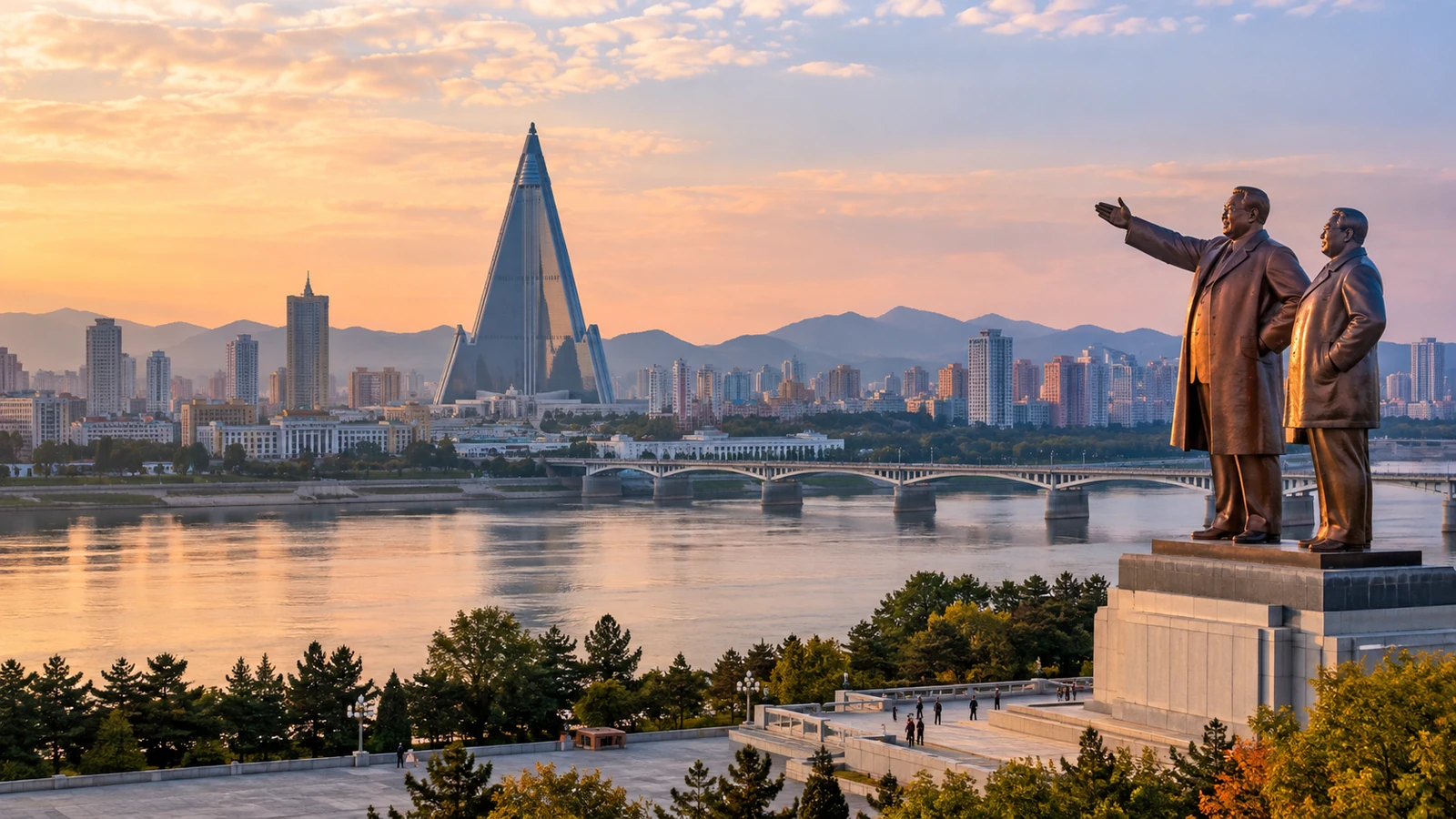
Dominating the skyline of Pyongyang is the Ryugyong Hotel, a massive 105-story pyramid-shaped skyscraper that stood unfinished for over twenty years. Construction began in 1987, but the collapse of the Soviet Union triggered a devastating economic crisis that halted work in 1992. The hollow concrete monolith sat entirely empty for decades, earning international notoriety as the "Hotel of Doom." Although an Egyptian telecommunications firm added exterior glass panels and dynamic LED displays in the late 2000s, the interior remains unopened to guests. It stands as the tallest unoccupied building in the world.
Sources & References
This AI-assisted post was rigorously curated and fact-checked for accuracy by:
 Martin Roháček
How fun was this article? 🤔
Tap a star to rate it
🧠 Quiz: How closely were you paying attention?
10 questions — all answers are in the article above!
Enjoyed these facts? There's more! 💌
Fresh fun facts in your inbox. No spam, ever.