The Unlikely Statesman: 15 Fascinating Facts About Harry S. Truman
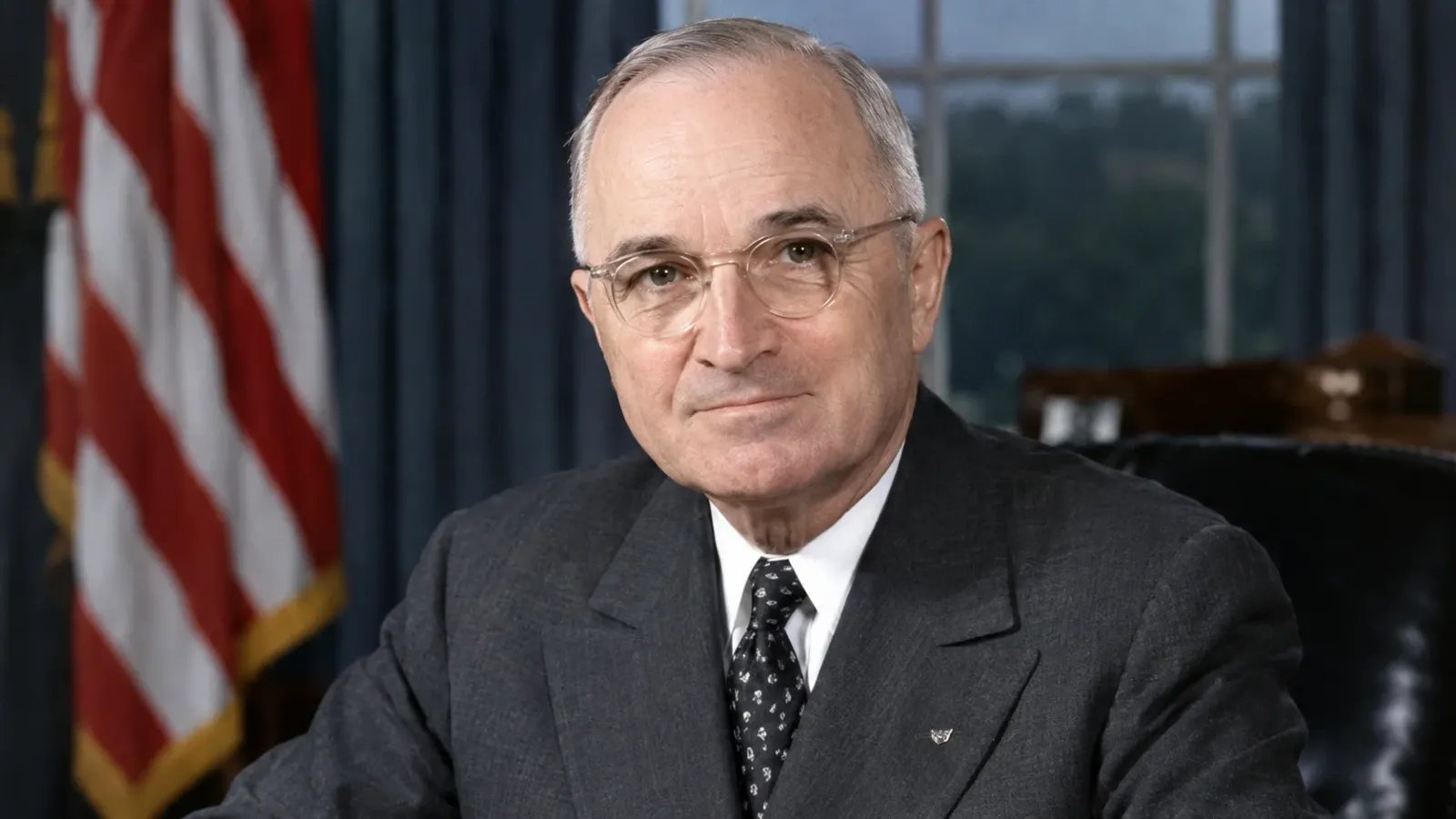
Not just an accidental president in FDR's shadow, Harry S. Truman was a complex leader. Far from a simple haberdasher, he navigated the atomic age, reshaped global geopolitics, and boldly championed civil rights. Discover the obscure historical surprises behind the man whose famous desk sign declared that the buck stopped with him.
1. The "S" in Harry S. Truman does not actually stand for a specific middle name.
Despite common assumptions that presidential middle initials represent a formal name, Truman's parents gave him the standalone letter to appease two grandfathers. His paternal grandfather was Anderson Shipp Truman, while his maternal grandfather was Solomon Young. Unable to choose between Shipp and Solomon without causing a family rift, his parents compromised by making his middle name simply the letter "S" itself. Consequently, Truman would often joke that the period after the initial was unnecessary, though he frequently used it anyway in official correspondence.
2. Truman remains the only president of the twentieth century to serve without holding a college degree.
In an era where Ivy League pedigrees became the presidential standard, Truman's formal education was notably modest. He attended a local business college in Kansas City for only a single semester before dropping out to help support his family through clerical work. Years later, he took night classes at the Kansas City Law School but never completed his legal studies. This lack of a formal degree often led political elites to underestimate his intellectual curiosity, ignoring the fact that he was an avid lifelong reader of dense historical and biographical texts.
3. Because of his remarkably poor eyesight, Truman had to secretly memorize the eye chart to enlist in the military.
From a young age, Truman suffered from flat eyeballs, a condition that left him with severe myopia and legally blind in his left eye. When the United States entered World War I, he was determined to serve but knew his vision would immediately disqualify him from military duty. To bypass the medical examiners, he surreptitiously memorized the standard Snellen eye chart before his physical evaluation. His ruse was successful, allowing him to join the Missouri National Guard and eventually lead an artillery unit in combat in France.
4. Before entering politics, Truman opened a men's clothing store that failed spectacularly during an economic recession.
Returning from World War I as an artillery captain, Truman partnered with his war buddy Eddie Jacobson to open a haberdashery in downtown Kansas City in 1919. The store initially thrived by selling shirts, ties, and hats to returning veterans, but the post-war economic depression of 1921 completely decimated their customer base. The business collapsed, leaving Truman burdened with massive debts that took him over fifteen years to fully pay off. This humiliating financial failure profoundly shaped his fiscal conservatism and his empathy for struggling small business owners.
5. Despite being Vice President, Truman was completely unaware of the Manhattan Project until Franklin D. Roosevelt died.
Roosevelt famously kept his vice presidents out of the loop on major strategic decisions, and Truman was no exception during his brief 82-day tenure in the role. When FDR unexpectedly died in April 1945, Truman was abruptly sworn into the presidency without knowing America possessed a devastating new weapon. It was only after the swearing-in ceremony that Secretary of War Henry Stimson pulled him aside to reveal the existence of the atomic bomb. Truman was suddenly forced to grasp the scientific realities of nuclear warfare and make the agonizing decision on whether to deploy it.
6. Truman defied intense political opposition within his own party to permanently desegregate the United States Armed Forces.
Recognizing the hypocrisy of fighting for freedom abroad while denying it at home, Truman took a bold stance on civil rights that alienated many Southern Democrats. In 1948, he issued Executive Order 9981, which abolished racial discrimination in the United States military and mandated equal opportunity for all service members. The move was widely considered political suicide and prompted a walkout by the segregationist Dixiecrat faction during the Democratic National Convention. Despite threats of losing the upcoming election, Truman held firm, arguing that integrating the military was an urgent moral imperative.
 US Presidents
Discover the eccentricities, secret talents, and surprising hidden lives of America's most influential presidents, from frontier wrestlers to covert strategists.
See All Facts
US Presidents
Discover the eccentricities, secret talents, and surprising hidden lives of America's most influential presidents, from frontier wrestlers to covert strategists.
See All Facts
7. Puerto Rican nationalists attempted to assassinate Truman while he was temporarily living in the Blair House.
During major renovations of the crumbling White House in 1950, Truman and his family temporarily resided across the street at the Blair House. On November 1, two heavily armed Puerto Rican independence activists launched a brazen daytime assault on the residence, attempting to shoot their way inside to kill the president. A fierce gun battle erupted on the sidewalk, resulting in the death of one attacker and White House policeman Leslie Coffelt, who fatally shot the assailant before dying from his own wounds. Truman, awoken from a nap by the gunfire, shockingly walked to an open window to see what was happening before guards shouted at him to take cover.
8. The most famous photograph of Truman features him holding a newspaper that incorrectly declared his election defeat.
The 1948 presidential election between Truman and Republican challenger Thomas E. Dewey was widely expected to end in a landslide victory for Dewey. Polling was so skewed that the Chicago Daily Tribune preemptively printed the headline "Dewey Defeats Truman" to ensure their morning edition hit the streets early. Instead, Truman pulled off one of the greatest political upsets in American history, winning the electoral college decisively. Two days later, a victorious Truman was photographed at a St. Louis train station gleefully holding the erroneous front page, cementing the image as an iconic symbol of media hubris.
9. Decades after his presidency, Truman was awarded the very first Medicare card by Lyndon B. Johnson.
During his time in office, Truman fiercely advocated for a national health insurance program, but his proposals were systematically blocked by a hostile Congress and the medical lobby. His dream of providing healthcare for the elderly remained unfulfilled until President Lyndon B. Johnson successfully signed the Medicare act into law in 1965. To honor Truman's pioneering efforts on the issue, Johnson traveled to the Truman Presidential Library in Missouri for the signing ceremony. There, he presented the 81-year-old former president with Medicare card number one, while his wife Bess received card number two.
10. Truman's severe financial struggles after leaving the White House led directly to the creation of the presidential pension.
When Truman's presidential term ended in 1953, the federal government did not provide pensions, secret service protection, or expense accounts for former chief executives. Returning to Missouri, Truman survived on a minimal army pension of about 112 dollars a month and refused numerous lucrative corporate endorsements, believing they would cheapen the office of the presidency. His mounting financial distress became a poorly kept secret in Washington, eventually catching the attention of lawmakers. In response, Congress passed the Former Presidents Act in 1958, granting a $25,000 annual pension to ensure leaders did not fall into destitution.
11. Truman was an accomplished classical pianist who often woke up early to practice Mozart and Chopin.
Music was one of Truman's greatest lifelong passions, fostered by years of intensive piano lessons during his childhood in Missouri. He was highly skilled at the keyboard and reportedly considered pursuing a career as a concert pianist before turning his attention to farming and politics. Even during the most stressful periods of his presidency, he found solace in playing the White House piano, often waking up before dawn to practice classical compositions. His public performances, including a famous duet with comedian Jack Benny, helped humanize him in the eyes of the American public.
12. Truman made the United States the first nation to officially recognize the modern state of Israel, doing so in just eleven minutes.
The geopolitical debate surrounding the establishment of a Jewish state in Palestine deeply divided Truman's own administration. Secretary of State George Marshall vehemently opposed recognition, fearing it would disastrously alienate Arab nations and threaten global oil supplies. Despite intense pressure from his top advisors, Truman sympathized with the plight of Holocaust survivors and believed deeply in the principle of self-determination. On May 14, 1948, mere minutes after David Ben-Gurion declared Israeli independence, Truman issued a de facto recognition of the new government, fundamentally altering Middle Eastern geopolitics.
13. He ordered a complete gutting and structural reconstruction of the White House after a piano leg fell through the floor.
By the late 1940s, the White House had deteriorated into a severe structural hazard, weakened by decades of hasty renovations and the massive additions made during previous administrations. The crisis peaked when the floor beneath Truman's daughter's piano warped so badly that one of its legs punched right through the rotting floorboards. Engineers discovered the mansion was dangerously close to total collapse, forcing the first family to immediately evacuate to the nearby Blair House. Truman oversaw a massive four-year reconstruction project that completely dismantled the interior, replaced the wooden beams with a modern steel frame, and rebuilt the historic rooms inside the original stone shell.
14. Truman willingly surrendered naming rights for his European recovery initiative to ensure its passage through a Republican Congress.
Following World War II, Europe was economically devastated and increasingly vulnerable to Soviet communist expansion. Truman's administration devised a massive financial aid program to rebuild the continent, but Truman knew that a plan bearing his name would be instantly rejected by the Republican-controlled Congress. Recognizing that the mission's success was more important than his own political legacy, he tasked his highly respected Secretary of State, George C. Marshall, with presenting the idea. The strategy worked brilliantly; the "Marshall Plan" received bipartisan support, successfully revitalized Western European economies, and solidified the transatlantic alliance.
15. The famous wooden sign on Truman's desk declaring "The Buck Stops Here" was actually crafted by inmates at a federal reformatory.
Truman's mantra of absolute executive accountability is permanently immortalized by the small wooden sign that sat on his Oval Office desk. The phrase derives from the slang expression "passing the buck," meaning to shift responsibility to someone else. The sign itself was not a fancy presidential commission, but rather a gift made by the inmates of the Federal Reformatory in El Reno, Oklahoma. A friend of Truman's saw a similar sign at the prison and requested one for the president, who proudly displayed it as a daily reminder that he alone bore the ultimate weight of the nation's hardest decisions.
Sources & References
This AI-assisted post was rigorously curated and fact-checked for accuracy by:
 Martin Roháček
How fun was this article? 🤔
Tap a star to rate it
🧠 Quiz: How closely were you paying attention?
10 questions — all answers are in the article above!
Enjoyed these facts? There's more! 💌
Fresh fun facts in your inbox. No spam, ever.