The Reluctant Politician: 15 Fascinating Facts About Dwight D. Eisenhower
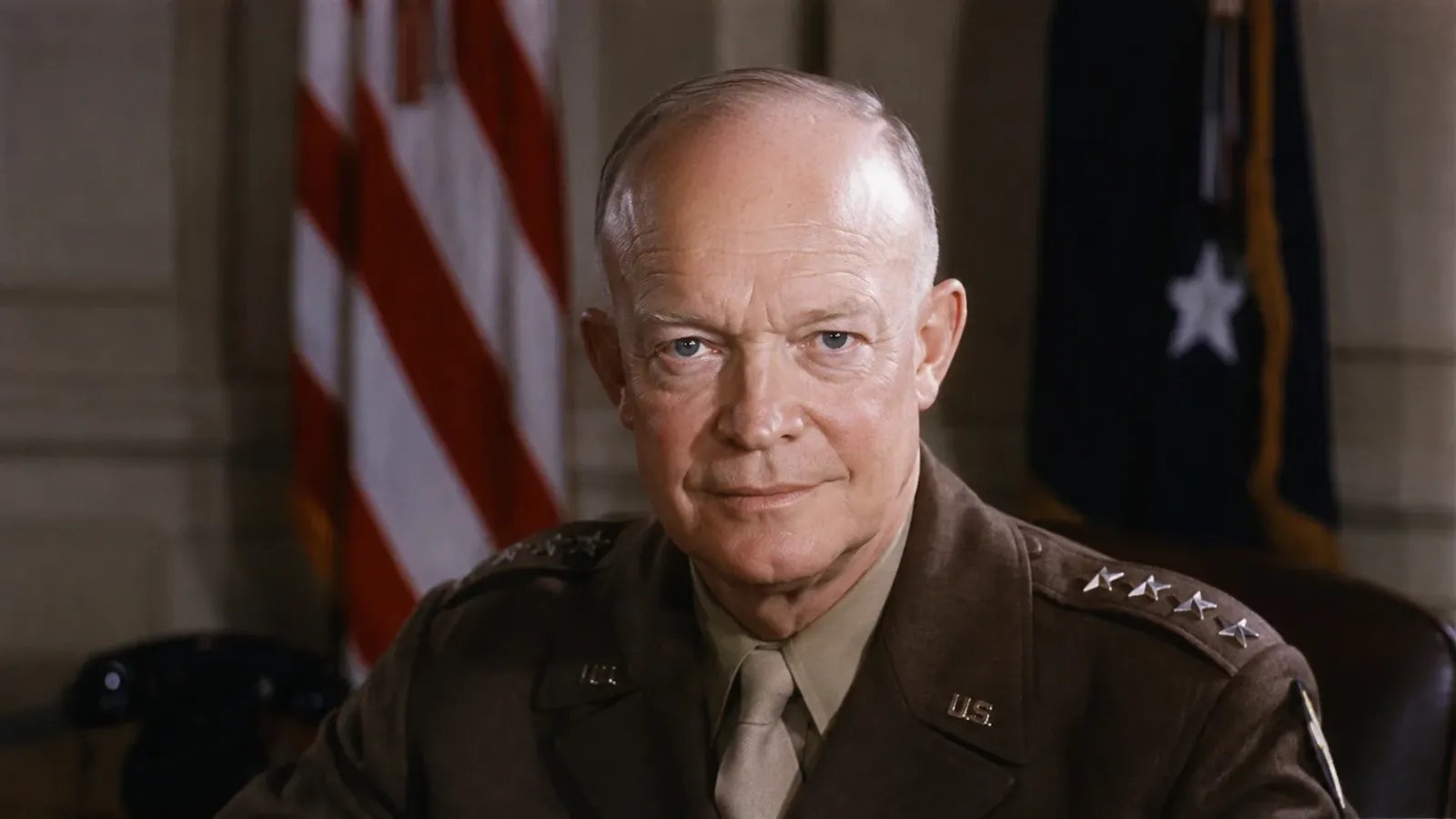
Often dismissed as a golf-loving grandfather who presided over a sleepy 1950s America, Dwight D. Eisenhower was actually a ruthless strategist. Far from a passive observer, he ran a "hidden-hand" presidency, wielding covert tactics and psychology to shape the Cold War. Discover the secrets of this commander.
1. Eisenhower originally wanted to join the Navy, not the Army, but was rejected because of his age.
Before becoming the supreme commander of Allied forces in Europe, a young Eisenhower passed the highly competitive entrance exam for the Naval Academy at Annapolis. However, he soon discovered he had just exceeded the strict maximum age limit for naval cadets. Pivoting his strategy, he applied to the United States Military Academy at West Point, permanently altering the trajectory of American military history.
2. He never saw active combat during his entire extensive military career.
Despite holding the five-star rank of General of the Army and orchestrating the largest amphibious invasion in human history, Eisenhower never engaged in a firefight. During World War I, his repeated requests for an overseas combat deployment were denied, and he was kept stateside to command a tank training center in Pennsylvania. By the time the United States entered World War II, his logistical brilliance made him far too valuable to risk on the front lines.
3. Eisenhower spearheaded the creation of the interstate highway system after being inspired by the German Autobahn.
While a young army officer in 1919, Eisenhower participated in a miserable cross-country military convoy that took 62 days to cross the abysmal dirt roads of the United States. Decades later, while pushing through Germany in World War II, he observed the immense strategic and logistical efficiency of the Autobahn network. This realization directly fueled his push for the Federal-Aid Highway Act of 1956, shaping modern American infrastructure under the guise of national defense.
4. He was the first United States president to regularly fly in a helicopter.
To solve the logistical headache of traveling between the White House and his summer home in Rhode Island, Eisenhower began using a Bell UH-13J Sioux helicopter in 1957. The Secret Service initially balked at the safety risks, but the massive reduction in transit time won out. This practical decision established the template for the modern Marine One transport system used by all subsequent presidents.
5. The initial "D" in Dwight D. Eisenhower originally stood for David, but his mother swapped his names to avoid family confusion.
He was born David Dwight Eisenhower, named after his father. Because his mother found it tedious to have two Davids in the house, the family exclusively called him Dwight. When it came time to officially enroll at West Point, he permanently reversed his first and middle names to Dwight David to match his lifelong moniker.
6. Eisenhower drafted a secret letter taking full personal blame in case the D-Day invasion failed.
Known by historians as the "In Case of Failure" message, Eisenhower penned a short, heavy-hearted note on June 5, 1944. In it, he stated that the troops had done everything that bravery could do, and that if any fault or blame attached to the failure of the operation, it was his alone. He quietly tucked it into his wallet, fully prepared to resign in disgrace if the Normandy landings collapsed.
 US Presidents
Discover the eccentricities, secret talents, and surprising hidden lives of America's most influential presidents, from frontier wrestlers to covert strategists.
See All Facts
US Presidents
Discover the eccentricities, secret talents, and surprising hidden lives of America's most influential presidents, from frontier wrestlers to covert strategists.
See All Facts
7. He waged a furious, secret war against the squirrels digging up his White House putting green.
An avid golfer, Eisenhower had a custom putting green installed on the South Lawn, but the local squirrel population persistently buried nuts in the freshly manicured turf. The president became so enraged that he ordered his Secret Service detail to shoot the offending rodents. To avoid an utter public relations disaster, the groundskeepers secretly resorted to catching the squirrels in humane box traps and relocating them to local parks.
8. Eisenhower was a remarkably prolific oil painter who produced over two hundred fifty canvases.
Taking up painting at the relatively late age of 58 to relieve the immense stress of his duties, Eisenhower mostly painted landscapes and portraits. He painted likenesses of his wife, Winston Churchill, and George Washington, often gifting them to friends and staff. He was incredibly humble about his hobby, outright refusing to consider himself a real artist and calling his works mere daubs.
9. He was the first sitting American president to appear on color television.
As broadcast technology advanced rapidly during his tenure, Eisenhower became the face of a new media era. In June 1955, his commencement address to the graduating class at the United States Military Academy at West Point was broadcast in full color. He understood the psychological power of television and regularly hired actors and media consultants to help him project a calm, authoritative persona on camera.
10. Eisenhower essentially invented the modern Camp David presidential retreat by renaming it after his grandson.
Franklin D. Roosevelt had originally established a rustic presidential retreat in the Maryland mountains, naming it "Shangri-La" after the fictional Himalayan paradise. Eisenhower found the name unnecessarily ostentatious and rebranded the compound as Camp David, in honor of his young grandson. The name stuck permanently, becoming the site of countless historical diplomatic negotiations.
11. He quietly threatened to use nuclear weapons to break the diplomatic deadlock of the Korean War.
Frustrated by the stalled peace talks upon entering office in 1953, Eisenhower engaged in high-stakes diplomatic brinkmanship. Through backchannel contacts in India and Taiwan, he signaled to the Chinese and North Korean governments that the United States would not rule out an atomic strike if an armistice wasn't reached swiftly. The psychological pressure worked, and an armistice was signed just months later.
12. Eisenhower coined the phrase "military-industrial complex" to warn against the very defense establishment he helped build.
In one of the most remarkable paradoxes of American history, a five-star general who spent his life in the military used his 1961 farewell address to sound the alarm on the defense sector. He warned the American public that the unprecedented alliance between an immense military establishment and a massive arms industry could easily subvert democratic processes and lead to disastrous, perpetual wars.
13. He was nearly expelled from West Point due to a severe knee injury sustained while trying to tackle Olympic legend Jim Thorpe.
During a highly anticipated football game in 1912 between Army and the Carlisle Indian Industrial School, Eisenhower attempted a tactical tackle on the phenomenal athlete Jim Thorpe. The encounter exacerbated a knee injury that eventually ended Eisenhower's athletic career and plunged him into a deep depression. The injury was so severe that military doctors recommended he be discharged, but a sympathetic medical officer intervened to let him finish his commission.
14. The CIA carried out its first successful covert regime change operations under Eisenhower's direct orders.
While publicly projecting the image of a grandfatherly statesman focused on peace, Eisenhower aggressively expanded the use of the Central Intelligence Agency to fight the Cold War in the shadows. He personally authorized Operation Ajax in Iran in 1953 and Operation PBSUCCESS in Guatemala in 1954, utilizing covert psychological warfare and paramilitaries to overthrow democratically elected governments he perceived as sympathetic to communism.
15. He was offered the presidential nomination by both the Democratic and Republican parties before the 1952 election.
Following World War II, Eisenhower's national popularity was so absolute that his actual political leanings were irrelevant to party bosses. Democratic President Harry S. Truman actively tried to recruit Eisenhower to run as a Democrat, offering to step aside and run as his vice president. Ultimately, Eisenhower rejected the Democrats' New Deal domestic policies and declared himself a Republican, securing the presidency in a landslide.
Sources & References
This AI-assisted post was rigorously curated and fact-checked for accuracy by:
 Martin Roháček
How fun was this article? 🤔
Tap a star to rate it
🧠 Quiz: How closely were you paying attention?
10 questions — all answers are in the article above!
Enjoyed these facts? There's more! 💌
Fresh fun facts in your inbox. No spam, ever.