The Unprecedented Leader: 15 Fascinating Facts About Franklin D. Roosevelt
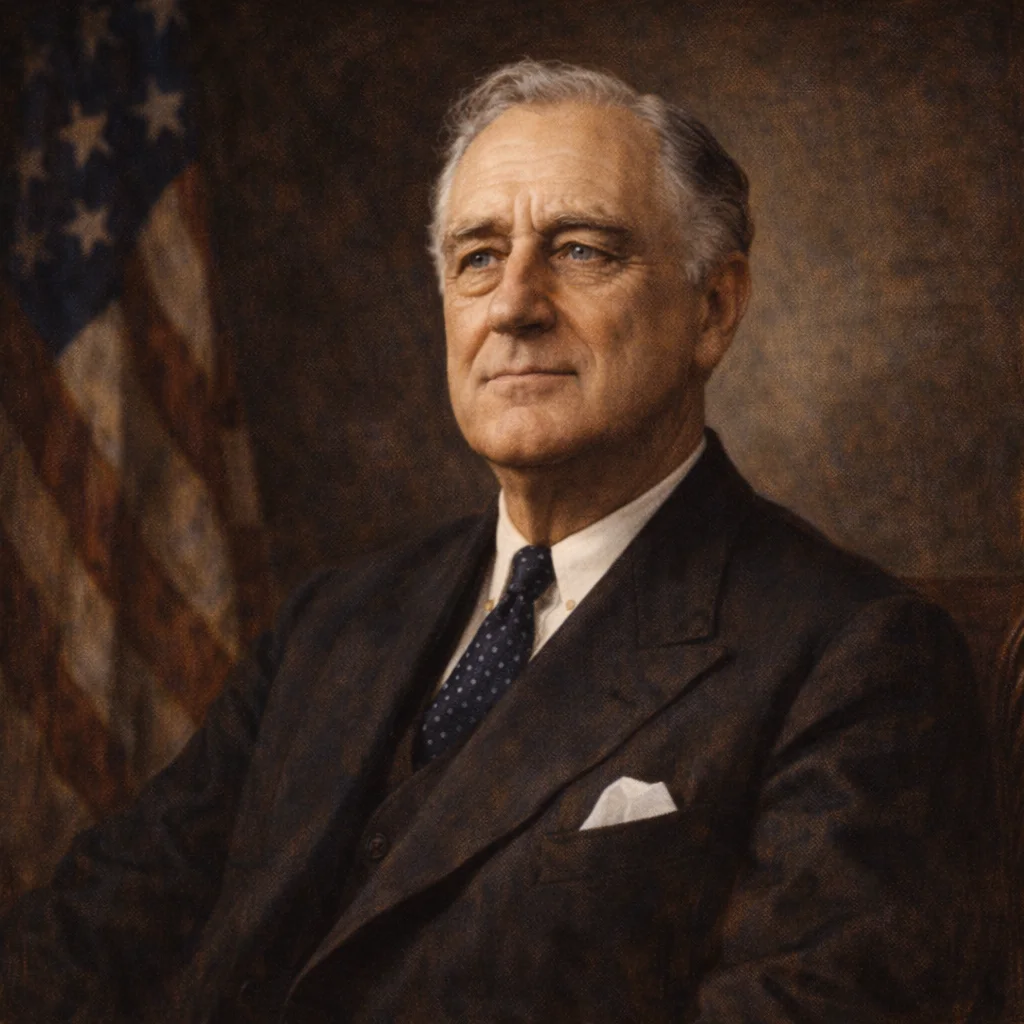
Franklin D. Roosevelt remains one of the most transformative figures in American history, leading the United States through both the Great Depression and World War II. As the only chief executive elected to four terms, his presidency reshaped the nation's political landscape and the scope of executive power. Behind his confident public persona was a complex leader who overcame severe physical challenges to reshape modern democracy. Discover 15 fascinating facts about FDR, from secret air travel and presidential pets to royal hot dog picnics.
1. He Was Elected to the Presidency Four Times
Franklin Delano Roosevelt remains the only U.S. president to serve more than two terms in office, winning consecutive elections in 1932, 1936, 1940, and 1944. Guiding the nation through the Great Depression and World War II, his extended tenure lasted over twelve years until his death in 1945. Before FDR, presidents voluntarily followed George Washington's unwritten two-term tradition, though no law explicitly forbade a third run. Roosevelt's unprecedented streak prompted Congress to propose the Twenty-second Amendment in 1947, which was ratified by the states in 1951. Today, this constitutional amendment strictly limits all future American presidents to a maximum of two elected terms in office.
2. He Carefully Concealed His Paralysis from the American Public
After contracting a paralyzing illness—long diagnosed as polio—at age 39 in 1921, Roosevelt lost the functional use of both legs. Determined to maintain an image of physical strength and vitality in a political landscape that prized vigor, he went to extraordinary lengths to hide his mobility limitations. He wore heavy, rigid steel leg braces under his trousers, allowing him to stand at podiums by supporting himself on his cane or an aide's arm. White House staff and military aides arranged discreet ramps, while press photographers observed an unwritten gentleman's agreement not to shoot pictures of him using his wheelchair or being carried. Consequently, out of thousands of surviving photographs from his presidency, only a handful show FDR clearly seated in a wheelchair.
3. He Married His Cousin, and Theodore Roosevelt Walked Her Down the Aisle
In 1905, Franklin Roosevelt married Eleanor Roosevelt, who was his fifth cousin once removed. The couple had known each other since childhood, sharing deep ancestral ties to the wealthy New York Roosevelt clan. The wedding took place on St. Patrick's Day in New York City and generated enormous media attention across the nation. Adding to the family drama, President Theodore Roosevelt—Eleanor's uncle and Franklin's fifth cousin—gave the bride away because her father had passed away years earlier. Theodore's overwhelming charisma reportedly stole the show from the newlyweds, yet the union marked the start of one of history's most influential political partnerships.
4. An Assassin’s Bullet Intended for FDR Killed the Mayor of Chicago
In February 1933, just weeks before his first presidential inauguration, Roosevelt survived an assassination attempt in Miami, Florida. An unemployed bricklayer named Giuseppe Zangara opened fire on the president-elect following an informal speech delivered from an open car. A bystander, Lillian Cross, grabbed Zangara's arm, causing his shots to stray into the surrounding crowd. While FDR escaped entirely unharmed, five people were struck, including Mayor Anton Cermak of Chicago, who was mortally wounded. Cermak famously told Roosevelt at the hospital, "I'm glad it was me instead of you," a quote that entered American political folklore before Cermak succumbed to his injuries.
5. He Served Hot Dogs to the King and Queen of England
In June 1939, King George VI and Queen Elizabeth made history as the first reigning British monarchs to visit the United States. To showcase American hospitality, Roosevelt hosted the royal couple for an informal American-style picnic at his estate in Hyde Park, New York. The menu famously featured quintessential American comfort food: grilled hot dogs served on buns with mustard, alongside beer and potato salad. The press was initially scandalized by the informal dining choice, fearing it disrespected royal etiquette. However, Queen Elizabeth reportedly enjoyed her hot dog thoroughly, and the gesture helped forge a warm personal relationship that bolstered Anglo-American ties on the eve of World War II.
6. He Was the First American President to Appear on Television
On April 30, 1939, Franklin D. Roosevelt entered the technological record books by becoming the first U.S. president to give a televised broadcast. The historic broadcast occurred during the opening ceremony of the New York World's Fair in Flushing Meadows. At the time, television technology was in its infancy, and only a few hundred households in the New York area possessed receivers capable of picking up the signal. Despite the minuscule viewing audience, Roosevelt recognized the immense potential of the medium for political communication. His broadcast signaled the dawn of modern electronic media in American politics, paving the way for the televised era of government.
7. He Became the First Sitting President to Fly on Official Business
Roosevelt broke aviation ground in January 1943 when he became the first sitting U.S. president to travel by airplane while in office. Bound for the high-stakes Casablanca Conference in French Morocco to meet with British Prime Minister Winston Churchill, FDR took a secret, multi-leg journey across the Atlantic. The primary leg involved a Boeing 314 flying boat named the Dixie Clipper, which took off from Florida and made stops in South America and West Africa. Wartime security dictated absolute secrecy surrounding the flight path and scheduling to avoid enemy interception. The voyage demonstrated the safety and speed of transoceanic air transport, forever transforming presidential diplomacy.
8. He Appointed the Very First Female Presidential Cabinet Member
In 1933, Roosevelt broke long-standing political barriers by appointing Frances Perkins as his Secretary of Labor. Perkins held the position for twelve years, making her the longest-serving Labor Secretary in American history and the first woman to hold a cabinet-level post. A brilliant sociologist and veteran labor advocate, she accepted the role only after FDR agreed to support her ambitious social policy goals. Perkins served as a key architect of the New Deal, playing an indispensable role in drafting the Social Security Act of 1935 and establishing federal minimum wage and overtime rules. Her groundbreaking tenure laid the structural foundation of the modern American welfare state.
9. His Scottish Terrier, Fala, Became an International Celebrity
FDR’s Scottish Terrier, named Fala, was arguably the most famous presidential pet in United States history. Gifted to Roosevelt in 1940, Fala accompanied the president everywhere, attending top-secret wartime conferences, riding in presidential motorcades, and sleeping at the foot of FDR's bed. The public adored the dog, prompting the White House to assign a secretary specifically to handle his mountain of fan mail. Fala even played a central role in the 1944 presidential campaign after political opponents falsely accused FDR of wasting taxpayer money by sending a naval destroyer back to the Aleutian Islands to retrieve a forgotten dog. Roosevelt's witty public rebuttal, known as the Fala Speech, delighted voters and cemented the dog's place in American pop culture.
10. He Was an Obsessive Stamp Collector Who Helped Design Postage
Throughout his life, Roosevelt was a passionate philatelist, collecting more than 1.2 million stamps over several decades. He began collecting at age eight and famously turned to his stamp albums for relaxation and mental clarity during the stressful years of his presidency. Roosevelt spent time almost every evening reviewing new issues, carefully organizing albums on his desk. Beyond collecting, he worked closely with Postmaster General James Farley to sketch and approve dozens of new United States postage stamp designs. Following his death, his massive collection was auctioned off at public sales, fetching hundreds of thousands of dollars for his estate.
11. A Letter Signed by Albert Einstein Convinced Him to Build the Atomic Bomb
In October 1939, Roosevelt received a fateful letter signed by renowned physicist Albert Einstein, though drafted largely by physicist Leo Szilard. The letter warned the president that recent breakthroughs in nuclear fission made it possible to construct extraordinarily powerful atomic weapons. Einstein alerted FDR that Nazi German scientists were already researching uranium production, urging the United States government to take immediate action. Heeding the stark warning, Roosevelt created an advisory committee that eventually evolved into the top-secret Manhattan Project. This massive scientific initiative developed the world's first atomic weapons, fundamentally altering international relations and ushering in the nuclear age.
12. He Passed Away While Posing for a Famous Watercolor Portrait
On April 12, 1945, while resting at his beloved retreat in Warm Springs, Georgia, Roosevelt sat for a watercolor portrait painted by artist Elizabeth Shoumatoff. During the session, the president suddenly collapsed after complaining of a severe headache, having suffered a massive cerebral hemorrhage. He was pronounced dead shortly thereafter at the age of 63, sending shockwaves across a nation nearing victory in World War II. Shoumatoff never completed the painting, leaving the background unfinished and preserving FDR's final likeness as it was at that exact moment. Today, the iconic artwork, known as the Unfinished Portrait, remains on display at the Little White House historic site in Warm Springs.
13. His Controversial Plan to "Pack" the Supreme Court Backfired Politically
Frustrated by the Supreme Court striking down key pieces of New Deal legislation as unconstitutional, Roosevelt launched a radical legislative strategy in 1937 known as the Judicial Procedures Reform Bill. The proposal sought to grant the president authority to appoint one new justice for every sitting justice over the age of 70, up to a maximum of six additional members. Opponents across the political spectrum denounced the initiative as a brazen "court-packing" scheme designed to undermine judicial independence and expand executive authority. Congress overwhelmingly rejected the bill, dealing FDR one of the most significant political defeats of his presidency. Nevertheless, the court subsequently shifted its jurisprudence, upholding several major New Deal programs shortly after the controversy erupted.
14. He Founded the March of Dimes to Eradicate Polio
In 1938, Roosevelt established the National Foundation for Infantile Paralysis to combat the devastating viral disease that had paralyzed him seventeen years earlier. Popular entertainer Eddie Cantor suggested a national fundraising campaign calling on citizens to send small coins directly to the White House, coining the phrase "March of Dimes." The response was overwhelming, as millions of ordinary Americans mailed millions of dimes and quarters directly to 1600 Pennsylvania Avenue. The funds collected by the foundation financed medical care for affected patients and funded scientific research, culminating in Dr. Jonas Salk's breakthrough polio vaccine in 1955. Today, the March of Dimes continues its mission as a premier global charitable organization dedicated to maternal and infant health.
15. His Lifelong Love of the Navy Led to His First Major Political Role
From early childhood, Roosevelt held a deep passion for the sea, accumulating a world-class collection of naval art, nautical maps, and detailed ship models. Although he briefly considered pursuing a naval career, his family steered him toward law and politics, though his passion for maritime history never waned. In 1913, President Woodrow Wilson appointed him Assistant Secretary of the Navy, a post FDR held for seven years, including throughout World War I. Drawing on his extensive personal knowledge of naval architecture and strategy, he managed civilian personnel, expanded naval facilities, and oversaw wartime mobilization. This administrative experience proved invaluable, providing him with crucial executive credentials that launched his path toward the White House.
Sources & References
This AI-assisted post was rigorously curated and fact-checked for accuracy by:
 Martin Roháček
How fun was this article? 🤔
Tap a star to rate it
🧠 Quiz: How closely were you paying attention?
10 questions — all answers are in the article above!
Enjoyed these facts? There's more! 💌
Fresh fun facts in your inbox. No spam, ever.