The Hexagon: 15 Fascinating Facts About France
France welcomes more international visitors than any other country, drawn by its museums, medieval abbeys, Alpine peaks, vineyards, and beaches. Behind the postcard images lie surprising stories, from a tower that was meant to be temporary to cave paintings found by teenagers. Discover 15 fascinating facts about the world's most visited country.
1. France is the most visited country in the world.
According to UN Tourism data, France received around 100 million international arrivals in 2023, more than any other country. The figure includes short trips and visitors passing through, but even so it shows how powerfully the country attracts travelers. Paris, the Riviera, the Alps, Normandy, and Provence are among the most popular destinations.
2. Its mainland outline gives it the nickname "the Hexagon."
The French often call metropolitan France l'Hexagone because its outline has roughly six sides. The country is not only in Europe: overseas departments and territories in the Caribbean, the Indian Ocean, South America, and the Pacific mean that France spans 12 time zones, more than any other country.
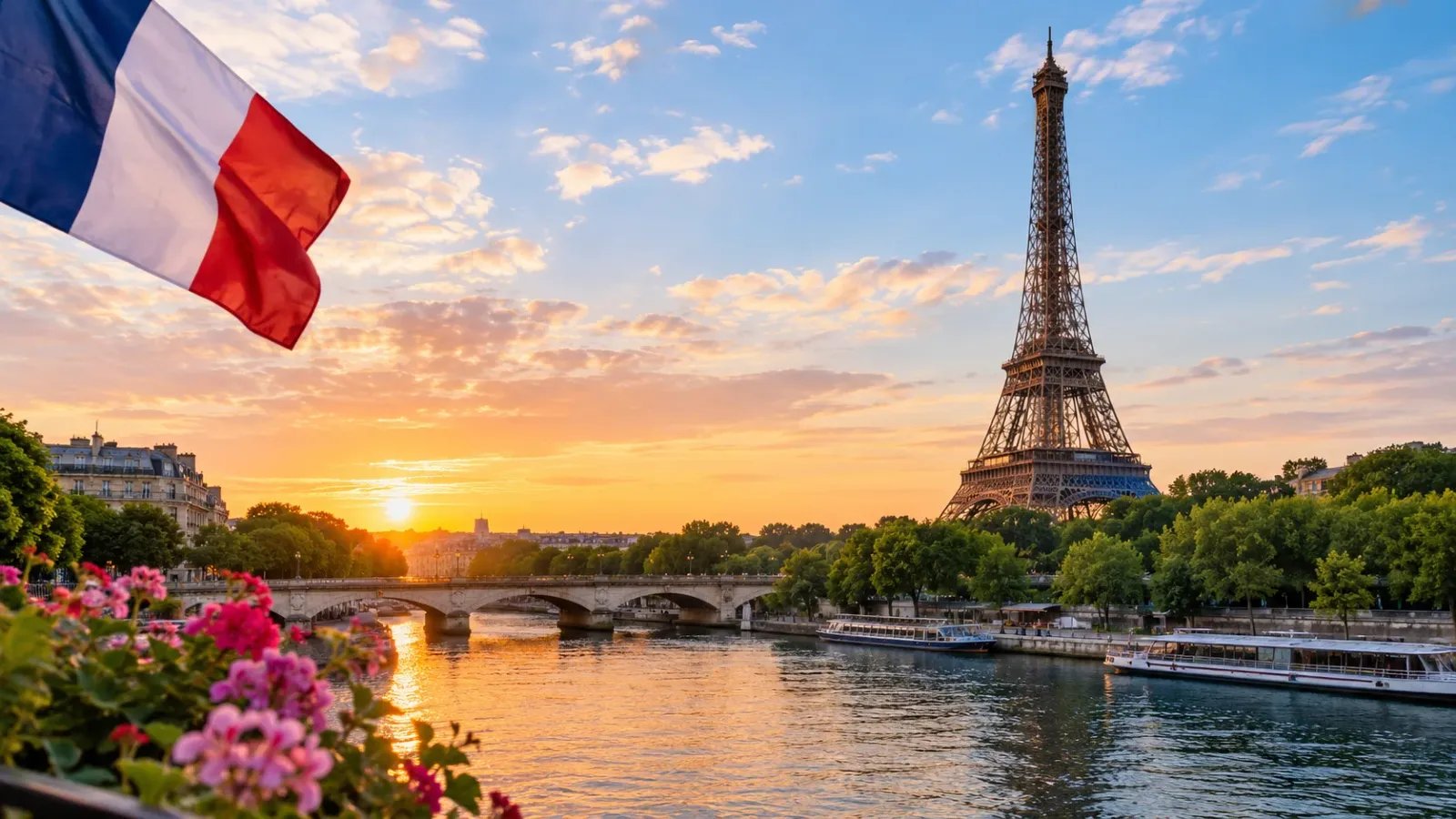
3. The Eiffel Tower was meant to be temporary.
The tower was built for the 1889 World's Fair in Paris and is about 330 meters tall including its antennas. It was originally permitted to stand for only 20 years. It survived because it proved useful as a radio antenna, and today it is the symbol of France.
4. The Louvre was a fortress before it was a museum.
The Louvre began around 1190 as a fortress built by King Philip II to defend Paris. It later became a royal palace, and it opened as a public museum in 1793 during the French Revolution. In 2023 it attracted about 8.7 million visitors, making it the most visited museum in the world.
5. Mont-Saint-Michel is surrounded by some of Europe's biggest tides.
The granite island abbey in Normandy sits in a bay where the difference between low and high tide can reach about 14 meters. At high tide the surrounding sands are flooded, and the island is cut off from the mainland. Since 2014 a bridge, rather than a causeway, connects it to the shore, letting water flow around the island more freely. Mont-Saint-Michel has been a UNESCO World Heritage Site since 1979.
6. Teenagers discovered the Lascaux cave paintings in 1940.
On 12 September 1940, four teenagers found a cave near Montignac in the Dordogne decorated with paintings of horses, bulls, and deer, made roughly 17,000 years ago. The cave was opened to visitors, but breath and humidity damaged the paintings, and it was closed in 1963. Today, visitors can see a faithful replica, Lascaux IV, which opened in 2016.
7. Roquefort was the first cheese with legal protection.
In 1925 Roquefort, a blue cheese made from sheep's milk and aged in natural caves in southern France, became the first cheese to receive the protected appellation of origin (AOC) status. France today has dozens of cheeses protected by such labels, and the country's cheeses are often counted in the hundreds.
8. The baguette has UNESCO recognition.
In 2022 UNESCO added the "artisanal know-how and culture of baguette bread" to its list of intangible cultural heritage. A French decree from 1993 specifies that a "traditional" baguette may contain only wheat flour, water, salt, and yeast, and must be made and baked on the premises. Paris holds an annual competition to choose the city's best baguette.
9. A French train holds the speed record for conventional trains.
The TGV began service between Paris and Lyon in 1981. In April 2007, a specially modified TGV reached 574.8 kilometers per hour on a test run, a record for conventional wheeled trains that still stands. In regular service, the fastest TGVs run at up to 320 kilometers per hour.
10. The Michelin Guide started as a guide for motorists.
The Michelin Guide was first published in 1900 by the tire company Michelin to encourage people to drive more and wear out their tires. It included maps, advice on repairs, and lists of hotels and restaurants. The famous star system for restaurants was introduced in the 1920s and 1930s, and the guide is now one of the most influential in the world of dining.
11. Only some sparkling wine can be called Champagne.
By law, the name Champagne may be used only for sparkling wines made in the Champagne region in northeastern France using a traditional method. The popular story that the monk Dom Pérignon invented champagne is a myth. He worked to improve the wines of his abbey, but sparkling wines existed before him.
12. The Cannes Film Festival began in 1946.
The first Cannes Film Festival was held in 1946, and the top prize, the Palme d'Or, has been awarded since 1955. Each May, the Riviera town fills with filmmakers, actors, and fans. The festival helped turn Cannes into one of the best-known glamorous destinations in the world.
13. Mont Blanc is the highest peak in the Alps.
Mont Blanc, on the border with Italy, rises to roughly 4,806 meters. Its exact height changes by a few meters depending on snow and ice, so it is remeasured regularly. The nearby town of Chamonix hosted the first Winter Olympic Games in 1924.
14. The D-Day landings took place on the beaches of Normandy.
On 6 June 1944, Allied troops landed on five Normandy beaches, code-named Utah, Omaha, Gold, Juno, and Sword, beginning the liberation of Western Europe. Today the beaches, museums, and cemeteries, such as the Normandy American Cemetery at Colleville-sur-Mer, are visited by many people each year.
15. Provence's lavender fields and Grasse's perfume are part of French heritage.
In Provence, lavender fields bloom in purple rows, mostly from late June to July, with the Valensole plateau a popular place to see them. The town of Grasse, the traditional center of French perfume making, was recognized by UNESCO in 2018 for the know-how connected with perfume in the Pays de Grasse.
Sources & References
This AI-assisted post was rigorously curated and fact-checked for accuracy by:
 Martin Roháček
How fun was this article? 🤔
Tap a star to rate it
🧠 Quiz: How closely were you paying attention?
10 questions — all answers are in the article above!
Enjoyed these facts? There's more! 💌
Fresh fun facts in your inbox. No spam, ever.