
The Revolutionary Mind: 15 Fascinating Facts About John Locke
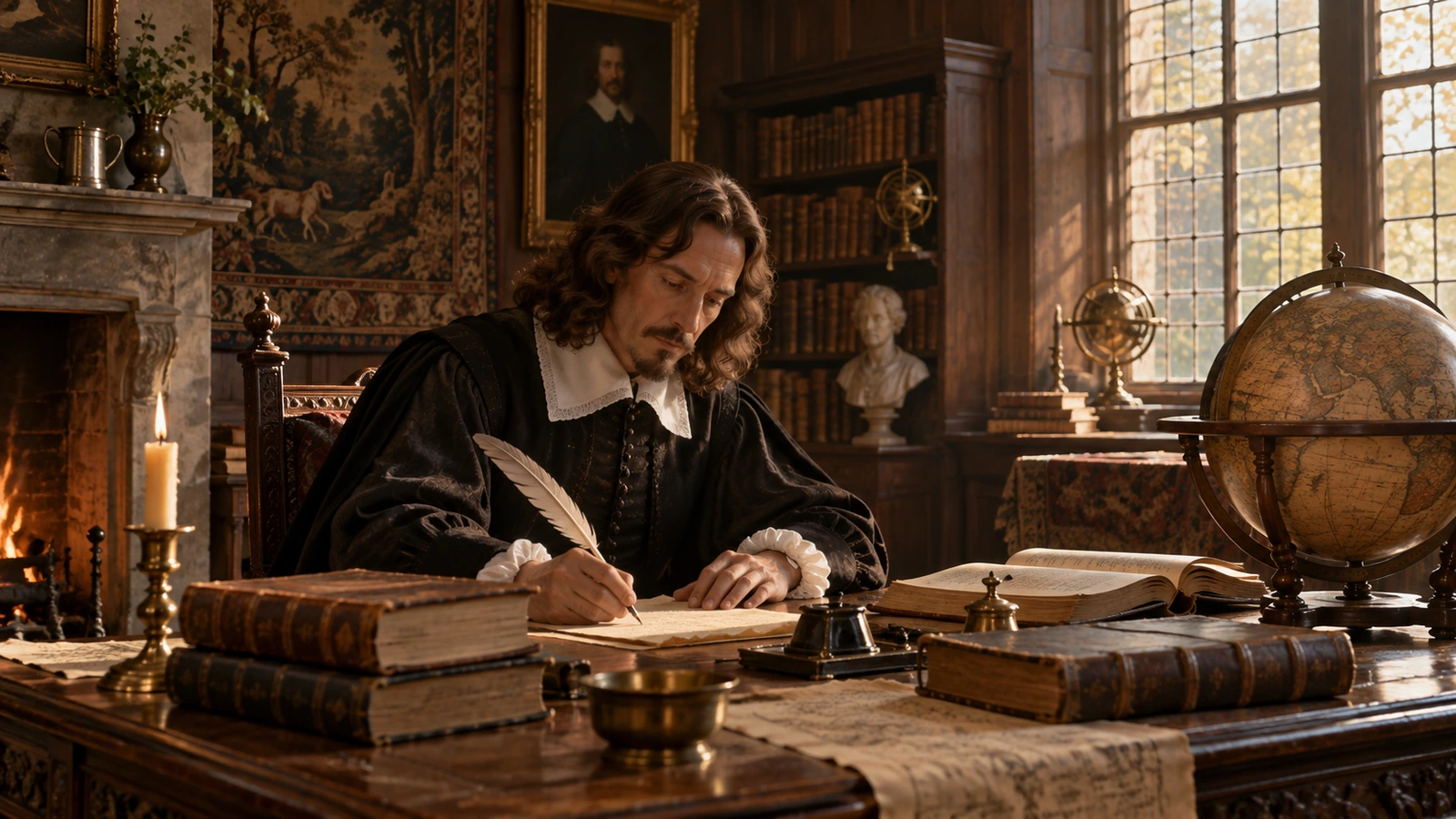
John Locke is widely remembered as the intellectual godfather of modern democracy and classical liberalism, but his real life was far more dramatic than a philosophy textbook suggests. From performing pioneering liver surgery to fleeing abroad under secret pseudonyms, Locke operated at the dangerous intersection of science, treason, and revolutionary thought. His radical ideas on natural rights reshaped world history, inspiring the American and French Revolutions while challenging centuries of absolute monarchical power. Discover the obscure truths, personal contradictions, and enduring legacy of one of history's most influential thinkers.
1. He Popularized the Concept of the "Blank Slate"
In his landmark 1689 work, An Essay Concerning Human Understanding, John Locke popularized the philosophical concept of tabula rasa, or the blank slate. He argued that human beings are not born with innate ideas, moral codes, or divine knowledge pre-programmed into their minds. Instead, every piece of knowledge, belief, and character trait is acquired through sensory experience and subsequent reflection. This radical perspective directly challenged the prevailing medieval belief in innate ideas and royal divine right. By arguing that experience shapes humanity, Locke established the foundation for modern empirical psychology.
2. He Was a Practicing Physician Who Saved a Lord's Life
While celebrated today primarily as a philosopher, Locke spent much of his career practicing medicine alongside pioneering physician Thomas Sydenham. In 1668, Locke oversaw a groundbreaking and highly risky surgical operation on his patron, Lord Ashley, who suffered from a life-threatening liver cyst. Locke directed surgeons to insert a bronze pipe to drain the abscess, successfully saving Ashley's life. The grateful nobleman later became the Earl of Shaftesbury and integrated Locke into the highest echelons of English politics. Locke's medical training deeply influenced his systematic, evidence-based approach to philosophy.
3. He Was Forced to Flee England for Exile in Holland
Locke's association with anti-monarchical political factions made him a target of King Charles II during the political turbulence of the 1680s. Following the suspected Rye House Plot to assassinate the king, Locke came under heavy royal surveillance and fled to the Netherlands in 1683. While in Dutch exile, he lived under the secret pseudonym Dr. van der Linden to evade royal spies. He spent five years abroad refining his radical manifestos before returning to England in 1689 following the Glorious Revolution. This period of danger underscored just how subversive his political beliefs were considered at the time.
4. His Most Famous Work Was Published Anonymously
Locke published his seminal political text, Two Treatises of Government, in late 1689 without putting his name on the title page. Because the book argued that citizens had a right to overthrow unjust rulers, publishing it openly remained extremely dangerous even after the ascension of William and Mary. Locke went to extraordinary lengths to hide his authorship, instructing his printer to destroy original manuscripts and denying his involvement in private letters. He only publicly acknowledged writing the book in a codicil added to his final will shortly before his death in 1704. Consequently, one of history's most groundbreaking political texts was formally anonymous throughout its author's life.
5. His Ideas Directly Inspired the U.S. Declaration of Independence
When Thomas Jefferson drafted the Declaration of Independence in 1776, he drew heavily upon Locke's political theories. Locke's insistence that governments derive their legitimate authority from the consent of the governed forms the core architecture of American democratic theory. Jefferson famously modified Locke's trio of natural rights—"life, liberty, and property"—into "life, liberty and the pursuit of happiness." Large sections of Jefferson's preamble mirror the phrasing and logical structure of Locke's second treatise. Without Locke's earlier intellectual foundation, the rhetoric of the American Revolution would have looked radically different.
6. He Helped Draft a Feudal Constitution for Carolina
In 1669, working as an assistant to Lord Shaftesbury, Locke helped draft the Fundamental Constitutions of Carolina for the newly established American colony. Strangely for a champion of liberty, the document created an elaborate aristocratic hierarchy of landgraves and feudal titles. However, it also contained surprisingly progressive protections for religious freedom, offering civil rights to any group that acknowledged a divine power. This complex document illustrates the early, transitional phase of Locke's political development. It remains one of the stranger paradoxes of his intellectual career.
 Philosophers Through the Ages
From wrestling rings and pirate kidnappings to sword duels and secret brotherhoods, the greatest thinkers in history led lives as dramatic as their ideas. Explore the surprising human stories behind the brilliant minds who shaped Western and Eastern philosophy.
See All Facts
Philosophers Through the Ages
From wrestling rings and pirate kidnappings to sword duels and secret brotherhoods, the greatest thinkers in history led lives as dramatic as their ideas. Explore the surprising human stories behind the brilliant minds who shaped Western and Eastern philosophy.
See All Facts
7. He Held Financial Investments in the Slave Trade
Modern historians frequently grapple with the disturbing contradiction between Locke's universal theories of freedom and his practical economic activities. In the 1670s, Locke invested money in the Royal African Company, which held a royal monopoly over the British transatlantic slave trade. Furthermore, clauses in the Carolina constitution he helped draft explicitly granted masters absolute authority over enslaved people. While Locke later wrote passionate defenses of individual liberty, his personal investments linked him directly to human bondage. This historical reality remains a subject of intense scholarly debate and critique.
8. He Advocated for Broad Religious Toleration
In his influential 1689 publication, A Letter Concerning Toleration, Locke argued that state coercion could never force genuine religious belief. He maintained that civil magistrates should focus exclusively on protecting earthly property and peace rather than managing salvation. However, Locke's concept of tolerance had distinct boundaries rooted in the political realities of his era. He explicitly excluded atheists, believing that individuals who did not acknowledge God could not be trusted to honor solemn oaths or contracts. He also excluded Roman Catholics, arguing their primary political allegiance belonged to a foreign potentate, the Pope.
9. He Formulated the Tripartite Philosophy of Natural Rights
Locke argued that every human being possesses fundamental natural rights simply by virtue of being born. He categorized these inherent rights as life, liberty, and estate (or property). According to Locke, these rights exist naturally in a state of nature before any formal government is ever established. The primary mandate of any legitimate government is to protect these pre-existing rights through impartial laws. If a government fails in this singular duty, it forfeits its legitimate claim to authority.
10. He Championed Revolutionary Theories on Child Education
In his 1693 treatise, Some Thoughts Concerning Education, Locke fundamentally changed how Western society viewed childhood development. He argued strongly against physical punishment and mechanical rote learning in schools, advocating instead for character building, curiosity, and outdoor physical exercise. Locke urged parents to treat children as rational beings and adapt instruction to each child's individual temperament. His educational principles laid the foundation for modern child psychology and progressive pedagogy. The book became a runaway bestseller throughout the eighteenth century.
11. He Maintained a Lifelong Intellectual Partnership with a Female Philosopher
During the final fourteen years of his life, Locke lived at Oates, a country manor in Essex owned by Lady Damaris Cudworth Masham. Masham was a brilliant philosopher in her own right who published major works on ethics and women's education. The pair maintained a deep, mutually respectful intellectual partnership and carried on an extensive correspondence over several decades. Locke bequeathed a substantial portion of his private library and financial estate to Masham's family upon his death. Their relationship was one of the premier intellectual alliances of the early Enlightenment.
12. He Formally Articulated the Right to Revolution
Unlike previous political thinkers who preached absolute obedience to monarchs, Locke explicitly defended the moral right of armed resistance against tyrannical rule. He argued that political power is a fiduciary trust granted by the public to their rulers. If a monarch or legislature abuses that trust by violating citizens' natural rights, the social contract is broken. At that point, citizens possess not just the right, but the moral duty to dismantle the abusive government and establish a new one. This specific principle provided the legal justification for both the 1688 Glorious Revolution and the 1776 American Revolution.
13. He Believed Faith and Reason Were Completely Compatible
Despite being labeled a radical by theological critics, Locke was a devout Christian who spent decades studying biblical texts. In his 1695 work, The Reasonableness of Christianity, he argued that genuine religious faith was fully compatible with human reason. Locke sought to strip away complex medieval church dogmas, advocating for a streamlined faith centered on the basic teachings of the New Testament evaluated through rational inquiry. He believed that God gave humans reason specifically so they could understand divine truth.
14. He Pioneered the Separation of Church and State
Locke was one of the first Western philosophers to articulate a formal separation between civil government and religious institutions. He argued that the state's jurisdiction extends only to civil goods like life, liberty, health, and physical property. Conversely, religious institutions exist solely for the public worship of God and the salvation of souls, matters outside state authority. By insisting that government has no legitimate mandate to enforce religious orthodoxy, Locke provided the philosophical architecture for modern secular constitutions.
15. He Managed British International Trade and Colonial Policy
Far from being an isolated scholar in an ivory tower, Locke served for years as a high-ranking government administrator. From 1696 to 1700, he held a key position on the Board of Trade, overseeing economic policy, colonial administration, and international commerce for the British Empire. In this administrative role, he analyzed trade balances, managed imperial monetary policy, and drafted colonial legislation. This real-world administrative experience grounded his abstract economic and political theories in practical statecraft.
Sources & References
This AI-assisted post was rigorously curated and fact-checked for accuracy by:
 Martin Roháček
How fun was this article? 🤔
Tap a star to rate it
🧠 Quiz: How closely were you paying attention?
10 questions — all answers are in the article above!
Enjoyed these facts? There's more! 💌
Fresh fun facts in your inbox. No spam, ever.