
The Infamous Break-In: 15 Fascinating Facts About the Watergate Scandal
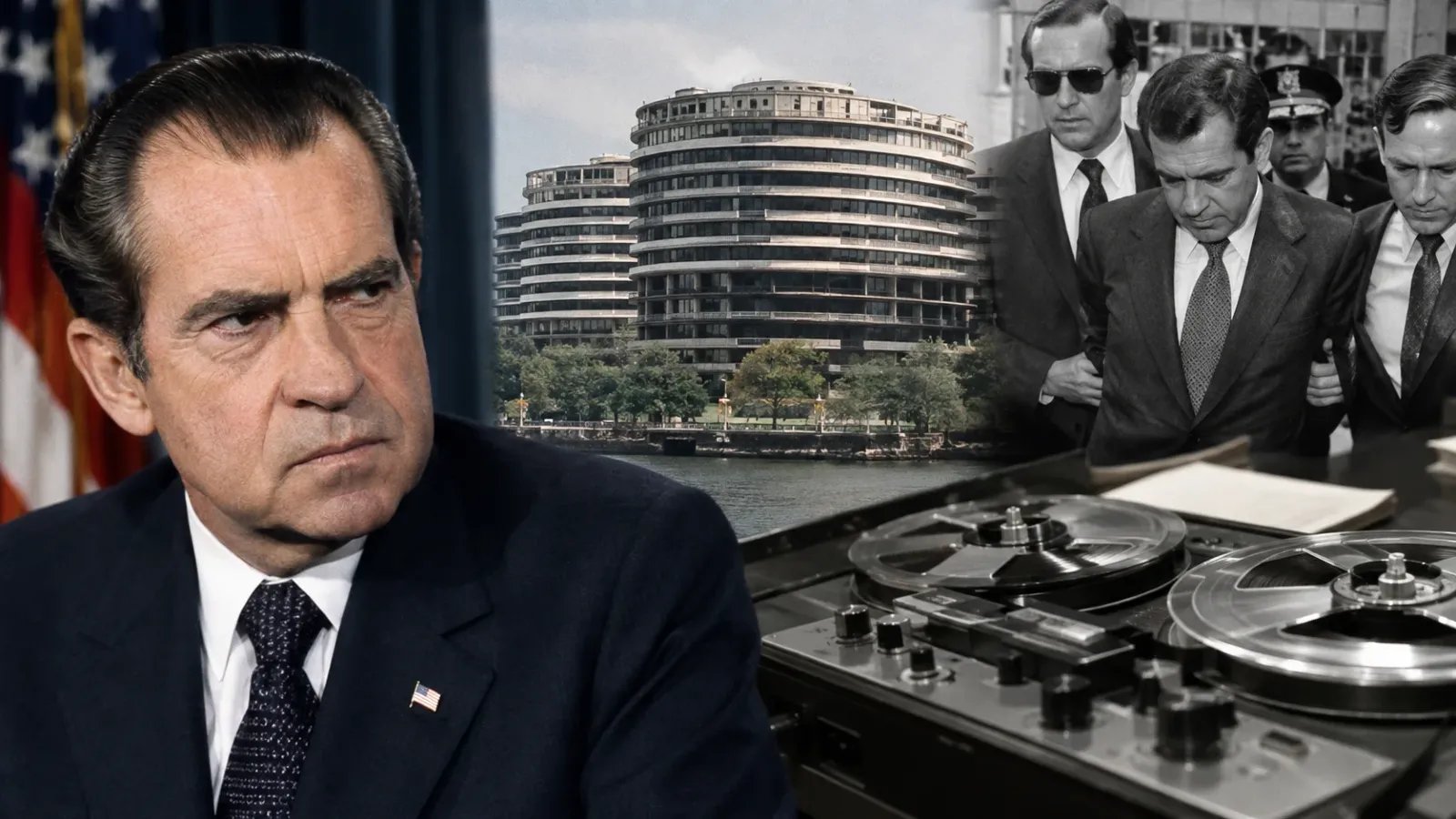
Many assume Watergate was just a simple burglary that brought down Nixon, but it was actually a sprawling web of sabotage, kidnapping, and illegal wiretaps. Far from an isolated blunder, it was the climax of institutional paranoia. Discover the obscure truths behind the ultimate political heist.
1. The infamous break-in that sparked the scandal was actually the burglars' second attempt to wiretap the Democratic National Committee.
Most historical accounts focus on the June 17, 1972 arrests, but the operatives had already successfully broken into the Watergate complex weeks earlier on May 28. During that initial intrusion, they placed wiretaps on the telephones and photographed classified documents. They only returned in June because the microphones they installed were defective and they needed to fix the faulty equipment, an operational flaw that ultimately led to their capture.
2. A simple piece of tape placed over a basement door latch was the careless mistake that brought down the Nixon presidency.
Security guard Frank Wills was making his midnight rounds when he noticed duct tape covering the latch of a basement door, allowing it to close without locking. He initially assumed a maintenance worker had placed it there and simply removed it. When Wills returned later and saw the door had been retaped, he immediately realized there was an intruder and called the police, setting the entire constitutional crisis into motion.
3. The arresting officers at the Watergate complex were disguised as hippies because they were operating undercover in a completely unrelated sting.
When the call about a burglary came in, the closest police unit was an unmarked car containing three plainclothes officers who had just been working an undercover narcotics beat. Dressed in long hair, denim jackets, and casual 1970s counterculture attire, they looked nothing like traditional law enforcement. Because they arrived in an unmarked car and civilian clothes, the lookouts posted by the burglars failed to recognize them as police, preventing the thieves from receiving a timely warning.
4. The Nixon administration actually kidnapped the wife of the former Attorney General to prevent her from talking to the press about the burglary.
Martha Mitchell, wife of John Mitchell, was renowned for her outspoken nature and close relationship with reporters. When the Watergate break-in occurred, she was in California, and Nixon's operatives realized she could recognize the names of the arrested men. Security guards physically restrained her, pulled the phone cord from the wall, and kept her forcibly locked in her hotel room for days, administering sedatives to keep her quiet, an ordeal that was dismissed for years as a paranoid delusion before being proven completely true.
5. The famous anonymous source known as Deep Throat remained a strictly guarded secret for thirty-three years until he voluntarily outed himself.
Mark Felt, the Associate Director of the FBI, was the elusive whistleblower who guided Washington Post reporters Bob Woodward and Carl Bernstein through the labyrinth of the cover-up. The journalists took extraordinary measures to protect his identity, using flower pots on balconies and clocked magazine pages as secret signals to arrange meetings in underground parking garages. Felt did not reveal his identity to the public until 2005, when his family convinced him to share his historic role before he passed away.
6. Richard Nixon did not destroy the incriminating White House tapes because he believed they legally belonged to him as personal property.
Even as investigators closed in, Nixon ignored desperate advice from his aides to burn the recordings of his Oval Office conversations. He genuinely believed that under the precedent of executive privilege and presidential papers, the tapes were his private property and could not be successfully subpoenaed. By the time the Supreme Court ruled unanimously in United States v. Nixon that the tapes had to be surrendered, it was too late to destroy them without explicitly confessing to obstruction of justice, sealing his own political doom.
 Wars and Conflicts of the 20th Century
Explore the hidden realities of 20th-century warfare and geopolitical conflicts. From world-altering military campaigns and covert intelligence operations to the eccentricities of ruthless dictators, uncover the surprising truths behind the events that shaped the modern world.
See All Facts
Wars and Conflicts of the 20th Century
Explore the hidden realities of 20th-century warfare and geopolitical conflicts. From world-altering military campaigns and covert intelligence operations to the eccentricities of ruthless dictators, uncover the surprising truths behind the events that shaped the modern world.
See All Facts
7. The infamous gap in the audio tapes exactly matches the duration of a critical conversation about the Watergate break-in.
When the tapes were finally handed over, investigators discovered an eighteen-and-a-half-minute erasure during a June 20, 1972 conversation between Nixon and his Chief of Staff, H.R. Haldeman. Nixon's loyal secretary, Rose Mary Woods, famously claimed she accidentally erased the section by stretching for a telephone while keeping her foot on the recording machine's pedal. Forensics experts later proved this gymnastic maneuver was practically impossible and that the tape had been deliberately erased and rewound at least five times.
8. The burglars were carrying an unusually large amount of sequentially numbered hundred dollar bills when they were arrested.
Police found thousands of dollars in crisp, newly minted currency in the burglars' hotel rooms and pockets. Investigators traced the serial numbers on these bills directly to a bank account in Mexico, which was subsequently linked back to the Committee for the Re-Election of the President. This physical money trail provided the first definitive proof that the burglary was not a random crime, but a highly funded operation connected directly to Nixon's inner circle.
9. The journalists who cracked the case relied heavily on a terrifying late-night encounter with a campaign saboteur to confirm the cover-up.
While Mark Felt provided crucial breadcrumbs, a lesser-known but vital source was Donald Segretti, who had run a massive campaign of political sabotage. To confirm the sheer scale of the illegal slush fund, Woodward and Bernstein aggressively cornered Segretti for secret interviews. The sheer terror and paranoia exhibited by this operative convinced the reporters that the conspiracy involved ruthless tactics orchestrated straight from the Oval Office.
10. The Watergate scandal originated from a highly secretive White House unit literally called the Plumbers.
The Special Investigations Unit was created by the Nixon administration in 1971 with one specific mandate to stop the leaking of classified information to the news media. They were colloquially dubbed the Plumbers because their job was to fix the leaks, starting with the aftermath of the Pentagon Papers publication. What began as an internal security operation rapidly devolved into a rogue, extra-legal squad executing burglaries, illegal wiretaps, and political espionage against Nixon's perceived enemies.
11. A pivotal figure in the burglary was a former CIA officer who specialized in writing espionage thriller novels.
E. Howard Hunt, a key architect of the Watergate break-in, had a storied career in the Central Intelligence Agency where he helped orchestrate the overthrow of the Guatemalan government. After retiring, he wrote dozens of spy novels under various pseudonyms. His penchant for dramatic, cinematic espionage tactics heavily influenced the bizarre methods used by the Plumbers, including using poorly conceived disguises, ill-fitting wigs, and codenames that felt ripped straight from the pages of his own pulp fiction.
12. The Senate Watergate Committee only learned about the existence of the secret Oval Office taping system by total accident.
During routine, closed-door questioning of former White House aide Alexander Butterfield, congressional investigators asked offhand if there was any way to verify the conflicting testimonies of various officials. Butterfield, believing the investigators already knew, casually revealed that Nixon had installed voice-activated recording devices in the Oval Office and other key locations. This bombshell revelation instantly shifted the entire investigation from a matter of hearsay to a hunt for definitive audio evidence.
13. The initial newspaper stories about the break-in barely made a ripple in the national news cycle and did not affect Nixon's reelection.
Despite Woodward and Bernstein's relentless reporting throughout the summer and fall of 1972, most major national newspapers and television networks completely ignored the story, dismissing it as partisan mudslinging. Nixon went on to win the 1972 presidential election in one of the largest electoral landslides in American history, carrying forty-nine states. It took the burglars' trial in early 1973 and the ensuing televised Senate hearings to finally force the rest of the country to pay attention to the massive scandal unfolding in Washington.
14. The judge presiding over the burglars' trial used incredibly aggressive sentencing threats to crack the conspiracy open.
Judge John Sirica, known colloquially as Maximum John, did not believe the burglars were acting alone and strongly suspected a massive political cover-up. To break their silence, he handed down staggeringly harsh provisional sentences, including up to forty years in prison for the foot soldiers, while hinting he would reduce the terms if they cooperated with the grand jury. This coercive tactic worked flawlessly, terrifying burglar James McCord into writing a letter confessing that perjury had been committed and higher-ups were intimately involved.
15. Richard Nixon is the only American president to resign from office, doing so strictly to avoid a guaranteed impeachment and removal.
Facing the release of the smoking gun tape which proved he had ordered the CIA to obstruct the FBI's investigation into the break-in just days after it happened, Nixon lost all remaining congressional support. A delegation of senior Republican leaders visited the White House to inform him that he had at most fifteen votes of support left in the Senate, far short of the number needed to survive an impeachment trial. Realizing his removal was an absolute certainty, Nixon announced his unprecedented resignation on national television the following evening.
Sources & References
This AI-assisted post was rigorously curated and fact-checked for accuracy by:
 Martin Roháček
How fun was this article? 🤔
Tap a star to rate it
🧠 Quiz: How closely were you paying attention?
10 questions — all answers are in the article above!
Enjoyed these facts? There's more! 💌
Fresh fun facts in your inbox. No spam, ever.