The Lost Superpower: 15 Fascinating Facts About The Soviet Union
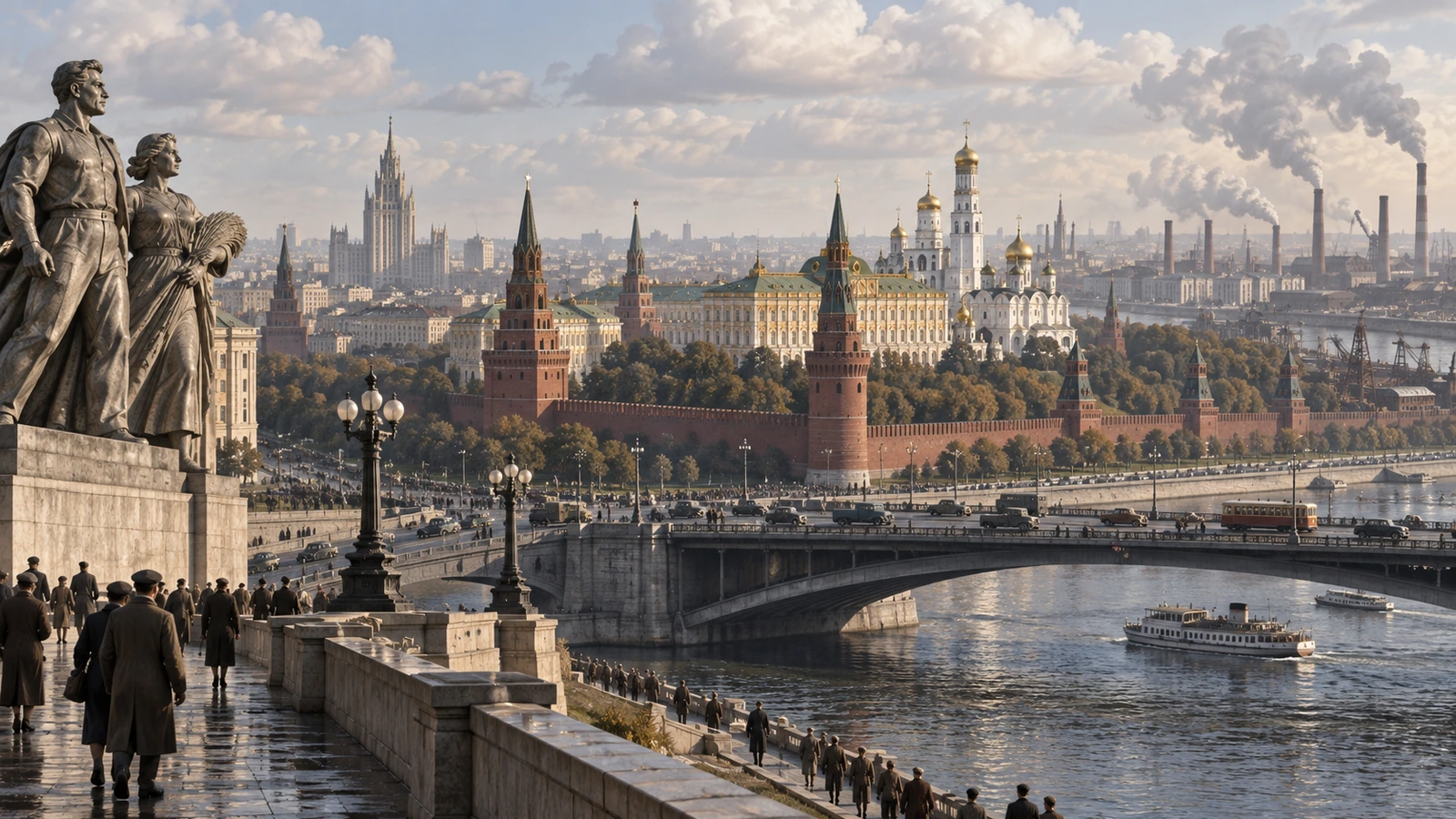
From secret subterranean cities and underground bone music to an unexpected military trade involving soft drinks, the Soviet Union was a land of extraordinary contradictions. Spanning eleven time zones at its height, the Eurasian empire reshaped global geopolitics while enforcing strict cultural control at home. Yet behind the Iron Curtain lay remarkable stories of scientific breakthroughs, black-market workarounds, and extreme military secrets. Here are 15 fascinating facts that reveal the bizarre, impressive, and shadowy reality of the Soviet Union.
1. Spanning Eleven Time Zones Across Two Continents
Spanning eleven time zones, the Soviet Union was the largest contiguous nation state in modern history, stretching across Eastern Europe and Northern Asia. When citizens on the western border in Kaliningrad were preparing for bed, residents on the Chukchi Peninsula in the far east were waking up to morning light. Managing such a vast expanse presented immense administrative and logistical hurdles for central planners in Moscow. Railroad conductors and telecommunications operators had to navigate complex local schedules across tundra, taiga, and steppes. Despite its geographical dominance, the nation suffered from severe infrastructure bottlenecks connecting these distant regions. The sheer expanse meant that sunrise and sunset occurred simultaneously within different parts of the same country.
2. The Time Pepsi Briefly Commanded a Naval Fleet
In 1989, the Soviet government finalized a bizarre commercial transaction with the American soft drink giant PepsiCo. Because Soviet rubles were not convertible on international currency markets, trade had to be conducted through barter. In exchange for Pepsi syrup, the USSR traded seventeen diesel submarines, a cruiser, a frigate, and a destroyer. For a fleeting moment, Pepsi owned the sixth-largest military submarine fleet on Earth before selling the vessels for scrap steel. Pepsi's chief executive officer joked to the U.S. National Security Advisor that they were disarming the Soviets faster than the Pentagon.
3. The Underground "Bone Music" X-Ray Records
During the 1940s and 1950s, the Soviet regime strictly outlawed Western jazz, rock and roll, and foreign pop music. Music enthusiasts bypassed state censors by inventing an ingenious bootleg format known as "music on ribs" or "bone music." Citizens scavenged discarded hospital X-ray films from trash heaps, cut them into crude circles, and burned center holes with cigarettes. Using converted phonographs, underground bootleggers etched music grooves directly onto images of broken skulls and spinal cords. These flimsy vinyl alternatives allowed a generation of Soviet youth to secretly listen to banned music at great personal risk.
4. The Secret Birth of Tetris in a Moscow Lab
In 1984, software engineer Alexey Pajitnov invented the world-famous puzzle game Tetris while working at the Soviet Academy of Sciences in Moscow. Inspired by classical pentomino puzzles, Pajitnov programmed the game on an aging Electronika 60 computer during his spare time. Because private enterprise was forbidden, the intellectual property rights belonged to the Soviet state entity Elorg. The game quickly spread like wildfire among Soviet researchers before being smuggled out to Western gaming companies. Tetris eventually became one of the best-selling video games in human history, though Pajitnov did not receive royalties until decades later.
5. Drilling the World's Deepest Hole at Kola Superdeep
In 1970, Soviet geoscientists initiated a massive drilling project on the Kola Peninsula near the Norwegian border. Their objective was to bore as deep into the Earth's continental crust as possible to study deep subterranean geology. By 1989, the Kola Superdeep Borehole reached an astonishing depth of 40,230 feet (12,262 meters), making it the deepest artificial point on Earth. Scientists encountered unexpectedly high temperatures exceeding 350 degrees Fahrenheit, which caused rock to behave like plastic and forced the project to halt. The abandoned site remains sealed with a bolted steel plate, serving as a monument to human engineering ambition.
6. The Subterranean Palaces of the Moscow Metro
Beginning in the 1930s, Joseph Stalin commissioned the construction of the Moscow Metro to serve as "palaces for the people." Architects were instructed to design subterranean railway stations that mirrored the grandeur of royal palaces rather than pragmatic transit hubs. Stations were embellished with marble walls, crystal chandeliers, intricate bronze statues, and ceiling mosaics portraying socialist heroism. Deep underground, the metro system was also engineered to double as bomb shelters during potential military attacks. Today, these stunning transit centers remain among the most celebrated examples of Soviet Socialist Realism architecture.
 Wars and Conflicts of the 20th Century
Explore the hidden realities of 20th-century warfare and geopolitical conflicts. From world-altering military campaigns and covert intelligence operations to the eccentricities of ruthless dictators, uncover the surprising truths behind the events that shaped the modern world.
See All Facts
Wars and Conflicts of the 20th Century
Explore the hidden realities of 20th-century warfare and geopolitical conflicts. From world-altering military campaigns and covert intelligence operations to the eccentricities of ruthless dictators, uncover the surprising truths behind the events that shaped the modern world.
See All Facts
7. Secret "Closed Cities" Left Off Official Maps
To protect sensitive military research, nuclear facilities, and weapons manufacturing, the Soviet regime established scores of secret "closed cities." Known officially as ZATO, these municipalities did not appear on public maps, and their existence was strictly omitted from official statistics. Residents of closed cities were granted higher wages and better consumer goods, but their movement was strictly monitored through special security clearances. Entire populations lived in administrative silence, using code names consisting of a nearby city and a secret postal number. Dozens of these closed territories still exist today across Russia, maintaining restricted access.
8. The Backfire of Screening The Grapes of Wrath
In 1948, Soviet film censors permitted public screenings of the American film adaptation of John Steinbeck's novel The Grapes of Wrath. Authorities calculated that the depiction of impoverished Okie farmers fleeing the Dust Bowl would demonstrate the cruelties of Western capitalism. However, the propaganda effort backfired disastrously when Soviet theater audiences focused on an unexpected detail. Viewers marveled that even the poorest migrant workers in the United States owned personal pickup trucks and automobiles. Shocked by the audience's envious reaction, Soviet censors abruptly pulled the film from theaters nationwide.
9. The Decades-Long Preservation of Lenin's Body
Following the death of Bolshevik leader Vladimir Lenin in 1924, top Soviet officials resolved to preserve his physical body indefinitely. A specialized team of biochemists developed unique embalming techniques involving regular bath treatments in glycerol and potassium acetate. Placed inside a glass sarcophagus in a granite mausoleum on Moscow's Red Square, Lenin's body has been maintained for over a century. A dedicated biological laboratory continuously monitors the body, replacing skin patches and maintaining precise temperature levels. Despite persistent debates regarding his burial, the embalmed leader remains on public display today.
10. Denim as a High-Value Black Market Currency
For Soviet youth growing up behind the Iron Curtain, Western blue jeans represented the ultimate symbol of personal freedom and cool style. Because foreign clothing imports were heavily restricted, genuine Levi's, Lee, and Wrangler denim became prized black market commodities. Smugglers known as fartsovshchiki traded illegally with foreign tourists and diplomats to obtain Western apparel. A single pair of original American jeans could sell for a worker's full monthly salary on the underground market. Denim held such cultural weight that it functioned virtually as an alternative hard currency among urban citizens.
11. Detonating Tsar Bomba, the Largest Nuclear Weapon
On October 30, 1961, the Soviet Union detonated the Tsar Bomba over the remote Severny Island in the Arctic Ocean. Yielding an explosive energy of 50 megatons, it remains the most powerful nuclear weapon ever tested in human history. The resulting shockwave was so immense that it circled the globe three times and shattered window glass hundreds of miles away. The mushroom cloud ascended to an altitude of 40 miles, penetrating deep into the Earth's mesosphere. The blast was roughly 3,000 times more powerful than the atomic bomb dropped during World War II.
12. The Tragic Journey of Laika into Earth Orbit
In November 1957, a stray Moscow dog named Laika made history by becoming the first living creature to orbit the Earth aboard Sputnik 2. Soviet scientists intended to test whether a mammal could survive the extreme stresses of space launch and weightlessness. Tragically, the spacecraft was built without a re-entry thermal shield, meaning Laika was never expected to return safely. She succumbed to overheating and panic just hours into the mission due to a system malfunction. Laika's sacrifice paved the way for human spaceflight, earning her monument statues and enduring historic fame.
13. History's Most Successful Female Sniper
During World War II, Soviet female snipers proved to be exceptionally lethal combatants on the Eastern Front. Among them was Lyudmila Pavlichenko, a university history student who joined the Red Army following the German invasion in 1941. Nicknamed "Lady Death" by foreign correspondents, Pavlichenko recorded 309 confirmed kills, making her the most successful female sniper in recorded history. She was later sent on a public relations tour across North America, becoming the first Soviet citizen received by a U.S. President. Her remarkable marksmanship and wartime courage made her an enduring national hero in the Soviet Union.
14. Airbrushing History Through Photographic Censorship
The Soviet state routinely altered photographs to erase political figures who fell out of favor with the leadership. Under Joseph Stalin, official censors meticulously airbrushed disgraced officials, former allies, and executed rivals out of archival imagery. Prominent Bolsheviks like Leon Trotsky and Nikolai Yezhov were removed from historic photos alongside Lenin as if they never existed. Photographers used retouching techniques, ink, and composite printing to rewrite visual history to match changing political doctrines. This widespread practice inspired George Orwell's concept of the "Memory Hole" in his dystopian novel 1984.
15. The USSR Lacked an Official State Language for Decades
Despite Russian being the dominant tongue of governance, the Soviet Union had no legally designated official state language for most of its existence. The country was composed of fifteen distinct Soviet Socialist Republics, each encompassing numerous native ethnic groups and languages. Local languages like Ukrainian, Georgian, Uzbek, and Armenian were recognized within regional educational and cultural institutions. It was not until 1990, just a year before the union collapsed, that a law officially proclaimed Russian as the state language. This policy reflected the complex multi-ethnic composition of the sprawling Eurasian empire.
Sources & References
This AI-assisted post was rigorously curated and fact-checked for accuracy by:
 Martin Roháček
How fun was this article? 🤔
Tap a star to rate it
🧠 Quiz: How closely were you paying attention?
10 questions — all answers are in the article above!
Enjoyed these facts? There's more! 💌
Fresh fun facts in your inbox. No spam, ever.