
The Elusive Acrobat: 15 Fascinating Facts About Ringtails
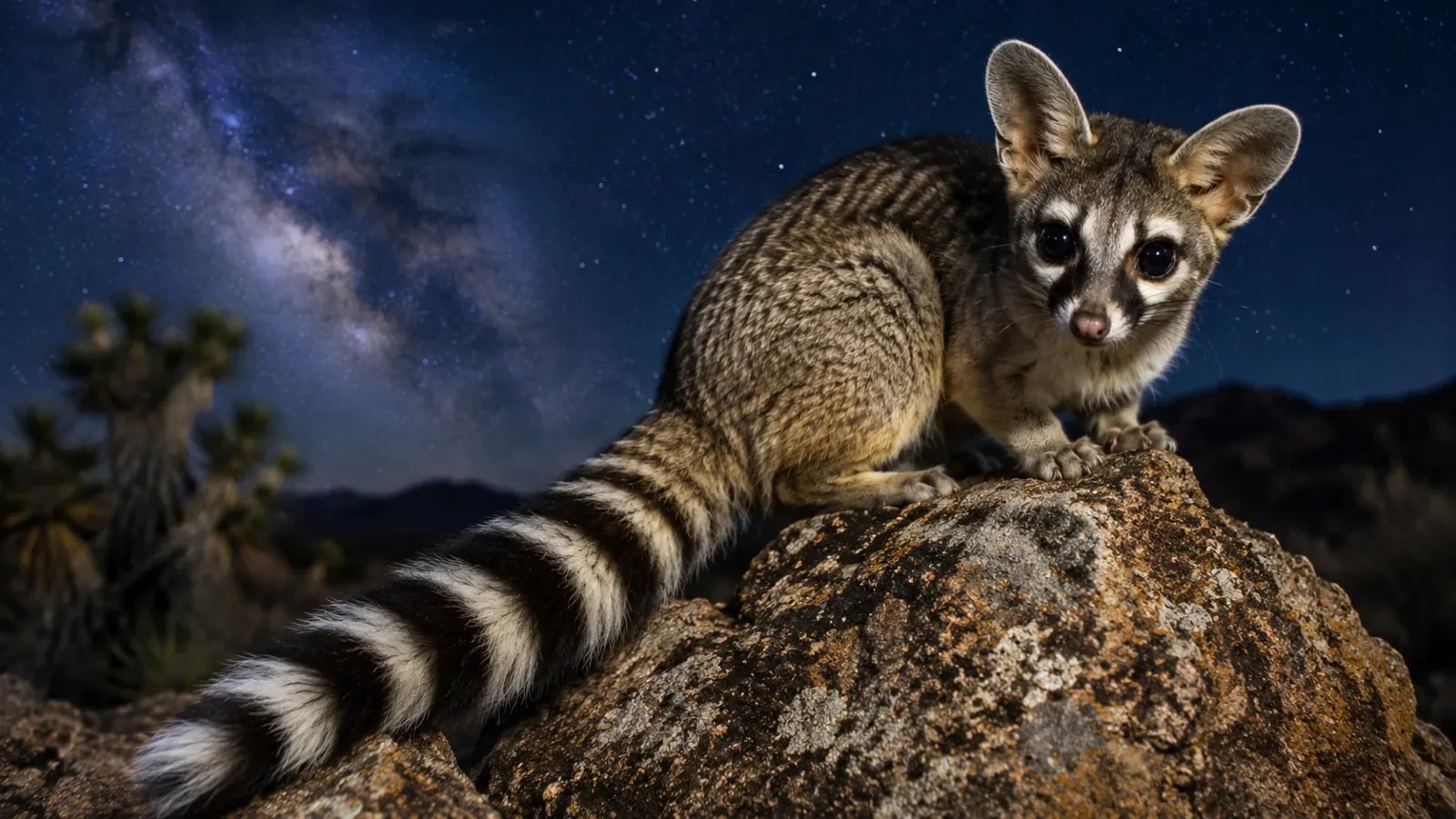
Despite its colloquial monikers like "ringtail cat" or "miner's cat," the elusive ringtail is not a feline at all, but rather a remarkably agile member of the raccoon family. Often overshadowed by its masked, trash-raiding cousins, this desert-dwelling acrobat possesses a suite of evolutionary marvels that make it one of North America's most fascinating predators. Misunderstood by early pioneers who mistook it for a civet, the ringtail boasts hyper-flexible anatomy, chemical warfare capabilities, and climbing skills that defy gravity. From its peculiar history as a domesticated rodent-slayer in Old West mining camps to its secretive, nocturnal life in arid canyons, this wide-eyed mammal is a masterclass in evolutionary adaptation that proves far stranger and more captivating than its pop-culture anonymity suggests.
1. They Are Anatomically Built for Parkour
Ringtails possess an extraordinary joint structure that allows their hind feet to rotate a full 180 degrees. This hyper-flexibility means they can rapidly descend vertical cliffs or tree trunks headfirst with the same speed and control as they climb upward. By gripping the bark or rock with their semi-retractable claws while their reversed hind paws act as brakes, they effortlessly navigate treacherous, sheer surfaces. This skeletal advantage allows them to utilize vertical environments to escape predators and ambush unsuspecting prey from above.
2. They Belong to the Raccoon Family, Not the Feline Tree
Despite their feline appearance and colloquial nicknames, ringtails are classified as procyonids, placing them in the same evolutionary family as raccoons and coatis. Early European settlers mistakenly identified them as civet cats due to their lithe bodies and banded tails, a misconception that persists in some regional dialects today. Unlike their scavenging raccoon cousins, however, ringtails are far more carnivorous and rarely venture into human settlements to rifle through garbage. This distinct evolutionary branch highlights a fascinating divergence where similar environmental pressures created a creature that acts like a cat but shares the genetic blueprint of a raccoon.
3. They Were the Exterminators of the Old West
During the gold and silver rushes of the nineteenth and early twentieth centuries, prospectors quickly realized that these wild animals were highly effective at pest control. Miners would leave boxes near their warm stoves and lure the nocturnal creatures inside with scraps of food, effectively semi-domesticating them to hunt mice and rats in the camps. This historical symbiotic relationship earned the animal the enduring moniker of the "miner's cat" throughout the American Southwest. Unlike traditional domestic cats, ringtails proved to be far more aggressive and efficient in eliminating entire populations of rodents from the dark, cramped mining shafts.
4. Their Tail is a Multi-Tool of Survival
The ringtail's most distinguishing feature is its spectacular bushy tail, which boasts alternating black and white bands and is often longer than the animal's entire body. Rather than just being a visual quirk, this appendage serves as a crucial counterbalance during high-speed, acrobatic leaps across narrow canyon ledges. In the freezing temperatures of desert winter nights, the ringtail wraps this dense, insulated tail around its body like a thermal blanket to conserve body heat. Furthermore, if pursued by a predator, the animal can arch the tail over its back to make itself appear larger or use it as a decoy to confuse attackers aiming for a lethal bite.
5. They Utilize Chemical Defense Mechanisms
When cornered or severely threatened, a ringtail does not rely solely on its sharp teeth and claws for protection. Similar to skunks, which are distant evolutionary cousins, ringtails possess specialized anal glands capable of emitting a highly pungent, foul-smelling secretion. This musky liquid is expelled to disorient and deter predators, leaving a lingering odor that effectively ruins the appetite of coyotes or bobcats. While not as weaponized or precisely sprayed as a skunk's defense, this chemical deterrent is a surprising adaptation that helps this relatively small mammal survive in habitats crawling with larger apex predators.
6. They Are Masters of Water Conservation
Thriving in some of the most arid environments in North America, including the Sonoran and Mojave deserts, the ringtail has evolved to survive with incredibly limited access to standing water. They obtain the vast majority of their required hydration directly from the bodily fluids of the prey they consume, such as insects, lizards, and rodents. Their kidneys are extraordinarily efficient, concentrating their urine to minimize fluid loss during the brutal summer months. This specialized physiology allows them to inhabit dry, rocky canyons and scrublands where other mammals of their size would quickly perish from dehydration.
7. Their Eyes Are Engineered for Complete Darkness
A ringtail's face is dominated by uncommonly large, dark eyes surrounded by distinct white spectacle rings, a structural necessity for their strictly nocturnal lifestyle. These massive eyes gather maximum ambient light, allowing them to spot the tiniest movements of nocturnal insects and rodents in near-total darkness. They also possess a highly developed tapetum lucidum, a reflective layer behind the retina that bounces light back through the photoreceptors a second time, significantly enhancing their night vision. This adaptation not only makes them lethal nocturnal hunters but also causes their eyes to glow a brilliant, haunting yellow when caught in the beam of a flashlight.
8. They Practice a Solitary and Secretive Lifestyle
While raccoons are known for their boisterous, social foraging, ringtails are fiercely solitary creatures that actively avoid interaction with others of their kind outside of the brief mating season. They maintain vast, exclusive home ranges that they meticulously mark with urine and feces to warn away potential trespassers. A single individual will maintain multiple dens within its territory, rotating between rock crevices, hollow trees, and abandoned burrows on a nightly basis to avoid leaving a predictable scent trail for predators. This ghost-like existence is the primary reason why, despite being relatively common in the American Southwest, they are almost never seen by casual hikers.
9. They Employ a Bizarre Arsenal of Vocalizations
Despite their quiet, stealthy nature while hunting, ringtails are capable of producing a shockingly diverse and bizarre array of sounds when communicating or distressed. Researchers have documented them barking like small dogs, chattering, chirping, and even producing a high-pitched, metallic squeak that resembles a squeaky toy. When highly agitated or captured, they unleash a blood-curdling screech that is entirely disproportionate to their diminutive, two-pound frame. These complex vocalizations are primarily used during territorial disputes or by mothers communicating with their hidden kits in the absolute darkness of the den.
10. Arizona Made Them an Official State Symbol
In a testament to the animal's deep historical and ecological ties to the American Southwest, the state of Arizona officially designated the ringtail as its state mammal in 1986. The legislation was largely driven by a grassroots campaign started by elementary school students who recognized the creature's unique adaptations to the harsh Sonoran Desert environment. By choosing the elusive procyonid over more iconic candidates, Arizona highlighted the importance of a species that profoundly shaped early pioneer survival through vital pest control. Today, this official status has helped raise conservation awareness for a creature that most residents have still never seen in the wild.
11. They Have Semi-Retractable Claws Like a Feline
In another fascinating example of convergent evolution with cats, ringtails possess semi-retractable claws, a rare trait among members of the raccoon family. This anatomical feature allows them to keep their claws razor-sharp by pulling them back during normal walking, preventing them from being ground down by the abrasive desert rocks. When climbing or seizing prey, the claws are rapidly extended to provide a lethal grip or flawless traction on vertical tree bark. This dual-purpose claw structure perfectly bridges the gap between the predatory needs of a carnivore and the mobility requirements of a dedicated arboreal acrobat.
12. Their Diet Shifts Drastically with the Seasons
Although classified as carnivores, ringtails are highly opportunistic omnivores whose diet fluctuates wildly depending on the seasonal availability of food in their harsh habitats. During the spring and summer, they act as apex micropredators, feeding almost exclusively on insects, scorpions, small reptiles, and rodents. However, as winter approaches and prey becomes scarce, they transition seamlessly to a frugivorous diet, consuming large quantities of juniper berries, hackberries, and prickly pear cactus fruits. This dietary plasticity ensures their survival in volatile desert ecosystems where relying on a single food source would inevitably lead to starvation.
13. They Hunt Highly Venomous Scorpions
In the rugged deserts of the American Southwest, ringtails regularly hunt and consume highly venomous scorpions, including the dangerous Arizona bark scorpion. Biologists have observed that ringtails show no ill effects when stung by these arachnids, suggesting a robust natural resistance or immunity to the neurotoxins. When hunting a scorpion, the agile mammal uses lightning-fast reflexes to bite off the venomous stinger before casually consuming the rest of the body. This specialized dietary niche allows them to exploit an abundant, protein-rich food source that most other desert predators actively avoid.
14. Mothers Are Sole Providers and Fierce Defenders
Male ringtails play absolutely no role in raising their young and will actually be aggressively chased away by the female if they approach the maternal den. A mother ringtail gives birth to a small litter of altricial kits, which are born blind, deaf, and completely covered in fine white fuzz. She must leave them alone in the den for hours each night to hunt, risking her life to secure enough calories to produce milk for her rapidly growing offspring. She is known to fiercely defend her den against much larger predators, using her chemical sprays, sharp teeth, and intimidating vocalizations to protect the helpless kits until they are ready to forage at two months old.
15. They Utilize Stemming to Defy Gravity
One of the most visually stunning feats of the ringtail is a rock-climbing technique known as stemming, which allows them to traverse vertical terrain that would stop a mountain goat. By pressing all four feet against one wall and their back against the opposite wall, or by bridging their limbs across a narrow gap, they can shimmy straight up vertical rock chimneys. If a crevice is slightly wider, they will rapidly ricochet back and forth between the opposing walls, using their momentum and sticky footpads to propel themselves upward. This unique form of locomotion turns the impassable slot canyons of the Southwest into an exclusive, high-speed highway for the ringtail.
Sources & References
This AI-assisted post was rigorously curated and fact-checked for accuracy by:
 Martin Roháček
How fun was this article? 🤔
Tap a star to rate it
🧠 Quiz: How closely were you paying attention?
10 questions — all answers are in the article above!
Enjoyed these facts? There's more! 💌
Fresh fun facts in your inbox. No spam, ever.