
The Masked Survivor: 15 Cool Facts About Raccoons
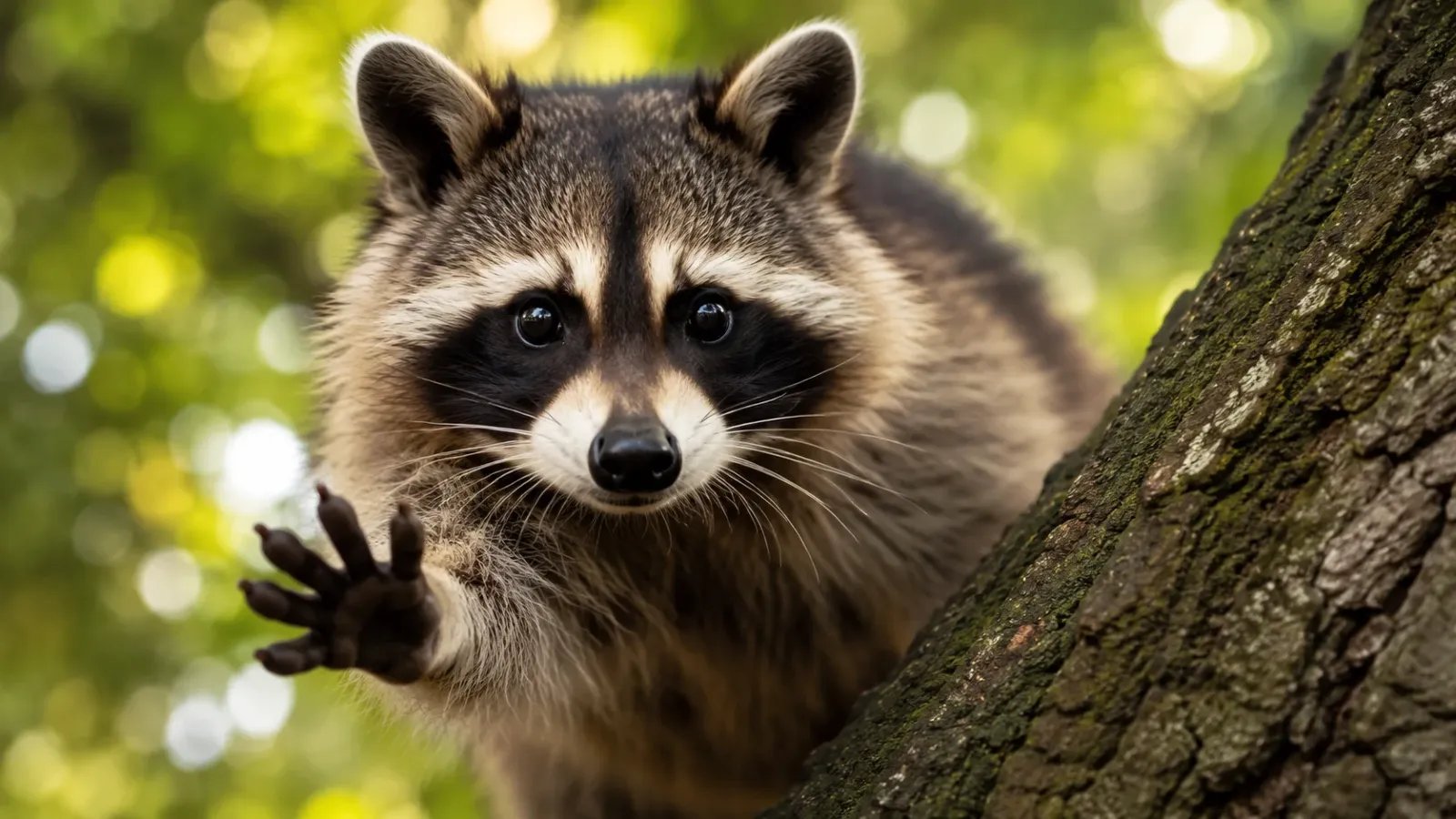
Dismissed as mere trash pandas, raccoons are actually highly intelligent mammals with remarkable evolutionary traits. Forget the myth that they wash food out of cleanliness; this behavior is rooted in complex sensory biology. Beyond their bandit masks lies a deeply misunderstood creature equipped with astonishing problem-solving skills and a fascinating, highly specialized anatomy.
1. Raccoons do not wash their food to clean it, but rather to increase the tactile sensitivity of their paws.
The common misconception that raccoons are fastidious eaters stems from their habit of dousing food in water. In reality, their front paws are packed with thousands of nerve endings, and water softens the hard, calloused layer of skin on their hands. This moisture enhances their tactile nerve responsiveness, effectively allowing them to see the object with their hands and gather crucial information about what they are about to eat.
2. Despite their incredible manual dexterity, raccoons do not actually possess opposable thumbs.
While they are famous for unlatching doors, opening jars, and untying complex knots, raccoons lack the opposable thumb that gives primates their grip. Instead, they have five highly articulated digits on their front paws that work together with astonishing coordination. This anatomy allows them to manipulate small objects and solve mechanical puzzles with a level of skill that rivals many monkeys, relying on synchronized finger movements rather than a grasping thumb.
3. Urban raccoons have demonstrably evolved to be smarter and more adept at problem-solving than their rural counterparts.
Decades of navigating human cities, avoiding traffic, and breaking into sophisticated garbage enclosures have acted as an evolutionary pressure cooker for urban raccoons. Scientific studies have shown that city-dwelling raccoons not only solve complex mechanical puzzles significantly faster than rural raccoons, but they also remember the solutions for years. The constant environmental challenges of the urban landscape have forced them to adapt rapidly, resulting in a markedly higher level of behavioral flexibility and intelligence.
4. The distinct black mask across a raccoon's eyes serves to reduce glare and enhance their nocturnal vision.
The bandit mask is often written off as a quirky aesthetic trait, but it plays a vital evolutionary role. Much like the black grease paint used by professional athletes under their eyes, the dark fur absorbs incoming light, reducing glare from bright light sources. This optical adaptation significantly improves their contrast vision during the night, allowing them to spot predators, navigate dark environments, and hunt for prey with exceptional precision.
5. Raccoons possess the rare ability to rotate their hind feet a full 180 degrees, allowing them to climb down trees headfirst.
Most mammals that climb trees struggle when it comes to getting back down, often having to reverse slowly or leap. Raccoons, however, have highly specialized ankle joints that can rotate backward. When descending a tree trunk, they flip their hind feet around so their claws point upward, gripping the bark securely. This anatomical quirk gives them a major advantage in escaping predators and navigating the dense forest canopy with agile speed.
6. The English word for raccoon is derived from an indigenous Powhatan term meaning an animal that scratches with its hands.
When English colonists first encountered these creatures in North America, they adopted the local Algonquian word aroughcun, which translates roughly to he who scratches with his hands or one who rubs, scrubs, and scratches. This indigenous naming brilliantly captures the animal's most defining behavioral trait, which is its constant tactile exploration of the world through its sensitive front paws, a fact noted long before European scientists began formally studying their biology.
7. Raccoons communicate using a surprisingly complex vocabulary of over two hundred distinct vocalizations.
Far from being silent scavengers, raccoons are highly vocal animals with a diverse acoustic repertoire. While humans most commonly hear them hiss or growl during territorial disputes, they also purr, chitter, whimper, and trill to communicate complex social information. Mother raccoons use specific maternal calls to keep track of their kits in the dark, and these varied sounds help them maintain social structures and warn one another of impending danger.
8. President Calvin Coolidge kept a highly publicized pet raccoon named Rebecca who had free roam of the White House.
Originally sent to the White House in 1926 to be served as part of a Thanksgiving feast, Rebecca the raccoon charmed President Coolidge and his family so completely that they pardoned her and adopted her as a pet. She was given an engraved collar, participated in the annual Easter Egg Roll, and even accompanied the President on vacations. Her presence highlighted the animal's tameable nature, though experts today strongly advise against keeping these highly curious and potentially destructive wild animals indoors.
9. A raccoon's hearing is so acute that it can detect the exact location of earthworms moving underground.
While their tactile senses receive most of the scientific attention, a raccoon's auditory system is incredibly fine-tuned. Their ears can capture sounds across a broad spectrum of frequencies, including the faint rustling of insects and earthworms moving through the soil. This acoustic precision allows them to hunt effectively in pitch darkness, pinpointing a subterranean meal before using their sensitive paws to dig it out of the dirt.
10. Raccoons do not undergo true hibernation in the winter, but rather enter a state of deep sleep known as torpor.
It is a common myth that raccoons hibernate through the cold months. Instead, they experience torpor, a temporary reduction in body temperature and metabolic rate that allows them to conserve energy. Unlike true hibernators, raccoons will wake up and emerge from their dens during warm spells in the winter to forage for food, relying on the thick layers of fat they accumulated during the autumn to survive the harshest weather.
11. Raccoons are exceptionally strong swimmers that can stay afloat for several hours to escape predators or hunt aquatic prey.
They may not look like aquatic athletes, but raccoons are incredibly buoyant and powerful in the water. They utilize a dog-paddle technique and can swim for long distances without tiring. This aquatic proficiency allows them to cross rivers, escape land-based predators like coyotes and wolves, and effectively hunt for crayfish, frogs, and fish in marshy environments where they thrive.
12. Human activity has inadvertently helped raccoons expand their range from North America into Europe and Asia.
Originally native exclusively to North and Central America, raccoons are now invasive species in countries like Germany, Russia, and Japan. In the mid-twentieth century, raccoons were introduced to Europe for the fur trade, and some escaped or were deliberately released during World War II. In Japan, a massive spike in raccoon imports as pets during the 1970s resulted in thousands being released into the wild when they became unmanageable, leading to widespread ecological disruption.
13. A raccoon's digestive system is uniquely adaptable, allowing it to safely consume plant matter, toxic insects, and human garbage.
The raccoon is the ultimate biological opportunist, largely due to an incredibly robust gastrointestinal tract. They are true omnivores, capable of extracting nutrients from nuts, berries, small rodents, and amphibians. Their stomachs can also process rotting human food and certain toxins that would sicken other mammals, making them perfectly suited to thrive in diverse environments ranging from pristine wilderness to the dumpsters of major metropolitan areas.
14. There is a staggering disparity in a raccoon's lifespan, with captive individuals living over twenty years while wild raccoons rarely survive past age three.
The wild environment is exceptionally harsh on raccoons. Between diseases like distemper, predation by owls and coyotes, and the ever-present threat of human vehicles, the average life expectancy of a wild raccoon is just two to three years. However, their biological potential is much greater; when kept in captivity with proper veterinary care, a steady diet, and shelter from the elements, raccoons have been documented living beyond two decades.
15. Raccoons have demonstrated the ability to understand the principle of water displacement to obtain a reward.
In a famous experiment mimicking Aesop's fable of the crow and the pitcher, scientists presented raccoons with a cylinder containing a marshmallow floating on water that was too low to reach. Several raccoons quickly learned to drop stones into the water to raise the water level and claim the treat. Even more remarkably, some raccoons bypassed the stones entirely and simply tipped the heavy cylinder over, proving an elite level of innovative, out-of-the-box thinking that shocked the researchers.
Sources & References
This AI-assisted post was rigorously curated and fact-checked for accuracy by:
 Martin Roháček
How fun was this article? 🤔
Tap a star to rate it
🧠 Quiz: How closely were you paying attention?
10 questions — all answers are in the article above!
Enjoyed these facts? There's more! 💌
Fresh fun facts in your inbox. No spam, ever.