The Resilient Scavenger: 15 Fascinating Facts About California Condors
Often dismissed as ugly scavengers, California condors are actually Pleistocene survivors with complex social lives. Far from being dirty, these meticulous giants almost vanished forever but staged one of history's greatest conservation comebacks. Discover the astonishing biology and hidden secrets of North America's largest land bird.
1. California condors do not have vocal cords and communicate through a series of hisses, grunts, and visual body language.
Unlike most avian species, New World vultures completely lack a syrinx, the specialized vocal organ that allows birds to sing or call. Because they are physically incapable of producing true vocalizations, condors rely on forcing air through their airways to create raspy hisses and guttural grunts. To make up for this auditory limitation, they use a highly developed system of visual cues, relying on posture and subtle physical movements to establish hierarchy and communicate with their flock.
2. The species is a living relic of the Pleistocene epoch that used to feast on the carcasses of woolly mammoths and saber-toothed cats.
Fossil records reveal that California condors have been flying over North America for tens of thousands of years. During the Pleistocene epoch, their massive size allowed them to scavenge on the abundant megafauna that roamed the continent, including mastodons and giant ground sloths. When this megafauna went extinct at the end of the last Ice Age, the condor survived by retreating to the Pacific coast, adapting to a diet of beached marine mammals like whales and seals.
3. Condors act as their own built-in evaporative cooling systems by urinating on their own legs to regulate their body temperature.
Often mistaken by observers as a sign of poor hygiene, this biological process is actually a brilliant evolutionary adaptation known as urohidrosis. Because condors do not have sweat glands, they direct their liquid excrement onto their legs during periods of intense heat. As the moisture evaporates from their scaly skin, it rapidly draws heat away from the blood vessels circulating through their legs, efficiently dropping their core body temperature.
4. A California condor's immune system is so powerful that it can safely consume meat infected with anthrax, botulism, and cholera.
Eating rotting carcasses would be a death sentence for most animals, but the condor's digestive tract is an evolutionary marvel. Their stomach acid is incredibly corrosive, allowing them to dissolve bone and neutralize deadly pathogens that naturally accumulate in decaying flesh. Furthermore, their gut microbiome is specially adapted to break down bacterial toxins, turning the birds into vital ecological custodians that remove deadly diseases from the environment before they can spread.
5. By 1987, the entire global population of the California condor had dwindled to just 22 individuals, all of which were captured for a desperate breeding program.
In one of the most controversial and dramatic conservation decisions in history, wildlife biologists made the agonizing choice to capture the last remaining wild condors. The wild population was suffering catastrophic losses due to habitat destruction, poisoning, and poaching. This high-stakes gamble paid off, as a meticulously managed captive breeding program brought the species back from the brink of total biological extinction, though their population still remains deeply vulnerable.
6. A condor's bald head is not just for hygiene when eating carcasses, but acts as an intricate emotional mood ring.
While the lack of feathers on their head is highly functional for plunging deep into messy carcasses without trapping infectious bacteria, the skin itself serves a secondary, highly social purpose. The skin on a condor's head and neck is deeply vascularized and can rapidly change color based on the bird's emotional state. Depending on whether a condor is agitated, excited, or ready to mate, its head will dramatically shift between vibrant shades of yellow, pink, red, and blue.
7. California condors possess an astonishingly long lifespan and can easily outlive the human scientists studying them by surviving up to sixty years.
As a classic K-selected species, condors invest heavily in their long-term survival rather than rapid reproduction. They grow slowly, taking up to six years to reach sexual maturity and acquire their striking adult plumage. In the wild, their robust physiology allows them to live for decades, meaning that researchers and conservationists often spend their entire professional careers monitoring the exact same individual birds.
8. Female condors have been scientifically proven to reproduce asexually through a rare phenomenon called parthenogenesis.
In a groundbreaking 2021 discovery, scientists at the San Diego Zoo analyzed the genetics of two condor chicks and found they lacked any male DNA, despite fertile males being housed with their mothers. This virgin birth phenomenon, known as parthenogenesis, is incredibly rare in birds and had never before been documented in a species where males were readily available for mating. This surprising biological quirk adds a fascinating layer of complexity to their reproductive capabilities.
9. Instead of flapping their wings, condors rely on thermal updrafts to soar up to 15,000 feet and can travel over 150 miles in a single day without tiring.
With a body weight pushing up to 26 pounds, sustained flapping flight is far too energetically expensive for a condor. Instead, they are masters of static soaring, waiting for the sun to heat the ground and create rising columns of warm air called thermals. By catching these invisible elevators, a condor can spiral upward for thousands of feet and then glide effortlessly across vast distances in search of food, sometimes flying for hours without a single wingbeat.
10. Lead poisoning from fragmented hunting ammunition remains the single greatest existential threat to the survival of the modern condor.
The scavenging instincts that have kept condors alive for millennia are now their biggest vulnerability. When hunters leave behind gut piles from harvested animals, those remains are frequently laced with tiny fragments of lead from shattered bullets. Because a condor's stomach acid is so strong, it rapidly dissolves the lead into their bloodstream, causing severe neurological damage, digestive paralysis, and ultimately a slow, painful death unless treated with chelation therapy.
11. Biologists disguise themselves in elaborate adult condor puppets to feed captive-bred chicks in order to prevent dangerous human imprinting.
A condor chick is highly intelligent and impressionable, meaning it will strongly bond with whatever creature feeds it during its formative months. If captive chicks associate humans with food, they will approach humans when released into the wild, a behavior that usually proves fatal. To bypass this, caretakers hide behind screens and use realistic, hand-crafted puppet heads to preen and feed the nestlings, ensuring the young birds only identify with their own species.
12. Adult condors are intensely dedicated parents who spend up to a full year teaching their single chick how to forage and navigate the skies.
Condor survival relies far more on learned behavior than innate instinct. A mating pair will typically lay only one egg every two years, investing enormous energy into that single offspring. After the chick fledges, it remains entirely dependent on its parents for months, following them closely to learn the complex geography of their foraging grounds, the social hierarchy of the flock, and the precise aerodynamics required to safely ride treacherous mountain thermals.
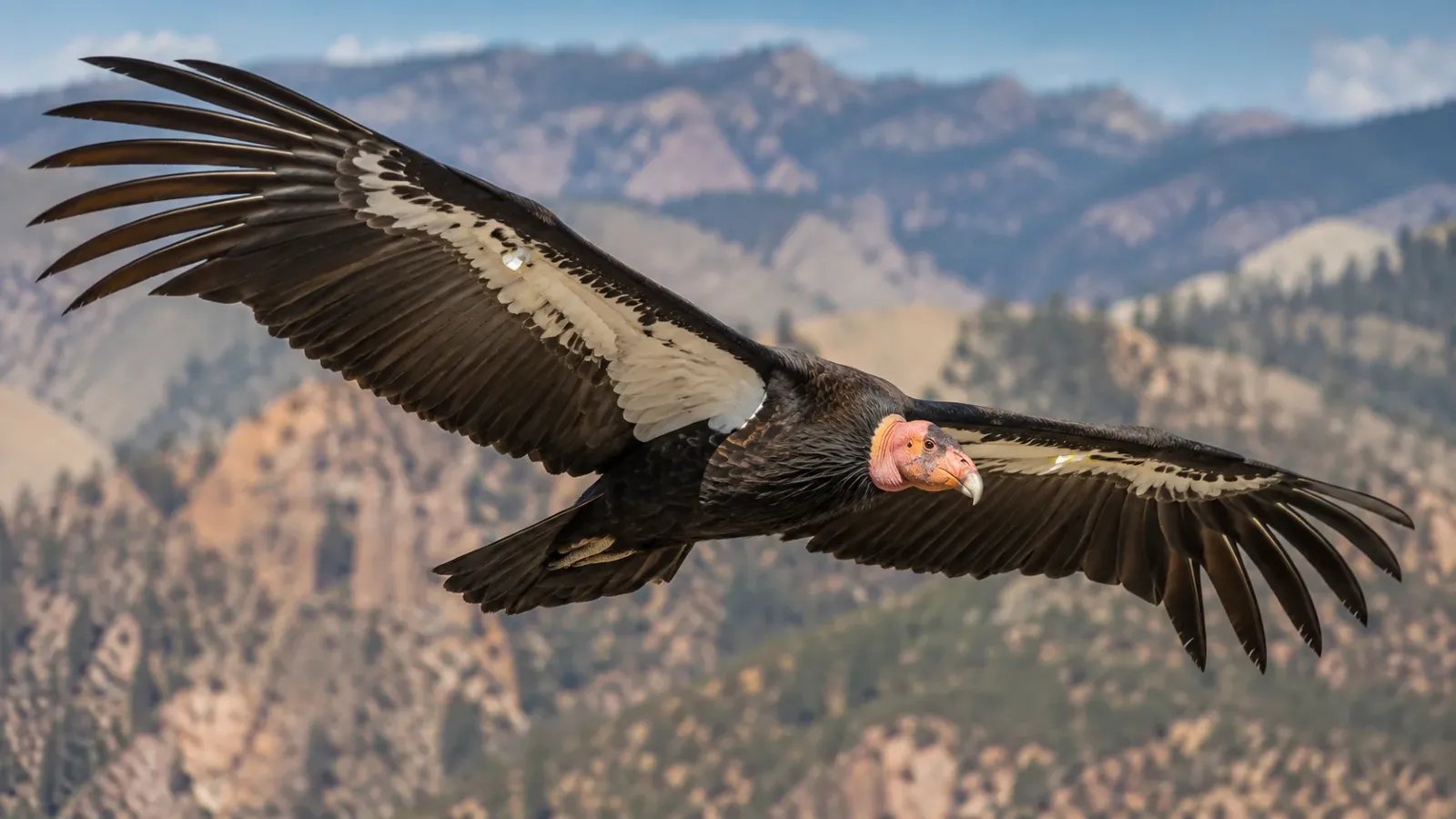
13. A condor's massive nine-foot wingspan features specialized, finger-like slotted feathers that dramatically reduce aerodynamic drag.
The sheer physics of keeping North America's largest flying land bird aloft requires brilliant anatomical engineering. The primary feathers at the tips of a condor's wings are deeply slotted and splay out like human fingers during flight. This biological design prevents the formation of large air vortices at the wingtips, reducing aerodynamic drag and increasing lift in the exact same way that upward-curving winglets function on modern commercial airliners.
14. Despite their massive size and intimidating appearance, condors have completely flat feet and lack the curved, gripping talons found on eagles or hawks.
Because they are often lumped in with birds of prey, many people mistakenly assume condors can swoop down and carry off small animals. In reality, a condor's feet are built much like those of a chicken or a turkey, designed specifically for walking and standing firmly on the ground rather than clutching struggling prey. Their hind toes are vestigial and poorly developed, leaving them biologically incapable of grasping or carrying objects in flight.
15. Every single living California condor is tracked via GPS and wing tags, making them the most heavily monitored wild bird population on Earth.
To ensure the fragile population does not collapse again, conservationists run a tightly controlled, high-tech surveillance operation on the species. Each bird is assigned a specific studbook number, receives giant, highly visible numbered tags on its wings, and is fitted with a GPS transmitter. This allows field biologists to track their daily movements, identify when a bird has stopped moving to intervene medically, and carefully manage the genetic diversity of the wild flock.
Sources & References
This AI-assisted post was rigorously curated and fact-checked for accuracy by:
 Martin Roháček
How fun was this article? 🤔
Tap a star to rate it
🧠 Quiz: How closely were you paying attention?
10 questions — all answers are in the article above!
Enjoyed these facts? There's more! 💌
Fresh fun facts in your inbox. No spam, ever.