The Nomadic Navigator: 15 Interesting Facts About Monarch Butterflies

Far from fragile insects wandering aimlessly, monarch butterflies are ruthless survivors executing one of nature's most complex migrations. Forget the myth that a single butterfly makes the journey from Canada to Mexico; it is a multi-generational relay race. Behind their delicate stained-glass wings lies a hidden world of toxic biological warfare, magnetic compasses, and genetic memory.
1. The monarch butterfly that arrives in Mexico for the winter is not the same insect that left Canada in the spring.
The famous continental migration is actually a massive relay race. It takes three to four short-lived summer generations to leapfrog their way north from Mexico into Canada. However, as daylight decreases in the fall, a "super generation" known as the Methuselah generation is born. Unlike their parents who live only a few weeks, these late-season butterflies delay reproduction and live up to eight months, making the entire three-thousand-mile journey back south in a single lifetime.
2. Monarchs navigate their cross-continental journey using a time-compensated sun compass located in their antennae, not their brains.
For decades, scientists assumed the butterfly's navigation system was entirely housed in its tiny brain. While the eyes do process the sun's position, the critical circadian clocks required to compensate for the sun's movement across the sky are actually located in the insect's antennae. If a monarch's antennae are removed or painted black to block light, the butterfly will fly in completely the wrong direction, hopelessly disoriented.
3. The vibrant orange and black coloration of the monarch is not for camouflage, but a biological warning sign called aposematism.
While many insects rely on blending into their surroundings to avoid predation, monarchs do the exact opposite. Their bright colors serve as an evolutionary billboard advertising their extreme toxicity to predators. Birds or frogs that make the mistake of swallowing a monarch will experience severe vomiting and cardiovascular distress, quickly learning never to target a similarly colored insect again.
4. A monarch caterpillar increases its body mass by nearly two thousand times in just two weeks before pupating.
If a human baby grew at the same astonishing rate as a monarch caterpillar, it would weigh the size of a commercial school bus within a fortnight. This hyper-growth is fueled by a singular, voracious obsession with milkweed. To accommodate this rapid expansion, the caterpillar must shed its skin five distinct times, with each phase between molting known scientifically as an instar.
5. Contrary to popular belief, a monarch does not spin a cocoon; it forms a chrysalis entirely from its own hardened exoskeleton.
The terms cocoon and chrysalis are often erroneously used interchangeably. Moths spin silk around themselves to create a protective cocoon, but a butterfly pupates in the open. When a monarch caterpillar reaches its final instar, it anchors itself upside down, splits its skin one last time, and reveals a soft, jade-green layer underneath that hardens into the jewel-like chrysalis.
6. Inside the chrysalis, the caterpillar does not simply grow wings, but digests its own body into a nutrient-rich cellular soup.
Metamorphosis is a violent, radical process of biological deconstruction. Enzymes completely dissolve the caterpillar's tissues, muscles, and digestive tract. Only highly organized clusters of cells known as imaginal discs survive this localized breakdown. These discs act as blueprints, utilizing the protein-rich fluid surrounding them to construct the adult butterfly's wings, legs, and completely redesigned internal organs.
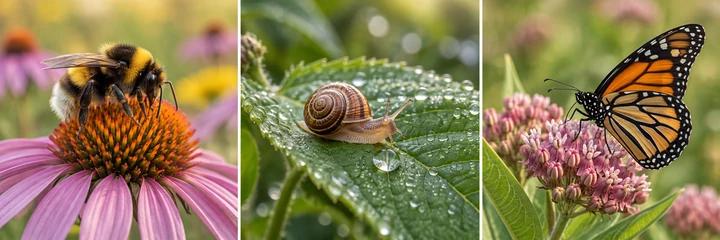 Insects and Invertebrates
Discover the bizarre biology and complex societies of the world's most misunderstood invertebrates. From subterranean fungus farmers to insects with microscopic solar panels, explore the hidden marvels of the creeping, crawling, and flying creatures that sustain global ecosystems.
See All Facts
Insects and Invertebrates
Discover the bizarre biology and complex societies of the world's most misunderstood invertebrates. From subterranean fungus farmers to insects with microscopic solar panels, explore the hidden marvels of the creeping, crawling, and flying creatures that sustain global ecosystems.
See All Facts
7. You can instantly distinguish a male monarch from a female by locating two distinct pheromone spots on the hind wings.
While male and female monarchs look incredibly similar at a glance, a closer inspection of their open wings reveals a stark structural difference. Males possess a prominent black spot on a vein of each hind wing. These spots are actually specialized organs called androconia, which in many butterfly species release courtship pheromones. Females lack these spots entirely and generally have thicker, darker wing veins.
8. In the absence of sunlight, monarchs rely on a built-in magnetic compass driven by ultraviolet light receptors to stay on course.
When heavy cloud cover obscures the sun, monarchs do not simply guess their way south. Researchers have discovered that monarchs possess an internal magnetic compass reliant on cryptochromes, which are specialized light-sensitive proteins found in their eyes. Triggered specifically by ultraviolet-A light penetrating the clouds, these proteins allow the butterfly to physically sense the Earth's magnetic inclination and maintain its precise trajectory.
9. Migrating monarchs routinely ride thermal updrafts to reach astonishing altitudes of up to ten thousand feet.
To survive a multi-thousand-mile journey without starving or exhausting their flight muscles, monarchs act more like soaring eagles than fluttering insects. They actively seek out columns of rising warm air, riding these thermals high into the atmosphere where powerful tailwinds carry them for hundreds of miles. Gliding at these dizzying heights allows them to conserve the vital lipid reserves they will need to survive the coming winter.
10. The microclimate of Mexico's Oyamel fir forests acts as a precise thermal blanket required to keep overwintering monarchs alive.
The Methuselah generation does not migrate to Mexico for a tropical vacation; they seek out very specific high-altitude forests in the Sierra Madre mountains. The Oyamel fir trees provide an incredibly delicate microclimate. The forest canopy acts as an umbrella to protect against freezing winter rain, while the exact elevation keeps the temperature just cold enough to slow the insects' metabolism without allowing them to freeze to death.
11. When tens of millions of overwintering monarchs take flight simultaneously, the collective beating of their wings sounds like a rushing waterfall.
During the deep winter, monarchs cluster together on tree branches by the thousands, entering a state of semi-paralysis to conserve heat. However, when the late winter sun eventually breaks through the canopy and warms their wings, millions of butterflies take to the air at the exact same moment. The sheer density of this biological cloud creates a profound acoustic phenomenon, producing a deep, rushing hum that echoes through the forest.
12. Despite surviving massive cross-continental storms, the average adult monarch butterfly weighs less than a standard paperclip.
The physical durability required to complete the North American migration is wildly disproportionate to the monarch's actual mass. An adult monarch weighs an average of just half a gram. Yet, this practically weightless organism regularly traverses mountain ranges, crosses vast bodies of water like the Great Lakes, and withstands gale-force autumn winds, all while relying on wings as thin as tissue paper.
13. Monarch butterflies possess specialized chemoreceptors on their feet, allowing them to taste plants simply by standing on them.
A female monarch on the hunt for a place to lay her eggs performs a rhythmic, drumming dance on the leaves of potential host plants. She uses highly evolved sensory spines on her tarsi, or lower legs, which are neurologically wired to detect specific chemical signatures. By stomping on the leaf, she is literally tasting the plant's chemical makeup to ensure it is a toxic milkweed plant suitable for her future caterpillars.
14. Lacking lungs entirely, monarchs breathe passively through a network of tiny vents on the sides of their abdomen.
Like all insects, the monarch butterfly bypasses the need for a complex pulmonary system. Instead, oxygen enters the butterfly's body through microscopic external openings called spiracles. This oxygen travels down a branching network of tracheal tubes directly into the surrounding tissues and cells. The insect can control the opening and closing of these spiracles to prevent internal moisture from evaporating during arid migratory flights.
15. Although deeply associated with North America, the monarch butterfly has successfully invaded habitats as far away as Australia and Spain.
While the North American migration dominates the scientific spotlight, the monarch is an incredibly successful global colonizer. Aided by human oceanic expansion and natural storms in the nineteenth century, monarchs hitched rides across the Pacific and Atlantic. Because humans had previously introduced ornamental milkweed to places like Australia, New Zealand, and the Iberian Peninsula, the wandering butterflies found familiar host plants and established thriving, permanent international populations.
Sources & References
This AI-assisted post was rigorously curated and fact-checked for accuracy by:
 Martin Roháček
How fun was this article? 🤔
Tap a star to rate it
🧠 Quiz: How closely were you paying attention?
10 questions — all answers are in the article above!
Enjoyed these facts? There's more! 💌
Fresh fun facts in your inbox. No spam, ever.