The Prudent King: 15 Fascinating Facts About Philip II of Spain
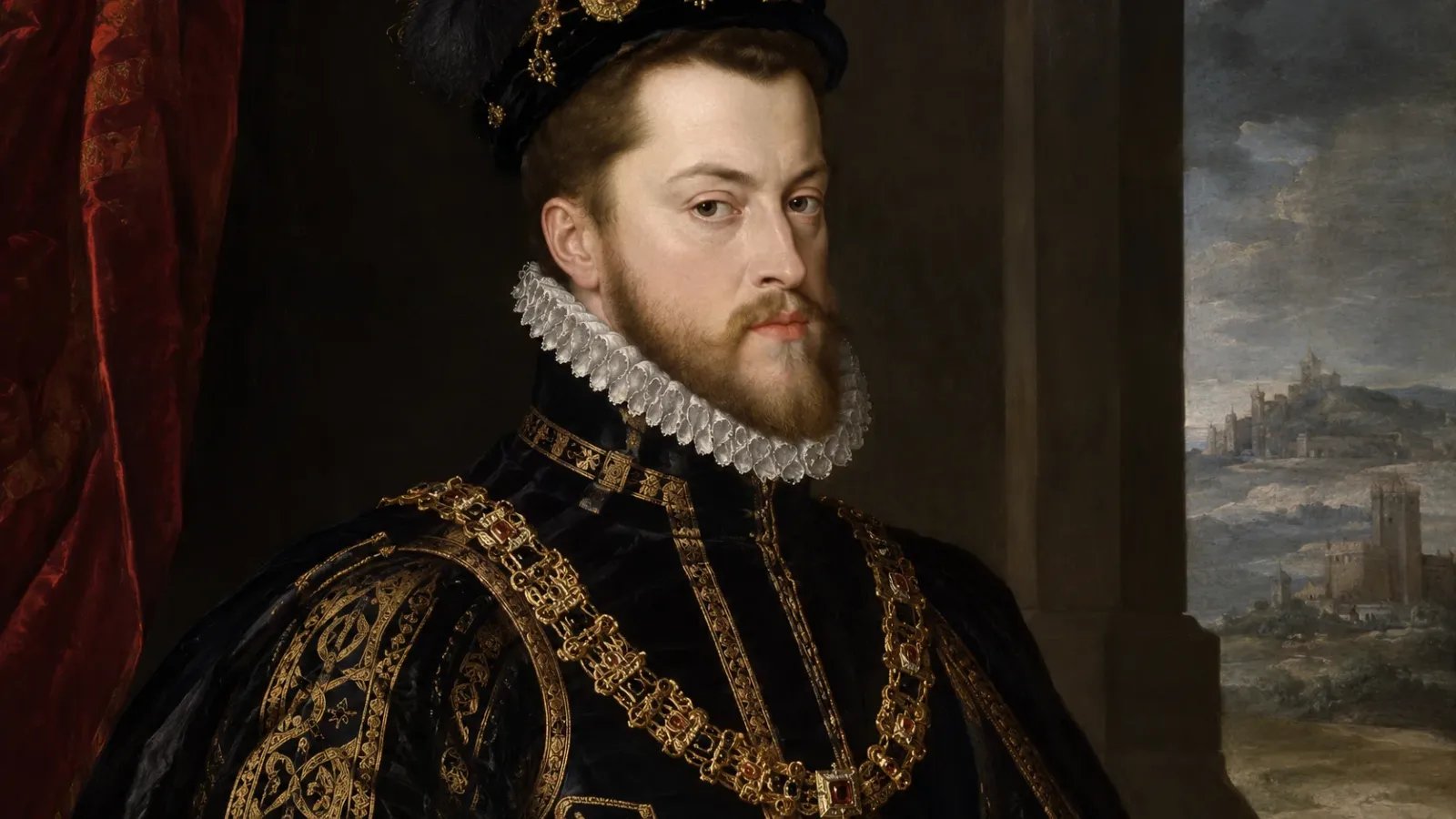
Philip II was a pioneer of modern bureaucracy who ruled the first global empire. Ruling from his desk rather than the battlefield, the Prudent King micromanaged territories from Asia to the Americas. Discover the shocking reality behind Spain's most misunderstood monarch.
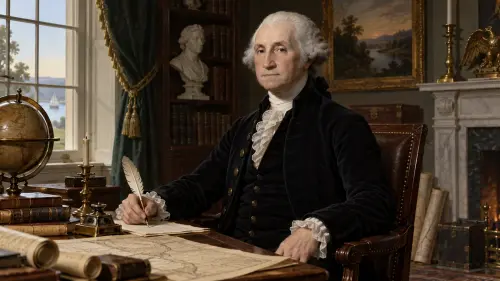
1. Philip II was nicknamed the "Paper King" because he ruled through paperwork.
Unlike medieval kings who traveled constantly, Philip preferred to remain in Spain and govern his realms from his desk. He read and annotated enormous numbers of dispatches. Historians note that he was a micromanager who tried to read every dispatch that came to his desk. By the time his decisions were made and his orders reached the people who were supposed to carry them out, the situation on the ground had often changed.
2. The Philippines are named after him.
In 1543, the Spanish explorer Ruy López de Villalobos named islands in the western Pacific "Las Islas Filipinas" in honor of Philip, then the Prince of Asturias. Spain began its colonization of the archipelago in the 1560s, and the name came to be applied to the whole island group. Philip's empire, which included Spain, Portugal and their colonies, was so large that it spanned several continents.
3. He was briefly king of England, but with limited power.
In 1554 Philip married Mary I of England. Under the terms of the Act for the Marriage of Queen Mary to Philip of Spain, he was given the title of king and was to co-reign with his wife, with official documents carrying both their names. The marriage treaty, however, limited his power, for example by keeping foreigners out of English offices. When Mary died childless in 1558, Philip lost the title, and he soon became an enemy of her half-sister Elizabeth I.
4. He built El Escorial, a palace, monastery, and mausoleum in one.
Philip's great architectural project was El Escorial, near Madrid, completed in 1584. Designed by Juan Bautista de Toledo and later Juan de Herrera, the vast complex combined a royal palace, a monastery, a basilica, a library, and the burial place of Spanish monarchs. Its plain, severe style matched Philip's personality. His bedroom was arranged so that he could follow Mass at the basilica's high altar from his bed, which he did in his final illness.
5. His library included banned books.
Philip was a devout Catholic who supported the Inquisition, but he was also a passionate book collector. His library at El Escorial held some 40,000 volumes, including about 1,800 Arabic titles and several thousand manuscripts. Although he was dedicated to rooting out heretical works, he collected forbidden books too, which were kept protected in a special room on an upper floor of the library.
6. His government went bankrupt several times despite silver from the Americas.
Silver from the New World was vital for Philip's foreign policy, but his wars against the Ottomans, France, England, and the Dutch rebels cost far more than he received. His government defaulted on its debts in 1557, 1560, 1569, 1575, and 1596. The flood of American silver also contributed to inflation across Europe. His son inherited a vast but financially strained empire.
7. His secret ciphers were cracked by a French mathematician.
Spain's diplomats and commanders used coded messages to communicate with Madrid. The French mathematician François Viète, working for King Henry IV, succeeded in breaking one of the Spanish ciphers in the 1590s. According to a well-known story, Philip was so astonished that he complained to the Pope that the French had used sorcery against his ciphers. Whether or not the complaint was exactly so, the episode shows the growing importance of codebreaking in early modern warfare.
8. His Armada against England failed in 1588.
In 1588 Philip sent the "Invincible Armada" to invade England and overthrow Elizabeth I. The plan depended on sailing up the Channel to link up with the Duke of Parma's army in the Netherlands, which proved extremely difficult to coordinate. The fleet's commander, the Duke of Medina Sidonia, had no naval experience and had tried to avoid the post. English attacks and storms scattered the Armada, and dozens of ships and thousands of men were lost on the way back around Scotland and Ireland.
9. He suffered from gout and died after a long, painful illness.
Philip suffered from gout for years, and in his last years he often had to be carried. He died at El Escorial on 13 September 1598 at the age of 71, after a prolonged illness, probably cancer. He was surrounded by priests, family, and trusted officials, and he followed religious services from his bed, which had been arranged to face the high altar of the basilica.
10. He funded the Catholic League in France.
During the French Wars of Religion, Philip signed the Treaty of Joinville in 1584, agreeing to fund the Catholic League against the French Huguenots. A key aim was to keep France, Spain's biggest rival, divided and weak. He even pushed the claim of his daughter, Isabella Clara Eugenia, to the French throne, which gave him a link through his marriage to Elisabeth of Valois. The plan failed after Henry IV converted to Catholicism, and the Peace of Vervins was signed with France in 1598.
11. He sponsored a scientific expedition to study the natural history of Mexico.
In 1570 Philip sent his court physician Francisco Hernández to New Spain to study the plants, animals, and medicines of the region. Over several years Hernández collected information on thousands of plants, often drawing on the knowledge of Indigenous healers. The expedition is often described as one of the first scientific expeditions to the Americas sponsored by a European monarch. Much of his work was lost in a fire at El Escorial in 1671, though parts survived in copies and summaries.
12. He made Madrid the capital of Spain.
Spain's court had moved between cities, with Toledo as the traditional royal seat. In 1561 Philip moved his court to Madrid, then a relatively small Castilian town. Except for a brief period under Philip III, Madrid has remained the capital of Spain ever since. Philip also converted the Alcázar of Madrid into a royal palace, with works that lasted from 1561 to 1598.
13. He supported the "purity of blood" statutes.
In Spain, many institutions required applicants to prove they had no Jewish or Muslim ancestors, a practice known as limpieza de sangre, or "purity of blood." These statutes were controversial, even among churchmen. Philip supported them: in 1556 he approved the statute of the cathedral of Toledo, and during his reign they spread widely. The system fed suspicion and discrimination against Spain's converted families for generations.
14. He became king of Portugal and united the Iberian Peninsula.
When the young King Sebastian of Portugal died in battle in Morocco in 1578 and his successor, Cardinal Henry, died in 1580 without an heir, Philip, whose mother was a Portuguese princess, claimed the throne. His army under the Duke of Alba defeated the Portuguese resistance, and Philip was recognized as king in 1581. The Iberian Union brought Portugal's overseas possessions in Brazil, Africa, and Asia under his rule, and lasted until 1640.
15. He was one of Titian's greatest patrons.
Philip was a passionate patron of the arts. He commissioned a series of mythological paintings from the Venetian master Titian, known as the "poesie," including Danaë and Venus and Adonis, as well as portraits and religious works. Philip's collection formed an important part of the royal collection from which the Prado Museum later grew. Although he had a reputation as a severe and pious ruler, he enjoyed sensuous paintings in his private rooms.
Sources & References
This AI-assisted post was rigorously curated and fact-checked for accuracy by:
 Martin Roháček
How fun was this article? 🤔
Tap a star to rate it
🧠 Quiz: How closely were you paying attention?
10 questions — all answers are in the article above!
Enjoyed these facts? There's more! 💌
Fresh fun facts in your inbox. No spam, ever.