The Stargazing Recyclers: 15 Fascinating Facts About Dung Beetles
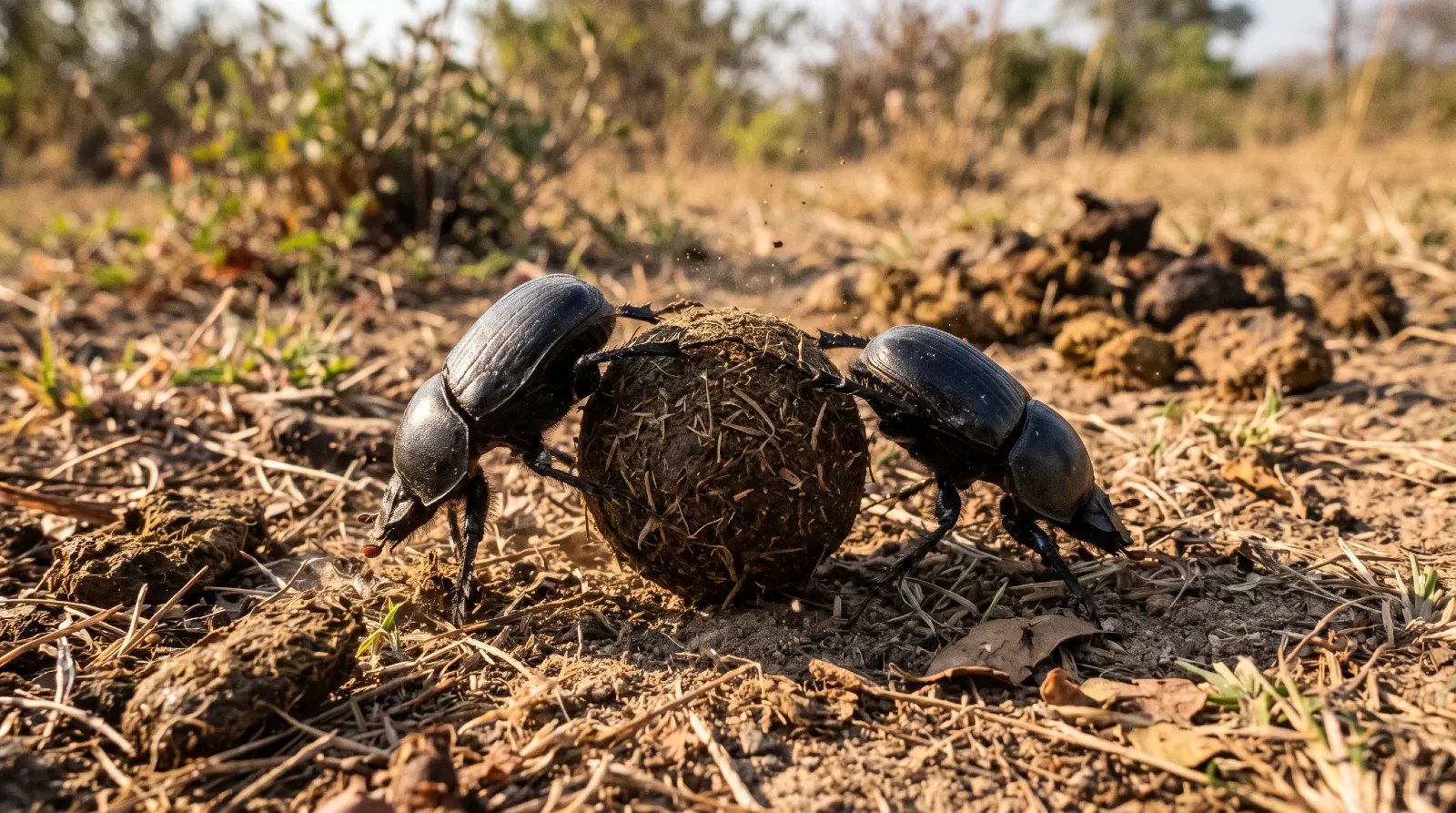
Dung beetles spend their lives rolling, burying and eating animal droppings, and they are far more impressive than their reputation suggests. They navigate by the Milky Way, are among the strongest animals on Earth for their size and were worshipped by the ancient Egyptians. Here are the surprising facts about nature's hardest-working recyclers.
1. Dung Beetles Can Use the Night Sky as a Compass
Experiments on nocturnal dung beetles demonstrated orientation using the Milky Way's broad band of light. They are no longer the only insects with evidence of stellar navigation: a 2025 study showed that Bogong moths use the starry sky to maintain a migratory direction over long distances. The beetles' short-range orientation and the moths' migration are distinct achievements.
2. Another species steers by polarised moonlight.
The African dung beetle Scarabaeus zambesianus uses a different trick. It orients itself using patterns of polarised light in the moonlit sky, which humans cannot see. It was the first animal known to navigate this way.
3. They dance on top of their dung balls.
Before setting off, and whenever it loses its way, a rolling dung beetle climbs on top of its ball and turns around in a little "dance". Researchers believe it is taking a snapshot of the position of the sun, moon or stars in the sky. It then uses this mental map to roll its ball away in a straight line.
4. They use their dung balls to cool their feet.
On scorching days in the African savanna, the sand can become hot enough to burn. Scientists discovered that dung beetles climb onto their moist dung balls to cool down their legs, using the ball as a portable air-conditioned platform. When researchers fitted beetles with tiny silicone boots, they climbed onto their balls less often.
5. One species can pull more than 1,000 times its own weight.
Dung beetles are incredibly strong for their size. Males of the horned dung beetle Onthophagus taurus have been recorded pulling 1,141 times their own body weight. For an average person, that would be like pulling six double-decker buses full of people.
6. There are rollers, tunnellers and dwellers.
Not all dung beetles roll balls. Scientists divide them into three main groups. Rollers shape dung into balls and roll them away to bury elsewhere. Tunnellers dig burrows directly beneath a dung pile and pull dung down into them. Dwellers simply live and breed inside the dung pile itself.
 You might also like
15 Interesting Facts About Catherine de’ Medici
7. Rollers must run from thieves.
A freshly made dung ball is a valuable prize, and other beetles often try to steal it. This is why rolling dung beetles hurry away from the dung pile in a straight line as fast as possible. The most efficient escape route from a crowded dung pile is to keep going straight, which is why accurate navigation matters so much.
8. A single elephant can feed millions of beetles.
Dung beetles prefer the droppings of plant-eating and omnivorous animals, and they can be extremely numerous. The daily dung of a single elephant can support around two million beetles. In some places, a fresh pile can be completely buried by beetles within hours.
9. The ancient Egyptians worshipped them.
In ancient Egypt, the scarab beetle was linked to Khepri, the god of the rising sun. The Egyptians imagined Khepri rolling the sun across the sky, just as a dung beetle rolls its ball. Scarab amulets were among the most popular charms in ancient Egypt and were often placed with the dead.
10. They saved Australia's pastures.
When cattle were introduced to Australia, native dung beetles, which were adapted to the small, dry droppings of marsupials, could not cope with large cow pats. Millions of hectares of pasture became covered in dung and plagued by flies. From the 1960s, the Australian Dung Beetle Project introduced 23 species from Africa and Europe, improving the pastures and greatly reducing the number of bush flies.
11. A 2006 Estimate Valued Their US Services at $380 Million a Year
A study published in BioScience in 2006 estimated that dung burial by beetles prevented about US$380 million in annual livestock-related losses. It is a historical economic estimate, based on assumptions and prices of that period, rather than an automatically current value. Their services include nutrient recycling and reducing dung-associated pests.
12. They help plant forests.
Dung often contains seeds that animals have swallowed with their food. When dung beetles bury the dung, they also bury many of these seeds, protecting them from seed-eating animals and placing them in rich soil. This makes dung beetles important helpers in regenerating tropical forests.
🤔 Quick guess
On which continent are dung beetles NOT found?
13. Some males fight with horns.
Many male dung beetles have impressive horns on their heads or bodies, which they use to fight rivals for access to females inside tunnels. In some species, smaller males without horns use a different tactic, sneaking past the guarding males through side tunnels to reach the females.
14. Not all dung beetles eat only dung.
Most dung beetles feed on droppings, but many also eat mushrooms, rotting fruit or decaying leaves. A few species in South America have even become predators, attacking and eating millipedes. They are found on every continent except Antarctica.
15. Parents raise their young inside balls of dung.
Many dung beetles lay their eggs inside specially prepared brood balls, which they bury underground. When the larva hatches, it is surrounded by food and simply eats its way through the ball. In some species, both parents work together to prepare and guard the brood balls.
How did these facts land?
Know someone who'd love these facts? Share them 👇
🧠 Quiz: How closely were you paying attention?
Think you remember the facts? 10 questions, tap an answer.