The Living Lanterns: 15 Fascinating Facts About Fireflies
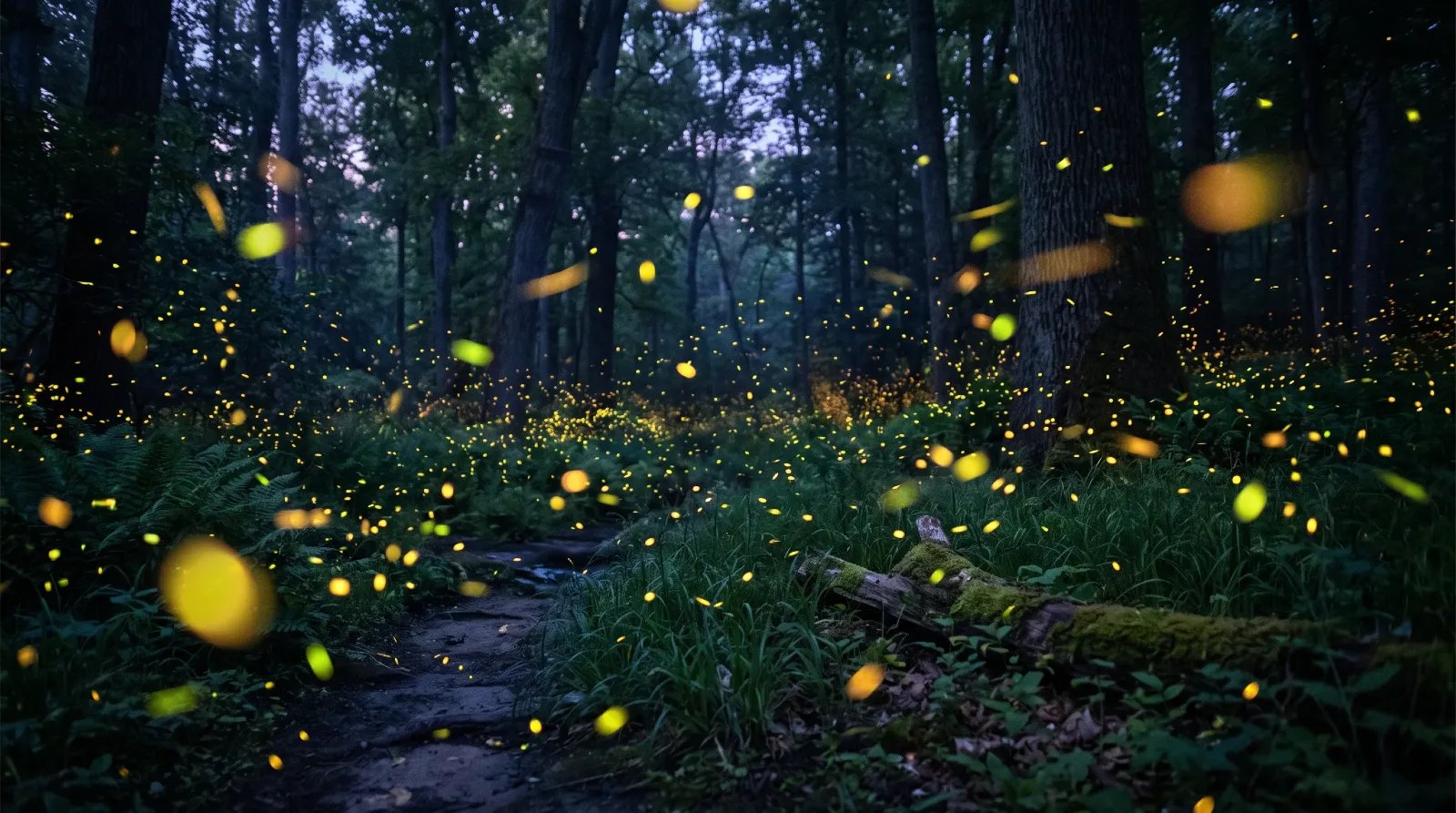
On a summer night, fireflies turn meadows into a twinkling light show. But these glowing insects are not flies at all, some of them flash in perfect unison, and certain females use fake signals to lure males to their deaths. Here are the surprising facts about one of nature's most magical creatures.
1. Fireflies are actually beetles.
Despite their name, fireflies are not flies. They are soft-bodied beetles belonging to the family Lampyridae, which includes more than 2,400 described species. Depending on where you live, they may also be called lightning bugs or glow-worms.
2. Their light is "cold".
Fireflies produce light through a chemical reaction inside special light organs, usually on the underside of the abdomen. An enzyme called luciferase acts on a compound called luciferin, together with oxygen and the energy molecule ATP. The result is "cold light", which produces almost no heat. If a light bulb were as efficient, it would barely get warm.
3. Many Species Have Distinctive Courtship Signals
In flashing species, the timing and pattern of light signals help males and females recognize potential mates. Other fireflies glow continuously, and some day-active species use pheromones instead of adult light signals. A flashing 'Morse code' is therefore a useful comparison for some species, rather than a rule for the entire family.
4. Some fireflies flash in perfect unison.
In a few places, thousands of fireflies synchronise their flashes, lighting up and going dark at the same moment. Along rivers in Southeast Asia, whole trees can blink in rhythm. In the United States, a famous synchronous display takes place near Elkmont in Great Smoky Mountains National Park each June, and visitors must enter a lottery to see it.
5. Some Females Lure Other Fireflies by Mimicry
Female Photuris fireflies can imitate the response timing of female Photinus. Males approaching the apparent mate may instead be captured and eaten. This is aggressive mimicry; the observation does not by itself show that each female learned the pattern through experience.
6. Eating rival males makes them toxic.
Many fireflies contain bitter, toxic chemicals called lucibufagins, which make them unpleasant or even dangerous for predators to eat. Photuris females cannot make enough of these chemicals themselves. By eating males of other species, they absorb the toxins and use them to protect themselves and their eggs.
 You might also like
The Blonde Bond: 15 Fascinating Facts About Daniel Craig
7. Their glow probably began as a warning.
All firefly larvae glow, even in species whose adults do not. Scientists believe that light production first evolved as a warning signal to tell predators that the larvae tasted bad. Only later did adult fireflies start using their lights for courtship.
8. Firefly larvae are fierce predators.
Most fireflies spend the majority of their lives as larvae, living on the ground or in moist soil for a year or more. These larvae are hunters that feed on snails, slugs and worms, injecting them with digestive chemicals and then sucking up the liquefied remains. Some adult fireflies do not eat at all.
9. Not all fireflies glow as adults.
Many firefly species are active during the day and produce little or no light as adults. Instead, they rely on chemical signals called pheromones to find a mate. Glowing at night is only one of several ways fireflies communicate.
10. Firefly colours range from green to red.
Depending on the species, firefly light can be yellow, green or pale red. The exact colour depends on small differences in the luciferase enzyme. Some species, such as the "blue ghost" firefly of the eastern United States, seem to glow bluish-white.
11. Their glow chemistry is used in medicine and science.
Because the firefly light reaction needs ATP, the energy molecule found in every living cell, luciferase is used in laboratories to detect living cells and bacteria. Scientists have also inserted the firefly's light genes into other organisms, creating glowing plants and cells that make it easier to track how genes work.
12. Light pollution is a serious threat.
Because fireflies rely on their own light signals to find each other, artificial light at night can make courtship much harder. Street lamps, car headlights and garden lights can drown out their flashes. Habitat loss and pesticides are also major threats, and some species are now considered at risk of extinction.
🤔 Quick guess
Which US state has the firefly as its official state insect?
13. Firefly tourism is booming.
Watching fireflies has become a popular activity in many countries, from the United States and Mexico to Taiwan, Thailand and Malaysia. While firefly tourism can raise awareness, scientists warn that large crowds with torches and phones can trample habitats and disturb the insects' displays.
14. They need dark, damp places to thrive.
Fireflies are found in temperate and tropical regions around the world. Many live in marshes, meadows and moist woodland, where their larvae can find plenty of snails and worms. Long grass and leaf litter give larvae and adults places to hide during the day.
15. Some US states have made them official symbols.
Fireflies are so loved that several American states have honoured them. The firefly is the official state insect of Pennsylvania, and Tennessee has also named the firefly one of its state insects. In Japan, fireflies have long been celebrated in poetry and festivals as symbols of summer and of fleeting life.
How did these facts land?
Know someone who'd love these facts? Share them 👇
🧠 Quiz: How closely were you paying attention?
Think you remember the facts? 10 questions, tap an answer.