The Land of Smiles: 15 Fascinating Facts About Thailand
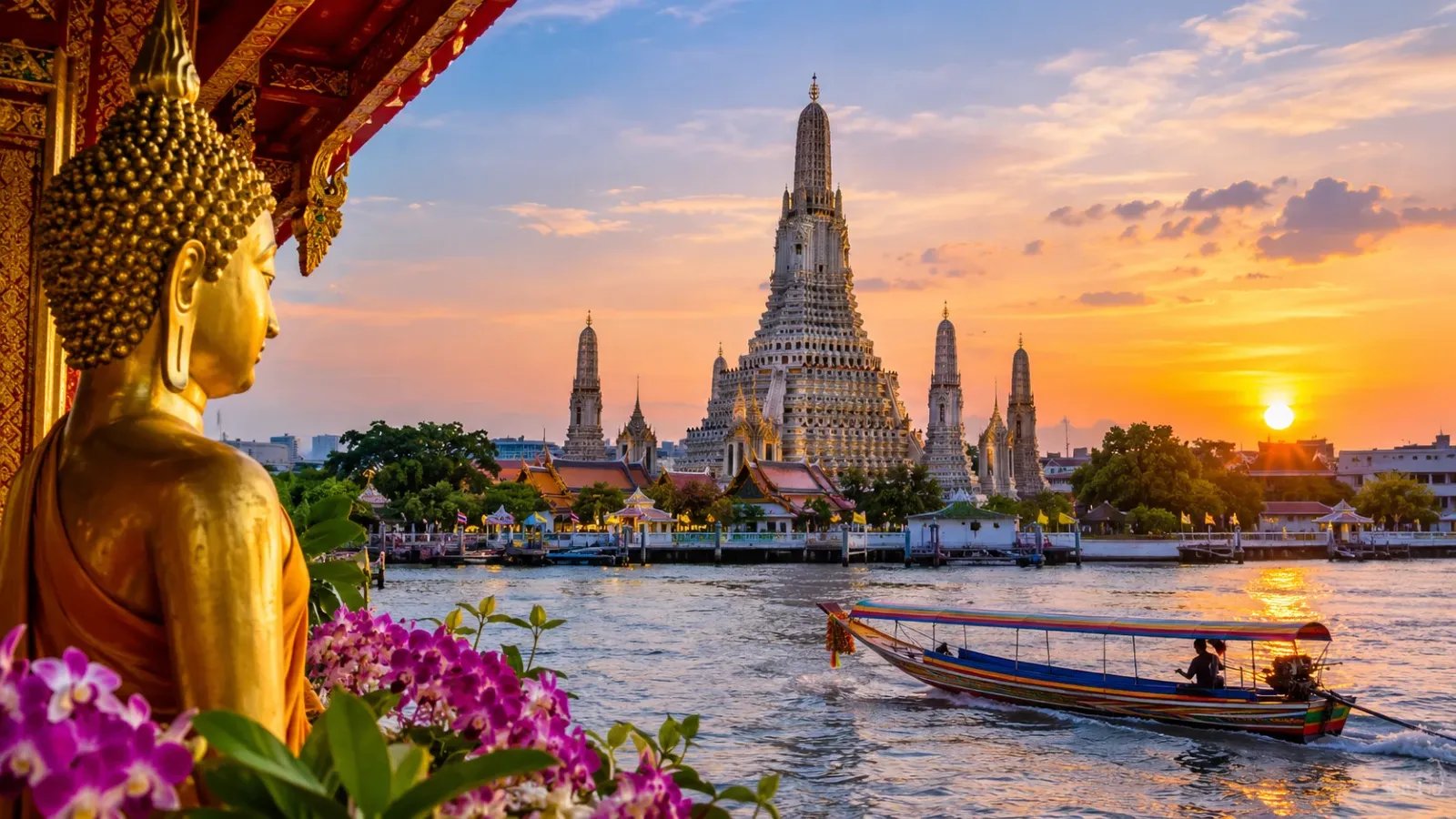
Thailand attracted almost 40 million visitors in 2019, drawn by golden temples, tropical islands, street food, and a welcoming culture. It is also the only Southeast Asian country that avoided European colonization. Discover 15 fascinating facts about the Land of Smiles.
1. Thailand is the only Southeast Asian country that was never colonized by a European power.
While its neighbors came under British, French, Dutch, or Spanish rule, Thailand, then called Siam, remained independent. It did so through skilled diplomacy by its kings and by playing the colonial powers against each other, though it had to give up some territory. Many Thais are proud of this history.
2. The name Thailand dates from 1939.
The country was known as Siam to the outside world until 1939, when the government changed the official name to Thailand, "land of the Thai" or "land of the free." The name Siam was briefly restored from 1945 to 1949, after which Thailand was adopted again.
3. Bangkok has one of the longest place names in the world.
Thais call their capital Krung Thep, "city of angels." The full ceremonial name, Krung Thep Mahanakhon Amon Rattanakosin and so on, is 168 letters long when written in the Latin alphabet, and Guinness World Records has recognized it as the longest place name for a capital city.
4. Almost 40 million tourists visited in 2019.
Thailand welcomed around 39.9 million international visitors in 2019, a record before the pandemic. Tourism recovered strongly in the following years. Visitors come for Bangkok's markets, the beaches of Phuket and the Gulf islands, and the mountains and temples of the north.
5. The Reclining Buddha of Wat Pho is 46 meters long.
Wat Pho in Bangkok, one of the city's oldest temples, houses a Reclining Buddha covered in gold leaf, about 46 meters long and 15 meters high. Its feet are decorated with mother-of-pearl designs. Most Thais, about 90 percent or more, follow Theravada Buddhism, and temples are central to community life.
6. Songkran is a water festival recognized by UNESCO.
Songkran, the traditional Thai New Year, is celebrated each year from 13 to 15 April. It began as a ritual of pouring water over Buddha statues and the hands of elders to show respect, and has grown into a nationwide water fight. UNESCO inscribed Songkran in Thailand on its intangible heritage list in 2023.
7. Thai massage is also on the UNESCO list.
Nuad Thai, traditional Thai massage, combines stretching, acupressure, and breathing and is rooted in Buddhist and Ayurvedic traditions. UNESCO recognized it as intangible cultural heritage in 2019. The tradition is associated with Wat Pho, where massage points are illustrated on stone inscriptions.
8. Pad Thai was promoted as a national dish.
Stir-fried rice noodles with egg, tofu, peanuts, and tamarind became a national dish in the 1930s and 1940s when the government of Prime Minister Plaek Phibunsongkhram promoted noodles as part of a nationalist campaign. The government encouraged rice noodle consumption and promoted the dish. Street vendors in Bangkok still serve it today.
9. Ayutthaya was a great royal capital.
Ayutthaya was the capital of the Kingdom of Siam from about 1350 until 1767, when it was sacked by a Burmese army. Its ruins, with prang towers and Buddha statues overgrown with tree roots, are a UNESCO World Heritage Site and a popular day trip from Bangkok.
10. Maya Bay was closed so nature could recover.
Maya Bay on Phi Phi Leh island, made famous by the film The Beach, was closed to tourists in June 2018 because heavy visitor numbers had damaged its coral reef. It reopened in January 2022 with limits on the number of visitors and boats, and no swimming is allowed on the beach itself.
11. Loy Krathong lights up rivers.
During Loy Krathong, held on the full moon of the twelfth lunar month, usually in November, Thais float small decorated baskets with candles and flowers on rivers and lakes to thank the water spirits. In Chiang Mai, the festival coincides with Yi Peng, when thousands of paper lanterns are released into the sky.
12. Doi Inthanon is the country's highest peak.
Doi Inthanon, in northern Thailand near Chiang Mai, rises to 2,565 meters. Its summit is often cool and misty, and the national park contains waterfalls, forests, and two royal pagodas. It is a popular spot for bird-watching.
13. The term "Siamese twins" comes from Siam.
Chang and Eng Bunker, conjoined twins born in 1811 in Siam, toured Europe and America and later settled in North Carolina. Their fame led to the term "Siamese twins" for conjoined twins.
14. The Death Railway was built on the River Kwai.
During World War II, the Japanese army built a railway from Thailand to Burma, using Allied prisoners of war and Asian laborers. Roughly 12,000 Allied prisoners and many more Asian workers, estimated at around 90,000, died of disease, hunger, and exhaustion. The bridge at Kanchanaburi and war museums commemorate the history.
15. Thai is a tonal language with its own script.
Thai has five tones, so the same syllable can have different meanings depending on pitch. It is written in its own alphabet with 44 consonant letters. The Thai script is traditionally linked to the 13th century, and today it is used by about 60 million native speakers.
Sources & References
This AI-assisted post was rigorously curated and fact-checked for accuracy by:
 Martin Roháček
How fun was this article? 🤔
Tap a star to rate it
🧠 Quiz: How closely were you paying attention?
10 questions — all answers are in the article above!
Enjoyed these facts? There's more! 💌
Fresh fun facts in your inbox. No spam, ever.