The Sacred Monasteries in the Sky: 15 Fascinating Facts About Meteora
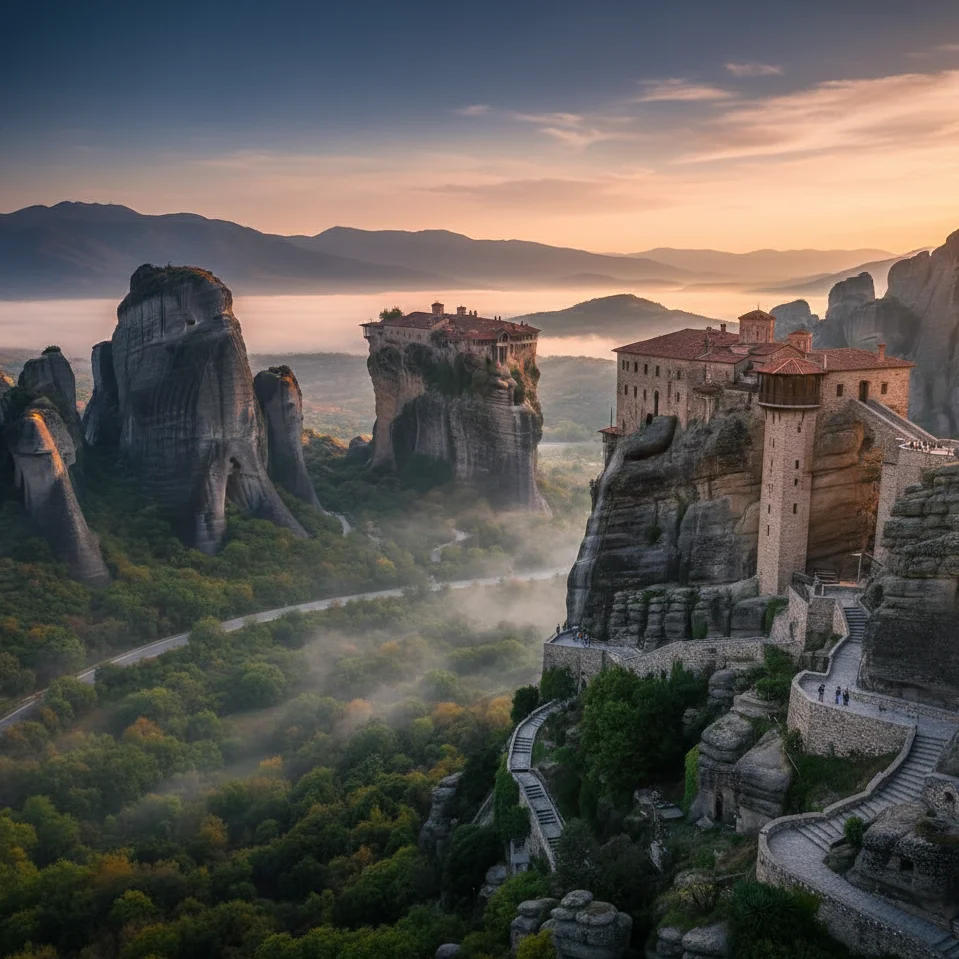
Perched atop gravity-defying sandstone pinnacles in central Greece, Meteora is one of the world's most astonishing architectural and natural wonders. For over six centuries, Orthodox Christian monks have lived in sky-high sanctuaries built directly onto raw vertical cliffs. From ancient caves harboring prehistoric human walls to Hollywood film cameos and rare wildlife, this sacred geological landscape holds endless secrets. Discover the mesmerizing history, geology, and spiritual heritage of Greece's floating monasteries.
1. The Name Translates to "Suspended in the Air"
The word Meteora derives from the Greek adjective meteoros, which literally translates to "suspended in the air" or "hovering in the heavens." When hermit monks first established solitary retreats atop these sheer sandstone columns, the structures appeared to defy gravity, floating seamlessly above the Thessalian plain. This poetic description is also the linguistic root for the modern English word meteor. Walking through the misty morning air around the rock formations, visitors quickly realize how appropriate the moniker remains today. The visual illusion of floating medieval buildings continues to spellbind travelers from around the globe.
2. Geological Origins Date Back 60 Million Years
The towering rock pinnacles of Meteora were not sculpted by human hands or ancient volcanic eruptions, but rather by millions of years of natural weathering. Around 60 million years ago during the Paleogene period, riverbed deposits composed of sandstone, pebbles, and conglomerate sediments collected at the edge of an ancient sea. Tectonic uplift later thrust these compacted stone masses upward into high plateaus. Over millennia, water currents, wind, and severe temperature fluctuations eroded the softer rock, leaving behind extraordinary vertical columns reaching up to 1,300 feet high. Today, these unique geological formations draw geologists and rock climbers alongside religious pilgrims.
3. Ancient Monks Ascended Using Nets and Vertigo-Inducing Ladders
Before modern staircases were cut into the cliffs, reaching a summit monastery required extraordinary physical endurance and faith. Early monks climbed using long wooden folding ladders that swayed dangerously in high winds and could be pulled up in times of peril. For heavy supplies and elderly residents, the monks used woven rope nets attached to wooden windlasses and pulleys to haul people up sheer vertical drops. Legend holds that when anxious visitors asked how often the hoisting ropes were replaced, the monks famously replied, "Only when the Lord lets them break." This perilous isolation successfully kept the communities safe from unwanted intruders for centuries.
4. Only Six of the Original Twenty-Four Monasteries Remain Active
During the peak of Meteora's monastic culture in the 15th and 16th centuries, at least 24 distinct monasteries perched atop these isolated peaks. Over centuries of warfare, political decline, and natural degradation, the vast majority fell into ruin or were abandoned completely. Today, only six functioning monasteries remain active, each carefully preserved as both a living place of worship and a historic museum. Four of these active sanctuaries are inhabited by monks, while two host religious communities of nuns. Visitors can explore all six remaining complexes, provided they adhere to strict traditional dress codes out of respect for the monastic orders.
5. Saint Athanasios Founded the First Organized Monastic Community
While individual hermit monks had inhabited the natural caves of Meteora since at least the 10th century, the organized monastic movement began during the 14th century. A scholar-monk named Saint Athanasios the Meteorite fled Mount Athos due to pirate raids and settled atop the massive rock known as Broad Rock. Around 1340, Athanasios gathered local hermits, established strict rules based on Eastern Orthodox traditions, and laid the foundations for the first organized monastery. He personally named the site Meteora, initiating a golden age of monastic sanctuary high above the turbulent valley floor. His royal disciple, King John Uroš of Serbia, later renounced his throne to join the brotherhood and fund further construction.
6. The Great Meteoron is the Oldest and Largest Monastery
Towering over the surrounding landscape at over 2,000 feet above sea level, the Holy Monastery of the Transfiguration—commonly known as the Great Meteoron—is the largest and oldest of the complex. Founded by Saint Athanasios in the mid-14th century, it served as the administrative and spiritual heart of the region's monastic system. The monastery's impressive central church features stunning 16th-century post-Byzantine frescoes depicting saints and biblical scenes in vivid detail. Within its massive stone walls, the complex houses historical museum collections, rare manuscripts, ancient wine cellars, and an ossuary containing the skulls of former monks. Exploring its expansive stone terraces provides an unforgettable view of the surrounding vertical terrain.
7. Nearby Theopetra Cave Preserves 50,000 Years of Human History
Just three miles from the rock columns of Meteora lies Theopetra Cave, a site of extraordinary archaeological importance for ancient Greece and European history. Excavations inside the cave revealed continuous human occupancy stretching back roughly 50,000 years, spanning the Middle Paleolithic to the end of the Neolithic period. Researchers discovered ancient stone tools, hearths, human footprints, and even a stone wall built roughly 23,000 years ago to shield inhabitants from cold Ice Age winds. This crude barrier is considered by many archaeologists to be the oldest known man-made structure on Earth. The cave demonstrates that long before monks sought spiritual solitude on the cliffs, early humans found survival in the shadows of the rocks.
8. The Monasteries Were Built as Fortresses Against Ottoman Expansion
The dramatic flourish of monastery construction in the 14th century was directly triggered by intense political turmoil across the Balkan peninsula. As the Ottoman Empire expanded across Greece, Orthodox Christians faced heavy taxation, religious suppression, and military raids. The unreachable cliff faces of Meteora offered an ideal natural refuge where religious scholars could preserve Orthodox theology, language, and culture without fear of attack. Because the rock pinnacles were virtually immune to medieval siege weapons, the monks could easily haul up their ladders and cut off all contact with the outside world. This defensive isolation played a crucial role in safeguarding Greek cultural heritage during centuries of foreign rule.
9. Byzantine Architecture Merges Seamlessly with Raw Rock Tops
The construction of Meteora's monasteries represents an astonishing feat of medieval engineering and artistic integration. Lacking modern machinery, builders carried every brick, beam, and mortar bag up the vertical rock walls by hand or hoist basket. Architects designed the buildings to conform directly to the uneven surface of the cliff edges, using local stone so the walls appeared to grow straight out of the bedrock. The roofs featured traditional red clay tiles, while timber-framed balconies projected precariously over immense abysses. Inside, the church interiors followed classic Byzantine cross-in-square architectural plans decorated with intricate woodwork and brilliant gold-leaf icons.
10. The Cliffs Are Home to Rare and Endangered Wildlife
Meteora is not merely a historical treasure; it is also a vital biodiversity hotspot protected within the European Natura 2000 ecological network. The sheer sandstone cliffs and undisturbed oak forests below host one of Europe's last remaining nesting habitats for the endangered Egyptian vulture. High-altitude raptors like peregrine falcons, golden eagles, and Eurasian eagle-owls frequently nest in the deep fissures of the rock walls. The surrounding ecosystem also supports unique flora, including rare butterfly species and endemic plants adapted specifically to vertical rock crevice environments. Preservation efforts now focus on balancing high tourist traffic with the delicate conservation needs of these rare species.
11. Carved Rock Staircases Only Replaced Nets in the 1920s
For more than five centuries, entering a Meteora monastery required trusting a frayed rope network or ascending endless wooden ladders. This extreme isolation ended during the 1920s when local authorities and monks commissioned the carving of formal stone staircases and tunnels directly into the rock walls. More than 300 steps were laboriously hand-chiseled into the mountainsides, allowing safe foot access for residents and modern travelers. This infrastructure overhaul transformed Meteora from an inaccessible monastic redoubt into an accessible cultural destination. Today, visitors still climb hundreds of steps to reach each monastery, but without the heart-pounding risk of a hanging rope basket.
12. World War II and the Greek Civil War Left Severe Scars
Despite their formidable height, the monasteries were unable to escape the destruction of 20th-century warfare. During World War II, Axis occupying forces shelled and bombed several of the remote complexes, suspecting they were hiding Greek resistance fighters. Irreplaceable religious artwork, ancient libraries, and historical structures suffered direct hits, while troops looted precious relics and artifacts. Further damage occurred during the Greek Civil War that followed, leaving several smaller, unrestored monasteries in complete ruins. Subsequent restoration efforts over recent decades have painstakingly repaired much of the structural damage, restoring the active sites to their former glory.
13. Dramatic Microclimates Separate the Peaks from the Valley Below
The steep vertical drop of Meteora creates distinct microclimates between the valley floor and the high cliff summits. While the valley towns of Kalabaka and Kastraki experience warm Mediterranean summers, the high monasteries are exposed to fierce mountain winds, rapid temperature shifts, and dense fogs. In winter, heavy snowfalls often blanket the upper monastic roofs while rain falls in the valley below, creating surreal atmospheric landscapes. Autumn and spring mornings frequently produce a phenomenon where clouds settle below the peaks, making the monasteries literally look like islands floating on a sea of white fog. Travelers are always advised to dress in layers due to these rapid environmental changes.
14. Meteora Starred in a Classic James Bond Feature Film
Meteora's jaw-dropping topography has captivated international filmmakers and pop culture creators for decades. Most famously, the Holy Monastery of the Holy Trinity served as the climactic villain hideout in the 1981 James Bond movie For Your Eyes Only. Filming at the site caused friction with local monks, who protested the disruption by hanging their laundry over the walls to spoil camera shots. The unique location has also inspired stages in popular video games like Tomb Raider, as well as landscapes in acclaimed anime series like Attack on Titan. Its otherworldly aesthetic continues to make it a favorite setting for international production teams.
15. UNESCO Awarded Meteora a Rare Dual Heritage Status
In 1988, UNESCO officially inscribed Meteora onto its prestigious World Heritage list under a relatively rare dual designation. Most UNESCO sites qualify strictly under cultural criteria (like ancient monuments) or natural criteria (like national parks and geological formations). Meteora satisfied both classifications simultaneously, recognized for its exceptional post-Byzantine monastic art and engineering alongside its globally unique geological landscape. This dual status highlights the harmonious relationship between human spiritual ambition and raw natural beauty. Today, strict environmental guidelines protect both the delicate cliff ecosystems and the sacred traditions of the living monasteries.
Sources & References
This AI-assisted post was rigorously curated and fact-checked for accuracy by:
 Martin Roháček
How fun was this article? 🤔
Tap a star to rate it
🧠 Quiz: How closely were you paying attention?
10 questions — all answers are in the article above!
Enjoyed these facts? There's more! 💌
Fresh fun facts in your inbox. No spam, ever.