The Slow-Motion Survivalists: 15 Fascinating Facts About Sloths
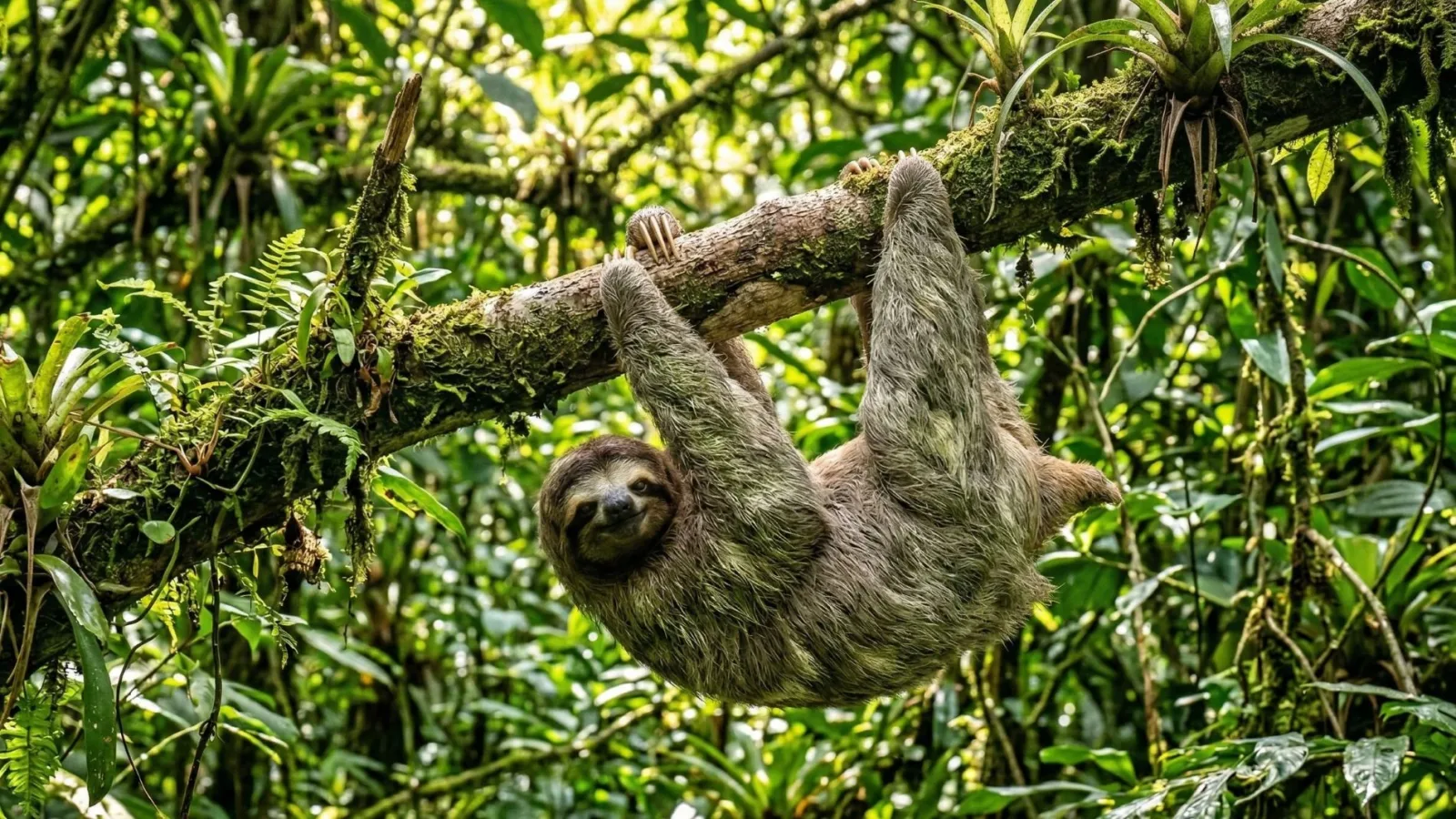
Sloths are far more than just the sluggish creatures of internet memes; they are among the most evolutionarily refined mammals on the planet. Operating on a diet of tough, low-calorie leaves, these canopy dwellers have adapted by slowing their metabolisms to near-reptilian levels and developing complex internal ecosystems. From swimming faster than they walk to hosting an entire species of moth found nowhere else on Earth, their survival strategies are astonishingly efficient. Discover the fascinating anatomical quirks, underwater abilities, and prehistoric origins of these arboreal wonders.
1. Their Extreme Slowness Is a High-Tech Survival Strategy
Their legendary slowness is actually an incredible evolutionary adaptation rather than mere laziness. Because their diet consists almost entirely of tough, low-calorie leaves that provide very little energy, sloths survive by moving only when absolutely necessary. This deliberate lack of motion renders them practically invisible to apex aerial predators like harpy eagles, which rely heavily on movement to spot prey. Furthermore, their low muscle mass requires significantly less metabolic energy to maintain than that of typical mammals. By doing almost nothing, sloths have mastered one of the most efficient survival strategies in the animal kingdom.
2. Digesting a Single Leaf Can Take up to a Month
Sloths possess a surprisingly complex, multi-chambered stomach that occupies nearly a third of their total body mass. Much like a cow, their digestive system relies on a specialized cocktail of symbiotic bacteria to slowly ferment and break down tough, toxic foliage. This grueling chemical process is so extremely slow that digesting a single leaf can take up to thirty days. In fact, a sloth’s stomach can be completely full while the animal is actually starving if the surrounding temperature drops too low for its digestive bacteria to function properly. Consequently, they derive every drop of available energy from a diet that would be unviable for almost any other mammal.
3. They Can Hold Their Breath Underwater Longer Than Dolphins
Although they appear clumsy and vulnerable on the forest floor, sloths are shockingly capable divers. By intentionally slowing their heart rate down to just one-third of its normal resting pace, a sloth can comfortably hold its breath underwater for up to forty minutes. This metabolic drop allows them to easily outlast marine mammals like dolphins and sea otters in terms of underwater breath suppression. When crossing wide Amazonian rivers, they simply drop from the high branches into the water below and paddle across effortlessly. This surprising aquatic capability provides them with a fast and safe highway through the flooded rainforest canopy.
4. They Swim Three Times Faster Than They Can Walk
Dropping into a river unlocks a hidden athletic gear that sloths simply cannot access on dry land. Because their long limbs and specialized curved claws are built for hanging rather than walking, dragging themselves across the forest floor is a slow, agonizing crawl. In the water, however, their buoyant bodies float easily, allowing them to use a modified doggy-paddle stroke to cut through currents. In fact, sloths can swim approximately three times faster than they can travel across terrestrial terrain. This efficiency makes crossing water hazards a preferred method of travel during the tropical rainy season.
5. Their Fur Functions as a Thriving Mobile Ecosystem
A sloth's shaggy coat is not merely fur, but a living, breathing micro-environment teeming with specialized life. Due to the high humidity of their tropical habitat, the coarse grooves in their hair absorb moisture like a sponge, creating the perfect conditions for growing unique species of green algae. This algal growth turns the sloth's fur a distinct greenish hue, providing brilliant natural camouflage that blends seamlessly with the surrounding rainforest canopy. Additionally, a single sloth coat can harbor hundreds of specialized insects, including beetles, mites, and parasitic fungi. It is a completely self-contained biological world navigating the high branches.
6. They Eat the Microscopic Gardens Growing in Their Own Hair
The algae growing inside a sloth's fur is far more than just a clever camouflage suit; it also serves as a vital nutritional supplement. Sloths routinely groom themselves and, in doing so, lick the dense algal mats directly off their coarse hair. This green growth is highly digestible and packed with essential lipids, protein, and complex carbohydrates that their normal leaf diet severely lacks. By cultivating this rich microscopic garden on their own backs, sloths offset the severe nutritional deficits of their tree-foliage meals. It remains one of the most unusual farming relationships observed in the mammalian world.
7. An Entire Species of Moth Lives Nowhere Else on Earth
Deep within the dense fleece of the sloth resides the sloth moth (Cryptoses choloepi), an insect that depends entirely on the mammal for its survival. Dozens, or even hundreds, of these moths can inhabit a single sloth's coat, spending their entire adult lives hidden among the wet fur. The moths act as mobile fertilizer factories, depositing nitrogen compounds into the hair that stimulate the growth of the sloth's nutritious algae gardens. In return, the sloth provides the moths with a safe, sheltered home protected from canopy predators. Neither species could thrive in the wild without this remarkably intricate symbiotic partnership.
8. Their Weekly Bathroom Trip Is a Perilous Gamble
Approximately once a week, sloths leave the relative safety of the high canopy to descend all the way to the forest floor to defecate. Because their ground movement is so slow and awkward, this weekly bathroom break is by far the most dangerous activity in a sloth's life. Roughly half of all adult sloth fatalities occur while they are on or near the ground, leaving them completely exposed to jaguars, ocelots, and stray dogs. Despite the extreme danger, they stubbornly refuse to poop from the safety of the trees. They can lose up to one-third of their total body weight in a single dropping session.
9. Their Bathroom Routine Is Essential for Their Moths' Survival
The dangerous ground journey to poop is not a mindless habit, but a vital link in the life cycle of the sloth moth. When the sloth reaches the base of its tree to relieve itself, female moths living in its fur quickly crawl down to lay their eggs directly into the fresh waste. The eggs hatch into larvae that feed exclusively on the rich sloth dung before metamorphosing into adult moths. Once mature, the new generation of moths flies up into the forest canopy to seek out a new sloth host. Without this dangerous ground trip, the sloth moth population would immediately collapse.
10. Their Claws Feature an Automatic Hydraulic Lock
Unlike human hands, which require active muscle contraction and continuous energy to grip an object, a sloth's claws work in reverse. Their digital flexor tendons are wired to lock automatically into a closed, hook-like position when at rest. To open their grip, the sloth must actively exert energy to contract specific muscles. This means that a sleeping, or even deceased, sloth can remain hanging securely upside down from a tree branch without expending a single calorie. Their limbs act as biological grappling hooks perfectly suited for an effortless, lifelong overhead existence.
11. Internal Anchors Keep Their Organs from Crushing Their Lungs
Spending a vast majority of their life suspended upside down presents severe mechanical challenges for internal organs. In most mammals, hanging upside down for prolonged periods causes heavy organs like the liver and stomach to slide downward, pressing heavily against the diaphragm and suffocating the animal. Sloths solved this problem by evolving specialized fibrinous adhesions that physically anchor their internal organs securely to their lower ribs. These tough tissue straps hold their heavy digestive tract in place regardless of their orientation. As a result, they can sleep hanging completely upside down without experiencing any respiratory distress.
12. They Have Extra Neck Vertebrae for a 270-Degree View
Almost every mammal on Earth, from tiny mice to towering giraffes, possesses exactly seven cervical (neck) vertebrae. Three-toed sloths are a rare biological exception, boasting up to nine or ten neck vertebrae that give them extraordinary flexibility. This unique anatomical adaptation allows them to rotate their heads an astonishing 270 degrees without moving the rest of their body. By turning their heads almost completely around, they can scan for approaching predators in every direction while keeping their bodies dead still. This incredible range of motion saves critical energy that would otherwise be wasted moving their entire torso.
13. They Regulate Their Body Temperature Like Cold-Blooded Reptiles
Maintaining a warm, constant body temperature requires a massive amount of metabolic energy—a luxury sloths simply cannot afford on a leaf diet. To save precious calories, sloths surrendered strict endothermic thermal regulation, allowing their internal body temperature to fluctuate wildly. Their core temperature can swing by as much as 10 degrees Celsius (18 degrees Fahrenheit) throughout the day, closely matching ambient rainforest temperatures. On chilly tropical mornings, they actively sunbathe high in the emergency tree canopy to warm up, functioning remarkably like cold-blooded reptiles.
14. They Are Nearly Blind in Bright Daylight
Sloths possess a rare genetic condition known as rod monochromacy, which means their eyes completely lack cone cells. Because of this, they are functionally colorblind, struggle with poor visual acuity, and are almost completely blind in bright sunlight. To navigate the dizzying heights of the rainforest canopy, they rely almost exclusively on spatial memory, touch, and a surprisingly sharp sense of smell. They memorize the exact layout of their home trees, feeling their way along familiar branches rather than visually inspecting their paths. This reliance on touch and smell ensures they navigate safely even through the thickest jungle foliage.
15. Their Prehistoric Ancestors Were Giant Elephant-Sized Ground Dwellers
While modern sloths are small canopy creatures, their ancient evolutionary lineage was dominated by earth-shaking giants. During the Pleistocene epoch, prehistoric ground sloths like Megatherium roamed the open plains and scrublands of South America. These colossal creatures grew to the size of modern Asian elephants, reaching lengths of up to 20 feet (6 meters) and weighing up to four tons. Equipped with massive claws used for pulling down high tree branches and digging, these ground sloths thrived for millions of years before going extinct roughly 10,000 years ago alongside other Ice Age megafauna.
Sources & References
This AI-assisted post was rigorously curated and fact-checked for accuracy by:
 Martin Roháček
How fun was this article? 🤔
Tap a star to rate it
🧠 Quiz: How closely were you paying attention?
10 questions — all answers are in the article above!
Enjoyed these facts? There's more! 💌
Fresh fun facts in your inbox. No spam, ever.