1. They Are the Heaviest and Tallest Birds on Earth
The ostrich stands as an absolute giant among modern avian species, completely dwarfing all other birds. Fully grown male ostriches can reach an incredible height of up to 9 feet and weigh a staggering 320 pounds. Because of their immense physical mass, their bone structure is dense and heavy rather than hollow like those of flightless, airborne birds. This massive size makes it biologically impossible for them to ever take flight, forcing them to adapt completely to a permanent life on the ground.
2. The Fastest Two-Legged Creatures on the Planet
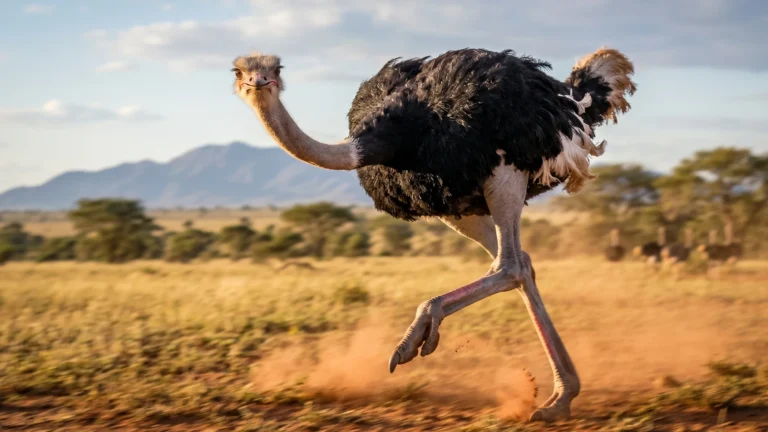
What ostriches lack in flying ability, they more than make up for with their mind-boggling terrestrial speed. They are officially the fastest two-legged animals on Earth, capable of sustaining a steady running speed of 30 miles per hour over long distances. When facing immediate danger, an ostrich can unleash a terrifying sprint reaching up to 43 miles per hour. Their powerful legs allow them to cover an astonishing 10 to 16 feet in a single bound, allowing them to effortlessly outrun most apex predators.
3. They Possess Only Two Toes Per Foot
While the vast majority of bird species possess three or four toes on each foot to help them grasp branches or perch, the ostrich has evolved a highly specialized foot structure. They are the only birds on Earth that possess just two toes on each foot. The inner toe is significantly larger and tipped with a massive, razor-sharp claw that can measure up to 4 inches in length. This unique, aerodynamic foot structure functions exactly like a hoof, reducing friction and providing maximum leverage for high-speed sprinting.
4. Their Kick Can Kill a Lion
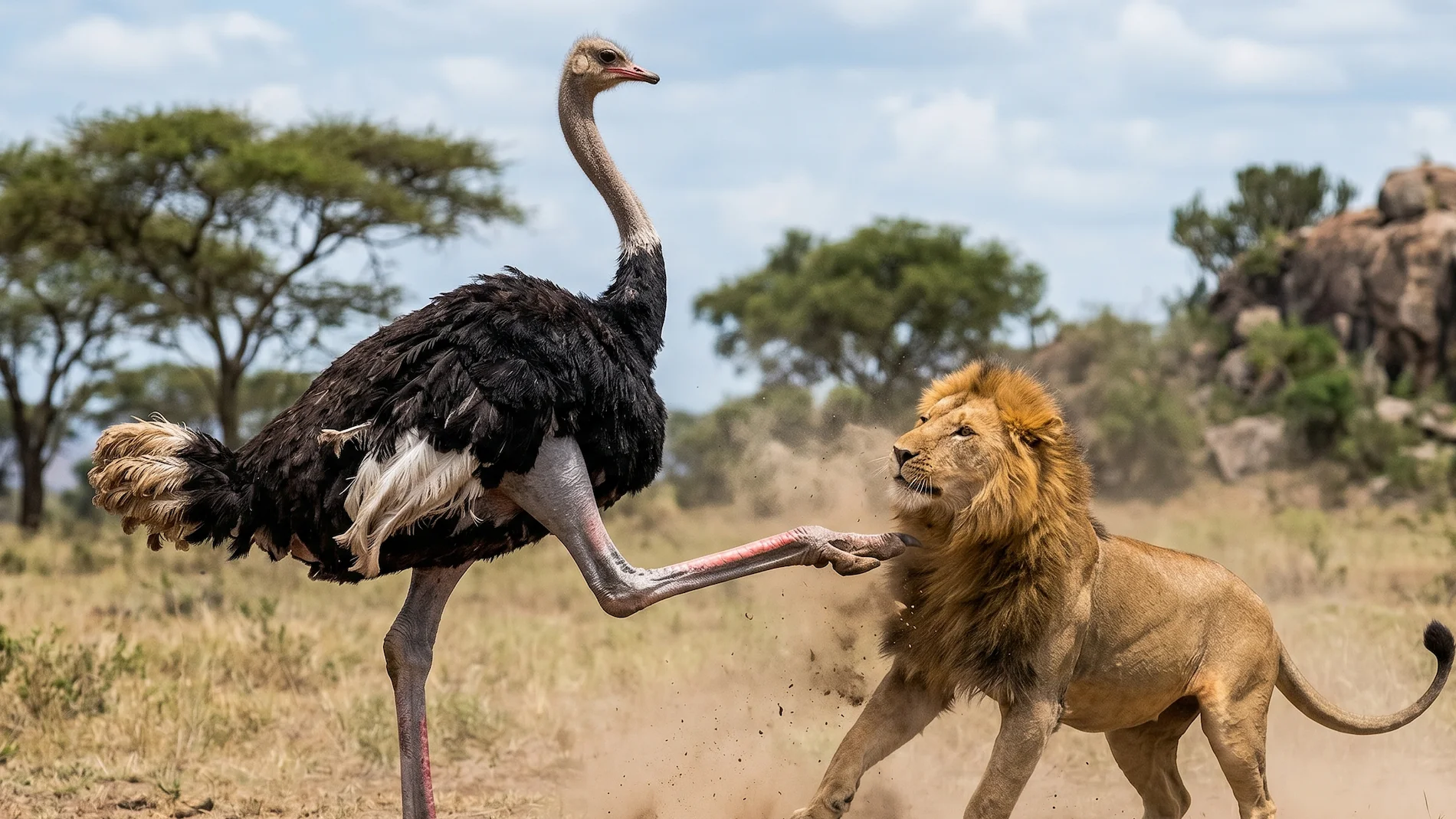
The powerful legs that make ostriches elite sprinters also serve as their primary and most lethal defense mechanism. When cornered by a predator like a lion or a hyena, an ostrich will not hesitate to deliver a devastating forward-facing kick. The combination of their immense body weight, muscular legs, and the sharp claw on their main toe creates enough blunt force trauma to instantly fracture bones or disembowel an attacker. Even a pride of lions will think twice before approaching a fully grown, defensive ostrich.
5. The Myth of Burying Their Heads in the Sand
One of the most persistent and widespread myths in the animal kingdom is that ostriches foolishly bury their heads in the sand when they are frightened. In reality, this bizarre behavior is a complete optical illusion caused by an evolutionary defense mechanism. When a nesting ostrich spots an approaching threat, it will lay its long neck completely flat against the dirt to blend in with the surrounding terrain. From a distance, their sandy-colored head and neck appear to vanish into the ground, creating the false impression that they have buried their head.
6. Their Eyes Are Larger Than Their Brains
The ostrich possesses the largest eyes of any land animal on the planet, measuring roughly 2 inches in diameter—roughly the size of a billiard ball. These massive, forward-facing eyes provide them with incredible, panoramic vision that can scan the open savanna for predators miles away. Surprisingly, an ostrich’s eye is actually significantly larger than its entire brain. Because their skulls are heavily optimized to accommodate these massive visual organs, their cognitive processing power is relatively limited, leaving them reliant on raw instinct.
7. They Lay the Largest Eggs in the World
As the largest living bird, it is only fitting that the female ostrich produces the largest egg of any modern animal. A single ostrich egg can measure 6 inches in length and weigh up to 3 pounds, which is roughly equivalent to the volume of two dozen standard chicken eggs. Despite their massive absolute size, ostrich eggs are actually the smallest eggs in the world relative to the size of the adult bird, representing just 1 to 2 percent of the mother’s total body weight. The shells are incredibly thick and durable, capable of supporting the weight of a full-grown adult.
8. A Communal Breeding System Known as a “Dump Nest”
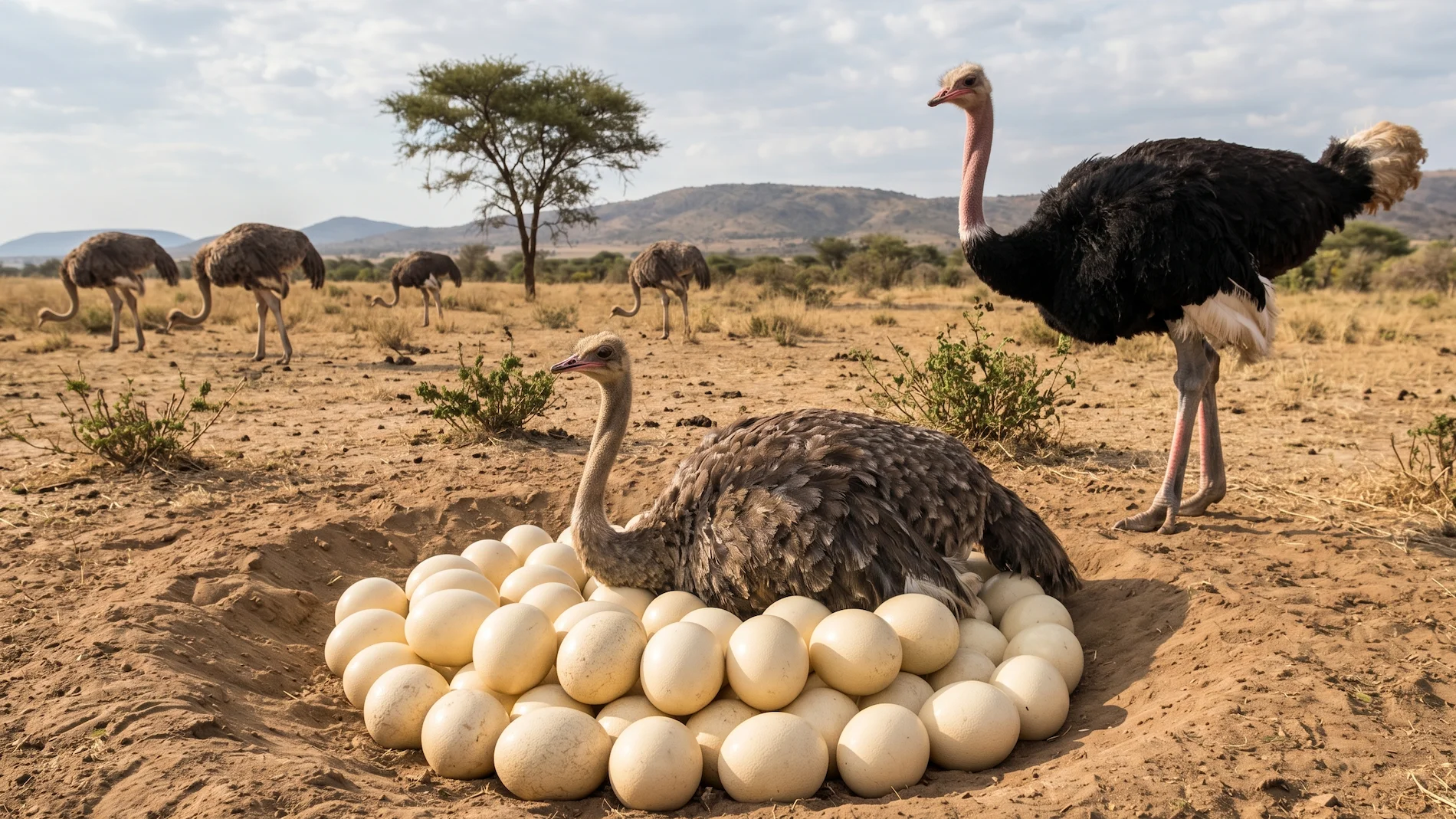
Ostriches utilize a highly organized and unique communal nesting system to ensure the survival of their offspring. A dominant male will territory and court a primary female, along with several secondary females. All of the females will lay their massive eggs into a single, shallow pit dug into the dirt, known as a “dump nest,” which can hold up to 60 eggs at a time. The alpha pair takes complete responsibility for incubating the massive clutch, with the camouflaged brown female sitting on the nest by day and the black-feathered male taking over by night.
9. They Deliberately Swallow Stones to Digest Food
Because ostriches completely lack teeth, they have evolved a highly unusual and mechanical method for breaking down their diet of tough plants, seeds, and occasional insects. An adult ostrich will deliberately swallow large quantities of small pebbles, sand, and smooth stones. These stones collect inside a specialized, highly muscular section of their stomach known as the gizzard. As the gizzard contracts, the stones rub violently against each other, acting like a natural internal millstone that grinds the tough vegetation into a digestible paste.
10. They Can Survive for Days Without Water
Thriving in the arid, unforgiving environments of the African savanna requires incredible physiological adaptations for water conservation. Ostriches can survive for several consecutive days without drinking a single drop of fresh water. They are masters at extracting moisture directly from the internal cellular structure of the succulent plants, roots, and fruits that make up their primary diet. Furthermore, they possess highly advanced internal cooling mechanisms that minimize moisture loss through respiration, allowing them to tolerate extreme desert heat.
11. Their Feathers Lack the Hooks of Flying Birds
If you touch the plumage of an ostrich, you will immediately notice that it feels incredibly soft, fluffy, and shaggy compared to the sleek feathers of a hawk or a duck. The feathers of flying birds possess tiny, microscopic hooks called barbules that lock together to form a rigid, airtight surface necessary to generate aerodynamic lift. Because ostriches have no evolutionary need for flight, their feathers completely lack these locking mechanisms. Instead, their loose, flowing plumage functions primarily as a highly effective thermal blanket to regulate body temperature.
12. They Use Their Wings as Rudders and Brakes
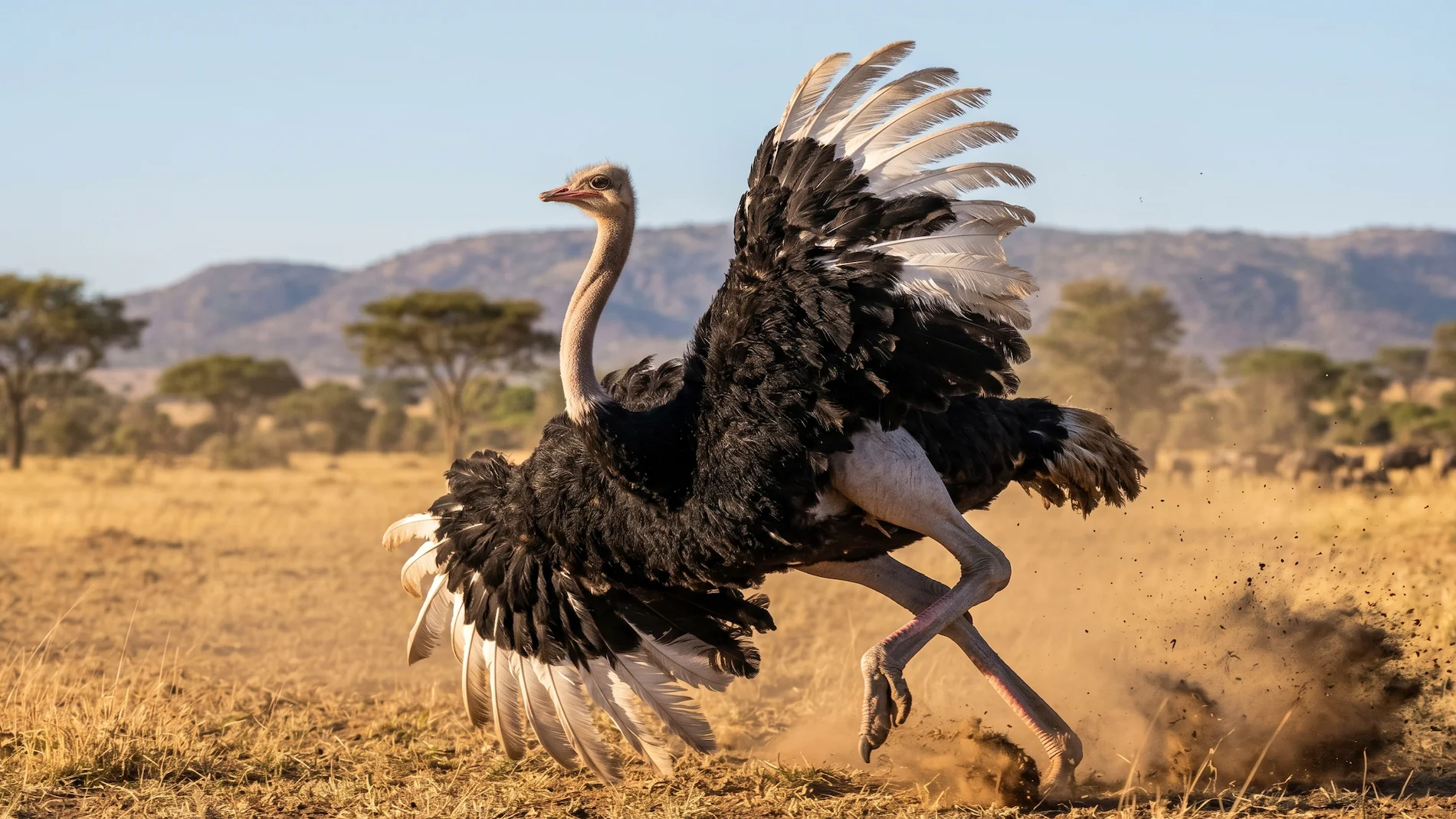
While their wings are completely useless for taking flight, they are far from vestigial. An ostrich boasts a massive wingspan of up to 7 feet, which they utilize as highly dynamic aerodynamic tools while sprinting across the savanna. When making sudden, sharp turns at speeds exceeding 30 miles per hour, the ostrich will lift and angle its wings to act as air rudders, allowing them to change direction instantly without losing balance. They also raise their wings vertically to function as air brakes when coming to a sudden halt.
13. They Have a Highly Complex Three-Stomach System
The digestive tract of an ostrich is an evolutionary marvel designed to extract maximum nutritional value from low-quality, fibrous desert vegetation. They possess a highly complex, three-stomach digestive system that sets them apart from most other bird species. The first stomach chamber stores the swallowed food, the second chamber secretes powerful digestive enzymes, and the third chamber—the muscular gizzard—uses swallowed stones to mechanically pulverize the meal. Additionally, their intestines stretch to an incredible length of over 40 feet to ensure complete nutrient absorption.
14. They Were Hunted to Near Extinction for Fashion
During the late nineteenth and early twentieth centuries, the global ostrich population faced a devastating crisis driven entirely by international high-fashion trends. The elegant, fluffy plumes of the ostrich became highly coveted luxury items in Europe and the United States, where they were used to decorate extravagant women’s hats and theatrical costumes. At the peak of the feather boom, ostrich plumes were worth almost their weight in gold. The extreme demand led to widespread hunting of wild populations until the establishment of commercial ostrich farms saved the species from extinction.
15. They Have a Lifespan Over 40 Years
Despite living in environments teeming with deadly apex predators like lions, leopards, and cheetahs, ostriches possess remarkable longevity. In the wild, an ostrich that manages to survive the vulnerable chick phase can easily live for 30 to 40 years. When kept in well-managed zoological facilities or protective farming environments free from the constant threat of predation and starvation, these resilient, prehistoric birds have been documented living up to 50 years, making them some of the longest-lived birds on the planet.+
Sources and References