The Radical Saint: 15 Fascinating Facts About Mother Teresa
Before she became a globally revered symbol of charity, Mother Teresa was a high school teacher who left her home at eighteen and never saw her mother again. From managing a worldwide humanitarian network without computers to rescuing trapped children during an active war zone in Beirut, her life was defined by extreme commitment and quiet steel. Behind her public devotion lay surprising truths, including a decades-long inner spiritual struggle that remained secret until after her death. Here are 15 fascinating facts about the life, work, and legacy of Saint Teresa of Kolkata.
1. She Left Home at 18 and Never Saw Her Family Again
Born in Skopje in 1910 as Anjezë Gonxhe Bojaxhiu, the future saint was raised in an ethnic Albanian family before answering a religious calling at eighteen. She traveled to Ireland to join the Sisters of Loreto, primarily to learn English so she could become a missionary in India. Because of international travel constraints and her immediate deployment to Asia, she never saw her mother or sister again after her departure. This painful initial sacrifice set the stage for a lifetime of total dedication to religious service far from her homeland. In Kolkata, she took her final vows and began her work far from her birth nation.
2. Her Religious Name Was a Backup Choice
When taking her initial religious vows as a nun, she chose to honor Saint Thérèse of Lisieux, the patron saint of Catholic foreign missions. However, another nun at the convent in Dublin had already chosen the traditional spelling of that saintly name. To avoid confusion within the community, she opted for the Spanish spelling, becoming Sister Teresa. This subtle adjustment gave her a distinct identity that would eventually become recognized around the world. The name reflected her core belief in doing small things with great love, echoing her saintly namesake.
3. She Was a High School Teacher and Principal First
Long before she became famous for her work in the slums of Kolkata, Mother Teresa spent nearly two decades working as a conventional educator. She taught geography and history to young women at St. Mary's High School in eastern Kolkata. She eventually rose to become the school principal, managing administrative duties, curriculum, and student welfare. This extensive background equipped her with organizational skills crucial for building her future global order. It surprises many that her early career was firmly rooted in academic education rather than direct street ministry.
4. A Train Ride Inspired Her "Call Within a Call"
On September 10, 1946, while traveling by train from Kolkata to the Himalayan foothills of Darjeeling for a retreat, Mother Teresa experienced what she termed a "call within a call." She felt an overwhelming divine instruction to abandon her comfortable life at the convent school and live directly among the poorest citizens. This experience convinced her that her true destiny lay in ministering directly to the destitute, sick, and dying. It took over a year of petitioning church superiors before she received official permission to leave her order. In 1950, this vision culminated in the official founding of the Missionaries of Charity.
5. Her Iconic Sari Pattern Is a Protected Trademark
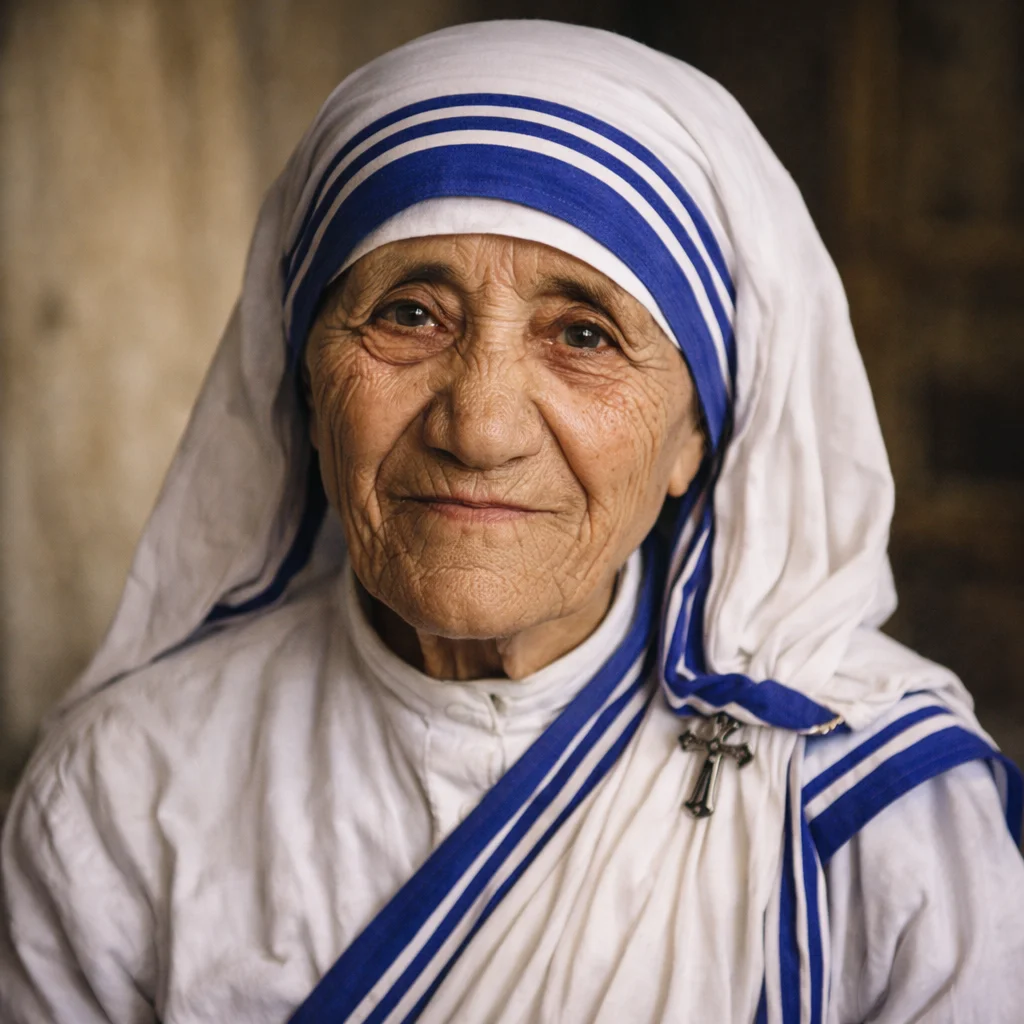
After leaving the Loreto convent in 1948, Mother Teresa abandoned the traditional habit of European nuns in favor of a simple Indian cotton garment. She chose a plain white sari adorned with three blue stripes, symbolizing purity and the religious vows of her order. The inexpensive fabric cost very little to produce, helping her sisters identify closely with the impoverished people they served. In 2016, the Indian Intellectual Property Office officially recognized the pattern as a protected trademark to prevent commercial exploitation. This marked the first time a religious uniform received such legal trademark protection in India.
6. She Was Fluent in Five Languages
Communicating across cultural and national boundaries required exceptional language skills, which Mother Teresa cultivated throughout her life. She was fluent in five distinct languages: Albanian, Serbo-Croatian, English, Hindi, and Bengali. Her mastery of local Indian dialects allowed her to speak directly with street dwellers, patients, and volunteers without needing translators. At the same time, her fluency in English and European languages enabled her to address international forums, politicians, and monarchs. This linguistic versatility was central to her ability to build a vast global network.
7. She Cancelled the Nobel Banquet to Feed the Hungry
When awarded the Nobel Peace Prize in 1979 for her work in overcoming poverty and distress, Mother Teresa broke standard royal protocol. She requested that the traditional lavish ceremonial banquet in Oslo be canceled entirely. The savings of approximately $192,000 were redirected to fund meals for thousands of needy individuals in Kolkata. She asserted that formal dinners provided no real value compared to feeding those suffering from starvation. Her decision astonished the Nobel Committee and reinforced her uncompromising commitment to the poor.
8. Her Entire Wardrobe Fitted Inside a Single Bucket
Throughout her adult life, Mother Teresa practiced an extreme form of personal asceticism that left her with virtually no physical belongings. Her entire personal wardrobe consisted of only two saris, a pair of sandals, a small prayer book, and a wooden crucifix. She washed her own sari by hand every night using a simple bucket and water. She consistently refused luxury items, personal gifts, or upgraded accommodations when traveling across the globe. This total detachment from worldly goods kept her focus centered on her spiritual work and solidarity with the impoverished.
9. She Managed a Global Empire Without Computers
By the time of her death, Mother Teresa's order operated over 500 missions across more than 100 countries worldwide. Managing thousands of nuns, international volunteers, and millions of dollars in donations required astounding organizational efficiency. Remarkably, she coordinated this massive global network without the aid of computers, modern filing systems, or corporate administrative staff. She relied on hand-written letters, basic ledger books, and personal memory to oversee the logistics of her organization. Critics and admirers alike noted that she ran her charity with the effectiveness of a chief executive officer.
10. She Experienced a 50-Year Spiritual Crisis
Following her death, the publication of her private journals and letters revealed a surprising inner crisis that she kept hidden from the public eye. For nearly fifty years, Mother Teresa suffered from what theologians term a "dark night of the soul," feeling an agonizing sense of spiritual emptiness. Her letters showed that despite her visible devotion, she spent decades tormented by quiet doubts and deep emotional loneliness. Rather than weakening her faith, scholars argue that this hidden struggle made her dedication to helping others even more remarkable. She continued her exhausting public ministry despite receiving little personal emotional comfort.
11. She Converted a Hindu Temple into a Hospice
In 1952, Mother Teresa convinced municipal authorities in Kolkata to grant her the use of an abandoned building attached to the famous Kalighat Kali Temple. She converted the structure into Nirmal Hriday, a free hospice for the destitute and dying. Initially, local residents and Hindu priests strongly protested her presence, suspecting her of attempting religious conversion. However, after witnessing her personally wash the maggot-infested wounds of a dying Hindu priest, the community embraced her efforts. The hospice became one of her most famous initiatives, offering dignity to thousands during their final hours.
12. She Brokered a Ceasefire to Rescue Children in Beirut
In August 1982, during the height of the Siege of Beirut, Mother Teresa traveled directly into an active war zone to rescue trapped civilians. Upon discovering that thirty-seven children with severe mental and physical disabilities were stranded in a frontline hospital, she negotiated a temporary ceasefire between the Israeli military and Palestinian fighters. Walking through devastated streets, she personally oversaw the evacuation of every single child to safe shelters in East Beirut. Her fearless intervention demonstrated her willingness to risk her life in the pursuit of saving others. This daring mission cemented her reputation for selfless bravery during moments of crisis.
13. She Won the US Presidential Medal of Freedom
In 1985, United States President Ronald Reagan awarded Mother Teresa the Presidential Medal of Freedom during a ceremony at the White House. This honor represents the highest civilian award bestowed by the American government. During her acceptance speech, she accepted the award not for herself, but on behalf of "the unwanted, the unloved, and the uncared for." She used the prominent national platform to speak against poverty and promote compassion across international borders. Her reception of the medal highlighted her standing as a universally recognized moral figure.
14. She Shared a Close Bond with Princess Diana
During the 1990s, Mother Teresa developed a deep friendship with Princess Diana, with both women uniting over shared humanitarian causes. They met several times in London, Kolkata, and New York, frequently speaking about AIDS relief, leprosy, and global poverty. Their final meeting took place in June 1997, just months before both women met tragic deaths. Princess Diana died in a Paris car crash on August 31, 1997, and Mother Teresa passed away five days later on September 5. The simultaneous loss of two global icons plunged the world into widespread mourning.
15. Her Canonization Required Two Verified Miracles
On September 4, 2016, Pope Francis officially canonized her as Saint Teresa of Kolkata during a ceremony in Saint Peter's Square attended by tens of thousands. The Vatican canonization process required the strict authentication of two divine miracles attributed to her intercession. The first involved the unexplained cure of an Indian woman suffering from a malignant abdominal tumor, while the second involved a Brazilian man healed of multiple brain abscesses. While her elevation to sainthood satisfied millions of believers, the Vatican emphasized that her true legacy lay in her relentless service to suffering humanity. Today, her life story continues to inspire millions of people across religious and cultural divides.
Sources & References
This AI-assisted post was rigorously curated and fact-checked for accuracy by:
 Martin Roháček
How fun was this article? 🤔
Tap a star to rate it
🧠 Quiz: How closely were you paying attention?
10 questions — all answers are in the article above!
Enjoyed these facts? There's more! 💌
Fresh fun facts in your inbox. No spam, ever.