1. He Was Originally from a Jewish Family
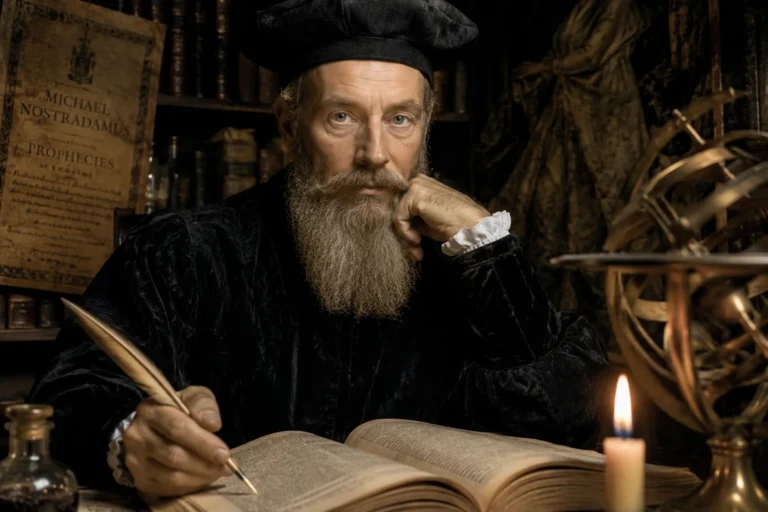
Nostradamus was born in Saint-Rémy-de-Provence in southern France. His family was originally Jewish but had converted to Catholicism in 1455, decades before his birth, to avoid persecution and the looming threat of the Inquisition. The family changed their surname from “Gasson” to “de Nostredame” (of Our Lady) to reflect their new Catholic faith.
2. He Dropped Out of Medical School
At age 15, Nostradamus entered the University of Avignon to study medicine, but he was forced to leave just over a year later when the university closed due to an outbreak of the bubonic plague. After traveling for several years as an apothecary, he enrolled at the University of Montpellier, one of Europe’s oldest medical schools. However, he was reportedly expelled when the university discovered he had been working as an apothecary, a trade strictly banned by university statutes at the time.
3. He Fought the Plague with the “Rose Pill”
Despite lacking formal medical credentials, Nostradamus gained a reputation for treating plague victims across southern France. He rejected the standard medical practices of the day, such as bloodletting and the use of mercury, which often killed patients faster than the disease. Instead, he emphasized basic hygiene, fresh air, and created a “rose pill”—a lozenge made of rose petals, sawdust, and various herbs rich in Vitamin C.
4. The Plague Took His First Family
Tragically, Nostradamus’s medical knowledge could not save his own family. In 1534, while he was away traveling, a virulent outbreak of the plague struck the city of Agen. His young wife (whose name remains lost to history) and their two young children contracted the disease and died. Following this devastation, Nostradamus wandered through Europe for nearly a decade before settling down again.
5. He Published Best-Selling Almanacs
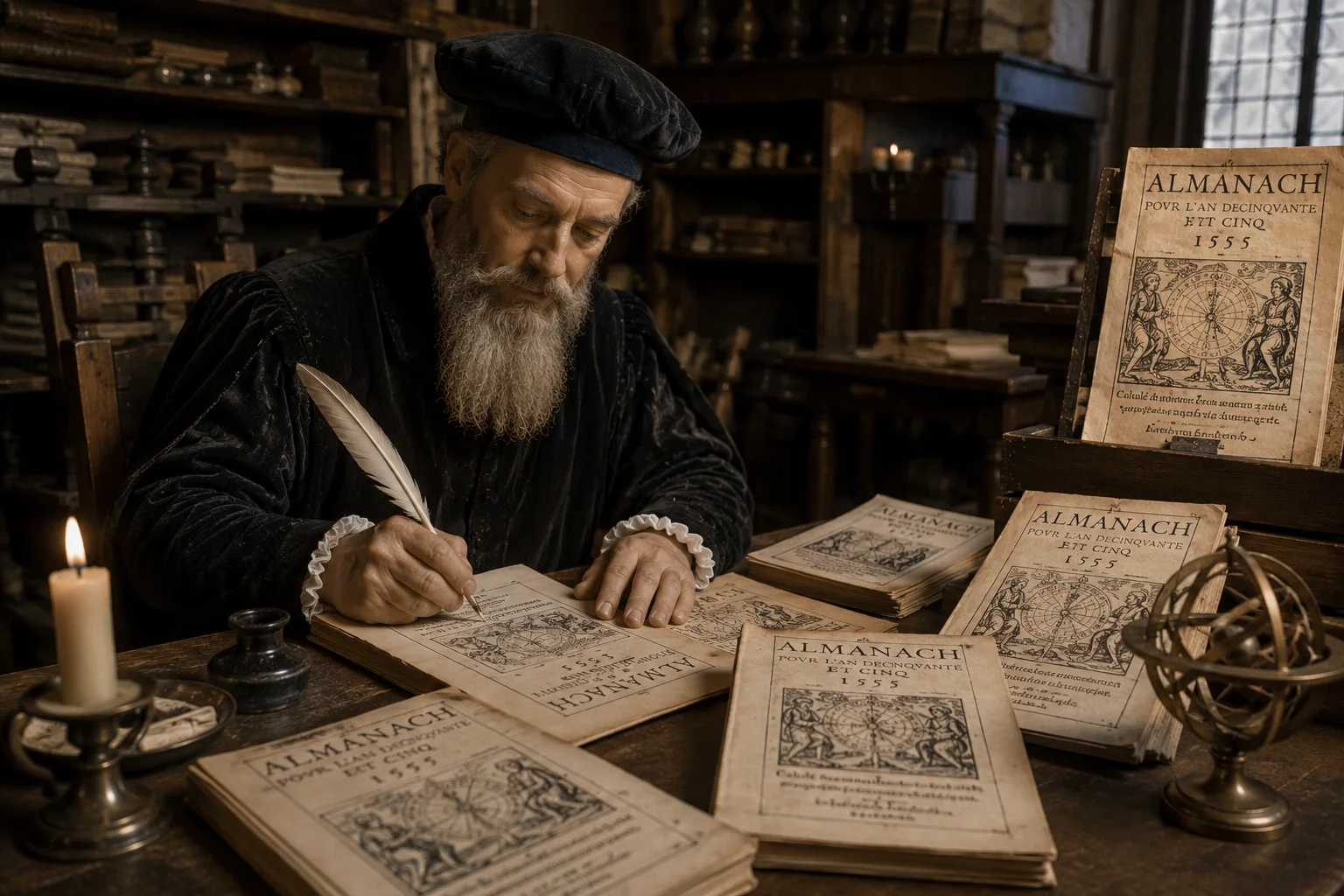
Before becoming famous for his long-term prophecies, Nostradamus made a lucrative living writing annual almanacs. Starting in 1550, he published these booklets detailing weather forecasts, astrological charts, and crop predictions for the coming year. They were highly popular and brought him to the attention of the French nobility.
6. He Wrote in a Complex “Twilight” Language
Nostradamus published his major work, Les Prophéties, in 1555. To avoid the scrutiny of the Catholic Church and accusations of witchcraft or heresy, he wrote his predictions in a deliberately obscure style. He used a mixture of Old French, Latin, Greek, and Provençal dialect, relying heavily on anagrams, mythological allegories, and astrological symbolism, making his verses incredibly difficult to decipher.
7. He Predicted the Death of a King (Allegedly)
Nostradamus’s fame skyrocketed during his lifetime due to a quatrain that supposedly predicted the bizarre death of King Henry II of France. The verse warned of a “young lion” who would overcome an “older one” on the “field of combat in a single battle” and pierce his eyes through a “golden cage.” In 1559, King Henry II was killed when a younger opponent’s jousting lance shattered, sending a splinter through the king’s golden visor and into his eye.
8. He Was Employed by Catherine de’ Medici
The powerful Queen of France, Catherine de’ Medici, was a fervent believer in astrology and the occult. Fascinated by Nostradamus’s almanacs and prophecies, she summoned him to the royal court in Paris in 1555. She tasked him with drawing up horoscopes for her children and later appointed him as Counselor and Physician-in-Ordinary to the King.
9. He Never Mentioned the “End of the World”
Contrary to popular belief, Nostradamus never predicted the apocalypse or the complete destruction of the earth. His timeline of prophecies simply ends. In the preface to Les Prophéties, he explicitly states that his predictions run from his own time until the year 3797.
10. He Also Wrote a Cookbook
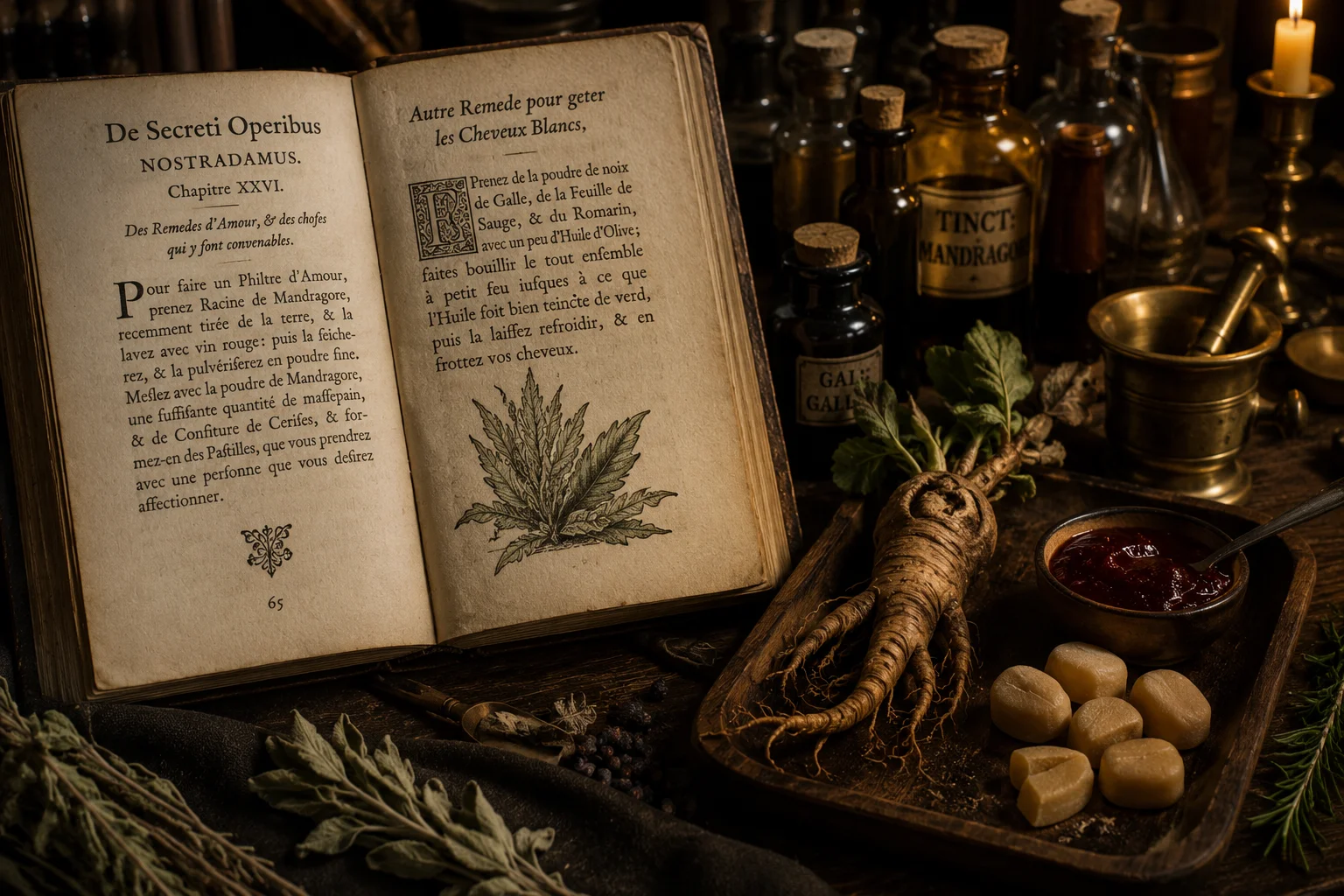
In addition to his almanacs and prophecies, Nostradamus authored a book titled Treatise on Cosmetics and Conserves (1555). The book contained practical recipes, including instructions for making hair dye, creating a “love potion” from mandrake root, marzipan, and cherry jam.
11. Most “Predictions” Are Retroactively Applied
Skeptics and historical scholars point out that Nostradamus’s quatrains are so vaguely worded and open to translation errors that they can be applied to almost any major historical event after it has already happened. Followers have claimed his verses predicted everything from the rise of Napoleon and Hitler to the assassination of JFK and the September 11th attacks, though none were definitively identified beforehand.
12. He Suffered from Severe Gout
In his later years, Nostradamus suffered from painful, chronic gout, a form of inflammatory arthritis. The condition eventually worsened into edema (dropsy), causing severe swelling as fluid accumulated in his body. His deteriorating health made it difficult for him to move or write during his final years.
13. He Predicted His Own Death
According to legend, Nostradamus accurately predicted his own demise. On the evening of July 1, 1566, his secretary, Jean de Chavigny, purportedly bade him goodnight, to which Nostradamus replied, “You will not find me alive at sunrise.” The next morning, he was found dead on the floor next to his bed.
14. His Grave Was Plundered During the Revolution
Nostradamus was originally buried in the Franciscan chapel in Salon-de-Provence. However, during the chaotic days of the French Revolution in 1791, superstitious soldiers broke into his tomb, hoping to find mystical artifacts or hidden prophecies. His remains were scattered, but they were later gathered by locals and reinterred in the Collégiale Saint-Laurent.
15. The Catholic Church Never Banned His Book
Despite the Inquisition being highly active during his lifetime, the Catholic Church never placed Les Prophéties on the Index Librorum Prohibitorum (the list of banned books). Nostradamus was careful to frame his visions as divine inspiration rather than the dark arts, and his friendship with the deeply Catholic Queen Catherine de’ Medici provided him with powerful political protection.