The Transforming Tsar: 15 Fascinating Facts About Peter the Great
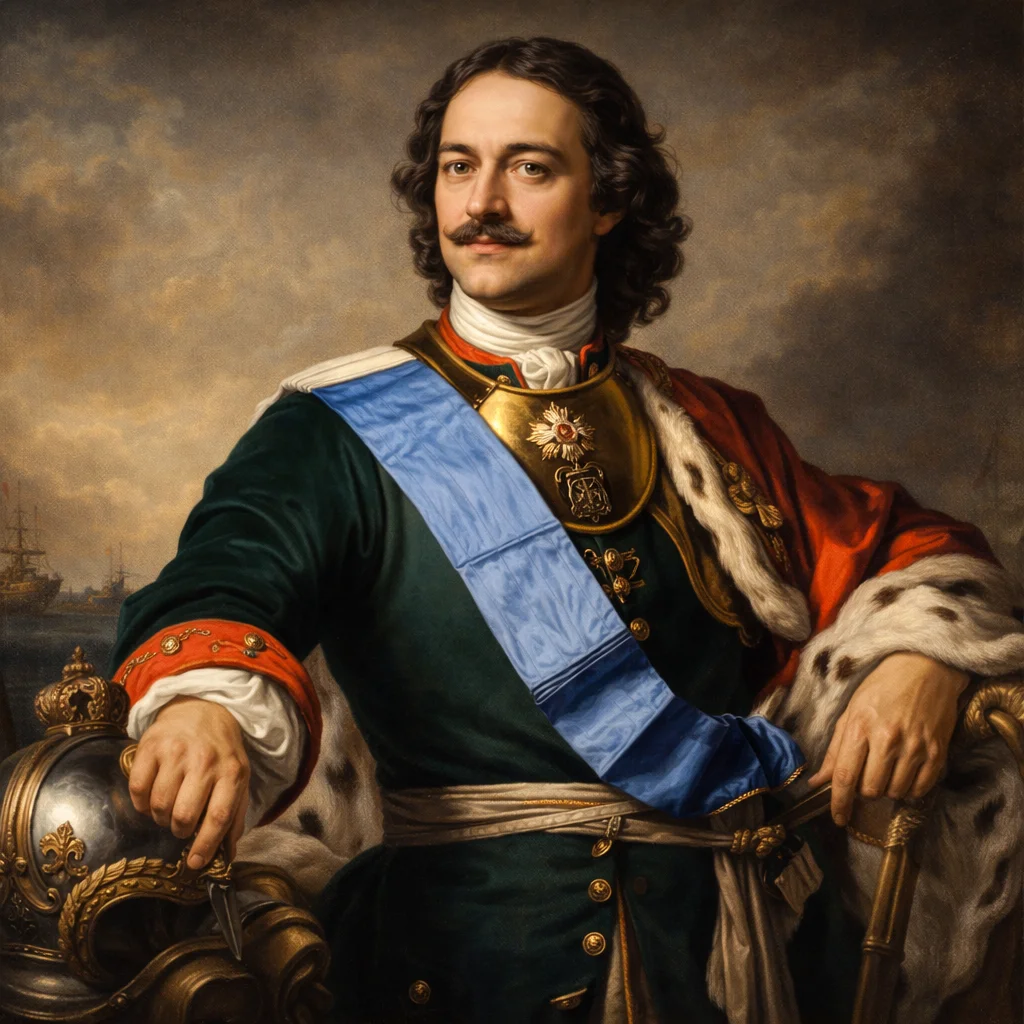
Standing at an astonishing six feet eight inches tall, Peter the Great reshaped Russia through sheer willpower, violent military campaigns, and radical Westernization. From incognito ship-building journeys across Europe to banning traditional long beards, his reign laid the foundation for the Russian Empire. He established a new capital built upon frozen marshes, modernized the nation's calendar, and shattered centuries of tradition. Here are 15 fascinating facts about the ruler who dragged Russia into the modern era.
1. Towering Height and Unusual Proportions
At approximately six feet eight inches tall, Peter the Great was a towering figure in an era when the average European man stood barely five feet five inches. Despite his immense stature, historical accounts note that his head was surprisingly small for his frame and his shoulders were strikingly narrow. This unusual proportion gave him a unique and imposing physical presence that intimidated both allies and enemies alike. His long stride was so brisk that courtiers often had to jog just to keep pace with him during casual walks. Throughout his life, his massive height made it impossible for him to blend into crowds, even when he desperately wanted to pass as a commoner.
2. Incognito Adventures on the Grand Embassy
In 1697, Peter launched the Grand Embassy, an unprecedented diplomatic tour across Western Europe aimed at building alliances and absorbing foreign knowledge. To observe European industry firsthand without formal diplomatic protocols, the monarch traveled under the pseudonym Peter Mikhailov. He worked as a basic laborer and ship carpenter in Dutch and English shipyards, mastering naval architecture from the ground up. Despite his blue-collar alias, his massive six-foot-eight frame and imperial entourage gave away his identity almost immediately. His time abroad fundamentally reshaped his vision for Russia, convincing him that naval power and Western industrial techniques were essential for his empire's future.
3. The Infamous Beard Tax
Determined to modernize Russian society and align its appearance with Western Europe, Peter took aim at traditional facial hair. Shortly after returning from Europe, he began personally snipping the long beards of his nobles with tailor shears. In 1698, he formalized this policy by enacting a mandatory beard tax on anyone who insisted on keeping their facial hair. Peasants and nobles alike were forced to pay an annual fee, after which they were issued a copper or silver beard token as proof of payment. The token featured a mustache and beard along with the inscription "the beard is a useless burden."
4. Personal Execution of the Streltsy Rebels
When the Streltsy—Russia's elite military guards—revolted in 1698 while Peter was traveling abroad, he rushed home to suppress the uprising with terrifying violence. Over one thousand rebels were tortured and executed in a brutal campaign designed to eliminate political dissent once and for all. Historical records report that Peter personally took up an axe and beheaded several mutineers himself, forcing his high-ranking boyars to participate in the executions. The corpses were left hanging publicly outside the Kremlin walls for months as a grim warning to potential traitors. This merciless response demonstrated that Peter would tolerate no opposition to his absolute authority.
5. St. Petersburg Was Built on Frozen Marshes
Seeking a direct naval portal to Europe, Peter captured swampy land along the Neva River from Sweden during the Great Northern War. In 1703, he founded St. Petersburg on these desolate marshes, envisioning a glittering modern capital modeled after Venice and Amsterdam. The construction was an engineering nightmare carried out under brutal physical conditions by conscripted serfs, prisoners, and Swedish prisoners of war. Diseases like malaria and scurvy, coupled with freezing weather and forced labor, claimed the lives of tens of thousands of workers. Because so many laborers perished during its creation, the majestic city earned the sobering epithet "the city built on bones."
6. Russia's First Museum of Curiosities
Peter had an intense fascination with natural sciences and human anomalies, which led him to create Russia's first public museum, the Kunstkamera. Established in St. Petersburg, this cabinet of curiosities housed thousands of preserved biological specimens, including malformed fetuses, anatomical oddities, and unusual taxidermy. Peter actively paid citizens to bring him biological anomalies to prove that deformities were natural scientific phenomena rather than divine curses or evil omens. To encourage citizens to visit the museum, Peter offered visitors a complimentary glass of vodka or a cup of coffee upon entry. Today, the preserved collection remains one of the most famous historical exhibits in Russia.
7. The Notorious All-Drunken Synod
To mock the conservative Russian Orthodox Church and foster absolute loyalty among his inner circle, Peter created the All-Joking, All-Drunken Synod of Fools and Jesters. This outrageous social club engaged in days-long marathons of heavy drinking, debauchery, and parody religious rituals. Peter used the club to test the devotion of his nobles, as refusal to participate in the extreme intoxication carried heavy social and political penalties. The synod performed elaborate mock weddings and absurd processions that thoroughly scandalized traditional Russian society. Beneath the crude humor, it served as a powerful tool for breaking down political taboos and consolidating royal power.
8. His Childhood Playmates Became Elite Regiments
As a young prince banished to the village of Preobrazhenskoye, Peter formed a group of childhood playmates, servants, and minor nobles into a "toy army" for mock military battles. Unlike typical childhood games, Peter equipped his young soldiers with real firearms, artillery, and fortifications, resulting in genuine injuries and occasional deaths. As Peter grew older, this play army evolved into serious, highly trained military units known as the Poteshnye Voiska. These childhood companions formed the nucleus of the legendary Preobrazhensky and Semenovsky guard regiments. These elite units eventually served as the backbone of Peter's imperial army and secured his throne against political rivals.
9. Condemning His Own Son to Death
Peter's eldest son and heir, Tsarevich Alexei, openly opposed his father's sweeping reforms and preferred traditional Russian religious customs. Fearing his life was in danger, Alexei fled Russia in 1716 to seek asylum in the Holy Roman Empire. Peter lured his son back to Russia with promises of forgiveness, only to arrest him immediately upon his return. Accused of high treason and conspiring to undo the empire's modernizations, Alexei was subjected to severe torture in the Peter and Paul Fortress. In 1718, after Peter signed a judicial decree approving his execution, the young tsarevich died from his injuries in prison.
10. An Obsession with Amateur Dentistry
During his travels in Western Europe, Peter developed a passionate fascination with surgery and dentistry, carrying a leather pouch of dental tools everywhere he went. He viewed himself as a skilled practitioner and actively sought out courtiers, servants, or friends who mentioned having tooth pain. Peter was so eager to practice his extraction techniques that he frequently pulled perfectly healthy teeth alongside diseased ones. Courtiers lived in dread of expressing oral discomfort near the tsar, knowing he would instantly produce his pliers. After his death, a bag containing over one hundred teeth that Peter had personally extracted was preserved in his cabinet of curiosities.
11. Relocating the Capital Away from Moscow
For centuries, Moscow served as the spiritual, political, and cultural heart of traditional Russian civilization. However, Peter viewed Moscow as a stronghold of reactionary noble influence, religious superstition, and outdated customs that resisted his reforms. In 1712, he took the radical step of moving the capital of the Russian Empire to his newly constructed Western city, St. Petersburg. He ordered thousands of noble families and merchants to abandon their ancestral homes in Moscow and build grand houses in the new maritime capital. This dramatic shift forced Russian elites to adopt a European lifestyle and look outward toward maritime trade.
12. Overhauling the Russian Calendar
Before Peter's reign, Russia measured time using an ancient calendar system that calculated years from the traditional Orthodox date for the creation of the world. Under this old system, the year 7208 began on September 1. In December 1699, Peter issued an imperial decree adopting the European Julian calendar and moving the start of the year to January 1. He commanded that the upcoming year be recognized as 1700, bringing Russia's chronology into alignment with the rest of Christian Europe. To celebrate the transformation, he ordered his subjects to decorate evergreen trees and ignite fireworks across Moscow.
13. A Severe and Involuntary Facial Tic
Throughout his adult life, Peter suffered from violent, uncontrollable facial tics and body spasms. Whenever he experienced intense anger, stress, or emotional turmoil, the left side of his face would twitch violently and his head would jerk repeatedly to his shoulder. Contemporary observers reported that during severe episodes, his eyes would roll upward and his neck muscles would lock up completely. Historians suspect these neurological spasms may have been triggered by trauma suffered during the bloody 1682 Streltsy uprising, which he witnessed as a ten-year-old child. Despite his terrifying appearance during these fits, those present knew better than to acknowledge the tsar's physical affliction.
14. Meritocracy via the Table of Ranks
To dismantle the entrenched political power of the hereditary aristocracy, known as the boyars, Peter introduced the Table of Ranks in 1722. This formal system organized state service—including military, civil, and court branches—into fourteen distinct hierarchical levels. Under this system, promotions were awarded strictly on individual talent, administrative efficiency, and military performance rather than noble lineage. Commoners who achieved the eighth rank were granted hereditary nobility, opening up government power to ambitious outsiders. This reform fundamentally restructured Russian governance and created a professional bureaucratic class devoted entirely to the tsar.
15. A Heroic Legend Surrounding His Death
According to popular historical legend, Peter's death in early 1725 was brought on by a heroic act of selflessness. Late in November 1724, while inspecting military shipyards along the Gulf of Finland, he saw a boat carrying soldiers capsize in icy waters. The fifty-two-year-old tsar leapt into the waist-deep freezing water to rescue the drowning men, dragging several to safety. The extreme cold exacerbated an existing chronic bladder and urinary tract condition, causing a violent fever from which he never recovered. He died two months later in February 1725, leaving his vast empire without having named an official successor.
Sources & References
This AI-assisted post was rigorously curated and fact-checked for accuracy by:
 Martin Roháček
How fun was this article? 🤔
Tap a star to rate it
🧠 Quiz: How closely were you paying attention?
10 questions — all answers are in the article above!
Enjoyed these facts? There's more! 💌
Fresh fun facts in your inbox. No spam, ever.