The Ancient Wonders: 15 Fascinating Facts About the Pyramids of Giza
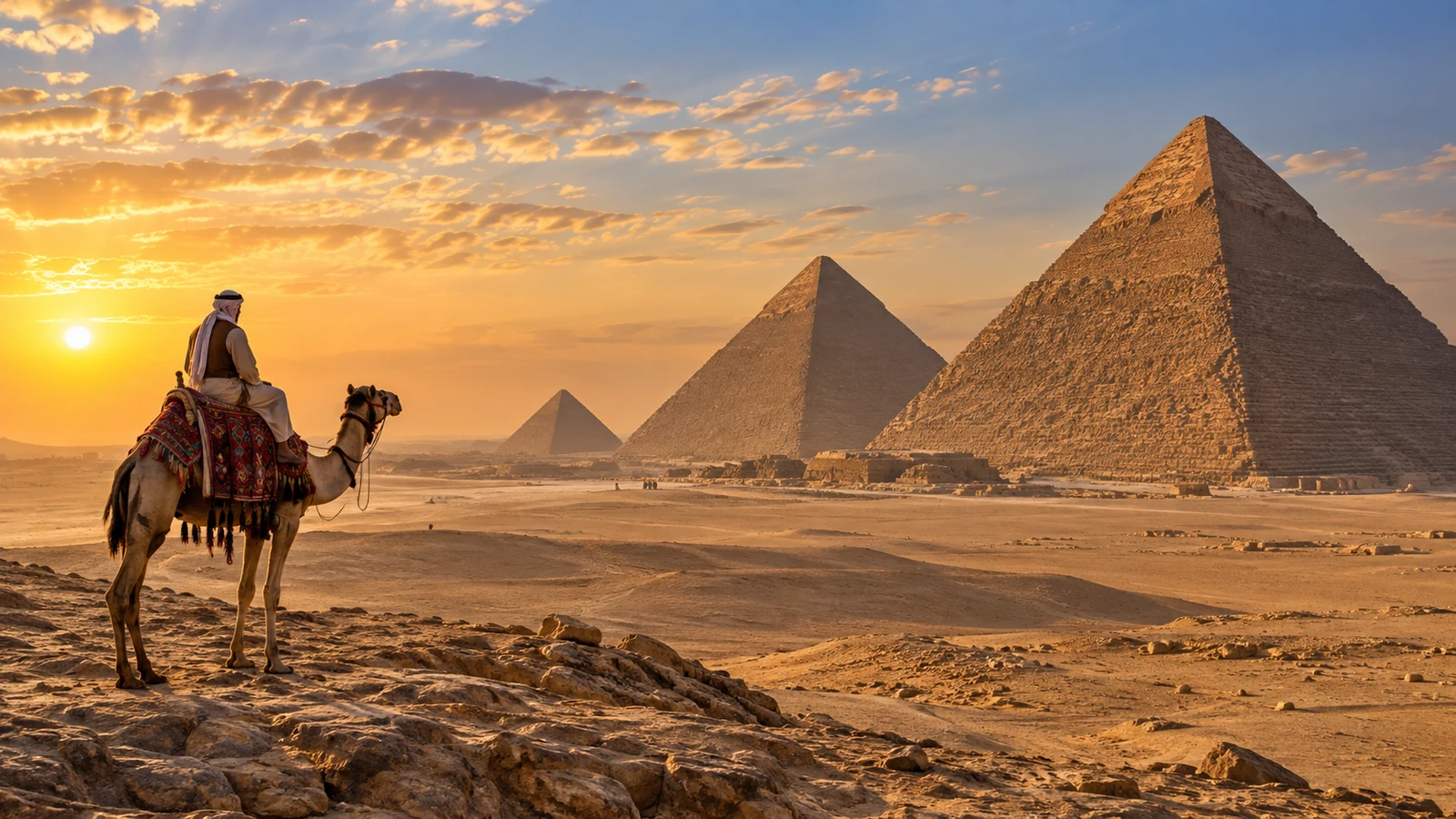
Standing on the edge of Cairo, the Pyramids of Giza remain humanity's most enduring architectural miracle. Built over 4,500 years ago, these immense stone structures continue to awe visitors while puzzling modern engineers and historians alike. From secret internal alignments and hidden boats to myths about forced labor, the true history of Giza is far more surprising than popular legends suggest. Here are 15 fascinating facts about the ancient wonders that dominated the desert sky for millennia.
1. The Pyramids Originally Shone Like Radiant Mirrors
Today, the Great Pyramid of Giza displays a rugged, tan stone exterior, but in ancient times it was covered in polished white Tura limestone. These fine casing stones were angled and buffed to a high gloss, reflecting the blinding desert sunlight across vast distances. Ancient writers noted that the monument seemed to glow like a giant beacon, earning it the Egyptian name Akhet Khufu, meaning "Horizon of Khufu." Over the centuries, powerful earthquakes loosened these casing stones, leading medieval rulers to harvest the smooth limestone to build bridges and mosques in nearby Cairo. Without this reflective shell, the structure lost roughly 26 feet in height and its gleaming splendor.
2. Free Workers and Craftsmen Built the Pyramids, Not Slaves
Hollywood movies often depict the pyramids being erected by thousands of enslaved people driven by harsh whips. Modern archaeological discoveries, however, have thoroughly shattered this widespread myth. Excavations in the nearby workers' village revealed that the builders were actually highly skilled, paid laborers organized into royal work crews. Skeletal remains show that these workers received high-quality medical care, including set bones and brain surgery, and enjoyed a rich diet packed with meat, bread, and beer. Being buried in tombs near the royal pyramid was a prestigious honor granted to those who dedicated their lives to constructing the pharaoh's eternal sanctuary.
3. The Mortar Used Remains Stronger Than the Stone Itself
An estimated two million stone blocks make up the Great Pyramid, held together by an astonishingly durable ancient mortar. Archaeologists and materials scientists have analyzed this adhesive and determined that it is composed primarily of processed gypsum, but its precise chemical formula remains an unsolved mystery. The mortar is significantly stronger than the surrounding limestone blocks, allowing the structure to endure thousands of years of extreme temperatures and seismic shocks. Scientists have tried to replicate this super-durable compound in modern laboratories without complete success. This resilient binding agent is one of the primary reasons the monuments remain standing intact today.
4. The Great Pyramid Aligns Almost Perfectly to True North
The precise engineering behind the Great Pyramid extends far beyond its sheer physical scale. The base of the monument is aligned with the four cardinal directions of the compass with mind-boggling precision. Specifically, its north-south orientation misses true mathematical north by only three-sixtieths of a single degree. This minimal margin of error is even more impressive considering the ancient Egyptians lacked modern compasses or satellite technology, relying instead on astronomical observations of stars. The alignment demonstrates an astonishing mastery of geometry and surveying techniques that rivaled modern engineering standards.
5. Construction Demanded Over Two Million Massive Stone Blocks
Constructing the Great Pyramid required a mind-boggling volume of natural rock sourced from nearby and distant quarries. Historians estimate that the giant structure contains approximately 2.3 million individual stone blocks. On average, each limestone block weighs around 2.5 tons, though some of the interior granite slabs imported from Aswan weigh upwards of 50 to 80 tons. Moving these colossal stones required complex logistics, wooden sledges, and wet sand to reduce friction along designated transit routes. To complete the massive tomb within Pharaoh Khufu's 27-year reign, workers had to set a massive block into place every few minutes.
6. Napoleon Bonaparte Did Not Destroy the Sphinx's Nose
A persistent historical myth claims that French soldiers under Napoleon Bonaparte shot off the nose of the Great Sphinx with a cannon in 1798. Historical evidence and artistic documentation completely disprove this popular legend. Detailed sketches drawn by Danish explorer Frederic Louis Norden in 1737 show the Sphinx missing its nose more than 60 years before Napoleon stepped foot in Egypt. Arabic historical records from the 15th century attribute the destruction to a Sufi Muslim named Muhammad Sa'im al-Dahr. Enraged by local peasants making offerings to the statue for a good harvest, he smashed the nose off with chisels to eliminate the idolatry.
 Ancient and Archaeological Sites
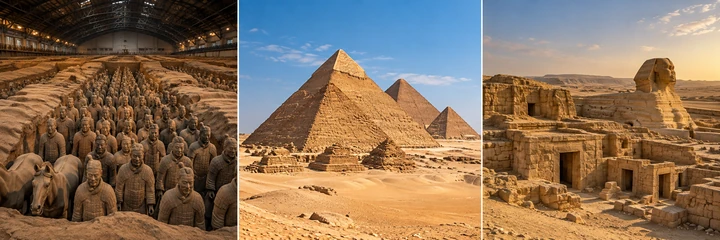
Humanity's impulse to build monumentally has left behind astonishing architectural legacies. From sky-high Incan citadels to sprawling Egyptian necropolises, these sites unite diverse cultures through their shared ambition to conquer geography and secure immortality. Discover the ingenious engineering and hidden histories behind the world's most incredible ancient archaeological wonders.
See All Facts
Ancient and Archaeological Sites
Humanity's impulse to build monumentally has left behind astonishing architectural legacies. From sky-high Incan citadels to sprawling Egyptian necropolises, these sites unite diverse cultures through their shared ambition to conquer geography and secure immortality. Discover the ingenious engineering and hidden histories behind the world's most incredible ancient archaeological wonders.
See All Facts
7. The Monument Maintains a Constant Interior Temperature
Despite being situated in the middle of the hot, arid Egyptian desert, the interior of the Great Pyramid stays remarkably stable. The massive volume of dense stone acts as an enormous thermal barrier against the blistering desert sun. As a result, the internal temperature inside the passageways and chambers remains at a constant 20 degrees Celsius (68 degrees Fahrenheit). This natural climate-control effect keeps the environment surprisingly cool during scorching days and comfortable during freezing desert nights. This environmental stability helped preserve the delicate royal chambers for thousands of years.
8. The Great Pyramid Has Eight Sides Instead of Four
At first glance, the Great Pyramid appears to be a standard four-sided pyramid, but it actually possesses eight distinct faces. Each of the four primary faces features a subtle concave indentation that splits the side into two halves down the center. This extraordinary architectural feature is virtually invisible to observers standing on the ground. The slight indentation is only visible from high above the air under specific lighting conditions during the spring and autumn equinoxes. This faint concavity required incredible mathematical precision and may have been designed to relieve stress on the casing stones.
9. A Fully Intact Ancient Ship Was Buried Beside the Great Pyramid
In 1954, archaeologists discovered a sealed pit near the base of Khufu's pyramid containing a disassembled cedarwood vessel known as the Khufu Ship. Constructed without a single nail, the massive 143-foot-long (44 meters) vessel had been meticulously broken down into 1,224 pieces and preserved for millennia. Experts spent over a decade reassembling the puzzle, restoring one of the oldest and largest intact vessels from antiquity. Known as a solar boat, this magnificent craft was buried to transport the deceased pharaoh through the heavens alongside the sun god Ra. Today, the legendary vessel is housed in the Grand Egyptian Museum.
10. It Remained the Tallest Human-Made Structure for 3,800 Years
When completed around 2560 BCE, the Great Pyramid reached an impressive height of 481 feet (146.6 meters). It held the title of the tallest human-made structure on Earth for an unprecedented 3,800 years. No civilization was able to build a taller structure until the medieval era. It was finally surpassed in 1311 CE when the construction of the central spire on Lincoln Cathedral in England reached 525 feet. Losing its capstone and outer casing over centuries reduced the pyramid's height, but its architectural legacy as an engineering miracle remains undisputed.
11. The Pyramid Was Once Crowned with a Gleaming Golden Capstone
The pinnacle of the Great Pyramid originally featured a specialized capstone known as a pyramidion. Ancient texts suggest that this uppermost point was covered in electrum, a natural alloy of gold and silver that caught the morning sun's rays. This reflective summit was designed to symbolize the primal mound from which the ancient Egyptian universe was created. Over time, scavengers and looters stripped the top of the pyramid, leaving the flattened summit seen today. Without its golden crown and protective casing stones, the monument lost its original gleaming point.
12. The Layout Mirrors the Constellation of Orion
The positioning of the three main pyramids on the Giza plateau—Khufu, Khafre, and Menkaure—is not random. According to popular astronomical theories, their layout directly mirrors the three stars that form the belt of the Orion constellation. To the ancient Egyptians, Orion was intimately connected to Osiris, the deity of resurrection, rebirth, and the afterlife. Aligning the royal tombs with these celestial bodies was intended to facilitate the pharaoh's journey into the night sky. Furthermore, air shafts inside the Great Pyramid point toward specific star constellations, highlighting the profound connection between architecture and astronomy.
13. The Entrance Originally Featured a 20-Ton Swivel Door
Ancient accounts recorded by historical figures like Strabo describe a mysterious, hidden entrance on the face of the Great Pyramid. This entrance featured a massive stone swivel door weighing roughly 20 tons that fit seamlessly into the surrounding masonry. When closed, the door was completely flush with the limestone casing, making the entrance practically invisible from the outside. Remarkably, the door was balanced so perfectly on its internal pivot hinges that a single person could push it open from the inside using minimal effort. The original mechanism was destroyed during later Arab excavations, but similar swivel doors have been found in other Old Kingdom tombs.
14. The Interior Walls Are Free of Hieroglyphs
Visitors expect the interior of the Great Pyramid to be covered in colorful wall paintings and intricate hieroglyphs like those seen in the Valley of the Kings. Surprisingly, the walls of the King's Chamber, Queen's Chamber, and grand passageways are entirely bare and unadorned. During the Old Kingdom era, Egyptians did not carve religious texts onto the interior surfaces of royal tombs. The only writing ever found inside the Great Pyramid consists of small quarry marks and worker graffiti hidden in stress-relieving chambers above the King's Chamber. These practical markings mention the names of work gangs, proving who built the monument.
15. Locals Named the Sphinx "The Father of Terror"
Guarding the Giza plateau stands the colossal Great Sphinx, carved out of a single ridge of natural limestone. While ancient Egyptians likely viewed the creature as a divine royal guardian depicting Pharaoh Khafre, local Arabic tradition gave it a far more intimidating name. In Arabic, the statue is called Abu al-Hol, which translates directly to "Father of Terror." Over centuries, desert sands buried the body up to its neck, leaving only the massive head exposed above the dunes. The mysterious colossal face emerging from the sand inspired awe, fear, and legend among traveling desert nomads.
Sources & References
This AI-assisted post was rigorously curated and fact-checked for accuracy by:
 Martin Roháček
How fun was this article? 🤔
Tap a star to rate it
🧠 Quiz: How closely were you paying attention?
10 questions — all answers are in the article above!
Enjoyed these facts? There's more! 💌
Fresh fun facts in your inbox. No spam, ever.