The Royal Rock Royalty: 15 Fascinating Facts About Queen
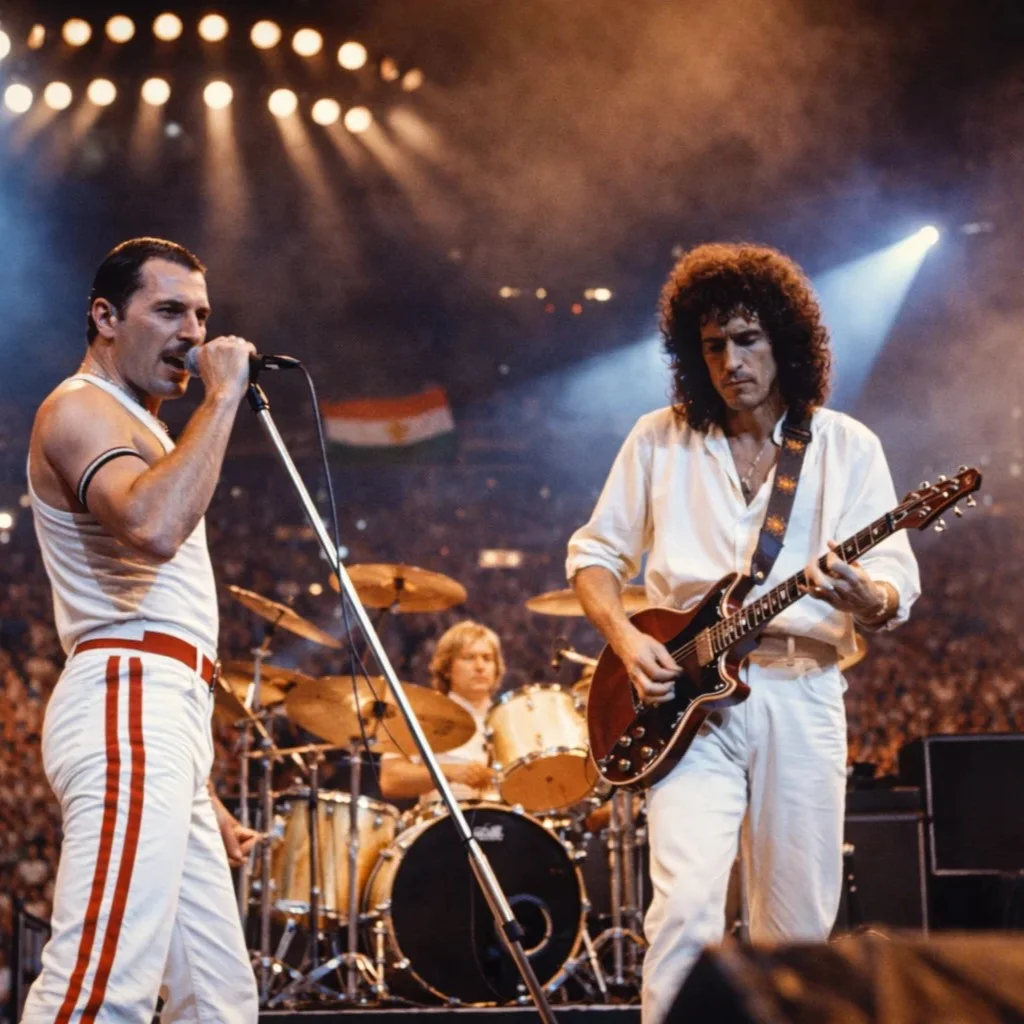
Formed in London in 1970, Queen revolutionized rock music with their theatrical arrangements, staggering vocal harmonies, and genre-bending anthems. From pioneering stadium rock to breaking sonic boundaries with tracks like Bohemian Rhapsody, the band comprised four distinct songwriters who each penned global chart-toppers. Despite tragic losses and shifting musical landscapes, Queen remains one of the most influential and best-selling music acts in history. Discover the astonishing stories behind their homemade instruments, secret collaborations, and iconic stage moments.
1. Freddie Mercury Designed the Band’s Crest Using Astrology and Art Training
Before becoming a legendary frontman, Freddie Mercury earned a diploma in graphic art and design from Ealing Art College. He put his artistic skill to work by hand-drawing Queen’s iconic band crest before they even released their debut album. The elaborate emblem features the zodiac signs of all four members: two Lions for John Deacon and Roger Taylor, a Crab for Brian May’s Cancer sign, and two Fairies representing Freddie’s Virgo sign. A stylized Phoenix rises above the entire arrangement to symbolize immortality and rebirth, framed inside a giant capital letter 'Q'. Mercury’s design mirrored the regal, theatrical identity the band strove to project throughout their legendary career.
2. Brian May’s Signature Guitar Was Handcrafted From a 200-Year-Old Fireplace
Unsatisfied with the expensive commercial guitars of the 1960s, Brian May built his legendary instrument, the "Red Special," alongside his father Harold. Constructed between 1963 and 1965, the neck was carved entirely by hand from an 18th-century oak and mahogany fireplace mantelpiece that a neighbor was throwing away. May used a hand-carved piece of oak for the body, filling insect holes with matchsticks and finishing it with a mahogany veneer. They even fashioned the tremolo system out of motorcycle valve springs and a knitting needle. This one-of-a-kind homemade guitar gave Queen its distinct sonic warmth and harmonized crunch across nearly every track they recorded.
3. Every Single Band Member Wrote at Least One Global Number-One Hit
Unlike many legendary rock groups dominated by a single songwriting duo, Queen operated as a completely democratic creative unit. Every single member of the band individually composed at least one massive track that reached the top of global music charts. Freddie Mercury penned classics like "Bohemian Rhapsody" and "We Are the Champions," while Brian May wrote "We Will Rock You" and "The Show Must Go On." Drummer Roger Taylor brought futuristic energy with "Radio Ga Ga" and "A Kind of Magic," and quiet bassist John Deacon authored massive hits like "Another One Bites the Dust" and "I Want to Break Free." This rare creative balance allowed Queen to effortlessly jump between rock, disco, opera, and pop genres.
4. Record Executives Fought Bitterly Against Releasing "Bohemian Rhapsody"
When Queen presented "Bohemian Rhapsody" to their record label, executives firmly refused to release it as a single, insisting no radio station would ever play a six-minute track. Undeterred, Freddie Mercury gave a copy of the cassette tape to his friend, London radio DJ Kenny Everett, strictly telling him not to play it. Sensing a guaranteed hit, Everett played the song 14 times in a single weekend on Capital Radio, causing fan demand to explode across record shops. Label bosses were forced to press the single, which subsequently spent nine consecutive weeks at number one on the UK charts. The song defied all industry convention and proved that audience taste could overrule corporate wisdom.
5. Brian May Paused His Astrophysics Degree for Rock, Then Finished It 33 Years Later
In the early 1970s, Brian May was studying physics and mathematics at Imperial College London, working toward a doctorate in astrophysics while researching zodiacal light. When Queen began achieving international stardom, May was forced to abandon his academic career to tour the world full-time. Decades later, after selling over 300 million albums, he re-enrolled at Imperial College to complete his remaining research. In 2007, May officially submitted his thesis on radial velocities in zodiacal dust and earned his PhD in astrophysics. Today, Dr. Brian May serves as a recognized astrophysicist, co-founder of Asteroid Day, and former chancellor of Liverpool John Moores University.
6. Freddie Mercury Accidentally Invented His Iconic "Bottomless" Mic Stand
Freddie Mercury’s signature stage prop—a heavy microphone attached to a broken, bottomless pole—came into existence purely by accident during Queen’s early days. During a high-energy show at Chester City Hall in 1970, the heavy cast-iron base of Mercury’s microphone stand suddenly unscrewed and fell off. Instead of pausing the show to replace the broken equipment, Freddie picked up the top half of the pole and kept strutting across the stage. He realized the lightweight stick gave him incredible freedom of movement, acting as a natural extension of his theatrical gestures. From that night forward, Mercury insisted on using a bottomless mic stand at every performance throughout his career.
7. Michael Jackson Persuaded Queen to Release "Another One Bites the Dust"
When bassist John Deacon presented his funk-infused track "Another One Bites the Dust," the band viewed it as an experimental album track rather than a lead single. However, King of Pop Michael Jackson attended Queen’s concert at the Los Angeles Forum and hung out backstage with the band. Jackson pulled Freddie Mercury aside and forcefully insisted that releasing the track as a single would be a colossal commercial victory. Taking Jackson's advice, the band released the track in August 1980, and it quickly surged to number one on the US Billboard Hot 100 chart. The track became Queen's best-selling single overall, selling over seven million copies worldwide thanks to Jackson's keen ear.
8. Queen Made History by Breaking Through the Iron Curtain in 1986
During their 1986 Magic Tour, Queen became one of the very first Western stadium rock bands to perform behind the Iron Curtain in Communist Eastern Europe. Held at the Népstadion in Budapest, Hungary, the landmark concert drew an incredible crowd of over 80,000 enthusiastic fans. To connect deeply with the local audience, Mercury even memorized and sang a traditional Hungarian folk song, "Tavaszi Szél Vizet Áraszt," from handwritten notes on his hand. The historic performance was captured on high-definition 35mm film and released globally as the legendary concert film Hungarian Rhapsody. The historic night proved that rock music could transcend intense geopolitical divides during the height of the Cold War.
9. The "I Want to Break Free" Music Video Was Severely Misunderstood in the US
The music video for "I Want to Break Free" featured all four band members dressed in women's clothing, executing household chores in a suburban home. In the United Kingdom, audiences immediately recognized the visual concept as a beloved parody of the long-running British soap opera Coronation Street. However, American audiences completely missed the cultural context, and the video was viewed as controversial, leading MTV to briefly ban it from broadcast. The resulting backlash heavily damaged Queen's popularity and airplay across the United States for years afterward. The band largely stopped touring in North America as a direct result, despite the single topping charts across Europe and Latin America.
10. Bassist John Deacon Retired Completely From Public Life in 1997
Following the tragic death of Freddie Mercury in 1991, bass player John Deacon was profoundly devastated and slowly began pulling back from the music industry. After recording the final Queen track "No-One But You (Only the Good Die Young)" in 1997, Deacon officially retired from public life. He chose not to participate in Queen's induction into the Rock and Roll Hall of Fame in 2001, nor did he join later tours with Paul Rodgers or Adam Lambert. Deacon continues to live a quiet, private life in South-West London, retaining his equal financial partnership in the band's business affairs. Remaining members Brian May and Roger Taylor have repeatedly stated that they fully respect his decision to step away.
11. A Toddler’s Mumbled Babble Inspired the Futuristic Track "Radio Ga Ga"
Drummer Roger Taylor came up with the idea for "Radio Ga Ga" while spending time at home with his young son, Felix. The toddler entered the room and mumbled "radio ca ca" after hearing a song playing on the radio. Taylor liked the phrase's rhythmic quality and locked himself in his home studio with a Roland drum machine and synthesizer to build the track. Originally titled "Radio Ca Ca," the phrase was slightly altered to "Radio Ga Ga" to sound more polished and radio-friendly. The resulting song became an international anthem lamenting how television and music videos were eclipsing traditional radio broadcasts.
12. Freddie Mercury Was a Devoted Cat Lover Who Dedicated His Solo Album to Them
Freddie Mercury’s love for domestic cats was legendary among those who knew him, as he owned up to ten cats throughout his life. Whenever he traveled on international tours, Mercury called home to speak to his pets over the telephone while his housemates held the receiver to their ears. He even dedicated his 1985 debut solo album, Mr. Bad Guy, directly "to my cat Jerry—also Tom, Oscar and Tiffany, and all the cat lovers across the universe." He commissioned custom portraits of his feline companions and gave them their own individual bedrooms inside his Kensington mansion, Garden Lodge. His favorite cat, Delilah, even inspired a namesake track on Queen’s 1991 album Innuendo.
13. "Under Pressure" Was Created During a Wine-Fueled Overnight Jam With David Bowie
In 1981, David Bowie stopped by Queen's recording studio in Montreux, Switzerland, to record backing vocals for another track, but the meeting quickly turned into an impromptu jam session. Fueled by food and plenty of wine, the musicians spent 24 hours experimenting with chord progressions and basslines. John Deacon created the song's iconic six-note bassline, though he famously forgot it after a dinner break until Roger Taylor reminded him how it went. Bowie and Mercury then stepped into the vocal booth separately, improvising lyrics over the backing track without hearing what the other had recorded. The resulting collaboration, "Under Pressure," became a worldwide number-one hit and one of rock’s greatest duets.
14. Voice Scientists Found Freddie Mercury Used Vibratos and Subharmonics Like Opera Singers
In 2016, a team of international voice researchers published a study analyzing Freddie Mercury’s vocal mechanics using recorded tracks and acoustic analysis. Though often classified as a tenor, evidence suggested Mercury was naturally a baritone who squeezed remarkable range out of his vocal cords. Researchers discovered that Mercury’s vocal folds moved significantly faster than average, producing a physical vibrato frequency of 7.04 Hz—substantially higher than a typical classical opera singer’s 5.5 to 6.0 Hz. Additionally, Mercury deliberately used ventricular folds (false vocal cords) to create subharmonics, producing his signature rasp and raw growl while maintaining incredible pitch control.
15. The Music Video for "We Will Rock You" Was Shot in Roger Taylor’s Freezing Backyard
Despite being one of the most famous stadium rock anthems in history, the music video for "We Will Rock You" was surprisingly low-budget. In January 1978, the band gathered in drummer Roger Taylor's cold, snowy back garden in Surrey to shoot promotional clips for "We Will Rock You" and "Spread Your Wings." Because it was freezing and snowing, the band members appear visibly shivering, wrapped in heavy winter coats and thick scarves. Brian May couldn't even play his custom "Red Special" guitar due to the extreme cold, forcing him to use an inexpensive replacement guitar instead. The raw, freezing footage perfectly captured the band's gritty determination and down-to-earth aesthetic.
Sources & References
This AI-assisted post was rigorously curated and fact-checked for accuracy by:
 Martin Roháček
How fun was this article? 🤔
Tap a star to rate it
🧠 Quiz: How closely were you paying attention?
10 questions — all answers are in the article above!
Enjoyed these facts? There's more! 💌
Fresh fun facts in your inbox. No spam, ever.