
The Eccentric Mastermind: 15 Fascinating Facts About Salvador Dalí
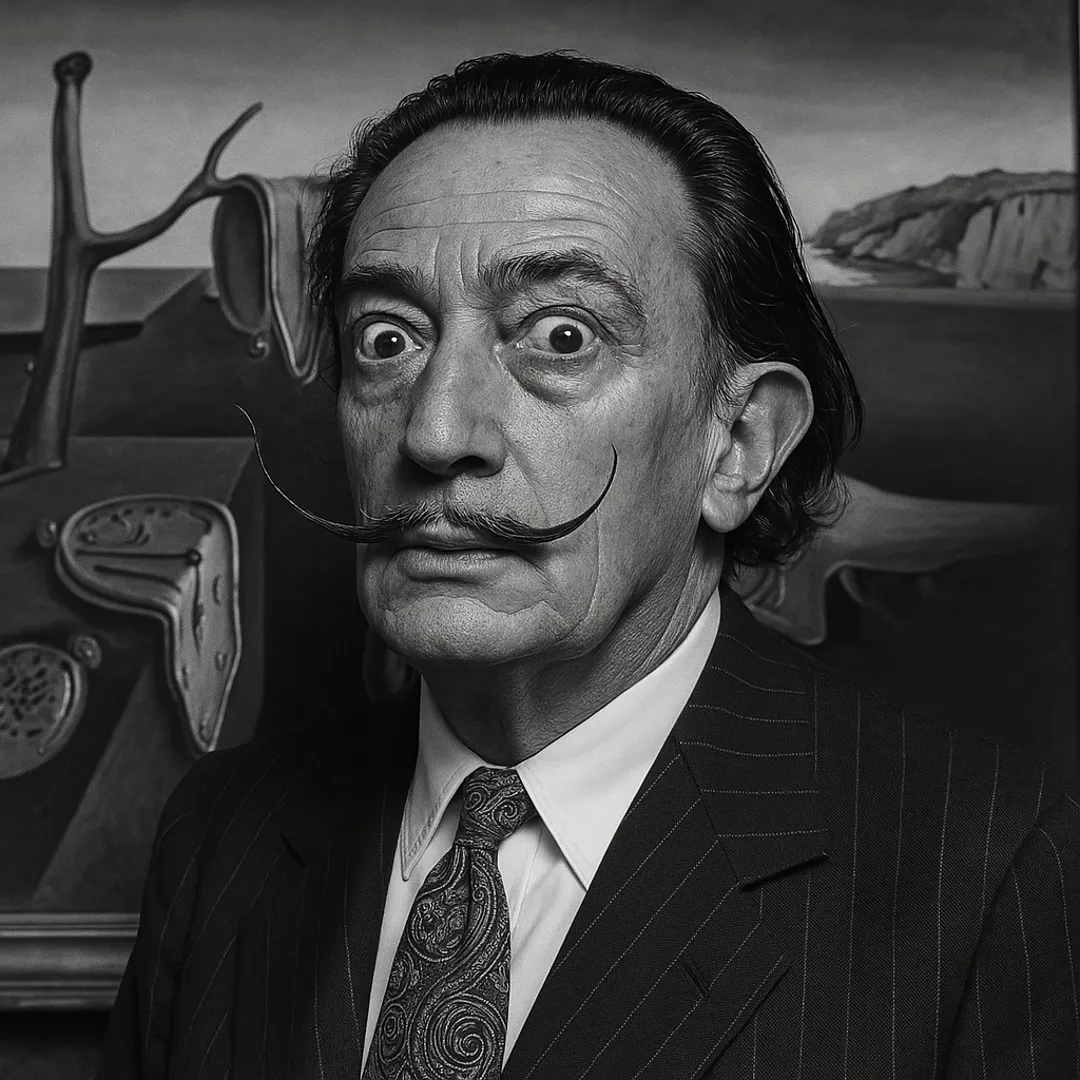
Salvador Dalí was far more than just a painter with a famously waxed mustache; he was a theatrical visionary who transformed surrealism into a global cultural phenomenon. From walking exotic pets down city streets to designing beloved commercial logos, Dalí lived his entire life as an unfolding work of art. His extraordinary mind produced iconic masterpieces while generating bizarre public spectacles that defined 20th-century pop culture. Discover the strange, surprising, and forgotten truths behind one of history's most creative geniuses.
1. He Believed He Was the Reincarnation of His Deceased Older Brother
Nine months before Salvador Dalí was born, his older brother—also named Salvador—died of gastroenteritis at just 22 months old. When Dalí was five, his parents took him to his brother's grave and told him that he was the literal reincarnation of his deceased sibling. This revelation profoundly affected Dalí's psyche, leading him to believe throughout his life that he was living as a dual entity trying to prove his own unique identity. He later claimed in his autobiography that he even remembered the dark, comfortable warmth of being inside his mother's womb. Dalí wrote that his extravagant, attention-seeking behavior was a conscious effort to demonstrate to the world that he was not the ghost of his dead brother.
2. He Was Expelled from Art Academy for Calling His Professors Unqualified
In 1926, just before taking his final examinations at the Real Academia de Bellas Artes de San Fernando in Madrid, Dalí was permanently expelled. When called upon to present his knowledge of art history, the young painter refused to be examined, boldly declaring that none of the faculty members were competent or qualified enough to evaluate his genius. This was actually his second expulsion from the institution, having previously been suspended for inciting a student protest against a faculty appointment. Dalí had already gained a reputation on campus for his eccentric dandy style, wearing knee-breeches, long coats, and waistcoats reminiscent of 19th-century fashion. His expulsion ultimately prevented him from obtaining his degree, though he famously did not care, as he was already turning his sights toward the Paris avant-garde movement.
3. The Iconic Melting Clocks Were Inspired by Camembert Cheese
Dalí’s 1931 masterpiece, The Persistence of Memory, features some of the most recognizable imagery in art history: soft, melting pocket watches draped over landscape elements. While critics and art theorists widely speculated that the limp timepieces represented Albert Einstein's revolutionary theory of special relativity, Dalí publicly dismissed this intellectualized reading. Instead, he revealed that the imagery was inspired by a slice of soft Camembert cheese that had melted into a gooey mess under the warm sun. After dinner one evening, Dalí observed the runny cheese and was immediately struck by the surreal concept of hardness becoming soft. He walked into his studio and painted the melting clocks onto an unfinished landscape of the Catalonian coast in less than two hours.
4. He Nearly Suffocated While Lecturing in a Deep-Sea Diving Suit
At the London International Surrealist Exhibition in 1936, Dalí decided to deliver his lecture wearing a heavy, antique copper deep-sea diving suit. He explained to the bewildered crowd that the metallic attire was intended to visually symbolize how deeply he plunged into the subconscious mind to retrieve his artistic ideas. However, the airtight helmet was bolted shut, and Dalí soon found himself gasping for breath inside the unventilated suit as his oxygen ran out. As he began flailing his arms and banging on the helmet in desperation, the audience assumed his panicked gestures were merely part of his theatrical surrealist performance and applauded enthusiastically. It was only when he nearly collapsed that his friend, poet Edward James, realized the emergency and scrambled to unscrew the heavy metal helmet using a hammer.
5. He Designed the Iconic Chupa Chups Lollipop Logo
Beyond fine art, Dalí left his mark on commercial graphic design in a surprisingly everyday way. In 1969, Spanish businessman Enric Bernat approached Dalí over coffee, asking for help designing a vibrant logo for his lollipop brand, Chupa Chups. Dalí agreed on the spot and immediately sketched out a bright yellow daisy-shaped emblem with bold red lettering on a piece of newspaper. Crucially, Dalí insisted that the wrapper design be placed directly on the top of the lollipop rather than on the side, ensuring the logo would always be fully visible and centered when wrapped. His design was an immediate commercial success, and the bright daisy logo remains virtually unchanged on Chupa Chups wrappers around the globe today.
6. He Created a Surreal Animated Short Film with Walt Disney
In 1945, Dalí joined forces with animation mogul Walt Disney to create a surreal short film titled Destino. The collaboration combined Dalí's dreamlike visual concepts with Disney’s legendary storytelling and animation techniques, set to music by Mexican songwriter Armando Dominguez. However, financial hardship following World War II forced the Disney studio to shelve the project after completing only a 17-second test sequence. The concept sat in company archives for over half a century until Walt Disney’s nephew, Roy E. Disney, decided to revive and complete the six-minute film in 2003 using Dalí’s original storyboards and notes. The finished short went on to receive an Academy Award nomination for Best Animated Short Film.
7. He Designed a Nightmare Dream Sequence for Alfred Hitchcock’s Spellbound
Legendary filmmaker Alfred Hitchcock hired Dalí in 1945 to design a psychoanalytic dream sequence for his psychological thriller Spellbound, starring Gregory Peck and Ingrid Bergman. Hitchcock sought Dalí’s help because he wanted a visual sequence characterized by sharp, bright, and surreal clarity rather than the blurry, misty dream tropes common in cinema at the time. Dalí crafted an elaborate, disturbing set featuring painted eyes, giant scissors cutting through curtains, and tilted architectural landscapes. Producer David O. Selznick found Dalí’s original vision far too bizarre and expensive to execute completely, resulting in several painted scenes being heavily cut or simplified during editing. Despite the studio cuts, the final scene remains one of the most famous dream sequences in Hollywood film history.
8. He Paid Restaurant Bills with Doodles on Uncashable Checks
Dalí was notoriously fond of wealth, prompting Surrealist writer André Breton to construct an anagram of Dalí’s name: "Avida Dollars," which roughly translates to "eager for dollars." Dalí embraced his love of money and devised a clever trick to avoid paying for expensive dinners with friends at restaurants. When the bill arrived, he would willingly offer to pay by writing a check for the full amount in front of the restaurant owner. Before handing the paper over, however, Dalí would draw a small, original sketch on the back of the check, knowing the owner would never cash it. He correctly calculated that the manager would realize the sketch on the reverse side was far more valuable than the financial face value of the check, leaving Dalí to eat for free.
9. He Bought His Wife a Castle Where He Needed Written Permission to Visit
Dalí was passionately devoted to his muse and wife, Gala, born Elena Ivanovna Diakonova, whom he met in 1929. In 1969, Dalí purchased a 14th-century gothic castle in Púbol, Spain, as a gift for Gala, personally restoring and decorating the interior with lavish surrealist details. However, Gala established a strict boundary regarding the estate: Dalí was explicitly forbidden from setting foot in the castle without her prior written permission. Dalí accepted this unusual condition with enthusiasm, viewing the requirement of a formal written invitation as a romantic game that restored a sense of chivalrous mystery to their relationship. When Gala died in 1982, she was buried in a crypt beneath the castle grounds, where Dalí subsequently lived out her final years.
10. His Signature Waxed Mustache Was Inspired by Diego Velázquez
Dalí's flamboyant, gravity-defying mustache became one of the most recognizable personal visual brands of the 20th century. His facial hair style was inspired by the majestic mustache of 17th-century Spanish court painter Diego Velázquez, whom Dalí revered as an artistic master. Dalí maintained the iconic look by applying Hungarian mustache wax every morning, meticulously styling the sharp tips upward toward the sky like radar antennas. In a 1954 television interview, he humorously claimed his mustache served as a transmitter to receive surrealist messages from the universe. Remarkably, when Dalí’s body was exhumed in 2017 for a paternity test, forensic scientists reported that his iconic mustache remained completely intact in its signature ten-past-ten position.
11. He Was Formally Expelled from the Surrealist Movement
Although Dalí became the international face of Surrealism, his relationships with fellow surrealist artists were notoriously volatile. The movement's founder, André Breton, grew disgusted with Dalí's refusal to align himself politically with anti-fascist communism and his weird fascination with figures like Adolf Hitler. Furthermore, Breton despised Dalí's unapologetic commercialism and willingness to paint promotional advertisements for corporate brands. In 1934, the Surrealists held a trial where they voted to expel Dalí from their official group, accusing him of glorifying fascism and vanity. Dalí famously brushed off the expulsion with his characteristic bravado, declaring to the press, "The only difference between me and the Surrealists is that I am Surrealism."
12. He Transformed Everyday Furniture into Surrealist Sculptures
Dalí was a pioneer of surrealist object design, frequently blending functional furniture with bizarre, dreamlike aesthetics. In 1935, inspired by the seductive lips of Hollywood actress Mae West, Dalí designed a vibrant crimson sofa shaped like a human mouth. He later expanded this concept at his home museum in Figueres by constructing an entire three-dimensional room designed to look like Mae West’s face when viewed through a specific lens. The installation incorporated framed paintings for eyes, a chimney construct for a nose, and the famous red lips sofa positioned as her mouth. His innovative design blurred the line between interior architecture, sculpture, and pop art decades before pop culture adopted similar immersive installations.
13. He Used a Key and Plate to Master the Art of Micro-Napping
Dalí actively sought ways to capture the fluid, irrational images of the hypnagogic state—the semi-lucid boundary between wakefulness and sleep. To harness these brief visual flashes before losing consciousness completely, he devised a precise micro-napping technique called "slumber with a key." Dalí would sit upright in an armchair holding a heavy brass key or heavy metal spoon suspended directly over an upside-down metal plate resting on the floor. As he drifted off to sleep, his hand muscle relaxed and dropped the spoon, causing a loud clang as it struck the metal dish. The noise instantly woke him from his brief sleep state, allowing him to immediately sketch the fresh, uninhibited images lingering from his subconscious mind.
14. He Kept Exotic Pets Including an Ocelot and a Giant Anteater
Dalí loved creating public spectacles, and his choice of animal companions was no exception to his flamboyant public persona. In the 1960s, Dalí purchased an ocelot named Babou from a homeless man in New York and brought the wild cat almost everywhere he traveled. He famously walked Babou on a studded leash, bringing the leopard-like feline into high-end restaurants and onto television talk shows. When a terrified diner at a Paris restaurant questioned the wild animal's presence, Dalí calmly assured her that Babou was merely an ordinary house cat that he had painted with a pop art motif. On another occasion in 1969, Dalí was photographed emerging from the Paris Metro leading a giant, long-snouted anteater on a leash.
15. He Built His Own Mind-Bending Museum Where He Is Buried Today
In the 1960s, the mayor of Dalí's hometown of Figueres asked the artist to donate a single painting to the local municipal museum. Instead, Dalí decided to convert the entire ruins of the town's Municipal Theatre—which had been destroyed during the Spanish Civil War—into the Dalí Theatre-Museum. Dalí spent over a decade designing every inch of the structure, resulting in a surreal monument topped with massive glass domes, giant golden eggs, and plaster croissants on the exterior walls. Inside, the museum houses thousands of his works, ranging from tiny sketches to room-sized installations and mechanical sculptures. When Dalí died of heart failure in 1989 at age 84, he was buried in an unmarked crypt beneath the museum’s main stage, ensuring he would forever rest at the heart of his final artistic creation.
Sources & References
This AI-assisted post was rigorously curated and fact-checked for accuracy by:
 Martin Roháček
How fun was this article? 🤔
Tap a star to rate it
🧠 Quiz: How closely were you paying attention?
10 questions — all answers are in the article above!
Enjoyed these facts? There's more! 💌
Fresh fun facts in your inbox. No spam, ever.