1. It Started as a Show of Military Bravery
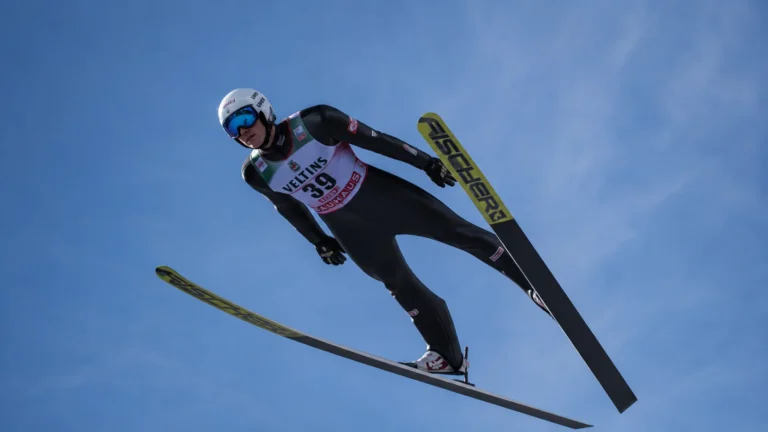
The origins of ski jumping can be traced back to Norway in the early 19th century. The first recorded jump was performed in 1808 by a Norwegian-Danish military officer named Olaf Rye. To prove his courage to his fellow soldiers, he launched himself off a snowpile and flew 9.5 meters (about 31 feet) through the air.
2. A “V” Shaped Revolution Changed the Sport
For over a century, ski jumpers kept their skis perfectly parallel during flight. However, in 1985, Swedish jumper Jan Boklöv revolutionized the sport by introducing the “V-style,” spreading the tips of his skis outward. Initially, traditionalist judges penalized him heavily for “poor style,” but the V-shape caught twice as much air, providing roughly 28% more lift. By 1992, virtually every jumper had adopted the technique.
3. The “Telemark” Landing is Mandatory for Top Scores
To earn maximum style points, athletes cannot simply land on two flat skis. They must execute a “Telemark landing,” named after the Norwegian region where modern skiing was born. This requires the jumper to land with one ski pushed forward, the other slightly trailing with a bent knee, and arms outstretched for balance. Failing to stick the Telemark landing results in severe point deductions.
4. Judges Score Style, Not Just Distance
Ski jumping is not just about who flies the furthest. While distance is crucial, five international judges critically evaluate the athlete’s flight trajectory, balance, and landing. The highest and lowest judges’ scores are dropped, and the remaining three are added to the distance points to calculate the final score.

5. There Is a Strict “BMI Rule”
In the late 1990s and early 2000s, ski jumping faced a crisis: athletes were intentionally starving themselves because lighter bodies flew significantly further. To combat rampant eating disorders, the International Ski Federation (FIS) introduced a strict Body Mass Index (BMI) rule in 2004. If a jumper’s BMI is below the mandatory threshold, they are penalized by being forced to use shorter skis, drastically reducing their aerodynamic lift.
6. The Suits Are Heavily Regulated
The jumping suit is essentially an athlete’s parachute. Because a looser suit catches more air and prolongs flight, the FIS has incredibly strict regulations regarding the permeability, thickness, and fit of the fabric. Suits must conform almost exactly to the jumper’s body shape (with only a few centimeters of tolerance). If a suit is deemed even slightly too baggy during a post-jump inspection, the athlete is immediately disqualified.
7. Wind and Gate Points Leveled the Playing Field
In the past, sudden gusts of wind could ruin a great jumper’s chances or unfairly assist a weaker one. In 2009, the FIS introduced a complex mathematical compensation system. If a jumper gets a favorable headwind (which provides lift), points are deducted from their score. If they get a detrimental tailwind, points are added. Adjustments are also made if the judges decide to raise or lower the starting gate mid-competition.
8. Women Fought a Bitter Battle for Olympic Inclusion
Despite men jumping in the Olympics since the inaugural Winter Games in 1924, women were barred from Olympic ski jumping for decades. The International Olympic Committee (IOC) and FIS long argued that the sport was medically dangerous for women’s bodies or lacked enough international competitors. After years of lawsuits and relentless campaigning, women’s ski jumping finally made its Olympic debut at the 2014 Sochi Games.
9. “Ski Flying” is the Extreme Version of the Sport
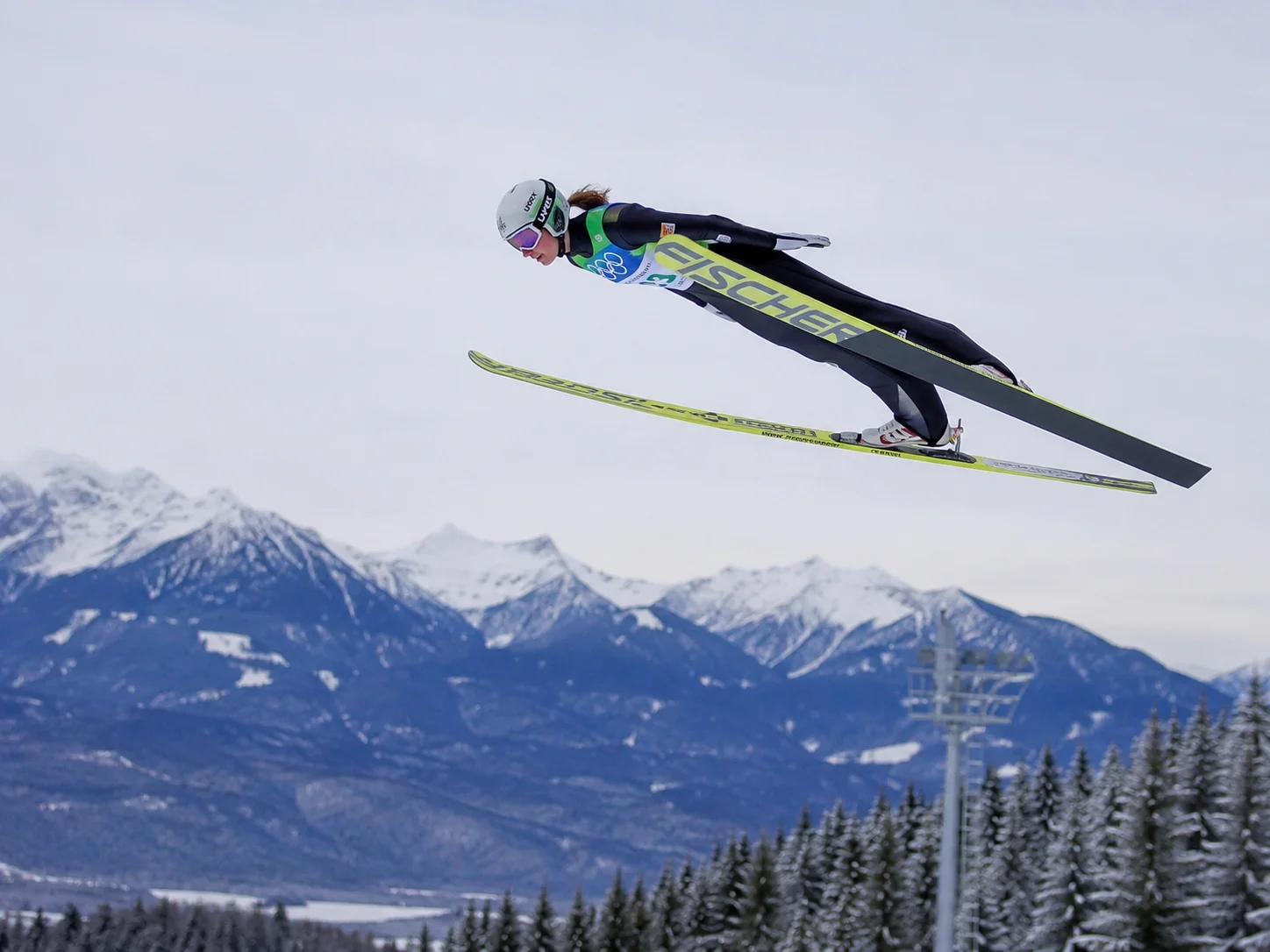
While standard large Olympic hills have a calculation point of 120 meters, there is a much more extreme, specialized version of the sport called “Ski Flying.” There are only four homologated ski flying hills currently in use globally. On these massive structures, athletes routinely fly well past the 200-meter mark, experiencing immense g-forces upon landing.
10. The World Record is Over 250 Meters
The current official world record for the longest ski jump is held by Austrian jumper Stefan Kraft. In March 2017, at the monstrous Vikersundbakken flying hill in Norway, Kraft flew an astonishing 253.5 meters (831.6 feet)—roughly the length of two and a half American football fields.
11. The Skis Are Massive
You cannot use standard alpine skis for this sport. Jumping skis are specially designed to act as aerodynamic wings. They are exceptionally wide (up to 11.5 centimeters) and incredibly long, maxing out at $145\%$ of the athlete’s total body height, provided the athlete meets the required BMI minimum.
12. Eddie the Eagle Inspired a New Rule
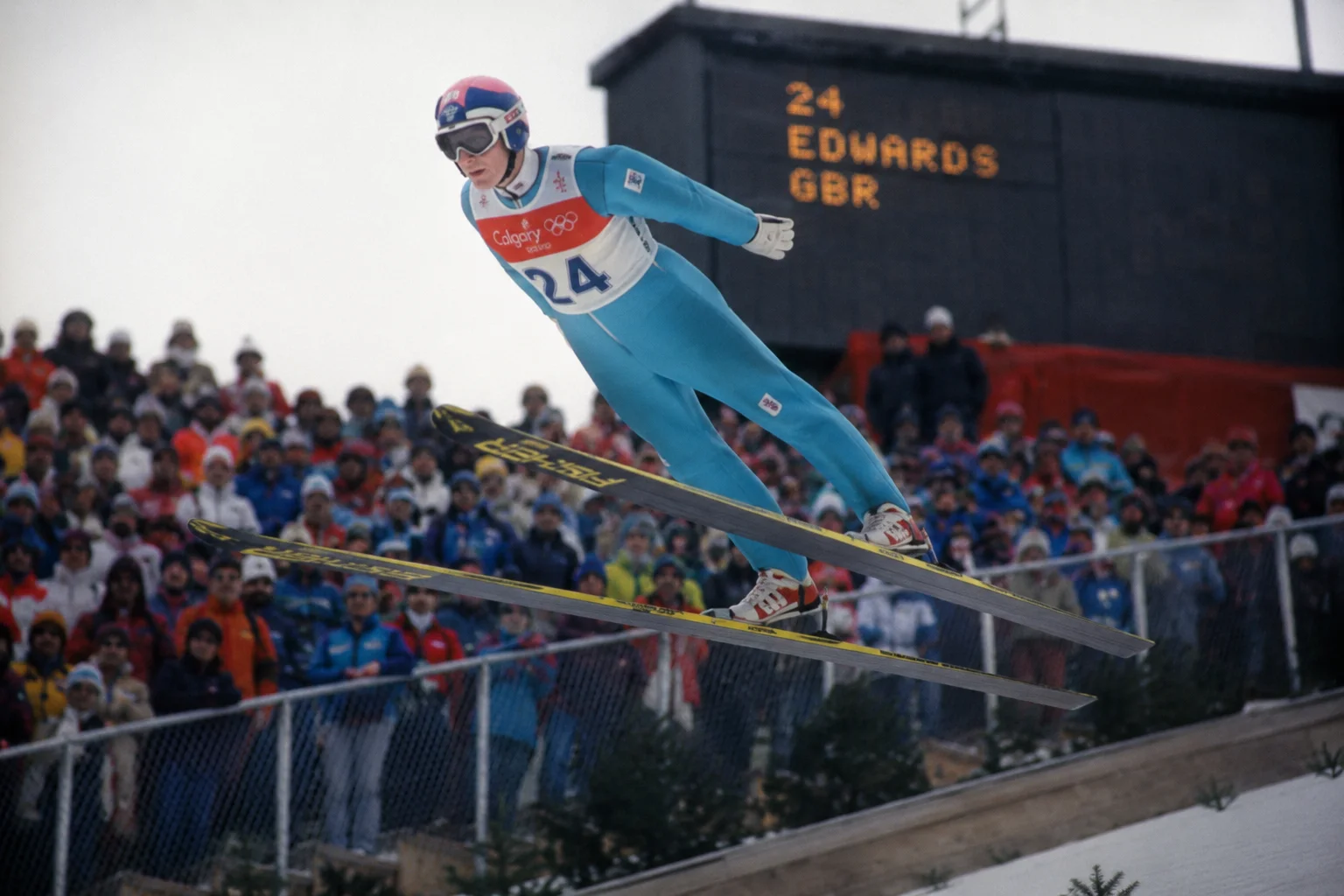
At the 1988 Calgary Olympics, British amateur jumper Michael Edwards, known affectionately as “Eddie the Eagle,” became a global folk hero. Weighing significantly more than his competitors and suffering from severe farsightedness (wearing thick glasses under his goggles), he finished dead last. In response, the IOC instituted the “Eddie the Eagle Rule,” imposing strict international qualification standards to prevent pure amateurs from competing in the Olympics.
13. It Is a Year-Round Sport
Ski jumpers do not sit idle during the summer. The sport has successfully adapted to warmer weather with the FIS Ski Jumping Grand Prix. During the summer months, athletes jump on tracks made of slick porcelain or ceramic, and they land on steep outruns covered in water-soaked plastic mats that perfectly simulate the sliding friction of winter snow.
14. The Four Hills Tournament is the Sport’s “Grand Slam”
Outside of the Olympics and World Championships, the most prestigious prize in ski jumping is the Vierschanzentournee (Four Hills Tournament). Held annually since 1952 around New Year’s Eve, the grueling tournament takes place across four historic jumping hills in Germany and Austria over just nine days.
15. The “K-Point” is the Red Line to Beat
When watching a competition, you will notice a distinct red line painted across the landing zone. This is the K-Point (Calculation Point or Kritischer Punkt). It marks the steepest part of the hill where the curve begins to flatten out. Jumpers are awarded exactly 60 base points for landing perfectly on the K-point, with points added or subtracted for every meter they land past or short of it.