
The Colossal Monolith: 15 Fascinating Facts About the Statue of Unity
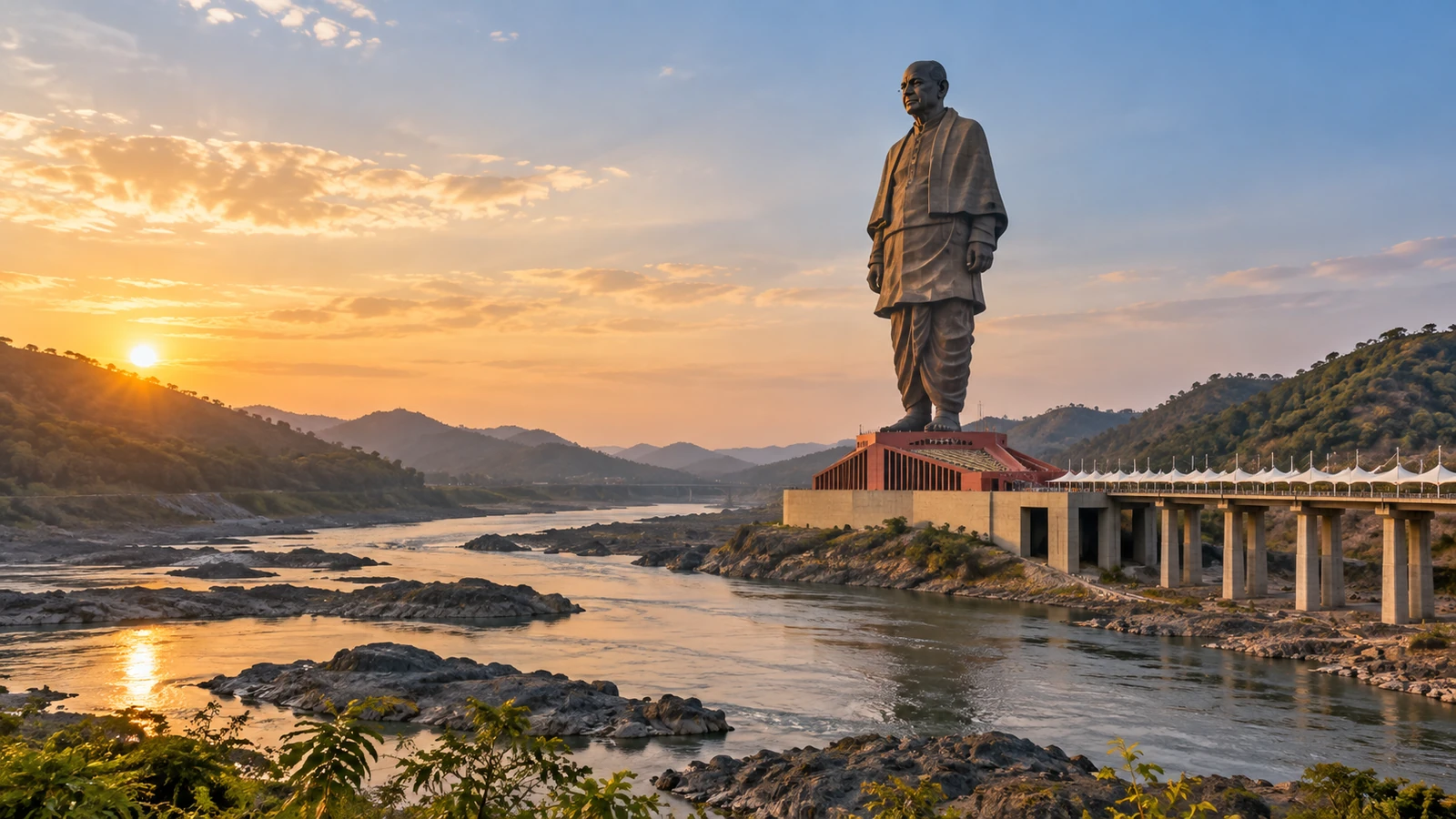
Soaring high above the Narmada River in Gujarat, India, the Statue of Unity is a monumental tribute to political leader Sardar Vallabhbhai Patel and a triumph of modern engineering. Standing at a mind-boggling height of 182 meters, this colossal monument holds the official record as the world's tallest statue. From scrap iron donated by millions of rural farmers to dinosaur fossils uncovered during its construction, the backstory of this structure is packed with incredible details. Discover 15 fascinating facts about the engineering, artistry, and history behind this iconic landmark.
1. It Reaches a Staggering Height of 182 Meters
Standing at a breathtaking height of 182 meters (597 feet), the Statue of Unity in Gujarat, India, holds the official title of the world's tallest statue. When including its massive pedestal base, the entire architectural structure soars 240 meters (787 feet) into the sky. This incredible monument easily eclipses other famous landmarks around the globe, standing nearly twice as high as the Statue of Liberty in New York and almost 50 meters taller than China's Spring Temple Buddha. Construction teams utilized massive scaffolding and specialized cranes to assemble the colossal structure on Sadhu Bet island in the Narmada River. Today, its sheer scale serves as a monumental tribute to modern structural engineering and master artistic design.
2. The Height Directly Honors Democratic Representation
The height of 182 meters was not chosen at random or purely for the sake of setting a world record. Designers specifically selected this exact measurement to match the 182 electoral constituencies of the Gujarat Legislative Assembly. This intentional design choice directly links the monument to the democratic governance of Sardar Vallabhbhai Patel's home state. Every single meter of height symbolically represents a geographic constituency and the citizens who reside within it. By integrating state democracy directly into the architectural blueprints, the statue reflects the living political fabric of the nation it celebrates.
3. Indian Farmers Donated Millions of Used Tools to Build It
To make the statue a true national effort, the Indian government launched the nationwide "Statue of Unity Movement" requesting contributions from rural communities. Millions of farmers across the country responded by donating their worn-out iron agricultural tools to aid in construction. In total, the drive successfully collected over 135 metric tonnes of scrap iron from farming communities across India. Metallurgists processed and refined this gathered metal, utilizing approximately 109 metric tonnes of it to reinforce the foundation of the monument. This massive grassroots effort ensured that agricultural workers from every corner of India possessed a literal physical stake in the structure.
4. The Statue Is Sculpted in a Dynamic Walking Pose
Unlike traditional ancient or modern monuments that depict figures standing entirely rigid, this statue features an active walking stance. Lead sculptor Ram V. Sutar deliberately designed the figure of Sardar Patel with his left foot positioned slightly forward. This subtle architectural choice gives the illusion that the grand figure is actively striding toward the nearby Sardar Sarovar Dam along the Narmada River. Creating a walking pose at such a massive scale presented immense engineering challenges regarding weight distribution and center of gravity. Consequently, structural engineers had to design specialized internal supports to safely maintain the asymmetrical posture against natural forces.
5. Natural Weathering Will Eventually Turn the Bronze Green
The outer skin of the massive monument is clad in roughly 1,700 metric tonnes of bronze plating. Over the next several decades, environmental exposure to atmospheric oxygen, rain, and humidity will trigger a natural chemical transformation known as oxidation. Much like the famous copper exterior of the Statue of Liberty, the bronze exterior will gradually develop a protective green patina. This natural aging process was fully anticipated by the design team during the initial planning phase. Over the next century, the original reddish-brown hue will slowly shift into a majestic weathered green, transforming its appearance for future generations.
6. It Is Engineered to Withstand Severe Earthquakes and Hurricanes
Positioned in an open river basin, the monument is built to endure some of the most violent weather conditions imaginable. Engineers designed the structure to withstand sustained wind speeds of up to 180 kilometers per hour (112 mph). Additionally, the internal skeleton is reinforced to survive major seismic events measuring up to 6.5 on the Richter scale. Tuned mass dampers and advanced structural engineering techniques ensure that the monument can flex slightly without compromising its stability. These protective design elements ensure that the towering structure will remain standing for centuries despite severe natural disasters.
7. High-Speed Lifts Transport Visitors to a Chest-Level Observation Deck
To accommodate millions of annual tourists, the interior of the structure contains a state-of-the-art transportation network. High-speed elevators installed inside the statue's legs can carry up to 20 passengers per ride at high velocity. Visitors are whisked from the ground level to a high-altitude observation gallery located in the statue's chest at 135 meters (443 feet) in just about 60 seconds. This spacious viewing gallery can hold up to 200 people at once and offers panoramic views through dramatic observation windows. From this elevation, tourists enjoy breathtaking sights of the surrounding Vindhya and Satpura mountain ranges as well as the Narmada River.
8. The Cladding Consists of Thousands of Individual Bronze Tiles
Constructing the exterior surface required an unprecedented level of metallurgical precision due to the intricate folds of Patel's traditional attire. Designers were unable to use massive continuous metal sheets due to the complex geometry of the sculptured clothing. Instead, artisans crafted 565 macro-panels and over 6,000 micro-panels that fit together like a massive three-dimensional jigsaw puzzle. These individual bronze plates replicate the detailed folds of Patel's traditional dhoti and draped shawl with extraordinary artistic fidelity. The modular assembly allowed engineers to secure the skin to the internal steel framework while allowing room for thermal expansion.
9. The Structure Is Easily Visible from Space Satellites
Due to its colossal dimensions and reflective metallic coating, the monument is clearly discernible from Earth's orbit. Commercial and scientific observation satellites regularly capture sharp images of the statue from space. The shiny bronze exterior creates a vivid contrast against the natural greens and blues of the surrounding river valley landscape. Astronauts and orbital cameras can easily identify the distinct outline of the giant figure standing beside the Narmada River. Very few man-made structures on the planet possess a footprint and height combination that can be so clearly observed from high orbit.
10. A 93-Year-Old Sculptor Created the Master Model
The artistic vision behind this modern wonder came from the celebrated Indian sculptor Ram V. Sutar, who was 93 years old during the project's development. Sutar, a renowned artist who has crafted thousands of statues worldwide, spent months studying historical photographs and audio recordings of Sardar Patel. His objective was to capture not just physical likeness, but the formidable dignity, resolve, and warmth of the historical leader. Sutar created a 30-foot model that was digitized using advanced 3D scanning technology to guide the full-scale construction. His incredible dedication ensured that the massive engineering feat retained the delicate artistic nuances of a hand-crafted sculpture.
11. The Entire Tourist Complex Cost Nearly 430 Million Dollars
Building the statue and transforming the surrounding region into a world-class tourism hub required a massive financial commitment. The total expenditure reached approximately 2,989 crore rupees, which equals roughly 430 million US dollars. A substantial portion of this budget was dedicated to creating secondary attractions and infrastructure to support millions of visitors. The broader complex features a high-tech museum beneath the statue, a research center dedicated to good governance, and the sprawling "Valley of Flowers." This massive capital investment successfully turned a remote river basin into one of the most visited tourist destinations in India.
12. Construction Required Hundreds of Thousands of Tonnes of Concrete and Steel
The sheer volume of raw materials required to construct the monument rivals that of major modern skyscrapers. Structural engineers poured over 210,000 cubic meters of high-strength concrete and cement to form the core and foundation. Additionally, the interior structural framework incorporates 18,500 tonnes of reinforced steel bars and 6,500 tonnes of structural steel. This massive steel matrix supports the immense weight of the outer bronze skin and balances dynamic environmental loads. The sheer quantity of materials used guarantees that the monument will endure structural stress for centuries.
13. The Surrounding Grounds House an Enormous Cactus Garden
Situated near the monument along the river valley is an unexpected botanical sanctuary known as the Cactus Garden. This unique attraction covers a massive area and showcases over 600,000 individual plants representing roughly 450 distinct cactus and succulent species. Landscapers gathered rare flora from desert regions across the Americas, Africa, and Asia to stock the open-air and dome greenhouses. The contrast of a flourishing desert ecosystem set within a lush tropical river basin provides visitors with a captivating ecological experience. It stands as one of the largest specialized botanical collections of arid plants in the entire region.
14. Excavations Nearby Uncovered Rare Dinosaur Fossils
During initial geological and infrastructure surveys along the Narmada River valley, paleontologists made remarkable prehistoric discoveries. The region was found to contain rich fossilized remains of Rajasaurus narmadensis, an apex predatory dinosaur native to late Cretaceous India. To highlight this remarkable natural history, project planners constructed a dedicated "Dino Trail" near the statue site. The educational trail features a life-sized, 75-foot replica of the ancient predator along with interactive fossil exhibits. Visitors to the complex can explore both modern political history and prehistoric earth history at the exact same location.
15. The Statue Honors the Leader Who Unified 562 Princely States
The primary subject of the colossal monument is Sardar Vallabhbhai Patel, India's first Deputy Prime Minister and home minister. Affectionately nicknamed the "Iron Man of India," Patel played a decisive role following the nation's independence in 1947. Through extraordinary diplomacy, political skill, and sheer determination, he successfully integrated 562 semi-autonomous princely states into a unified Indian republic. Without his tireless efforts, modern India might have remained fractured into dozens of independent territories. The Statue of Unity stands as a permanent, physical symbol of the national cohesion and political unity he forged.
Sources & References
This AI-assisted post was rigorously curated and fact-checked for accuracy by:
 Martin Roháček
How fun was this article? 🤔
Tap a star to rate it
🧠 Quiz: How closely were you paying attention?
10 questions — all answers are in the article above!
Enjoyed these facts? There's more! 💌
Fresh fun facts in your inbox. No spam, ever.